
NEWS
Warsaw Equity Bets €27.2 Million on Cheap Space Power
Warsaw Equity Group leads Dcubed’s €27.2 million Series A+ so silicon origami arrays can cut space power costs before a 2 kW 2027 demo.

Dcubed has raised €27.2 million in an oversubscribed Series A+ to scale satellite hardware and fly a cheap silicon solar array in 2027. Warsaw Equity Group led the round, with the European Innovation Council Fund and the HTGF Opportunity Fund joining existing backers BayBG and Expansion.
The cheque pays for plants in Germany and the United States. The proof is a 2 kW Halo array booked on a SpaceX rideshare as early as February 2027.
A Polish Fund Bets on Cheap Orbital Power
HTGF, the German seed house that has backed Dcubed since 2021, posted the oversubscribed €27.2 million Series A+ on 18 November 2026. Warsaw Equity Group ran the process. The Warsaw firm, set up in 1993, puts €4-15 million of its own capital into growth companies, has closed 62 investments, and has about €170 million at work. It has no outside fund clock.
Jan Szumada, the investment manager who led the deal, said WEG screened several dozen space companies and picked Dcubed because hundreds of its parts already fly. He also said the usual Series A hunt for customers is inverted here: orders arrive, and the plant is the constraint.
Leading this round reflects our conviction that Dcubed is one of the few European space companies positioned to become critical infrastructure for the global space economy, from flight-proven deployment systems and solar arrays today to affordable power in orbit tomorrow. Getting there will take more than great engineering. It means building the leadership and organization of a global industrial company, and that is where we will bring our experience, working closely with the founders.
Jan Szumada, Investment Manager, Warsaw Equity Group
Helen McBreen, a board member of the EIC Fund, tied the cheque to solar arrays rather than to actuators. Reliable and affordable power, she said, will be essential to the next generation of work in space, and Dcubed’s arrays “could help make this possible.” The Fund’s slice of the round is equity from the EIC Accelerator, on top of a €9.5 million European Innovation Council grant in July 2024 for the ISM4Europe in-space manufacturing project.
Christian Ziach, a principal at HTGF, put it more plainly. The firm has been in since seed. Product-market fit is no longer the question. The company, he said, now has to scale production.
The Actuator Line Already Funds the Bet
Thomas Sinn founded Dcubed in 2019 after he could not buy a release device for a deployable experiment. The first commercial actuators shipped that December to MIT Haystack Observatory and the University of Auckland. The line still uses patented shape-memory metal and origami folds, sold as catalogue parts rather than as one-off mechanisms.
On 5 August 2024 the company closed a Series A that was oversubscribed by 26 percent, led by Expansion and BayBG. That round was meant to quadruple actuator output. Two years later the same complaint is back, only louder. Sinn said demand is “going through the roof,” and that expanding in Germany and the United States is how Dcubed keeps delivery times from slipping.
THE HARDWARE BUSINESS UNDER THE WAGER
- Customers: More than 170 worldwide, across five continents.
- Hardware in orbit: Over 500 products already flying.
- Headcount: 87 people in Germering, Germany, and Berthoud, Colorado.
- Run rate: Production and revenue have more than doubled year over year.
That base is why a Polish industrial shop would underwrite a solar-power claim that has not yet flown. The actuators pay wages while ARAQYS, the new array family, tries to change the cost of a watt on orbit.
Silicon Cells Inside an Origami Array
Launch got cheaper. Power did not. Space-grade cells are still custom III-V stacks, and the wings that carry them have to survive a fairing, then unfold without jamming. Sinn, who worked on a NASA NIAC space-solar study more than 15 years ago, now sells that bottleneck as the next one to break.
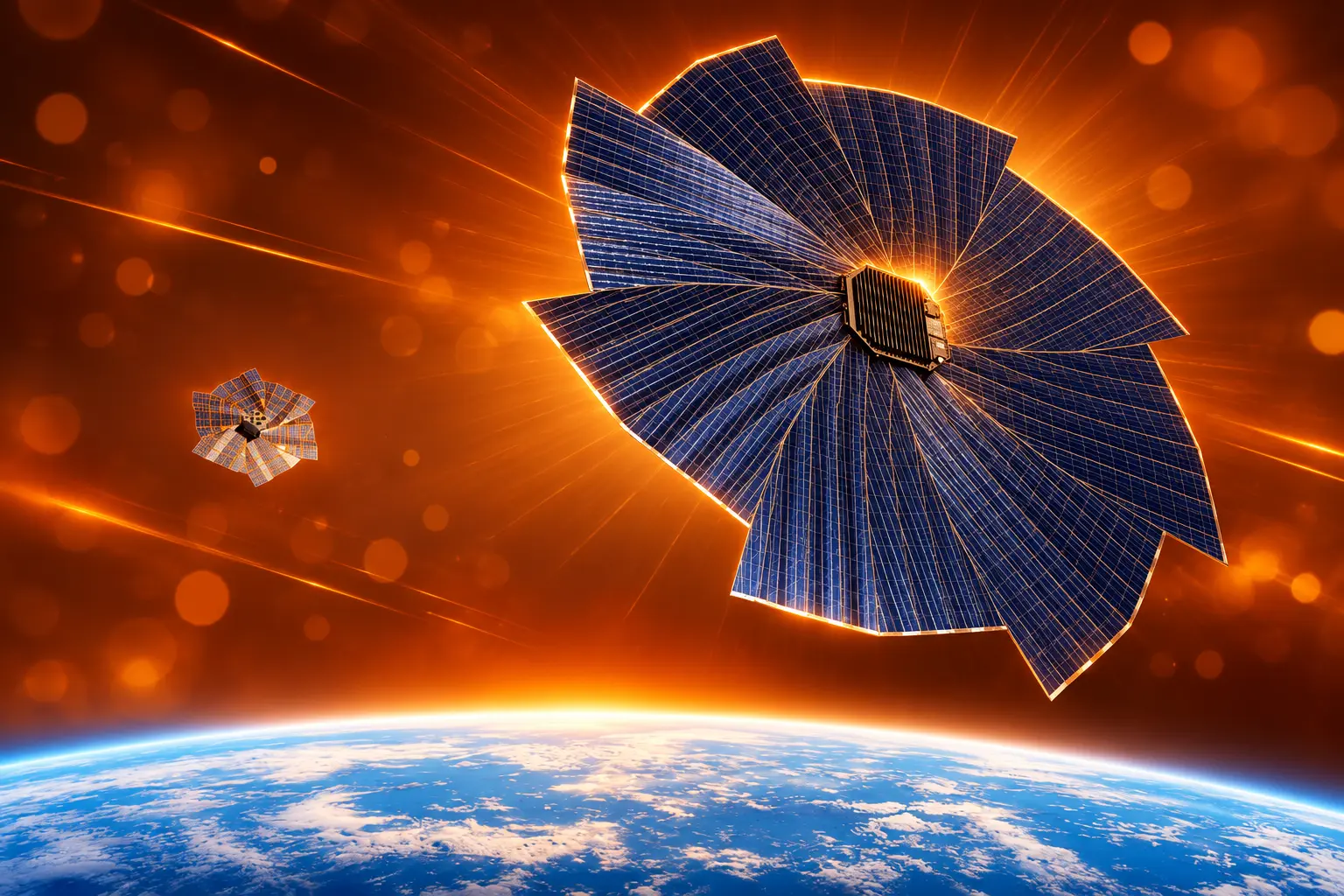
Halo, the first ARAQYS architecture, is a radial origami solar array that opens around the spacecraft instead of stretching into long wings. Dcubed designed it around widely available silicon cells, the same commodity used on Earth, and says that swap is how cost per watt falls by one to two orders of magnitude. The published range runs from hundreds of watts to hundreds of kilowatts. Flex Wing, a linear array for classic buses and standard drive units, is still in development.
WHAT DCUBED LISTS FOR HALO
- Mass: Four times more mass efficient than the arrays it is meant to replace.
- Specific power: Four times more watts per kilogram.
- Stowage: A launch envelope sixteen times smaller.
- Control: Four times lower moment of inertia, so a high-power craft needs a smaller attitude upgrade.
- Drive units: Built to work with standard solar-array drives.
Those figures are company claims, not flight data. Silicon will convert less sunlight per square metre than the III-V cells on most large satellites. The wager is that cheap area and a compact fold beat expensive efficiency once the job is tens of kilowatts, not a few hundred watts on a cubesat.
Fairing volume, not daylight, is what caps power today. An array that is printed or unfolded after launch is the only way a small bus grows into the kind of plant that can feed a radar, a tug, or a compute rack. That is the reading the 2027 flight has to carry, and it is why the round is not only a factory story.
What the 2027 Rideshare Has to Prove
ARAQYS-D3 is the first Halo flight and the first time Dcubed will put a kilowatt-class array next to power-beaming payloads. Astro Digital is building the bus a few miles from the Berthoud plant. Maverick Space Systems is booking the SpaceX rideshare and will integrate the satellite in San Luis Obispo, California. Chris Biddy, Astro Digital’s chief executive, said the craft is meant to show small satellites that can generate, store and send the energy later missions will need.
THE THREE FLIGHTS BEHIND HALO
| Mission | Date | What flies |
|---|---|---|
| ARAQYS-D1 (Dcubed-1) | 11 January 2026 | 3U cubesat on SpaceX Twilight from Vandenberg; prints a 60 cm boom in free space |
| ARAQYS-D2 | Planned early 2026 | 1 m printed solar array on Exotrail’s SpaceVan; no public flight result yet |
| ARAQYS-D3 | As early as February 2027 | 2 kW Halo, a 10-meter boom made in space, five beaming payloads |
D1 left the pad on Twilight, SpaceX’s first dusk-dawn rideshare, on 11 January 2026. Dcubed said the satellite deployed and would enter commissioning before the boom print started. It has not published whether that 60 cm tube actually hardened in sunlight. D2 was supposed to print a one-metre blanket on Exotrail’s next SpaceVan in early 2026. That result is also unpublished, so the 2027 mission is still climbing a ladder with two rungs unconfirmed.
The 10-meter boom on D3 is a second path, not a second name for Halo. If the print works, later arrays can be sized in orbit instead of being folded on the ground. If it does not, Halo still has to open, track the sun, and put 2 kW on the bus with silicon cells.
Power-Beaming Partners Book a Seat
On 23 March 2026 Dcubed named five international power-beaming partners for the same flight. Three are public. Two are still listed as to be announced. Optical and radio-frequency payloads will fly together, which is the company’s first attempt at what it calls Power-as-a-Service: a craft that makes power and hands it to someone else.
WHO IS FLYING ON ARAQYS-D3
- ORiS, Italy: Laser beaming for satellites that already fly, with no extra hardware on the receiving craft, aimed at a Power-as-a-Service offer.
- TerraSpark, Luxembourg: A 2025 startup that wants to catch sunlight in orbit and send it to Earth by radio frequency.
- Volta Space Technologies, Canada and the United States: Optical wireless power for the lunar surface, with a receiver due to land with Firefly Aerospace in 2027 and orbital service aimed at 2029.
- Two more: Selected, unnamed, on the same demonstration.
Sinn described D3 as Dcubed’s first “Space Power Plant,” a phrase that runs ahead of a 2 kW test. The named riders are the sharper signal. A lunar power firm, a laser-beaming startup, and a European RF shop would not book mass on a German demo if catalogue actuators were the whole product.
Dcubed’s own Halo page lists the same hunger in other forms: data centres in orbit, communications constellations, radar satellites, orbital transfer vehicles, and factories that cannot run on a few hundred watts. Launch firms already sell frequent rides. They do not sell cheap kilowatts.
Germering and Colorado Must Quadruple Output
The round has two stated uses. One is to industrialize release actuators and solar arrays in Germering and Berthoud, with new tools, automation, hires and suppliers, and a target of quadrupling capacity. The other is to bring the ARAQYS family to market. Both sites will work on the D3 spacecraft and the in-space-manufactured array, a split Dcubed presents as a hedge for European and U.S. government work. Dcubed USA LLC was set up in 2024 for that reason.
Demand for our products is going through the roof. We are scaling Dcubed to become the global category leader in space deployment and power systems. Expanding production in Germany and the United States will allow us to deliver even faster and meet this growing demand. Our ambition is simple: make space hardware as easy to buy and use as anything on Earth, while making abundant, affordable power the foundation for entirely new markets in space through ARAQYS.
Thomas Sinn, CEO and founder, Dcubed
The catalogue half of that sentence is already true enough to oversubscribe a round. The power half is a 2 kW array, a 10-meter printed boom, and five beaming payloads on a SpaceX rideshare as early as February 2027.

One UI 9.5 Beta Puts the Galaxy S26 on Last Year’s Clock

DBS Puts a 24/7 USDC Window Inside the Bank

European Startups Head for $81 Billion as First Checks Shrink

US Stocks Lost $1.3 Trillion Before Nvidia’s Beat

Home Depot Bets on Finance Chief Richard McPhail as CEO

Aramco Crash Kills 14 Two Days After Oil Restart

Salah Captained Egypt to Their First World Cup Win

Zelda’s 40th Switch 2 Ships Without a Zelda Game

Apple Labor Day Deals Hide June’s Memory Price Hike

El Niño Puts Israel’s Needed Winter Rain on a Flood Clock
-
 BUSINESS5 months ago
Aramco Crash Kills 14 Two Days After Oil Restart
-
 NEWS6 months ago
Salah Captained Egypt to Their First World Cup Win
-
 GAMING2 months ago
Zelda’s 40th Switch 2 Ships Without a Zelda Game
-
 NEWS3 months ago
Apple Labor Day Deals Hide June’s Memory Price Hike
-
 NEWS4 months ago
El Niño Puts Israel’s Needed Winter Rain on a Flood Clock
-

 GAMING2 months ago
Palworld 1.0.4 Adds Palpedia Search After the 1.0 Launch
-

 NEWS4 months ago
Saudi Visa Routes Split Nigerian Travelers Into Two Speeds
-

 BUSINESS9 months ago
BAE’s 60-Year Saudi Franchise Now Runs Through Taif