
NEWS
Chainalysis Attack Exposed the People Who Hunt Crypto Crime
An agentic break-in at Chainalysis pulled user IDs, names, emails and job-role labels for the investigators and agencies that use its tools.

Chainalysis said an outside actor used offensive agentic techniques this month to reach its systems, internal tools, and a slice of customer identity data. The blockchain analytics firm told customers on October 30 that user IDs, full names, email addresses, and organization role labels were accessed, and said it found no sign that case files, passwords, or login tokens were taken.
Those fields are the roster of people who pay Chainalysis to hunt stolen coins. The leak landed on the same day the firm named North Korea’s TraderTraitor group for a $6.4 billion theft from Binance.
An Outside Actor Reached Chainalysis Systems This Month
Chainalysis posted a public notice on October 30 and printed the full text of the customer email with it. The firm said it detected the activity during October, described the method as “offensive agentic techniques,” and said an external actor reached “Chainalysis systems and internal tools.”
It did not name the actor, the tool, or the first hole. It also did not give a clock time for when the break-in started or ended. The notice groups this incident with “many other tech platforms in recent weeks” and frames a wider rise in AI-driven attacks, without listing those jobs.
This month, Chainalysis detected an external actor using offensive agentic techniques to gain unauthorized access to Chainalysis systems and internal tools. Our teams have been working around the clock to investigate unauthorized activity, patch vulnerabilities, and harden our systems.
Chainalysis Team, customer notice, October 30, 2026
The company said it has brought in outside security specialists and is using large language models to review the platform beyond the holes already patched. Customers were told a per-organization breakdown of accessed records is still being assembled. On October 31, Chainalysis had still not added an actor, a count of hit users, or a list of hit organizations.
A Staff Directory With Job Titles Attached
Chainalysis called the taken fields “non-sensitive customer data.” A work email next to a job-role label is still enough to write a password-reset message that looks like it came from a colleague. The notice itself told users to watch for unexpected reset requests and login prompts, and to turn on two-factor authentication if it is off.
Role labels are the detail that changes the file from a mailing list into a map. They tell an outsider who the investigator is, who runs compliance, and who holds an admin seat, without any need to open a case graph. Chainalysis said it is still matching which records belong to which customer, so the people on that list do not yet have a line-by-line account of what left.
WHAT THE ATTACKER DID AND DID NOT GET
| Record type | Chainalysis finding to date |
|---|---|
| User IDs, full names, email addresses, organization role labels | Accessed, including data tied to notified customers |
| Investigation graphs, notes, or cases | No indication of access |
| Transaction or query results | No indication of access |
| Clear-text passwords, MFA secrets, user session tokens | No indication of access |
The firm drew a hard line around case content and login secrets, and that line is the reason it can still claim the investigative product itself was not emptied. The directory of who uses that product is a different asset, and that is the one it says walked out.
The Same Friday It Blamed TraderTraitor for $6.4 Billion
Funds began leaving Binance hot wallets around 4:20 p.m. Eastern Time on October 29. Chainalysis put the unauthorized transfers at about $6.4 billion and said stolen Binance coins later mixed on-chain with proceeds from Bitget’s $387 million theft on September 24, a job it had already tied to North Korean actors. About $2.8 billion has been frozen, the firm said.
Chief executive Jonathan Levin, co-founder of Chainalysis, put the attribution in public the same morning the customer notice went out. “We have a high degree of confidence that DPRK is responsible for the $6.4 billion hack of Binance,” the company posted, citing the Bitget overlap. No government has confirmed that finding.
Our investigators observed funds stolen by DPRK in last month's Bitget exploit commingling with funds stolen from Binance.
We have a high degree of confidence that DPRK is responsible for the $6.4 billion hack of Binance. https://t.co/xj9dQYcbKr
— Chainalysis (@chainalysis) October 30, 2026
Chainalysis also said its own security incident “is not related to the recent crypto theft involving Binance.” Nothing in the public file contradicts that. The collision is operational: the same shop that spent October 30 walking the market through TraderTraitor’s trail was, that afternoon, telling every customer that an agentic actor had already been inside its tools.
Figures the firm circulated with that day’s analysis show how concentrated the theft ledger has become. Suspected North Korea-linked hacks made up nearly 89% of reported crypto hack losses in 2026 through October 29, up from 15% in 2021.
NORTH KOREA’S SHARE OF REPORTED HACK LOSSES
- This year: Nearly 89% of reported crypto hack losses through October 29 were suspected DPRK-linked, per Chainalysis.
- 2021 share: That slice was 15%.
- Average haul: The average suspected DPRK-linked hack rose from $50.65 million in 2021 to $185.65 million in 2026 year-to-date, about 3.7 times as large.
- Five-year stack: From 2021 through October 29, 2026, suspected DPRK-linked hacks accounted for $13.24 billion of $22.34 billion in reported losses, about 59%.
TraderTraitor, a Lazarus-linked unit, is the name Chainalysis put on Binance. The company has not put any name on the actor inside its own network.
Who Sits on the Other Side of Those Role Labels?
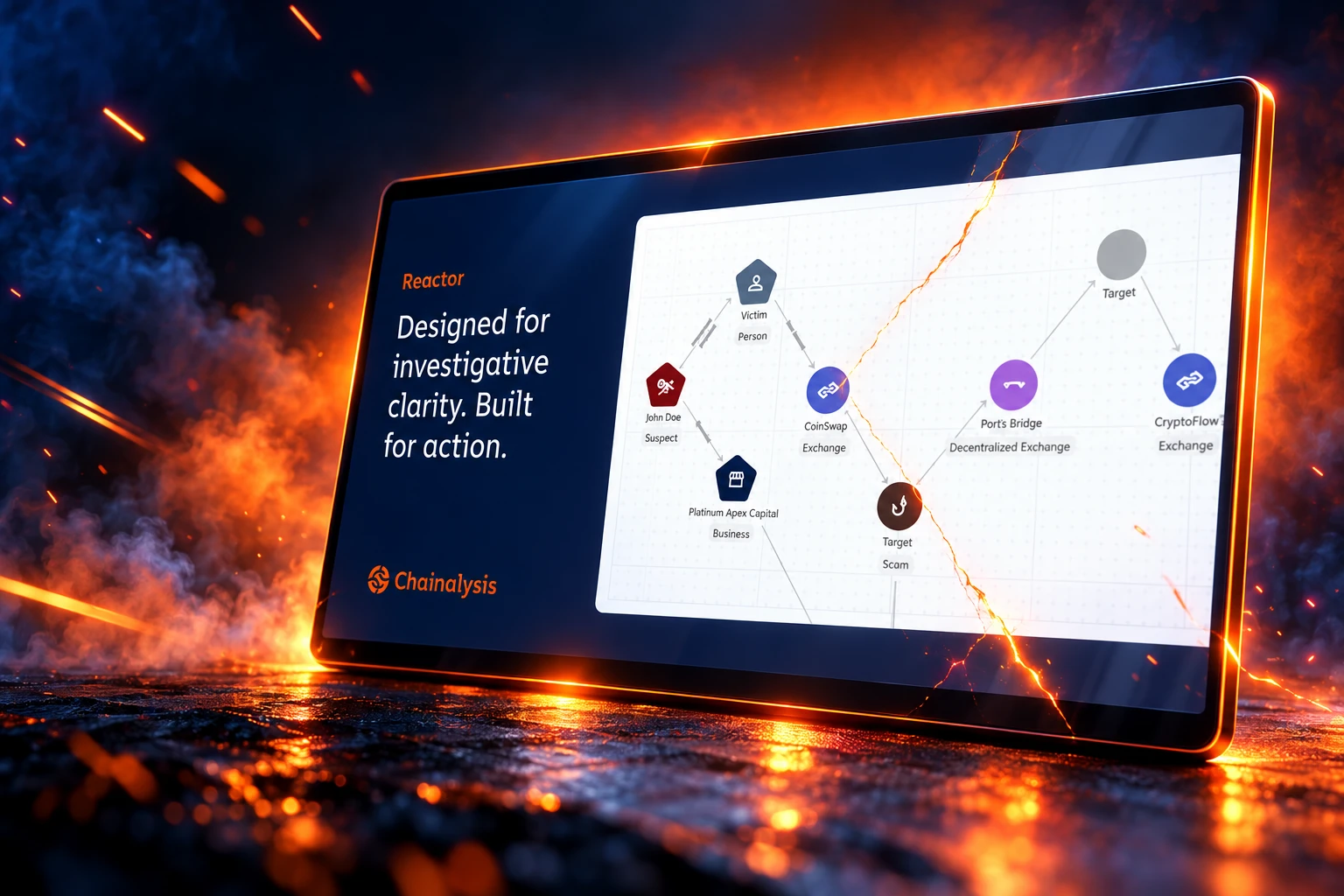
Reactor, the tracing product law enforcement and intelligence agencies use to follow stolen coins, is sold as the standard for that work. Chainalysis says it is relied on by 1,500+ organizations worldwide and cites more than $34 billion in crypto assets frozen and recovered in cases that used its intelligence.
The buyer list is the hidden stake in a “non-sensitive” identity dump. A role label on that platform is not a marketing job title. It is a pointer to the person who opens the graph when an exchange is drained.
WHO PAYS FOR REACTOR
- Public-sector hunters: Law enforcement, intelligence services, regulators, and tax agencies use it to trace assets and tie wallets to real-world entities.
- Market operators: Crypto exchanges and financial institutions escalate alerts into full traces on the same graph.
- Corporate teams: In-house investigation units run the same workflow when they need evidence that will stand up in court.
- Government deployments: Chainalysis Government Solutions sells to United States defense, intelligence, law enforcement, and civilian agencies, including FedRAMP-authorized setups.
Those seats are exactly the people a state hacking unit would want to phish while a $6.4 billion trail is still hot. Even if the case files stayed closed, the attacker now knows which inboxes belong to the units that would be assigned to chase them.
Agentic Break-Ins Were Already Hitting Cloud Tenants
Chainalysis did not describe the agent, the model, or the steps. Other vendors spent October documenting what “offensive agentic” looks like when it is instrumented. Microsoft said a China-state-aligned actor it tracks as Storm-0940 used an open-source agentic framework called ARTEX from as early as September 2026, automating reconnaissance, password spraying, and OAuth abuse after a ConnectWise Cloud Backup compromise.
Agents ran those follow-on steps at machine speed. Microsoft said several ARTEX-driven jobs reached privileged cloud access in under three hours, and that the same tooling was used to attempt sign-ins against more than 2,250 Microsoft 365 tenants. On October 11, a related password-spray burst peaked at 2,900 failed logons a minute.
This activity demonstrates how threat actors are integrating agentic AI into existing offensive security workflows and allows them to scale their operations exponentially.
Microsoft Threat Intelligence, Security Blog, October 21, 2026
Chainalysis already markets its own AI agents for blockchain intelligence. An agent allowed to operate internal tools is already inside the perimeter, which is why some vendors now move agent authority off the model rather than trust the model with those tools. The firm that just got hit by offensive agentic techniques says it is now using large language models to audit the same platform.
OCTOBER’S AGENTIC BREAK-IN CALENDAR
- September 2026: Microsoft says Storm-0940 begins using ARTEX against hundreds of organizations.
- October 11, 2026: A Storm-0940 password spray peaks at 2,900 failed logons a minute.
- October 16, 2026: ConnectWise publishes an advisory on unauthorized access tied to Cloud Backup.
- October 2026: Chainalysis detects an external actor using offensive agentic techniques on its systems and internal tools.
- October 29, 2026: About $6.4 billion leaves Binance hot wallets, per Chainalysis.
- October 30, 2026: Chainalysis names TraderTraitor for Binance and, separately, publishes its customer security notice.
None of that calendar proves the Chainalysis actor is Storm-0940, TraderTraitor, or anyone else. It shows why a firm in this trade is writing “agentic” into a customer letter without needing to invent a new category.
Password Resets Are the Cheap Next Step
The useful next move against a file of names, emails, and role labels is not another smash-and-grab on Reactor. It is a reset email that cites a real job title, or a login prompt that lands while Binance recoveries are still on every compliance desk. Chainalysis told customers to treat those messages as hostile until proven otherwise.
Two-factor authentication is the control the notice pushed hardest, which is a tell. If session tokens and MFA secrets were untouched, as the firm says, then the remaining path is to trick a named user into handing over a fresh session. The people most worth tricking are the ones whose role labels mark them as investigators.
On October 31 the company’s public account was still tracing a Tron freeze-dodge used on Binance proceeds, including a path that swaps stablecoins into unfreezable deposit tokens. It was not using that account to add facts about its own incident. Customers were promised updates “relevant to your organization as our investigation progresses,” with no date attached.
Several Basic Facts Remain Unanswered
The notice leaves the operational questions blank. Who did it, how they got in, how long they stayed, and which customers’ records were copied are all still inside the investigation. Chainalysis says a detailed breakdown is coming once that matching work is done.
Until that list arrives, the people on the other side of those role labels are working under a simple assumption: an unknown actor has their name, their email, and their function, and knows they sit on a platform built to chase stolen funds. The actor, the entry point, and the organizations whose records were touched are still unnamed.

One UI 9.5 Beta Puts the Galaxy S26 on Last Year’s Clock

DBS Puts a 24/7 USDC Window Inside the Bank

European Startups Head for $81 Billion as First Checks Shrink

US Stocks Lost $1.3 Trillion Before Nvidia’s Beat

Home Depot Bets on Finance Chief Richard McPhail as CEO

Aramco Crash Kills 14 Two Days After Oil Restart

Salah Captained Egypt to Their First World Cup Win

Zelda’s 40th Switch 2 Ships Without a Zelda Game

Apple Labor Day Deals Hide June’s Memory Price Hike

El Niño Puts Israel’s Needed Winter Rain on a Flood Clock
-
 BUSINESS5 months ago
Aramco Crash Kills 14 Two Days After Oil Restart
-
 NEWS6 months ago
Salah Captained Egypt to Their First World Cup Win
-
 GAMING2 months ago
Zelda’s 40th Switch 2 Ships Without a Zelda Game
-
 NEWS3 months ago
Apple Labor Day Deals Hide June’s Memory Price Hike
-
 NEWS4 months ago
El Niño Puts Israel’s Needed Winter Rain on a Flood Clock
-

 GAMING2 months ago
Palworld 1.0.4 Adds Palpedia Search After the 1.0 Launch
-

 NEWS4 months ago
Saudi Visa Routes Split Nigerian Travelers Into Two Speeds
-

 BUSINESS9 months ago
BAE’s 60-Year Saudi Franchise Now Runs Through Taif