
NEWS
VIVIFoCAL S1 Automates a 1967 Alvarez Lens on Kickstarter
VIVIFoCAL S1 motorized Alvarez glasses hit Kickstarter at $339, a new motor on a 1967 lens after PixelOptics spent $132 million.

VIVIFoCAL opened pledges on November 17, 2026 for the S1, glasses that slide two Alvarez lens plates with a motor in under 0.1 seconds. Super early bird pricing is $339 against a $499 list price, a $160 cut that also bundles magnetic sun lenses and a prescription build.
The optical idea is old enough to have a graveyard. Luis Alvarez, the Berkeley physicist, designed the sliding pair for spectacles in the 1960s. Superfocus tried a fluid lever and disappeared. PixelOptics put liquid crystal in the lens, raised $132 million, and filed Chapter 7. The S1’s wager is a time-of-flight sensor plus a motor, sold on Kickstarter, with a printed warning not to drive.
The S1 Measures Distance, Then Slides Two Plates
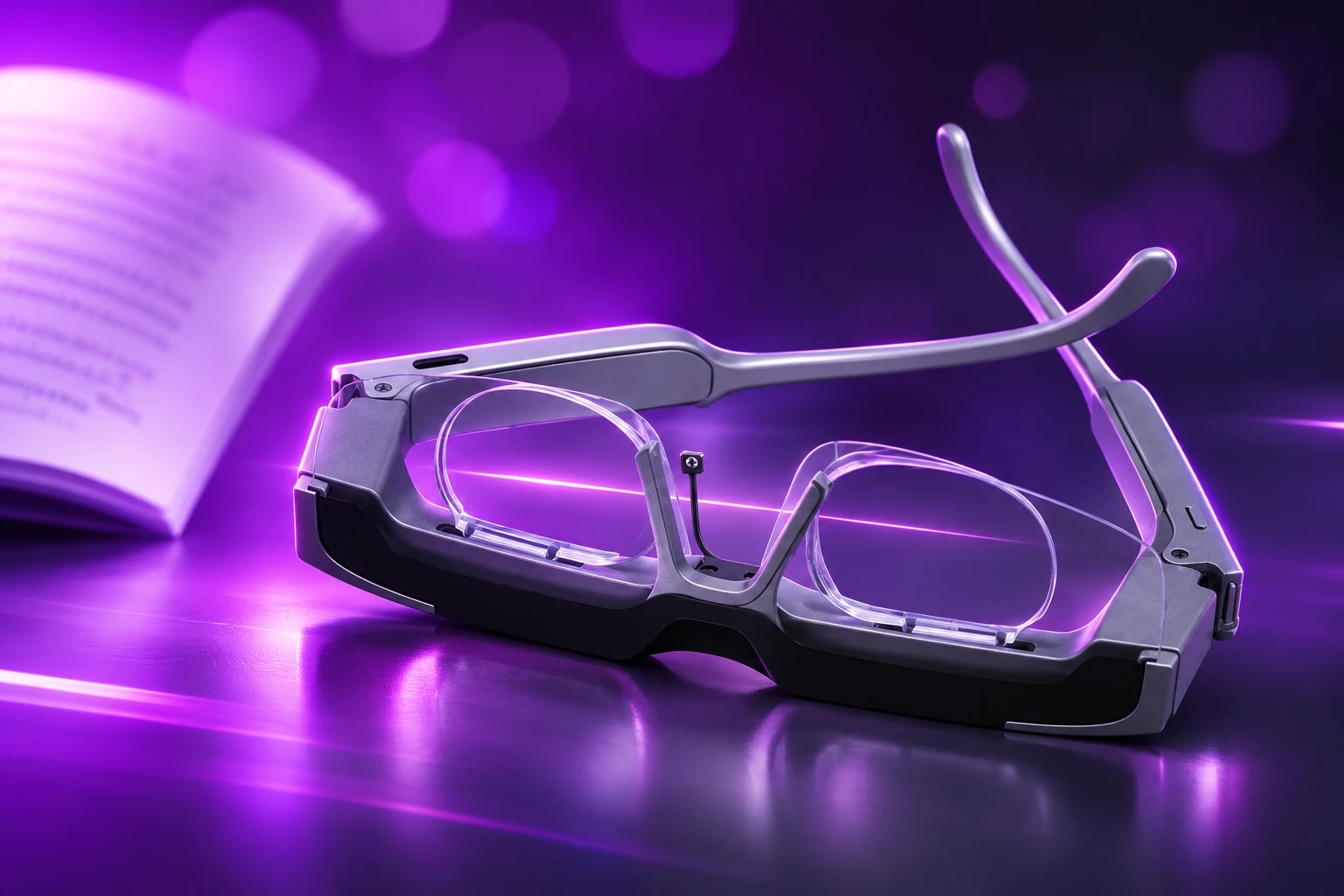
VIVIFoCAL, founded by optical engineer Dr. Zhao, describes the S1 as mechanical Alvarez optics rather than a display on your face. Two complementary plates sit in the frame. When one plate slides sideways, the pair’s focusing power changes. A small motor now does the slide that older Alvarez glasses asked you to do with a dial.
The company publishes an 8 inches to infinity focus range, an add-power band of 0 to 3.5D, and a field of view wider than 110 degrees. Lenses are polycarbonate with anti-reflective and anti-smudge coats and light transmission above 90 percent. The frame is listed at 50g with the magnetic sun clip and 40g without it, in three pad sizes, with TR90 temples and a 250mAh cell charged over USB-C in about an hour. Intensive focusing is rated at 8+ hours. An app trims focus by ±0.5D. Distance, near, and astigmatism scripts can be built into the same pair, the company says, if you send a current prescription.
THE FOCUS LOOP INSIDE THE S1
- Sensing: A time-of-flight laser in the bridge times a light bounce to estimate how far the object ahead sits, while an infrared sensor checks that the glasses are on and a G-sensor watches head motion.
- Computing: A microcontroller turns that distance into a lens position for the add power you need at that range.
- Actuation: A motor shifts the Alvarez plates, and VIVIFoCAL says the move finishes in under 0.1 seconds.
- Lock: A single click on the temple freezes the setting for a fixed task; taking the glasses off clears the lock and centers the plates.
The FAQ on the company’s own shop page is blunter than the launch copy. A slight turn of the head toward the thing you want to see can help the sensor pick a target. A gentle sound can accompany the plates as they move. Both, it says, are normal.
Luis Alvarez Patented This Spectacle Lens in 1967
Alvarez filed the design on December 3, 1964, as a continuation of a 1962 application, and the United States granted patent 3,305,294 on February 21, 1967, under the title two-element variable-power spherical lens. The inventor, listed in Berkeley and assigning the grant to Optical Research and Development Corporation of Oakland, wrote that the pair was “particularly useful in spectacles.” Two plates sit in tandem. Move one across the other, and spherical power changes with a small travel, with less distortion than earlier sliding schemes. American Optical later put translating lenses into phoropters. Consumer glasses were the hard part, because someone still had to do the sliding, and the surfaces were expensive to cut.
Manual versions did reach shops. Superfocus, founded in Van Nuys in 2006 by Stephen Kurtin, used a nose-bridge lever to push fluid in a membrane and add up to about +2.5D on top of a distance prescription. The College of Optometrists later listed the device as no longer available. Adlens, founded in Oxford in 2005 by James Chen, mass-produced Alvarez plates you twist with side dials, won an iF Product Design Award in 2014, and sold the glasses as a cheap spare pair and through charity channels, including Rwanda. Those products proved the plates can be molded. They also proved that most buyers still had to focus the glasses themselves.
HOW POWER CHANGES IN EACH DESIGN
| Product | Mechanism | How power changes | Where it went |
|---|---|---|---|
| Alvarez patent (granted 1967) | Two freeform plates | Wearer slides one plate | Expired; used in instruments |
| Superfocus (founded 2006) | Fluid-filled membrane | Lever on the bridge | Discontinued |
| Adlens Adjustables | Alvarez plates | Dials on the temples | Sold as a low-cost spare |
| PixelOptics emPower (2011) | Liquid crystal layer | Auto, on, or off modes | Chapter 7 in 2013 |
| VIVIFoCAL S1 (2026) | Alvarez plates plus motor | ToF sensor drives the motor | Kickstarter |
The S1 does not invent the plates. It invents, or at least ships, the part Alvarez left to the wearer: a motor that listens to a laser and moves the glass before you reach for a dial.
$132 Million Did Not Produce a Lasting Pair
PixelOptics, founded in 2005 in Roanoke, Virginia, by optometrist Ron Blum, took the other fork. Instead of sliding plates, emPower buried a thin liquid crystal layer in a composite lens, with a microchip, an accelerometer, and a rechargeable cell hidden in the temples. Panasonic Healthcare was to make the electronic blanks. Aspex Eyewear was to make the frames. The March 18, 2011 launch at Vision Expo East promised 12 styles and 36 frames, three modes (automatic, manual on, manual off), no moving parts, no sound, and two to three days on a charge. Blum, then president and CEO, sold the pitch as control handed back to the wearer.
With the ability to substantially reduce or eliminate the perceived distortion and other limitations associated with traditional progressive lenses, emPower! places control of your vision back in the hands of the consumer, providing a level of vision clarity and comfort never experienced before in the correction of presbyopia.
Ron Blum, President and CEO of PixelOptics, at the March 2011 launch
Dealroom’s company file puts total capital at $132 million across 11 rounds, including Safeguard Scientifics and The Carlyle Group. The first generation had reliability and design problems. PixelOptics stopped distributing it in March 2013 after selling more than 1,000 pairs. A second generation was tested in Europe and never commercialized. On November 4, 2013, the company filed Chapter 7 in Delaware (case 13-12875). The estate’s prize was an intellectual property stack of more than 400 patents and applications. Mitsui Chemical later bought the assets.
That history is why a motorized Alvarez pair arriving through Kickstarter, rather than through a Panasonic line and a chain of eye-care shops, is the actual bet. PixelOptics tried the professional channel with a silent, no-moving-parts lens and still could not service the first generation. VIVIFoCAL is asking backers to live with a motor, a charge cable, and a sound, and to skip the shop.
Why VIVIFoCAL Tells Buyers Not to Drive
Progressive lenses stay on your face in the car. The S1, as specified, does not. The company’s shop FAQ says the glasses are meant for office and workspace tasks such as reading, computer work, and ordinary day-to-day jobs, and then lists the exclusions in one sentence: it does not recommend heavy machinery, driving, or physically strenuous work in dynamic settings. A second line is flatter. The product is not intended for driving or operating motor vehicles.
LIMITS THE COMPANY PUTS ON THE S1
- Driving: The glasses are not intended for driving or operating motor vehicles.
- Machinery: Heavy machinery and strenuous work in moving environments are outside the recommended use.
- Aiming: When things sit at different distances, a slight head turn toward the target can help the ToF sensor lock on.
- Noise: A gentle sound may be heard as the plates move, which the company calls a normal part of the system.
- Power: A 250mAh cell is rated for 8+ hours of heavy focusing and about an hour to refill, so a long day still ends at a USB-C cable.
Those limits put the S1 in a narrower slot than the launch films imply. The company’s own early clips are soldering, scale-model work, serial numbers on equipment, and the hop from a paper part number to a keyboard. That is close work at a bench, which is exactly where readers, computer glasses, and the near strip of a progressive already fail people in their 40s. It is also not the commute, the school run, or a warehouse floor. Anyone who still needs a distance pair for the car will keep a second frame, which is the hassle the pitch said it would end.
Presbyopia Already Touches 1.8 Billion People
The condition the S1 is aimed at is not rare. The crystalline lens inside the eye stiffens with age, so near focus fades, usually in the 40s. Readers fix one distance. Bifocals and progressives carve the lens into zones and ask you to find the strip that is in focus. VIVIFoCAL’s claim is that a whole lens at one power, reset as you look, beats that hunt.
PRESBYOPIA AT GLOBAL SCALE
- Near impairment: The World Health Organization lists 826 million people with near vision impairment from presbyopia, citing the Fricke review.
- Everyone with the condition: Timothy R. Fricke and colleagues estimated 1.8 billion people with presbyopia in 2015 (about 25 percent of the world), with the headcount peaking near 2.1 billion in 2030.
- Unmet need: That 2018 Ophthalmology model put global unmet need for a presbyopia correction at 45 percent in 2015.
- Wider vision loss: WHO’s February 10, 2026 fact sheet says at least 2.2 billion people have near or distance vision impairment, and it puts annual productivity losses near US$411 billion.
Most of that unmet need sits in places where a $339 connected frame with a custom script is not the intervention WHO is pushing. Ready-made near glasses cost little to make. SPECS 2030 is about getting ordinary spectacles to people who have none. The S1 is a rich-world desk tool aimed at people who already own readers, computer glasses, and a progressive, and who are tired of swapping them. The addressable buyer is a slice of 1.8 billion, not the whole number.
The Super Early Bird Price Is $339
VIVIFoCAL’s Facebook countdown set the Kickstarter open at 8:00 AM PST on November 17, 2026, with a run of about 45 days. The project page had 340 followers before launch. The company also ran a $10 refundable deposit that locked an effective $289 price, with a later $50 cashback plus return of the $10, or $60 back if the pledge clears. Kickstarter’s public page is a JavaScript shell in some crawls, so a live pledged total is not a figure this report can stand behind. The price card the company itself prints is stable enough to quote.
VIVIFOCAL S1 PRICE LADDER
| Offer | Price | What the company attaches |
|---|---|---|
| $10 refundable deposit | $289 effective | Lowest listed price, plus $50 cashback after a confirmed pledge |
| Super early bird | $339 | Magnetic polarized sun lens and prescription lenses in the special |
| Stated list | $499 | MSRP on the shop cards; the company says that figure can move |
The magnetic sun clip is assigned an $80 value on the shop card, and the personalized lens build an $179 value. Those are maker figures, not invoices. A Kickstarter campaign for the S1 is still a backing, not a retail sale. Launch timing can slip. The list price can change. The campaign filing also says the team will use AI tools to update an older product video to the current S1 look and to make some lifestyle images of virtual models, which is a quiet tell that an earlier hardware generation already existed on tape.
Paid review units are already in circulation, with at least one YouTube tester disclosing that VIVIFoCAL sent the glasses free and sponsored the clip. That is how a crowdfunding frame tries to look finished while the pledge clock is running. People who follow Alvarez optics had treated a motorized pair as implausible until a campaign page appeared; whether a pair actually ships is the part they still will not grant. The frames also still read as gadget hardware, which has been a tax on every electronic pair in this line.
Early Testers Keep Using Them at the Bench
Zhao’s public biography is thin by design. The company says he holds a doctorate in optics from a leading university, ran an optical lab at a major optics firm, and leads a team with more than 10 years of optical R&D. It does not name the school or the prior employer. What it does name are the jobs it wants the S1 to win: a painter moving between a canvas and a reference photo, a system engineer reading tiny serial numbers while walking a line, a model builder at a workbench.
I would look down at a part number on a piece of paper, look backup at the screen to type it in, and the glasses just kept right up with me
vrgamerdude, early tester, quoted on the VIVIFoCAL product page
That sentence is the honest product. A motorized Alvarez pair that keeps up when you glance from a sticker to a keyboard is a useful object for people who already hate their progressive strip. It is not, on the company’s own terms, a replacement for the glasses you wear to drive home. Alvarez wrote the plates for spectacles in 1967. Adlens sold the dial. PixelOptics spent $132 million on a silent crystal and still died in Wilmington. The S1 is the version with a laser and a motor, on sale for $339 if you back it before the early-bird tier goes, and the open question is the same one that closed the last shop: whether the moving parts still work after a year on a real face.
Disclaimer: This article is news reporting and analysis of a crowdfunding product and related vision-care history, and it is for information only. It is not medical advice, an eye examination, a prescription, or a recommendation to buy, back, or skip the VIVIFoCAL S1, and it is not investment advice about a Kickstarter pledge. Anyone considering these glasses should see a licensed optometrist or ophthalmologist with a current prescription and should read the campaign’s risks, refund rules, and shipping terms before sending money. Prices, battery claims, focus times, shipping windows, and medical suitability are taken from the company, from Kickstarter materials, and from the public health papers cited above, and all of those figures can change.

One UI 9.5 Beta Puts the Galaxy S26 on Last Year’s Clock

DBS Puts a 24/7 USDC Window Inside the Bank

European Startups Head for $81 Billion as First Checks Shrink

US Stocks Lost $1.3 Trillion Before Nvidia’s Beat

Home Depot Bets on Finance Chief Richard McPhail as CEO

Aramco Crash Kills 14 Two Days After Oil Restart

Salah Captained Egypt to Their First World Cup Win

Zelda’s 40th Switch 2 Ships Without a Zelda Game

Apple Labor Day Deals Hide June’s Memory Price Hike

El Niño Puts Israel’s Needed Winter Rain on a Flood Clock
-
 BUSINESS5 months ago
Aramco Crash Kills 14 Two Days After Oil Restart
-
 NEWS6 months ago
Salah Captained Egypt to Their First World Cup Win
-
 GAMING2 months ago
Zelda’s 40th Switch 2 Ships Without a Zelda Game
-
 NEWS3 months ago
Apple Labor Day Deals Hide June’s Memory Price Hike
-
 NEWS4 months ago
El Niño Puts Israel’s Needed Winter Rain on a Flood Clock
-

 GAMING2 months ago
Palworld 1.0.4 Adds Palpedia Search After the 1.0 Launch
-

 NEWS4 months ago
Saudi Visa Routes Split Nigerian Travelers Into Two Speeds
-

 BUSINESS9 months ago
BAE’s 60-Year Saudi Franchise Now Runs Through Taif