
NEWS
Audible AI Recaps Keep Paid Listens Inside the App
Audible is adding AI recaps and in-book questions that keep US listeners inside paid titles as Spotify opens more than 180 markets.

Audible began rolling out AI audio discovery in the US on November 16, pairing narrated samples with generated overviews so a listener can pick a book without opening a browser. Recaps and Ask a Question are moving from a small beta onto more English-language titles, with a wider launch set for December.
The company is selling a friendlier way to choose a credit. The design also keeps the question, the recap, and the next title inside a paid Audible session.
A Friend Tip That Never Leaves the Store
Audio discovery plays a short sound bite before anyone spends a credit. The clip stacks a narrated sample, a brief overview of themes and what listeners liked, and remarks from an author or an Audible editor. Overviews are read by Audible’s virtual voice. Author remarks come from recordings of past Audible interviews, not a new sit-down for each title.
The overview draws on public synopses, metadata, and reviews. Audible built the clip for commutes, chores, and the gap after one book ends, when a shopper used to jump out of the app to read comments. Andy Tsao, Audible’s chief product and analytics officer, put the pitch in the launch note.
Picking your next listen should feel like getting a tip from a friend. With audio discovery, you’ll get a quick audio take on why the title might be right for you, from our editors, fellow listeners, or even the author. Some of the best listening experiences are those rare finds or hidden gems, and we want to make those great discoveries happen more often and more easily.
Andy Tsao, Chief Product and Analytics Officer, Audible
US customers also get collections grouped around past listening, with editor notes on top of the ranking. Audible says that mix can surface books that never sit on a bestseller list. The clips can run one after another, which is handy when 84 percent of the audience ACX cites already listens on the go. It is also a way to never open a review tab.
A first chapter still does more selling than a generated blurb, because the product is the long version. The new clip is a store greeting that talks. It is not the book.
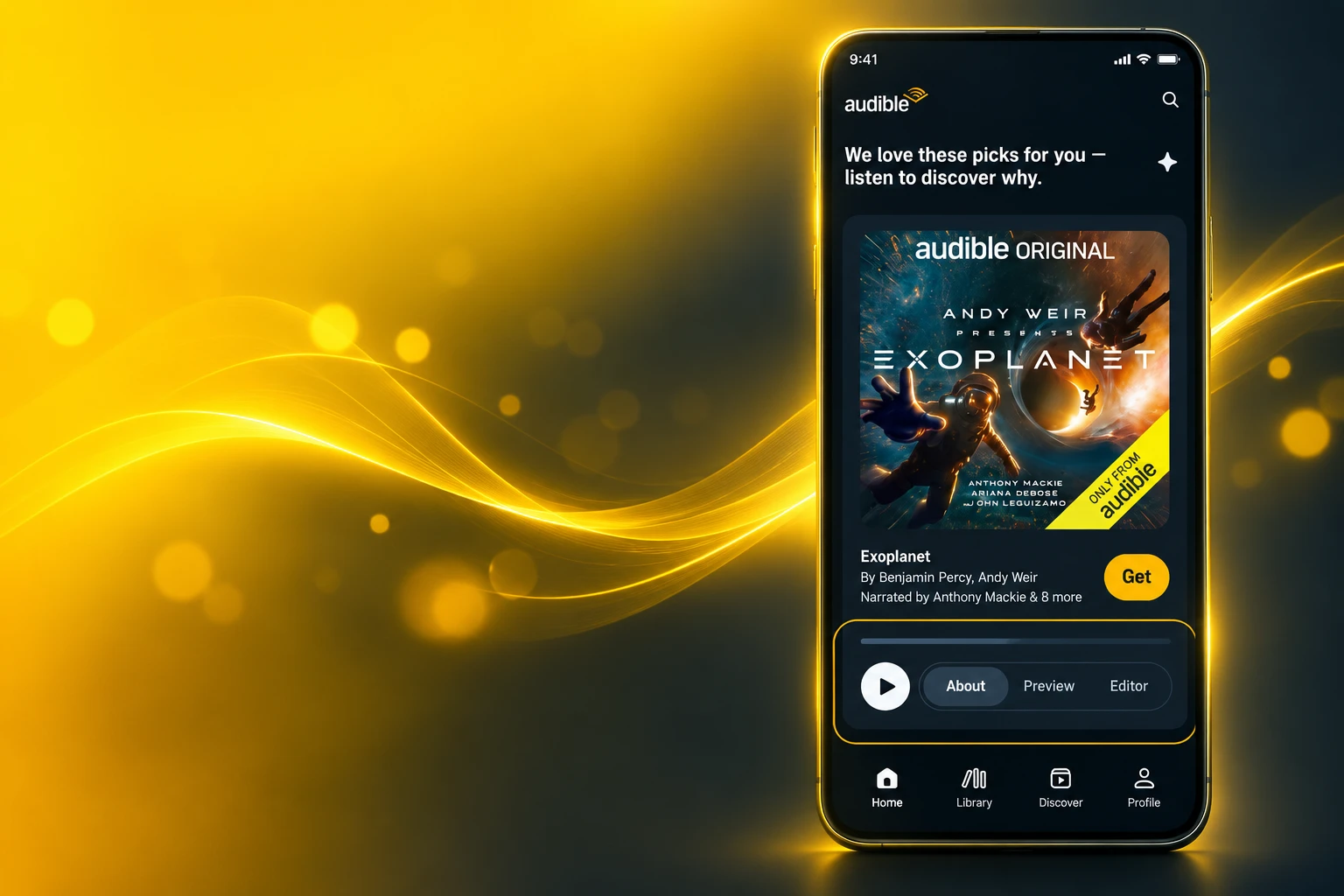
Ask a Question Users Stay With a Title Longer
Ask a Question and Recaps started earlier in 2026 on select Audible Originals and public-domain books. They now reach a larger set of English-language titles in the US and are due to spread further in December. Both tools work only on a book the customer already bought or can stream through an active membership, on every US platform and every membership tier.
Ask a Question takes a query about a character, a plot point, or a historical reference and answers it in the player. Audible says replies stay grounded in the title the person is on, and that they are capped at 100 words. The audiobook can keep playing while the answer comes back. Recaps cut a spoiler-free audio summary of only what has already been heard, up to the pause point.
On November 2, ACX told creators that early data on Ask a Question shows users complete more listening sessions and engagement days than people who do not use it. The public launch line is shorter: customers who use the tool tend to spend more time with a title. Either way, the metric Audible chose is time in the file, not a nicer recap for its own sake.
THE FOUR NEW LISTENING TOOLS
| Tool | Job | Access |
|---|---|---|
| Audio discovery | Sample, AI overview, interview clip | Select English titles in the US |
| Personalized collections | Taste groups off the bestseller lists | US customers, with editor notes |
| Ask a Question | In-player answers, 100-word cap | Owned or membership titles, widening in December |
| Recaps | Spoiler-free audio up to the pause | Same owned-or-member rule as Ask a Question |
A confused stretch of a novel used to send a walker or a driver to a search box. The new loop answers inside the same membership that sold the file. Ask a Question on classic titles already ran that test in 2025 on thousands of public-domain and classic stories, including Audible’s Pride and Prejudice adaptation.
An Opt-Out Window for ACX Creators
The listener tools arrived with a creator memo. ACX said the features were informed by early talks with publishers, then tried on a limited beta. Before the December spread, rights holders who do not want Recaps or Ask a Question on a title can take them off.
Audible’s other claim in that post matters for training fights that have already hit book contracts. Ask a Question, it said, uses the audiobook as a prompt, and that prompt is not kept or used to train the model underneath. Recaps stay behind the listener’s current place in the file, with no look-ahead. Neither tool is a new narration of the book. Both still rewrite how the book is heard in the app.
WHAT ACX CREATORS CAN DO NOW
- The window: Opt-out requests opened on November 2, ahead of the December expansion.
- The form: ACX points creators to how to submit opt-out requests in its help center.
- The promise: Audible says it will keep honoring those requests as the tools reach more titles.
- The edge: The posted choice covers Recaps and Ask a Question, not the new discovery overviews built from reviews and old interviews.
That last gap is the one authors actually live with. A virtual-voice blurb can still frame a book from public reviews even after a creator kills the in-player chat. Interview audio already in Audible’s archive can still show up in the friend-tip clip. ACX put the choice on the record the same day it asked creators to live with the tools.
Audible's Ask a Question and Recaps are expanding to select English-language titles in the US, with a broader rollout starting in December.
These features are designed to help listeners explore stories in greater depth and seamlessly return to the listening experience after time…
— Audiobook Creation Exchange (ACX) (@AudibleACX) November 2, 2026
No public tally of opt-outs has been released. The December date is the pressure. Titles that stay in will meet a larger US pool with an AI recap sitting on the pause button.
More Than 180 Markets and a 12-Hour Cap
The launch sits six weeks after Spotify used the Frankfurt Book Fair to say it would take audiobooks to more than 180 markets by the end of 2026, up from 22. Spotify put that catalog in front of more than 750 million people, with more than 350,000 titles across more than 120 languages. Eligible Premium subscribers in new markets such as Italy, Spain, Brazil, Mexico, and Poland get 12 hours a month in the plan they already pay for.
SPOTIFY’S SHELF AFTER FRANKFURT
- The map: Access moves from 22 markets to more than 180 by the end of 2026.
- The hours: Named new Premium markets include 12 hours a month; Family and Duo plans can add 15 hours through Audiobooks+.
- The catalog: New markets get more than 350,000 titles, with extra lists in Spanish, Portuguese, Italian, and Polish.
- The deals: Spotify says every publisher partnership is non-exclusive, so a title can stay on Audible too.
Audible does not sell hours. It sells credits and a membership catalog, then tries to make the next tap happen before a listener samples the same story in another app. YouTube has spent recent months in publisher talks for YouTube audiobooks that could sit inside the $15.99 Premium plan, with a possible 2027 window. That shelf is not live. Spotify’s is.
ACX has also circulated Audible and NielsenIQ figures from 18,000 listeners across 11 countries, including a finding that 65 percent of listeners look for more books by a narrator they like. Discovery clips that reuse interview tape, and collections that push lesser-known titles, are built for that habit. They are also built so the next credit does not walk over to a 12-hour bucket in another app.
What the Overviews Leave Out?
Audible did not publish a method for how an overview weighs a one-star review against a rave. The launch copy talks about themes and what listeners liked. That is a sales clip, and it behaves like one. Amazon already compresses product reviews into a friendly paragraph. The ear version of that trick can skip the pile-on that would have killed a credit.
Cautious shoppers still have the old comment field. The new path just makes that field optional, then fills the silence with a virtual voice and an archived author line. Because the overview is audio, it is harder to skim for a warning about pacing, a hated narrator, or a series order that the clip never flags.
Ask a Question has a harder lid. One hundred words, tied to the current book, with no extra hop to the open web, is a closed encyclopedia of the file you already paid for. It will not fetch a fan wiki, a map, or a spoiler from book four. For a driver, that is the feature. For anyone who used a search box to decide whether to quit, it is also a smaller door out.
Keep the Story Going After You Walk Away
Recaps exist for the other leak: the week you drop a 20-hour series and cannot remember who betrayed whom. The summary stops at the pause. Audible’s line is that people come back instead of starting something new. That is a mercy on a long commute. It is also how a half-finished credit stays a finished credit.
THE ROLLOUT CLOCK
- October 27, 2025: Audible describes Ask a Question as a US beta on thousands of classic and public-domain titles, with answers that arrive while the book keeps playing.
- November 2, 2026: ACX expands Recaps and Ask a Question to more English-language US titles and opens creator opt-outs before December.
- November 16, 2026: Audio discovery and taste-based collections begin on select English titles in the US.
- December 2026: Audible plans a broader US rollout of Recaps and Ask a Question. Audio discovery is slated to reach other regions later, with no date named.
The tools still run on a short list of English titles in one country. Creators still have a form. Spotify is already turning on markets by the batch. Audible’s bet is that a listener who can ask the book a question, then hear a recap at the next red light, will not spend the next credit anywhere else.

One UI 9.5 Beta Puts the Galaxy S26 on Last Year’s Clock

DBS Puts a 24/7 USDC Window Inside the Bank

European Startups Head for $81 Billion as First Checks Shrink

US Stocks Lost $1.3 Trillion Before Nvidia’s Beat

Home Depot Bets on Finance Chief Richard McPhail as CEO

Aramco Crash Kills 14 Two Days After Oil Restart

Salah Captained Egypt to Their First World Cup Win

Zelda’s 40th Switch 2 Ships Without a Zelda Game

Apple Labor Day Deals Hide June’s Memory Price Hike

El Niño Puts Israel’s Needed Winter Rain on a Flood Clock
-
 BUSINESS5 months ago
Aramco Crash Kills 14 Two Days After Oil Restart
-
 NEWS6 months ago
Salah Captained Egypt to Their First World Cup Win
-
 GAMING2 months ago
Zelda’s 40th Switch 2 Ships Without a Zelda Game
-
 NEWS3 months ago
Apple Labor Day Deals Hide June’s Memory Price Hike
-
 NEWS4 months ago
El Niño Puts Israel’s Needed Winter Rain on a Flood Clock
-

 GAMING2 months ago
Palworld 1.0.4 Adds Palpedia Search After the 1.0 Launch
-

 NEWS4 months ago
Saudi Visa Routes Split Nigerian Travelers Into Two Speeds
-

 BUSINESS9 months ago
BAE’s 60-Year Saudi Franchise Now Runs Through Taif