
NEWS
U.S. Humanoid Production of 400,000 Hinges on the Parts
J.P. Morgan’s 400,000 U.S. humanoid forecast is a parts bet: hands, actuators, and a 65 percent domestic-content test, not just robot brands.

J.P. Morgan put U.S. humanoid robot production at 300,000 to 400,000 units a year by 2030. It put 2035 output at about 1.5 million, naming labor shortages, better economics, and more factory space as the reasons plants and warehouses would buy the machines.
The November 12 note still treated the next few years as a supply problem. The bank’s near-term list is bearings, harmonic reducers, actuators, and cameras, and two of those names trade in Shanghai, even as Washington already treats a finished foreign humanoid as a security risk.
J.P. Morgan’s 400,000 Robots Still Need Hands
The brokerage described a shift from staged demos to commercial use in manufacturing, logistics, and warehousing. It also said hardware, training data, computing power, and factory capacity still limit how fast that shift can run. The binding list is shorter, and more physical: hands, actuators, the onboard computer it called the brain, and the lines that assemble complete robots.
THE J.P. MORGAN 2030 FORECAST
- 2030 output: 300,000 to 400,000 humanoid robots a year in the United States.
- 2035 output: About 1.5 million units if the labor and factory math holds.
- Customer savings: Multi-shift use could save a customer about $100,000 a year once robot costs sit near wages.
- Everyone but Tesla: Most U.S. makers are still aiming at 10,000 to 30,000 units a year.
Those four figures only work if the parts exist. A humanoid is a walking bill of materials: precision reducers at each joint, motors, encoders, cameras, and a pair of hands that have to last a full shift without going slack. J.P. Morgan named Tesla’s Optimus, Agility Robotics’ Digit, Boston Dynamics’ Atlas, Figure AI’s robots, and Apptronik’s Apollo as the U.S. platforms that matter. It did not publish the note in full, and it did not give a robot price or a wage rate behind the $100,000 savings line.
Smat Analytics Global put worldwide humanoid shipments at about 19,100 in the first half of 2026, with Chinese makers taking more than 97 percent of that total. AgiBot shipped about 8,400 and Unitree about 5,900. The U.S. 2030 number is a capacity plan set against a market that, on the shipping dock, is still a China volume story.
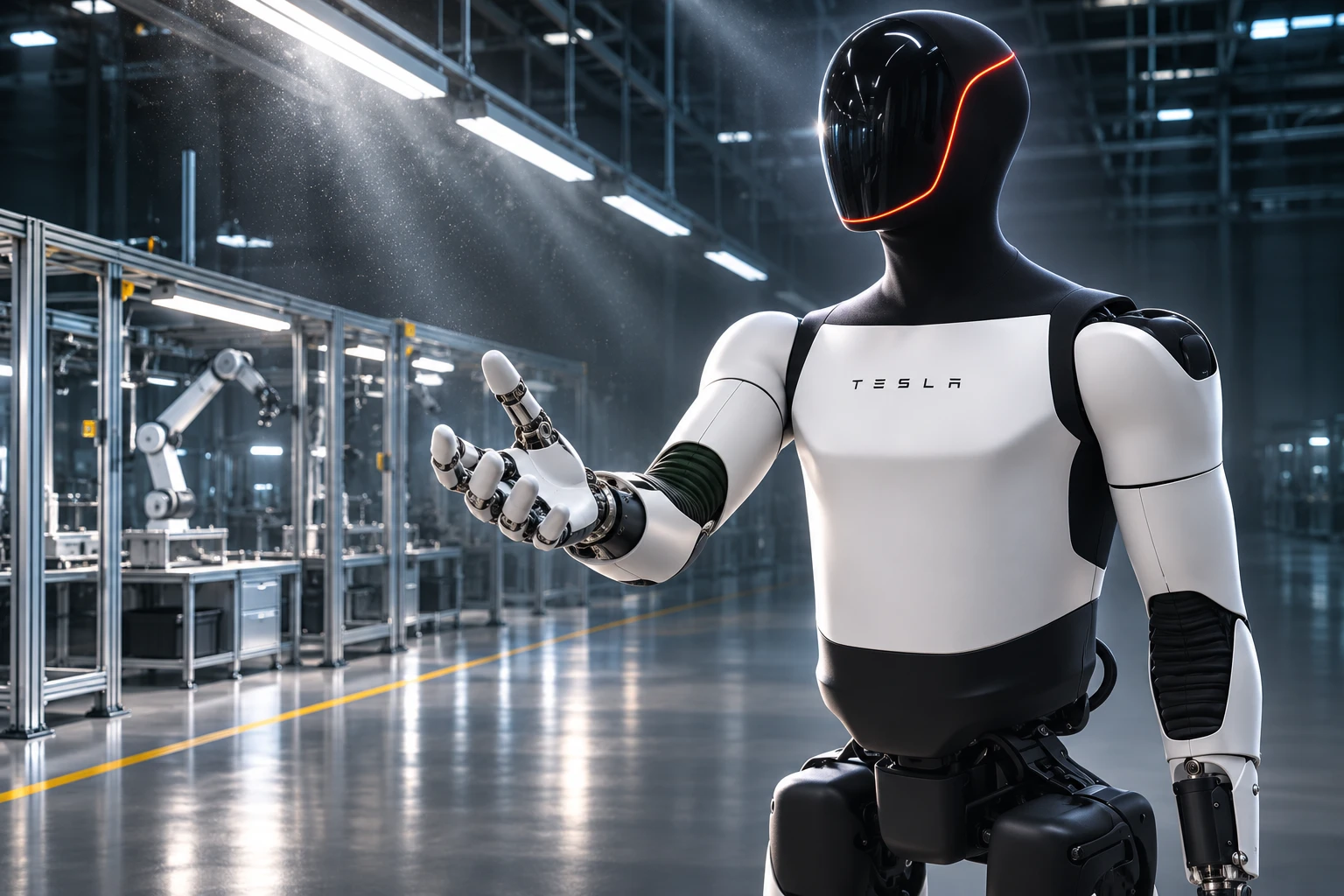
The Bank’s Near-Term Money Is in Parts
J.P. Morgan said component suppliers are the biggest near-term opening and that the market for actuators, motors, and vision systems could approach $30 billion by 2035. Value, it added, should later move toward the robot makers and the firms that stitch fleets into warehouses. The buy list it favors now is not those brands.
FIVE NAMES ON THE NEAR-TERM LIST
| Company | Listing | What it sells into humanoids |
|---|---|---|
| Timken | NYSE | Bearings and precision drives |
| ROBOTIS | KOSDAQ | Actuators and dual-arm warehouse workers |
| Leader Drive | Shanghai | Harmonic reducers from Suzhou |
| Orbbec | Shanghai | 3D vision sensors from Shenzhen |
| Cognex | Nasdaq | Machine vision systems |
Two of the five are Shanghai-listed. Leader Drive makes the harmonic reducers that turn a motor’s spin into a joint that can hold a load. Orbbec sells the cameras that tell a robot where a tote actually is. Timken and Cognex are the U.S. names. ROBOTIS, in South Korea, already has dual-arm machines on live fulfillment lines. Morgan Stanley ran a similar supplier-first screen last December. The pattern is the same: the scarce goods are the joints and the eyes, not the painted shell.
Apptronik has designed about 80 different actuators for Apollo, a count that shows how little of this hardware is a catalog part. Tesla chief executive Elon Musk told investors in July that with Optimus, “there is no supply chain.” That is the hidden roster J.P. Morgan is trying to underwrite.
A July Ban Already Closed the Import Door
The bank said a Trump administration finding that imported robotics and industrial machinery pose national security risks could lead to tariffs or other steps that lift domestic output. Some of that wall is already up. The finished Chinese machines that dominate current shipments are the first target. The parts inside U.S. robots are the next argument.
THE IMPORT CLOCK IN WASHINGTON
- July 28, 2026: The FCC adds foreign-produced advanced robotic devices, including humanoids and quadrupeds, to its Covered List, so new foreign models cannot get equipment authorization to be imported, marketed, or sold.
- October 28, 2026: President Donald Trump signs Proclamation 11077 under Section 232, accepting that imports of robotics and industrial machinery, and their parts, threaten national security, and orders talks rather than new duties.
- April 26, 2027: Commerce and the U.S. Trade Representative are due to report on those talks, after which tariffs, quotas, fees, or a domestic-production incentive program can still follow.
The White House fact sheet is blunt about the industrial gap: the United States produces less robotics and industrial equipment than it uses, and it relies on foreign imports for most types, including parts. No new tariff codes were named on October 28. Existing FCC-authorized robot models can still enter. New foreign models need a Department of War conditional approval, and counsel who have filed those papers say Chinese names have not been coming through.
Unitree, which Counterpoint Research has placed near a fifth of global humanoid share, listed in Shanghai on November 13 and jumped more than five-fold on debut. Future Unitree models are already shut out of the U.S. market under the July order. That is how a 400,000-unit domestic forecast gets policy lift: the cheap finished imports are no longer the easy alternative.
What Counts as an American Humanoid Now?
Under the FCC rule, a humanoid counts as foreign-produced unless it is made in the United States and the cost of its domestic components exceeds 65 percent through 2028, then 75 percent from 2029. A Fremont serial number does not settle that test if the actuators, reducers, and magnets still arrive in a container.
The Covered List tracks the Buy American definition of a domestic end product. The device must be manufactured in the United States, and it must clear a 65 percent domestic-content threshold through 2028, rising to 75 percent for items delivered from 2029. That is a parts test wearing a security badge. It is also a direct hit on the cost curve J.P. Morgan needs for the $100,000 savings pitch.
McKinsey has put the Optimus bill of materials without China at about $131,000, against about $46,000 with Chinese suppliers, or roughly three times as much. It counted 28 joint actuators in an Optimus body and 50 more in the Gen 3 hands. China still refines most of the rare-earth magnets those motors want, about 90 percent of processing on McKinsey’s figures, with about 69 percent of mine output. Substitute the Chinese kit and the robot that was supposed to undercut a warehouse wage becomes a much more expensive machine.
Section 232 now covers those parts as well as the finished robots, even though duties have not been set. The political story is onshoring. The purchasing story is whether Timken, a Korean actuator vendor, and two Shanghai specialists can replace a Chinese reducer cluster in time for a 2030 run-rate. Agility says about 75 percent of Digit’s parts already come from the United States, which would clear the current 65 percent line. That is one reason a Salem-built tote handler and a Fremont-built generalist are not the same trade case.
Tesla’s Fremont Line Is the Scale Outlier
J.P. Morgan’s range is a Tesla-heavy number dressed as an industry forecast. If four other U.S. makers each hit 30,000 units, Tesla would still have to build 180,000 to 280,000 robots that year to land inside 300,000 to 400,000. At the bottom of that 10,000 to 30,000 band, the rest of the field is a rounding error.
STATED U.S. CAPACITY AGAINST THE 2030 RANGE
| Maker | Robot | What the company has actually said |
|---|---|---|
| Tesla | Optimus | Fremont early ramp since October 21, 2026; Texas in construction; most of a 1 million-unit line already in Fremont; 20,000 a week at least a year away; outside deliveries around the end of 2027 |
| Figure AI | Figure 03 | BotQ first line at 12,000 a year, with a later goal of 50,000; more than 350 third-generation robots left the plant by April 29, 2026 |
| Agility Robotics | Digit | Salem RoboFab designed for up to 10,000 Digit robots a year at full capacity |
| Apptronik | Apollo | Jabil as production partner; no annual capacity figure; a GXO letter of intent for up to 1,000 units over four years |
| Boston Dynamics | Atlas | Named by J.P. Morgan; no volume target in the note as reported |
Tesla’s October 21 shareholder update said Optimus production had begun on high-volume lines in Fremont and that “the bots coming off this line are the first production-quality bots that we have manufactured.” California is listed as Early Ramp. Texas is listed as Construction. Neither row carries a capacity number, unlike the vehicle lines on the same table. Musk called it early production on the earnings call and said the ramp would be “somewhat bumpy because it is such a radically new product.”
There’s like 10,000 things that have to go right for production of the robot, and it’ll move as fast as the slowest, least lucky of the 10,000.
Elon Musk, chief executive, Tesla Q3 2026 earnings call
He said Tesla needed a robot that is safe, reliable, and long-lived, “so it can’t, like, wear out after a month.” Most of the remaining design work, he said, is on the hand. Outside companies should not expect deliveries until around the end of 2027. A 20,000-a-week rate, matched to the million-unit Fremont design, sits at least a year from that October call, maybe longer. Tesla also wants some 10,000 to 20,000 robots for its own training fleet first.
Figure founder Brett Adcock posted factory footage of F.03 robots on November 7, a reminder that U.S. metal is moving even when the annual math is still a plan.
F.03 humanoid robots pic.twitter.com/X50Yn9zVD8
— Brett Adcock (@adcock_brett) November 7, 2026
Agility began trading on Nasdaq as AGLT on November 5. Digit 5, unveiled September 15, is built for work next to people without cages. Early access is slated for the first half of 2027, with general availability by the end of that year. The 10,000-unit RoboFab ceiling is the top of J.P. Morgan’s non-Tesla band, not a shortcut around it.
Warehouse Orders Are Still Counted in Hundreds
Committed demand is still a long walk from 400,000 units a year. The same week as the J.P. Morgan note, the largest new warehouse paper on the table was a four-digit letter of intent, not a six-digit build plan. Labor savings only show up after a robot finishes a shift without a babysitter.
THE ORDERS ON THE BOOKS
- GXO and Apollo: A November 12 letter of intent covers up to 1,000 Apptronik robots over four years, with expanded trials in 2027 and a first North American commercial rollout late that year if productivity and safety targets are met.
- Digit 5 backlog: As of May 2026, Agility held more than $300 million in multi-year Digit 5 orders for 1,000 robots over three years from one customer, released in tranches as each use case is proven.
- Digit 4 in the field: More than 65,000 operating hours across nine sites, including GXO, Schaeffler, Amazon, Toyota Motor Manufacturing Canada, and Mercado Libre, plus a 100,000-tote mark at GXO’s Flowery Branch site near Atlanta at about 98 percent on-task accuracy.
- Figure 03: More than 350 third-generation robots had left BotQ by late April 2026, with BMW putting the machine on logistics work at Spartanburg.
GXO is spreading the bet. Digit’s next expansions, in Statesville, North Carolina, and Lebanon, Tennessee, start in early 2027 and stay on tote handling. Apollo is being tried on picking, packing, sorting, and case movement, the work that actually eats warehouse payroll. Amazon, an early Agility investor, bought five Digit robots for $1.05 million, a starter kit, not a fleet.
Agility’s cost plan, presented by chief operating officer Jen Hunter, takes Digit 5’s bill of materials from about $150,000 at launch to a target of $30,000 at 10,000 units a year, with an intermediate $75,000 at 1,000 units. Chief financial officer Michael Beer said a Digit on robots-as-a-service brings in about $500,000 over an assumed five-year life, or roughly $100,000 a year per robot including the deployment fee. That $100,000 is vendor revenue. J.P. Morgan’s $100,000 is a customer’s estimated multi-shift saving. They sit in the same neighborhood and are not the same check.
The $30 Billion Parts Bill Comes Due First
Hands remain the slowest joint on the whole machine. China sold about 19,200 dexterous hands in 2025, with 2026 demand modeled near 70,200 against far less merchant supply, a gap Unitree has been filling with a mix of in-house work and buys from Yinshi Robotics and Singapore’s Sharpa. Tesla’s remaining Optimus design work is concentrated in the same place. Policies can move in months. A five-finger hand that survives a warehouse year still moves in years.
Near-term progress remains supply constrained, with a few binding bottlenecks: hands, actuators, the brain, and production capacity.
J.P. Morgan, research note, November 12, 2026
The 400,000-unit U.S. figure is a 2030 production plan that only clears if those four bottlenecks move at once, and if a robot built in California or Oregon can still pass a domestic-content test while two of the bank’s favored parts vendors list in Shanghai. Tesla has a million-unit line on the floor and no public weekly rate. Agility and Figure have four-digit factories and named customers. Apptronik has a 1,000-unit letter of intent. The parts companies on J.P. Morgan’s list are the ones that have to show up before any of those logos can print the headline number.
Disclaimer: This article is news reporting and analysis of a J.P. Morgan research note and of related company statements and U.S. trade rules. It is for information only and is not investment advice, a recommendation to buy or sell any stock named here, or legal advice on import controls. Readers should consult a licensed financial adviser before acting on any forecast, supplier list, or ticker, and should consult qualified trade counsel on FCC or Section 232 questions that affect a specific product. Production plans, order figures, and policy timelines reflect the sources on the dates cited and can change as ramps, talks, and approvals move.

One UI 9.5 Beta Puts the Galaxy S26 on Last Year’s Clock

DBS Puts a 24/7 USDC Window Inside the Bank

European Startups Head for $81 Billion as First Checks Shrink

US Stocks Lost $1.3 Trillion Before Nvidia’s Beat

Home Depot Bets on Finance Chief Richard McPhail as CEO

Aramco Crash Kills 14 Two Days After Oil Restart

Salah Captained Egypt to Their First World Cup Win

Zelda’s 40th Switch 2 Ships Without a Zelda Game

Apple Labor Day Deals Hide June’s Memory Price Hike

El Niño Puts Israel’s Needed Winter Rain on a Flood Clock
-
 BUSINESS5 months ago
Aramco Crash Kills 14 Two Days After Oil Restart
-
 NEWS6 months ago
Salah Captained Egypt to Their First World Cup Win
-
 GAMING2 months ago
Zelda’s 40th Switch 2 Ships Without a Zelda Game
-
 NEWS3 months ago
Apple Labor Day Deals Hide June’s Memory Price Hike
-
 NEWS4 months ago
El Niño Puts Israel’s Needed Winter Rain on a Flood Clock
-

 GAMING2 months ago
Palworld 1.0.4 Adds Palpedia Search After the 1.0 Launch
-

 NEWS4 months ago
Saudi Visa Routes Split Nigerian Travelers Into Two Speeds
-

 BUSINESS9 months ago
BAE’s 60-Year Saudi Franchise Now Runs Through Taif