
NEWS
Fitbit Edge Keeps a Week of Battery by Going Dark
Google’s $179.99 Fitbit Edge lasts a week only with always-on display off. Turn the screen on and the rating falls to two days.

Google’s Fitbit Edge is $179.99 with a sold week of battery, and that week holds only if always-on display stays off. The tracker reached shelves on Oct. 27, 2026, after an Oct. 12 pre-order, sitting between the $99 Fitbit Air and the $399 Pixel Watch 5.
Hands-on runs of about 10 days matched Google’s split: about seven days with the screen dark, about two days when the display stays lit. The catch is the thing the ads put on the wrist.
The Seven-Day Claim Runs on a Dark Screen
Google’s wearable blog sells the Edge on up to a week of battery life from a 65mAh cell. The footnote under that line is narrower. The seven-day figure comes from 2026 tests in California on pre-production hardware, using default settings and a median usage mix of features that are on in Battery Saver mode. Use of certain features, Google says, will cut that number, and actual life may be lower.
Always-on display is one of those features. Google Health’s battery help page says the always-on display lasts up to 2 days on Edge, the same rating it gives older Sense and Versa 3 watches. Continuous built-in GPS is rated at up to 10 hours. Testers who left the screen on landed near that two-day mark. Testers who left it off got the week.
HOW GOOGLE RATES THE CELL
- Typical use: Up to seven days, measured with Battery Saver defaults on a median profile.
- Always-on display: Up to two days, which is five days less than the headline week.
- Continuous GPS: Up to 10 hours on the built-in chip, far short of a weekend ride block.
- Quick top-up: Five minutes for up to one day when the cell is low, if you use a 30W adapter sold separately.
A full charge takes about 90 minutes on the magnetic puck the Edge shares with the Air. The Pixel Watch 5 still wins the short-plug contest. The Edge also shuts itself down into a protective state at 4-5% to spare the cell, so the last slice of the week is not yours to spend.
People who raise a wrist to see the time can live with a dark panel. People who bought a screen so the time is simply there are back on a two-day cadence, which is where Google’s own watch already lives, with a heavier OS on top.
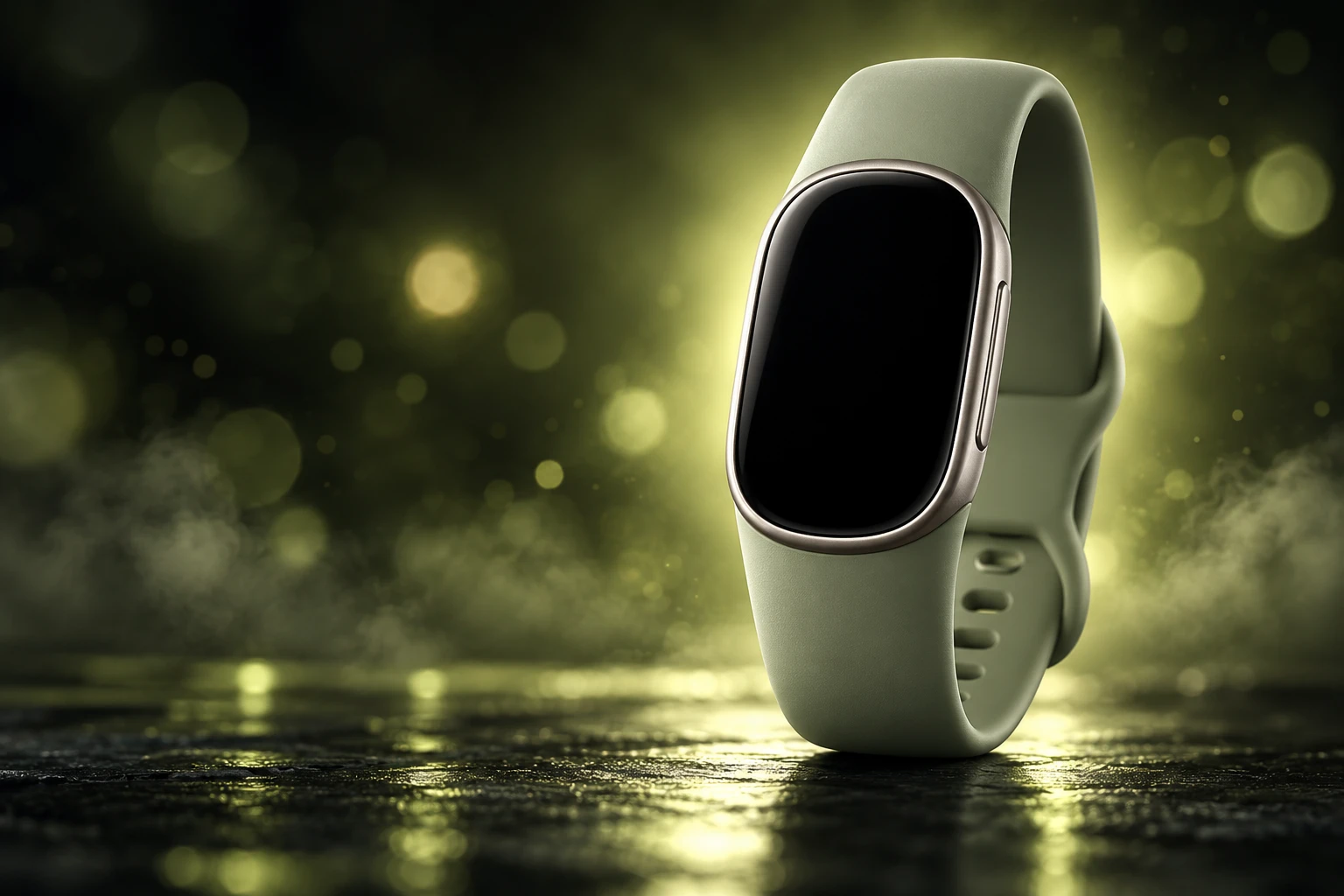
A 17.7-Gram Tracker With a Watch Face
The case is 39.2 x 25.6 x 11.6 mm and 17.7 g without a band, in 100% recycled aluminum, with a 1.3-inch (34 mm) AMOLED panel under Gorilla Glass 3. Google says that panel has 46% more viewing area than its earlier trackers and stays readable in sun. There is one mechanical side button, not the two-button layout on Pixel Watch.
Small and large Active Bands ship in the box (130-170 mm and 170-210 mm). Colors are Obsidian, Fog, Olive, and Canyon. A Stephen Curry Special Edition is $219.99 with a rye and game-day orange Performance Loop. The puck in the box is USB-C. A 30W brick is not.
Sensors cover the tracker brief: PPG heart rate, red and infrared SpO2, an ECG-capable electrical array, two temperature sensors, altimeter, gyroscope, accelerometer, and ambient light. Built-in GPS and Galileo are rated up to 40% more accurate than prior Fitbit generations. Google lists 50+ exercise modes on the wrist and automatic recognition of up to 100 workouts. Water ratings are 5 ATM and IP68, with a 50-meter line in the launch post.
The chip is an Ambiq AP5 microcontroller with 64MB of NOR flash. That is a tracker brain, not a watch brain. It stores one day of workout data, seven days of minute-by-minute motion, and 30 days of daily totals. Bluetooth 5.4 is the radio. Wi-Fi and LTE are not on the sheet.
Google calls this its first repairable fitness tracker, with a modular interior and a user-replaceable cell made with recycled cobalt and, for the first time in this line, recycled lithium. The same design is the replaceable battery and no NFC trade already on this tracker: you can plan to swap the 65mAh pack, and you cannot tap to pay. Hands-on time with the metal link band found spring-loaded caps that let you add or drop links without a pin and hammer, and the 17.7-gram body stayed light enough that the metal stayed on.
Fitbit OS Looks Like Wear OS Until You Need an App
Swipe through tiles and the Edge feels adjacent to Pixel Watch 5. Complications can be rearranged. Google Maps, media controls, a timer, alarms with smart wake, and phone notifications are on the official essentials list. SMS and chat replies can go out as canned quick replies you set in the phone app, because there is no keyboard on the band.
There is also no microphone. That is why there is no dictation, no on-wrist Gemini, and no phone call on the tracker. The launch copy talks about “call and message notifications.” Notifications are not a headset.
WHAT STAYS OFF THE WRIST
- Wear OS 7: The Edge runs Fitbit’s lighter OS, so there is no Play store and no third-party apps.
- A deep face catalog: Hands-on use found a limited set of clock faces, stylish in spots, nowhere near a smartwatch library.
- Wallet taps: The spec sheet never lists NFC or Google Wallet; those stay on Pixel Watch.
- A mic and Gemini: Quick replies are canned. The Health Coach lives in the phone app.
- Always-on as a freebie: You can light the panel all day, and you give back five days of the sold week.
Automatic exercise detection did pick up a long walk and a bike run to the store. It did not always flash a “we’re tracking this” ping while the work was happening, which is annoying if you like a live wrist card and fine if you only want the summary later. That is the software bargain that buys the week: fewer glowing pixels, fewer radios, fewer apps.
Google Health Coach Stays on the Phone
Many people are looking for a wearable that sits between an advanced smartwatch like Pixel Watch and the quiet simplicity of a band like Fitbit Air. That’s Fitbit Edge.
Ryan Krems and Noah Presler, Google Wearables, company blog
The middle they describe is real on a price sheet and thinner on the wrist. Health stats, sleep stages, readiness, cardio load, and the Gemini coach all funnel into the Google Health app, which also takes data from the Air and from Pixel Watch 5. Buyers get three months of Premium with the Edge. After that, Google Health Premium from $9.99 a month is the gate for the coach. Google listed $99 a year when it launched the plan in May, and it bundles the same tier into AI Pro and Ultra.
Core tracking still runs without the sub. Google Health has said insulin resistance and blood pressure trend monitoring on the Edge does not need Premium. Some Health Guardian alerts were still marked coming soon on the product page at launch, so do not treat every Guardian headline as a day-one switch.
The coach is the product Google actually wants on a daily loop: it reads readiness, sleep, and training load, then writes a plan you can start from the band. That loop is only as good as the nights you wear the tracker. First-day ECG and skin-temperature cards can sit empty until the band has a few sleeps to compare, which is how these sensors behave, not a broken unit. If you already log rest in Apple Health, the same night will not produce the same sleep score in Google Health. The two apps are not grading one test.
Google Health also confirmed you can pair the Air, the Edge, and a Pixel Watch on one account. Wear the Air and the Edge at the same time and the datasets will not merge, which can scramble accuracy. Pick a wrist.
Fitbit Edge vs. Fitbit Air vs. Pixel Watch 5
Google priced a three-rung 2026 stack on purpose. The Air is the quiet week. The Edge is the week with a panel. Pixel Watch 5 is the round Wear OS watch that still wants a nightly plug if you leave always-on display running.
GOOGLE’S 2026 WRIST LINEUP
| Spec | Fitbit Air | Fitbit Edge | Pixel Watch 5 (41mm) |
|---|---|---|---|
| US price | $99 | $179.99 | $399 |
| Display | None | 1.3-inch AMOLED, AOD optional | Actua 360, up to 3,000 nits |
| Google battery rating | Up to 7 days | Up to 7 days; 2 days with AOD | Up to 30 hours with AOD |
| Software | Fitbit / Google Health | Fitbit OS, tiles, no app store | Wear OS 7, apps, Gemini on wrist |
| Phones | Android 11+, iOS 16.4+ | Android 11+, iOS 16.4+ | Android 12+, no iPhone |
| GPS | Uses the phone | Built-in GPS and Galileo | Dual-frequency GPS |
| Wallet / NFC | No | No | Yes |
| Weight without band | Screenless plastic band | 17.7 g | 31 g |
The 45mm Pixel Watch 5 starts at $429 and is rated for up to 40 hours with always-on display, against 30 hours on the 41mm Pixel Watch 5. Either size is still a different job from a tracker that can, with the panel off, cover a work week. Leave the Edge’s display on and you are in the same charge rhythm as the cheaper hours on that watch, without the apps, the taps, or the assistant on the glass.
If you already live with a dark wrist, the Air at $99 does the seven-day job and skips the $80.99 jump. The Edge’s extra money buys GPS in the case, an altimeter, the ECG app, a 1.3-inch panel, and notifications. It does not buy a watch that stays glanceable for a week.
Does the Fitbit Edge Work With iPhone?
Yes. Google lists Apple iOS 16.4 or higher, Android 11 or newer, a Google Account, the Google Health app, and an internet connection. Pixel Watch 5 still does not support iPhone, so this is the screened Google wearable Cupertino phones can actually join. You get time, stats, Maps directions, media controls, and canned replies. You do not get Wallet, on-wrist Gemini, or a mic for talk-to-text.
That iPhone door is the cleanest reason to pick Edge over Pixel Watch 5, and it still collides with the battery split. A dark week is a strong tracker week on either phone. A lit two-day week is a weak smartwatch week on either phone. Launch-day chatter treated the gadget as stuck in that gap, a screen that interrupts the Air’s calm without replacing a watch, and the spec sheet agrees.
The Fitbit Edge is on sale at $179.99, with the Curry model at $219.99, and the seven-day rating is real when the panel sleeps. Light it, and Google’s own help page hands you two days.
Frequently Asked Questions
How Long Does Fitbit Edge GPS Last on a Charge?
Google’s help page rates continuous built-in GPS at up to 10 hours on Edge, a separate figure from the seven-day typical rating, which assumes Battery Saver defaults rather than a long mapped run. A five-minute magnetic top-up can return up to one day when the cell is low, but that test used a 30W adapter that is sold separately from the in-box USB-C cable.
Can You Replace the Fitbit Edge Battery Yourself?
Google documents a self-repair path that needs a 1IP Torx screwdriver, a 2IP Torx screwdriver, ESD tweezers, and a replacement cell, with official parts listed through iFixit when the device is out of warranty. The company says self-service is not recommended unless you are an adult with the skill to work on electronics, and it warns against touching a swollen or leaking pack. Replacement batteries are not shipped to India, Japan, Malaysia, Singapore, or Puerto Rico at this time.
Does the Fitbit Edge Need Google Health Premium?
Step, sleep, heart, and GPS tracking run without a paid plan. The Gemini Health Coach, adaptive workout plans, and several deeper insights sit behind Premium after the three-month trial that ships with the tracker. Google has said insulin resistance and blood pressure trend monitoring on Edge does not require Premium, and AI Pro and Ultra subscribers get Premium bundled rather than as a second bill.
Does the Fitbit Edge Support Google Wallet?
No contactless pay feature appears on the US spec sheet, which stops at Bluetooth 5.4, GPS, notifications, quick replies, media controls, alarms, a timer, and Google Maps. Google’s own Japan lineup chart shows payments on Pixel Watch 5 and not on Edge or Air, so a tap-to-pay habit still needs the phone or the round watch.
Can You Use Fitbit Edge and Fitbit Air Together?
Google Health says the Air, Edge, and Pixel Watch can sit on the same account and sync. Wear the Air and the Edge at the same time and the two streams will not merge, which the company says may hurt accuracy, so the second band is a swap, not a stack.
Disclaimer: This article is news reporting and product analysis of Google’s Fitbit Edge hardware, software, and published battery ratings, and it is informational only. It is not medical advice, a diagnosis, or a recommendation to use ECG, blood pressure trends, insulin resistance trends, heart-rate alerts, or any other sensor output to change medication, training, or treatment. Talk with a licensed physician or other qualified clinician before acting on wearable health data, and follow the device’s own age, country, and “not for medical purposes” limits. Prices, battery figures, software features, and subscription terms reflect the Google pages and hands-on tests cited here as of the dates on those sources and may change with software updates, region, and use.

One UI 9.5 Beta Puts the Galaxy S26 on Last Year’s Clock

DBS Puts a 24/7 USDC Window Inside the Bank

European Startups Head for $81 Billion as First Checks Shrink

US Stocks Lost $1.3 Trillion Before Nvidia’s Beat

Home Depot Bets on Finance Chief Richard McPhail as CEO

Aramco Crash Kills 14 Two Days After Oil Restart

Salah Captained Egypt to Their First World Cup Win

Zelda’s 40th Switch 2 Ships Without a Zelda Game

Apple Labor Day Deals Hide June’s Memory Price Hike

El Niño Puts Israel’s Needed Winter Rain on a Flood Clock
-
 BUSINESS5 months ago
Aramco Crash Kills 14 Two Days After Oil Restart
-
 NEWS6 months ago
Salah Captained Egypt to Their First World Cup Win
-
 GAMING2 months ago
Zelda’s 40th Switch 2 Ships Without a Zelda Game
-
 NEWS3 months ago
Apple Labor Day Deals Hide June’s Memory Price Hike
-
 NEWS4 months ago
El Niño Puts Israel’s Needed Winter Rain on a Flood Clock
-

 GAMING2 months ago
Palworld 1.0.4 Adds Palpedia Search After the 1.0 Launch
-

 NEWS4 months ago
Saudi Visa Routes Split Nigerian Travelers Into Two Speeds
-

 BUSINESS9 months ago
BAE’s 60-Year Saudi Franchise Now Runs Through Taif