
BUSINESS
Warsh’s Priced Pause Meets a 3.7% Inflation Test
Futures price a 90.6% October hold, but Kevin Warsh will not map December after a 3.7% CPI print, six days before the midterms.

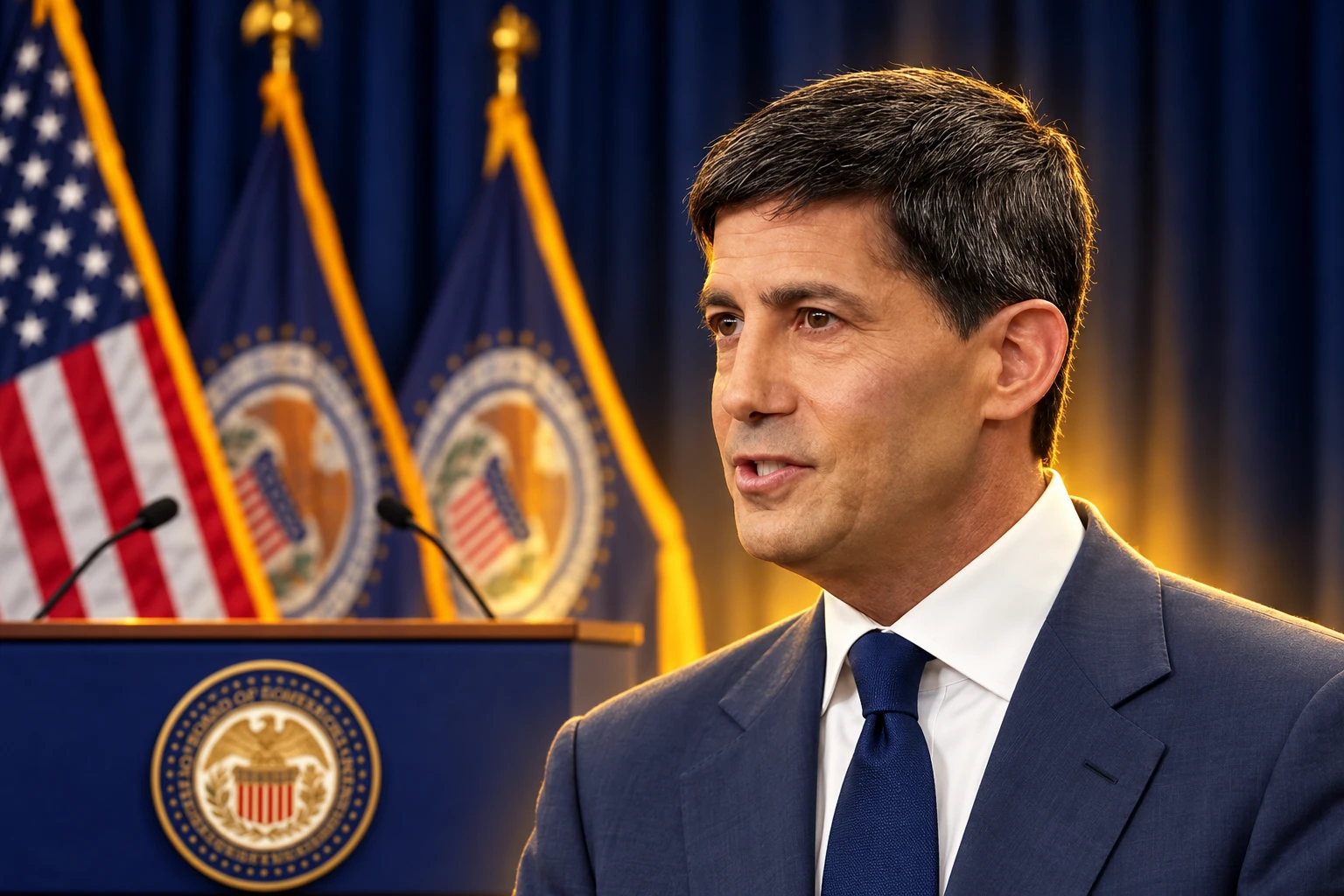
Kevin Warsh is set to leave the federal funds rate at 3.75% to 4% on October 28, a pause futures already price at 90.6%. The two-day Federal Open Market Committee meeting ends with a 2 p.m. Eastern statement and a 2:30 p.m. press conference from the chair. The hold is the easy side of the wager. The hard side is whether Warsh will say what December requires without doing the guidance he has spent the year taking apart.
Traders Have Already Collected on the Hold
On October 27, CME Group’s FedWatch tool, which publishes probabilities implied by fed funds futures, put a 90.6% chance on no change at this meeting and a 9.4% chance on a 25-basis-point increase. That is the October bet, and it is already owned. A survey of 100 economists taken between October 16 and 20 found 94 expecting a hold, which matches the tape more than it leads it.
December is a different contract. FedWatch on the same day put a 75.1% chance on a 25-basis-point rise at the December 8-9 meeting, a 17.2% chance the range stays at 3.75% to 4%, and a 7.6% chance of a 50-basis-point jump. Every one of those 100 economists expected a December increase. Of 92 who named a peak, 38 saw at least two more increases after this pause.
OCTOBER VS DECEMBER ODDS
| Meeting | Hold | 25 bp hike | 50 bp hike |
|---|---|---|---|
| October 28 | 90.6% | 9.4% | – |
| December 8-9 | 17.2% | 75.1% | 7.6% |
Michael Gapen, chief U.S. economist at Morgan Stanley, wrote that with many committee members calling for patience, officials would avoid surprising markets and remain on hold. Thomas Simons, a U.S. economist at Jefferies, put the bind in one line: the Fed is not going to hike, “but we’re not sure why.” That gap is the press conference.
The 3.7% Print Gasoline Carried
The Bureau of Labor Statistics, in its Consumer Price Index release for September, said the CPI-U rose 0.6% on the month after 0.4% in August and was up 3.7% from a year earlier, compared with 3.4% for the 12 months through August. That is 1.7 percentage points above the Fed’s 2% goal. Core prices, which leave out food and energy, rose 0.3% on the month and 2.6% over the year, after 2.4% through August.
gasoline rose 9.1 percent in September, and the bureau said that increase accounted for over half of the monthly all-items rise. Energy was up 5.2% on the month and 20.4% over the year. Gasoline was up 34.2% from a year earlier. Food was unchanged on the month and up 2.5% over the year. Shelter rose 0.4% on the month and 3.2% over the year.
WHAT SEPTEMBER PRICES DID
- Headline CPI: Up 0.6% on the month and 3.7% over the year, after 3.4% through August.
- Gasoline: Up 9.1% in September and 34.2% over the year, more than half the monthly all-items rise.
- Energy: Up 5.2% on the month and 20.4% over the year, with fuel oil up 74.2% from a year earlier.
- Core prices: Up 0.3% on the month and 2.6% over the year, after 2.4% through August.
Loretta Mester, who ran the Cleveland Fed until 2024, said the economics support another rate increase, and that by not moving in October she is “a little skeptical whether a timely path is substantially different from just being on a downward path to 2%.” Officials have said they want more data. Thursday’s personal consumption expenditures report, the measure the Fed prefers, is due the morning after this statement, which is a thin reason to skip and a real reason to sound unfinished.
Why Warsh Won’t Map December
Warsh has told markets, in public, that he will not do the job they have assigned him for 2:30 p.m. In Bangkok on October 16, on the sidelines of the International Monetary Fund and World Bank meetings, he said the economy had “broadly” moved as the committee expected in September, then refused to preview October or December.
I don’t prejudge meetings. I don’t believe in, saying now what I might do at the meetings that we have in the balance of this year.
Kevin Warsh, Federal Reserve chair, Bangkok, October 16, 2026
That line did more policy work than a rate path would have. After he declined to address October, futures cut the odds of a hike at this meeting. Traders treated the withheld sentence as a skip. John Kicklighter, a market strategist, wrote that Warsh “actively suppresses forward guidance and there is no SEP this event,” which is the mechanical problem: this meeting publishes no Summary of Economic Projections, so the statement and the chair’s answers are the whole file.
Brett Ryan, senior U.S. economist at Deutsche Bank, told clients Warsh is likely to say recent inflation data reinforce the September view that further tightening will likely be needed over time, and that skipping October gives officials more time to read the trend. Former Fed Vice Chair Alan Blinder has argued for a hawkish pause, meaning a hold that still says another increase is live. Blinder wants the old script. Warsh has spent the year tearing that script up. A hold that refuses to bless December will look soft next to a 3.7% print. A hold that talks December anyway will look like the forward guidance he says he will not give.
The Midterm Vote Is Six Days Away
The statement lands six days before the November 3 midterm elections, which will decide control of Congress in the second half of President Donald Trump’s term. Trump appointed Warsh earlier this year, then criticized the committee after the September increase even as he kept his support for the chair. Another increase this close to Election Day would have put the White House and the Fed on the same split-screen. A skip puts them there anyway, because the inflation number is still on the ballot.
Officials will say elections do not set the funds rate, as chairs always say. The calendar still sets the room they walk into. John C. Williams of the New York Fed and Vice Chair Philip N. Jefferson, both in the small group that frames options for the chair, have signaled little need to raise rates at back-to-back meetings. That is the patience Gapen cited. It is also the opening for anyone who wants to call the skip political. Warsh’s way out is a sentence about data still to come, including October jobs figures, the November 10 CPI, and Thursday’s PCE print. His way into trouble is the same sentence, if it sounds like delay.
Oil is the loose wire. The September CPI was an energy story first. If gasoline keeps doing the monthly work, a pause that refuses to name December leaves the next meeting to crude, not to the committee’s own forecast table.
September’s Unanimous Hike Left a Test
On September 16 the committee voted 12-0 to unanimous quarter-point rise to 4 percent at the top of the target range, the first increase in three years. The statement said economic activity was expanding at a solid pace, inflation remained elevated, and the action would support a “timelier” return to 2%. The Board raised the interest rate on reserve balances to 3.90% and the primary credit rate to 4.0%, both effective September 17. Minutes released October 7 showed most officials expected another increase before year-end.
THE PATH INTO THIS MEETING
- September 16, 2026: The FOMC raises the funds rate by a quarter point to 3.75% to 4% on a 12-0 vote, the first hike in three years.
- October 7, 2026: Minutes show most officials expected another increase before year-end.
- October 14, 2026: The BLS reports September CPI up 0.6% on the month and 3.7% over the year, with gasoline up 9.1%.
- October 16, 2026: Warsh in Bangkok refuses to preview October or December; futures cut the odds of a hike at this meeting.
- October 27-28, 2026: The committee meets, with the statement due at 2 p.m. Eastern on October 28.
- November 3, 2026: U.S. midterm elections.
- December 8-9, 2026: The next meeting, and the last 2026 session with a Summary of Economic Projections.
Warsh’s own test from September is still on the table. After that meeting he said inflation had not met the standard he had set for leaving rates alone.
The plain fact is that inflation is too high and has been for too long. We must be confident that underlying inflation is moving to our objective clearly and at sufficient speed. Today the FOMC decided that this standard has not been satisfied.
Kevin Warsh, Federal Reserve chair, September 16, 2026 press conference
September CPI did not satisfy it either. Core is closer to 2% than the headline is, because gasoline did the damage. That split is the only clean argument for waiting. It is also the argument that dies if energy stays hot through October.
Bitcoin Waits on a Press Conference
Equities already took the hold as payment. Over the two sessions into the meeting the S&P 500 added more than $900 billion in market value and gained 1.3%, after an earlier drop of more than $700 billion on the worst day since July 29. On October 27 the S&P 500 closed at 7,722.60, up 0.60%, and the Nasdaq Composite closed at 26,477.81, up 1.18%. That rebound is the pause, marked to market. A statement that only confirms 3.75% to 4% will not pay twice.
INTO THE 2 P.M. STATEMENT
- S&P 500: 7,722.60 on October 27, up 0.60% that session, after a two-day cap gain above $900 billion.
- Nasdaq: 26,477.81, up 1.18% on October 27 as AI-linked stocks led.
- Bitcoin: About $79,878.30 on October 27, up 0.52%, still down 5.9% over 30 days.
- Crypto market: About $2.68 trillion, up 0.54% that morning, with volumes up 13%.
Bitcoin is still waiting on the words, not the rate. The same 3.7% CPI that already pointed past October is why December, not this statement, is the live contract for anyone who trades liquidity. A clean hold with no December map would let a short squeeze in crypto run for a session. A hold that treats another increase as the base case would fade that bid in the same hour. The statement itself is the boring document. The press conference is the tape.
December Is the Meeting With Forecasts
October is the meeting without a forecast package. The Fed’s own calendar marks the December 8-9 meeting with projections, the last 2026 session that publishes a Summary of Economic Projections. Minutes of this week’s gathering are due November 18. October CPI is due November 10. By December the committee will have Thursday’s PCE print, two more inflation releases, and the midterms behind it. That is when officials have to put dots on paper, including the ones Warsh has been unwilling to talk through in a room with cameras.
Nearly 60% of the economists in that October poll saw the peak in a 4.00% to 4.25% range, which is one more quarter-point from here. The rest of that group wanted more. Goldman Sachs’s David Mericle has the next increase in December and another in March. None of those paths can be read off an October statement that, if the futures are right, will leave the range where September put it.
The 90.6% hold is not the news. The news is a chair who will not map the 75.1% December hike, six days before a vote, with gasoline still doing the CPI’s monthly work. If he stays quiet, traders will again treat silence as a skip, the way they did after Bangkok. If he talks, he will have used the tool he says he does not believe in. Either way the October pause is the cheap part of the ticket.
Disclaimer: This article is news reporting and analysis of Federal Reserve policy, market pricing, and published inflation data, and it is for information only. It is not investment advice, a recommendation to buy or sell any security, futures contract, cryptocurrency, or other financial instrument, and it is not a forecast of the October 28 decision or of later FOMC meetings. Readers should consult a licensed financial adviser or investment professional who can consider their own objectives and risk limits before acting on rate, equity, or crypto views. Figures, probabilities, and meeting status reflect the official releases and market tools cited here as of the dates given in the piece and will change when the statement, the press conference, and later data arrive.

One UI 9.5 Beta Puts the Galaxy S26 on Last Year’s Clock

DBS Puts a 24/7 USDC Window Inside the Bank

European Startups Head for $81 Billion as First Checks Shrink

US Stocks Lost $1.3 Trillion Before Nvidia’s Beat

Home Depot Bets on Finance Chief Richard McPhail as CEO

Aramco Crash Kills 14 Two Days After Oil Restart

Salah Captained Egypt to Their First World Cup Win

Zelda’s 40th Switch 2 Ships Without a Zelda Game

Apple Labor Day Deals Hide June’s Memory Price Hike

El Niño Puts Israel’s Needed Winter Rain on a Flood Clock
-
 BUSINESS5 months ago
Aramco Crash Kills 14 Two Days After Oil Restart
-
 NEWS6 months ago
Salah Captained Egypt to Their First World Cup Win
-
 GAMING2 months ago
Zelda’s 40th Switch 2 Ships Without a Zelda Game
-
 NEWS3 months ago
Apple Labor Day Deals Hide June’s Memory Price Hike
-
 NEWS4 months ago
El Niño Puts Israel’s Needed Winter Rain on a Flood Clock
-

 GAMING2 months ago
Palworld 1.0.4 Adds Palpedia Search After the 1.0 Launch
-

 NEWS4 months ago
Saudi Visa Routes Split Nigerian Travelers Into Two Speeds
-

 BUSINESS9 months ago
BAE’s 60-Year Saudi Franchise Now Runs Through Taif