
ENTERTAINMENT
A24’s Holmes Film Turns 34 Days Into $45 Million
You Can See Everything, the secret Holmes documentary that locked phones at Telluride, has taken $45,145,476 in 10 days from a subject who has not seen the film.

A24’s Elizabeth Holmes documentary You Can See Everything has taken $45,145,476 in 10 days, after a phone-free surprise premiere at Telluride on Sept. 6. Holmes invited the crew into her rented Del Mar house 34 days before she reported to federal prison, selling the visit as radical transparency, and she has not seen the finished film.
Nathan Fielder and Lance Oppenheim shot in secret for three years. The 174-minute result is now a wide-release hit whose title is also its dare: the more the cameras were allowed to take, the harder it became to say what, exactly, they had.
Phones, Night Vision, and the Herzog Theatre
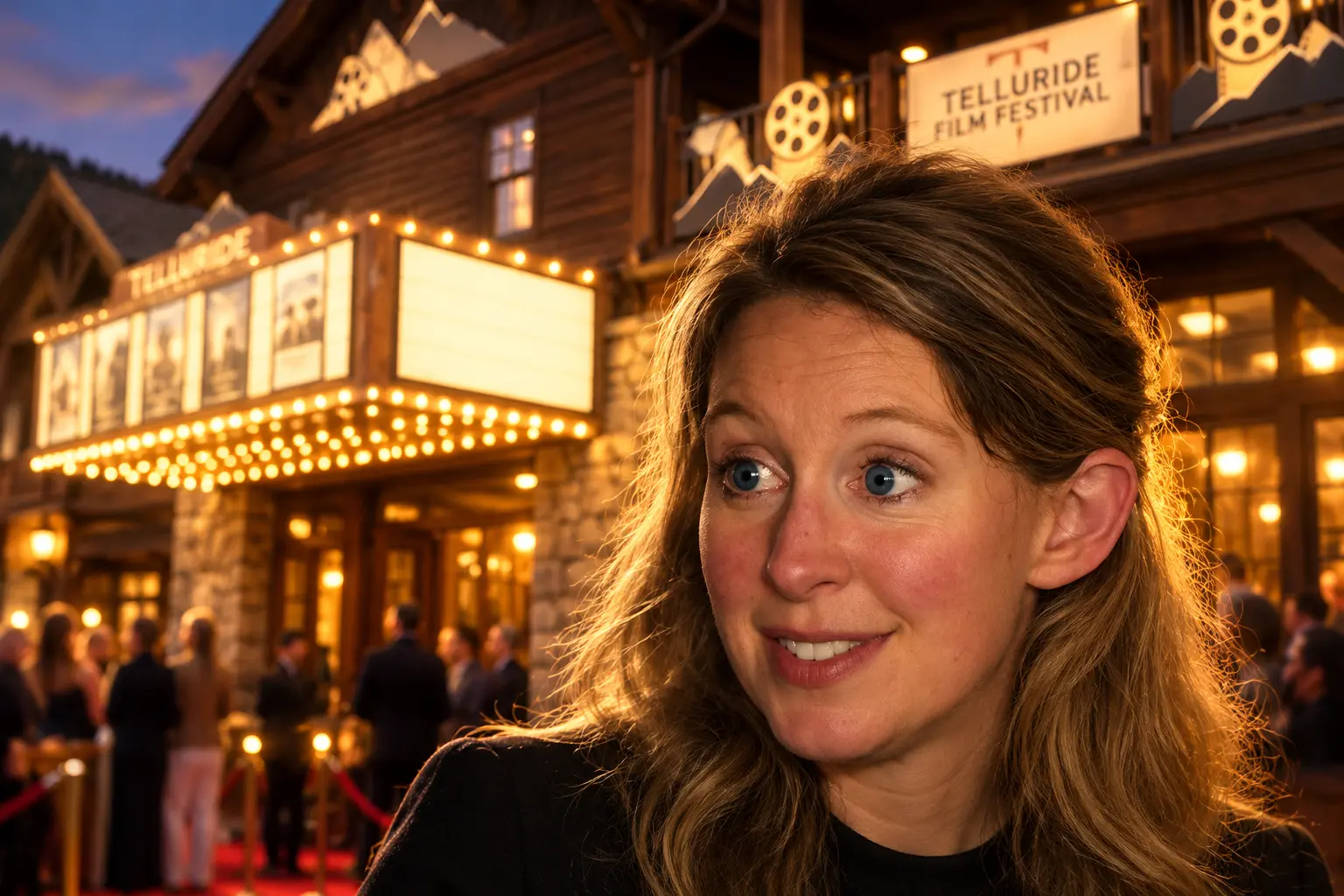
On Sunday evening, Sept. 6, hundreds of festivalgoers lined up for Telluride’s Werner Herzog Theatre without a title on the public schedule. Festival director Julie Huntsinger had spent the week feeding the guessing, calling the slot a film with “very known names” and promising jaws on the ground for its full length. People in town floated Aaron Sorkin, Denis Villeneuve, even an Elon Musk documentary. Someone yelled “Digger!” as the house filled, hoping for Tom Cruise.
Before anyone sat down, phones went into lock pouches. Staff warned that guards with night-vision goggles would watch for a device still in a pocket. Huntsinger told the room that what happens in Telluride stays in Telluride, then brought out Fielder and Oppenheim.
“For those of you who don’t know who we are and are disappointed, I apologize,” Fielder said. “But hopefully by the end of the film, you’ll be slightly less disappointed.”
While that crowd was sealed inside, A24 posted a teaser and dated a theatrical opening for October. Critics were asked not to describe the film’s later turns. Emma Stone, who starred with Fielder in The Curse, moderated the Q&A and backed the plea. The secrecy was not a side effect of a mountain festival. It was the first public version of the deal Holmes had offered the crew: you can look, on our terms, in a room we have already swept.
Holmes Reached Out to A24 Herself
The project did not begin with a journalist chasing a subject. Oppenheim said he and Fielder were at the Magic Castle in Los Angeles in 2023 when a magician asked for a celebrity name and someone shouted Elizabeth Holmes. Oppenheim had already heard, through a friend of a friend, that Holmes wanted someone to document her life and that she had called A24.
Fielder had read John Carreyrou’s Bad Blood and told the Telluride crowd he thought “the story was really fully told.” Holmes had given almost no interviews for years. Curiosity still got him on a plane. Sitting across from her, he found her “sort of honest and charming,” even as his own mind said, “No, don’t trust.” That split, between the person in the chair and the record in the clips, is the engine of the movie.
Holmes founded Theranos in 2003 on the claim that a few drops of blood could run a wide range of tests. A jury convicted her in 2022 on four counts of defrauding investors. A judge sentenced her to 135 months, later cut on March 26, 2026, to 123 months. She reported to Federal Prison Camp Bryan in Texas in May 2023. She is 42. She and Billy Evans have two children, a son named William and a daughter named Invicta.
A24 funded the shoot with no deadline and no promise of a movie. Fielder said the studio’s instruction was that if nothing came of it, “you can just throw everything away.” Holmes and Evans, for their part, said they wanted the cameras in so they could answer a public story they call a distortion, including Hulu’s The Dropout. Amanda Seyfried won an Emmy playing Holmes in that series. She appears again here, in reconstructions, with Christopher Abbott as Evans.
I really am struggling to this day to understand exactly what I experienced in this. I don’t quite know what I went through.
Nathan Fielder, co-director, Telluride post-screening Q&A
At the New York Film Festival, the second public showing, Fielder and Oppenheim said they kept leaving the house and disagreeing about what they had just watched. “If we can’t agree on what’s happening, there’s something here,” they told artistic director Dennis Lim. Fielder still could not say why the couple picked them. “Maybe there was a sense that inviting someone who was a friend of theirs, no one would take that seriously.”
What the Crew Was Allowed to Film
The house deal was simple on paper and strange in practice. Holmes and Evans used the phrase “radical transparency,” a Silicon Valley slogan with a sour echo given how Theranos actually ran, and they opened rooms most documentaries never see. Fielder, who had planned to stay off camera, ended up living in the house. A24’s own logline now sells the same invitation: 34 days out, Holmes asks a skeptical film crew to document her every move.
HOW THE HOUSE WAS SHOT
- The hours: Two small crews filmed about 16 hours a day, with no more than four people inside at once.
- The cameras: They went from one camera to three, including a wide lens that covered the whole house so a pan would not miss a face.
- The guest: Fielder moved in and became the person Holmes had to answer, close up, about whether she knew the blood tests did not work.
- The after: Once she reported to Bryan, Evans took over as the conduit, with power of attorney and control of her public posts.
Oppenheim said the extra cameras were there so the couple would not be able to tell which moment the crew valued. “Actually, we didn’t always know either,” Fielder added. In the trailer, he asks whether any part of them worries about him in the house around the clock. Holmes says she does not think so. He asks what happens if he sees something that makes her look bad. “I think this is the moment in time to capture this story before I’m gone,” she says.
The finished film is rated R for language and some graphic nudity. One sequence that people leave the theater talking about is Evans in the shower, door open, brushing his teeth while Fielder stands in the hall. Evans has said the shower was his idea. Another cut, widely noticed, pulls back from a polished desk and finds a WeWork logo. Grandeur, in this movie, keeps turning out to be leased.
THE SHOOT IN FOUR FIGURES
- Access window: 34 days of filming before Holmes reported to prison in May 2023.
- Finished length: 174 minutes, with reconstructions filling what the cameras could not enter.
- Studio outlay: A24’s production budget was $7 million, with permission to abandon the footage.
- Subject’s cut: Holmes has not seen the finished movie, and neither has Evans.
A24 posted the first teaser as the Herzog screening began, then a full trailer on Sept. 23. Holmes, asked on camera if she is being real, says, “I’m always being real.” Asked if she did anything wrong, she says she did not. “So, where did things get lost?” Fielder asks. “I wish I knew,” she says.
A Profit Share Negotiated Off Camera
The money fight is the scene that turns the title into a joke. Release forms were not yet signed. Holmes left the room to check on the children. Evans told Fielder, Oppenheim, and A24 executives that the movie might make a lot of money, and that if it did, “we should be entitled to some of it.” Fielder argued that a payment would taint motive and imply control over the cut. Evans called compensation nonnegotiable. A24, Fielder later said, felt it had to agree.
Shortly before prison, Holmes told Fielder on camera, “Obviously I’m not making any money or having any economic interest in this whatsoever.” Fielder could not tell whether she did not know about Evans’s ask or was performing not knowing. Evans later said he had kept details from her on purpose. “I purposely didn’t want her to be aware of it,” he said. She already owed hundreds of millions of dollars in restitution.
I do know that there is potential for this movie to also make a lot of money. And I feel strongly that if this movie were to make money, that we should be entitled to some of it.
Billy Evans, in a reconstruction of the unfilmed A24 meeting
A title card at the end says Evans walked away from the compensation. For a long stretch before that card, the film lets you sit there doing the arithmetic on your own ticket, wondering whether a slice of it is heading to the partner of a woman who still says she is owed a hearing. That suspicion is not a glitch in the night. It is what the movie is willing to make you buy.
Fielder also asked Evans, on camera, whether he had worried Holmes was scamming him when they met. “A hundred percent,” Evans said. “But what did she have to gain from me?” Fielder noted that Evans’s family is rich. “I think that there’s, like, a lot of different levels of wealth,” Evans said. The line plays as a laugh and as a stall.
A24 Opened Quiet, Then Went Wide
The same control tactic moved from a mountain theater to the multiplex. A24 opened You Can See Everything on Oct. 16 in 855 theaters after putting tickets for the Oct. 16 opening on the film’s site, and the company said more than 2,000 of those early screenings sold out. David A. Gross, who publishes the box office newsletter FranchiseRe, called it a $7 million bet on “an interesting but complicated idea without a beginning, middle or end” that turned into a film about money, dreams, truth, and reality. The opening weekend alone, $15,601,418, more than doubled the budget.
THE FIRST 10 DAYS IN THEATERS
| Weekend | Theaters | Gross | Running total |
|---|---|---|---|
| Oct. 16-18, 2026 | 855 | $15,601,418 | $15,601,418 |
| Oct. 23-25, 2026 | 2,655 | $19,500,000 | $45,145,476 |
The second weekend added 1,800 screens and rose 25 percent, to $19,500,000, a move that almost never happens to a 174-minute documentary already in wide-ish release. Per-theater take fell from $18,247 to $7,345 as the footprint grew, which is the ordinary cost of going from a hot limited run to 2,655 locations. Through Oct. 25 the ten-day domestic total of $45,145,476 was about 6.4 times the production budget, with no international number booked yet. The United Kingdom date is Nov. 20.
A24 billed the first weekend as one of the largest limited-release openings of the 21st century. Heading into that Friday, the company had been aiming at a $7 million to $8 million debut that would already have been enormous for a non-concert documentary nobody had heard of in August. The film came in at No. 2 behind Street Fighter, then held No. 2 a week later even as DC’s Clayface arrived. People paid premium prices to sit in a dark room for nearly three hours and not look at their phones, which is, in miniature, the Herzog night sold nationwide.
Who Runs Holmes’s Feed From Outside
Holmes is still at Federal Prison Camp Bryan, a minimum-security camp northwest of Houston. The Bureau of Prisons lists a projected release of Feb. 22, 2030. A Sept. 22 letter in the Justice Department’s victim-notification system said she is set to move on Aug. 23, 2027, to the Austin Transitional Center in Del Valle, Texas. On Sept. 27 her account posted that she had been imprisoned for 1,216 days and nights, a count that matches a start date of May 30, 2023.
THE CALENDAR AROUND THE FILM
- 2023: Fielder and Oppenheim begin shooting at the Del Mar house 34 days before prison.
- May 2023: Holmes reports to Federal Prison Camp Bryan to begin a 135-month sentence later cut to 123 months.
- Sept. 6, 2026: Telluride unveils You Can See Everything in a phone-free Sunday slot at the Werner Herzog Theatre.
- Oct. 16, 2026: A24 opens the film in 855 theaters; by Oct. 25 the domestic gross is $45,145,476.
Evans has power of attorney. He told the filmmakers he often decides for her without a call, because he knows what she would want. He also took over her previously quiet X account, saying about 80 percent of what he posts comes from her, and that posts carrying her own initials, EAH, are the ones she wrote. Fielder has said the relationship with Evans grew strained as Evans tried to exert more control over the project. In the film, vulgar posts go out under her name, and the directors press him on the mismatch with her public voice.
Holmes, from camp, has used the same channel to say she is fighting to prove her innocence and that she was silenced for a long time. She has completed a law apprenticeship, works as a reentry clerk, and sees Evans and the children on visits. The woman who invited cameras in so the world could “see everything” now reaches the public through a partner who already negotiated, then publicly forswore, a piece of a movie she has not watched, while that movie’s receipts climb past $45 million.
Fielder Still Has No Conclusion
After three years in the house and in the edit, Fielder is still asking other people to tell him what he made. “There was always more going on than I thought, and, even now, there are certain aspects of the film where I don’t feel I have a clear conclusion,” he said. “I want the audience to help me understand the experience.” At Telluride he put it more sharply to Stone and the crowd: they were working at the top of their intelligence, and they still could not make sense of what was happening in that house.
The objection that follows the movie around is that this is an unethical portrait, a convicted founder granted a three-hour close-up because she knew how to invite the right room. The other reading, which the film itself keeps staging, is that the invitation was the con, and that Fielder’s confusion is the evidence. Holmes’s most effective move on camera is still a sudden softness that reads as confession until it hardens into the same sentence she has been saying since 2022. You can see the tear. You can see the shower. You can see the WeWork sign. You cannot see the cut she would have approved, because she has never been in the room where it was made.
Holmes remains at Bryan. You Can See Everything opens in the United Kingdom on Nov. 20.

One UI 9.5 Beta Puts the Galaxy S26 on Last Year’s Clock

DBS Puts a 24/7 USDC Window Inside the Bank

European Startups Head for $81 Billion as First Checks Shrink

US Stocks Lost $1.3 Trillion Before Nvidia’s Beat

Home Depot Bets on Finance Chief Richard McPhail as CEO

Aramco Crash Kills 14 Two Days After Oil Restart

Salah Captained Egypt to Their First World Cup Win

Zelda’s 40th Switch 2 Ships Without a Zelda Game

Apple Labor Day Deals Hide June’s Memory Price Hike

El Niño Puts Israel’s Needed Winter Rain on a Flood Clock
-
 BUSINESS5 months ago
Aramco Crash Kills 14 Two Days After Oil Restart
-
 NEWS6 months ago
Salah Captained Egypt to Their First World Cup Win
-
 GAMING2 months ago
Zelda’s 40th Switch 2 Ships Without a Zelda Game
-
 NEWS3 months ago
Apple Labor Day Deals Hide June’s Memory Price Hike
-
 NEWS4 months ago
El Niño Puts Israel’s Needed Winter Rain on a Flood Clock
-

 GAMING2 months ago
Palworld 1.0.4 Adds Palpedia Search After the 1.0 Launch
-

 NEWS4 months ago
Saudi Visa Routes Split Nigerian Travelers Into Two Speeds
-

 BUSINESS9 months ago
BAE’s 60-Year Saudi Franchise Now Runs Through Taif