
ENTERTAINMENT
Paramount Bets $38 Million on Johnny Depp’s Familiar Scrooge
Paramount opened Johnny Depp’s Ebenezer in 3,500 theaters on November 13, betting Ti West’s hard-PG Christmas Carol can outrun mixed reviews.

Paramount Pictures opened Johnny Depp’s Ebenezer in about 3,500 theaters on Friday, November 13. The $38 million Dickens film is the studio’s wager that a hard-PG ghost story can still sell a tale everyone already knows.
Box Office Theory’s November 12 forecast puts the three-day take at $23.5 million, inside a $20 million to $27 million range. Rotten Tomatoes lists a 50 percent score from 68 reviews.
A $38 Million Opening on Familiar Ground
The official site sells Ebenezer as a thrilling take on the most iconic ghost story of all time, with the line “If you think you know his story, think again.” Nathaniel Halpern wrote the script. Emma Watts produced. Ti West directed and cut the picture, which runs 1 hour 56 minutes and carries a PG-13 for frightening material.
France got the film on November 11. Australia and Brazil followed on November 12. The New York premiere was November 1. By November 13 the United States and the United Kingdom were the main event, with Paramount treating the date as the start of the holiday derby two weeks before Thanksgiving.
The production budget is $38 million. Marketing costs have been reported at $50 million, higher than the shoot itself, which is how a mid-range film gets 3,500 screens and a star walking Comic-Con in full Scrooge kit. Traditional studio tracking sat at $20 million. Box Office Theory’s pinpoint is $23.5 million. Either figure would cover a large share of production in three days, before the Christmas calendar has even started.
THE FRIDAY-TO-SUNDAY FORECAST
| Film | Distributor | 3-day forecast | Locations |
|---|---|---|---|
| Ebenezer | Paramount | $23.5 million | 3,500 |
| Godzilla Minus Zero | GKIDS | $11.8 million | 3,254 |
| The Cat in the Hat | Warner Bros. | $10.6 million | 4,003 |
| How to Rob a Bank | Amazon MGM | $5.5 million | 2,810 |
Those are forecasts, not counts. If Ebenezer lands near the pinpoint, it opens ahead of a Godzilla holdover and a Cat in the Hat slide, which is the whole point of spending like this on a story that needs no introduction.
West Sold Paramount a Hard-PG Scare
West came in off X, Pearl and MaXXXine and told the studio he did not want cocoa. He wanted the version he remembered from childhood, when Clive Donner’s 1984 film with George C. Scott sent Jacob Marley into the room and the room got smaller.
As a kid, I watched the George C. Scott version, and Marley really freaked me out. I have this visceral memory of one of the earliest horror-ish things that I watched being A Christmas Carol, and I got a little scared in a couple parts. So when I was talking about making the movie to the studio, I was like, ‘It’s hard-PG.’ I want to make something like the movies I grew up on that you were allowed to watch as a kid but occasionally pushed it just a little too far.
Ti West, director
He also said no one had really made the ghosts a little bit spooky. Ian McKellen, who plays Marley, put the same idea in plainer words: Dickens wrote an exciting ghost story on the page, and this screen version is meant to be more ghostly than most. West even changed the famous opening. Instead of starting from the fact that Marley was dead to begin with, he lets McKellen live for a stretch of barbed talk with Depp, then kills him, then jumps seven years.
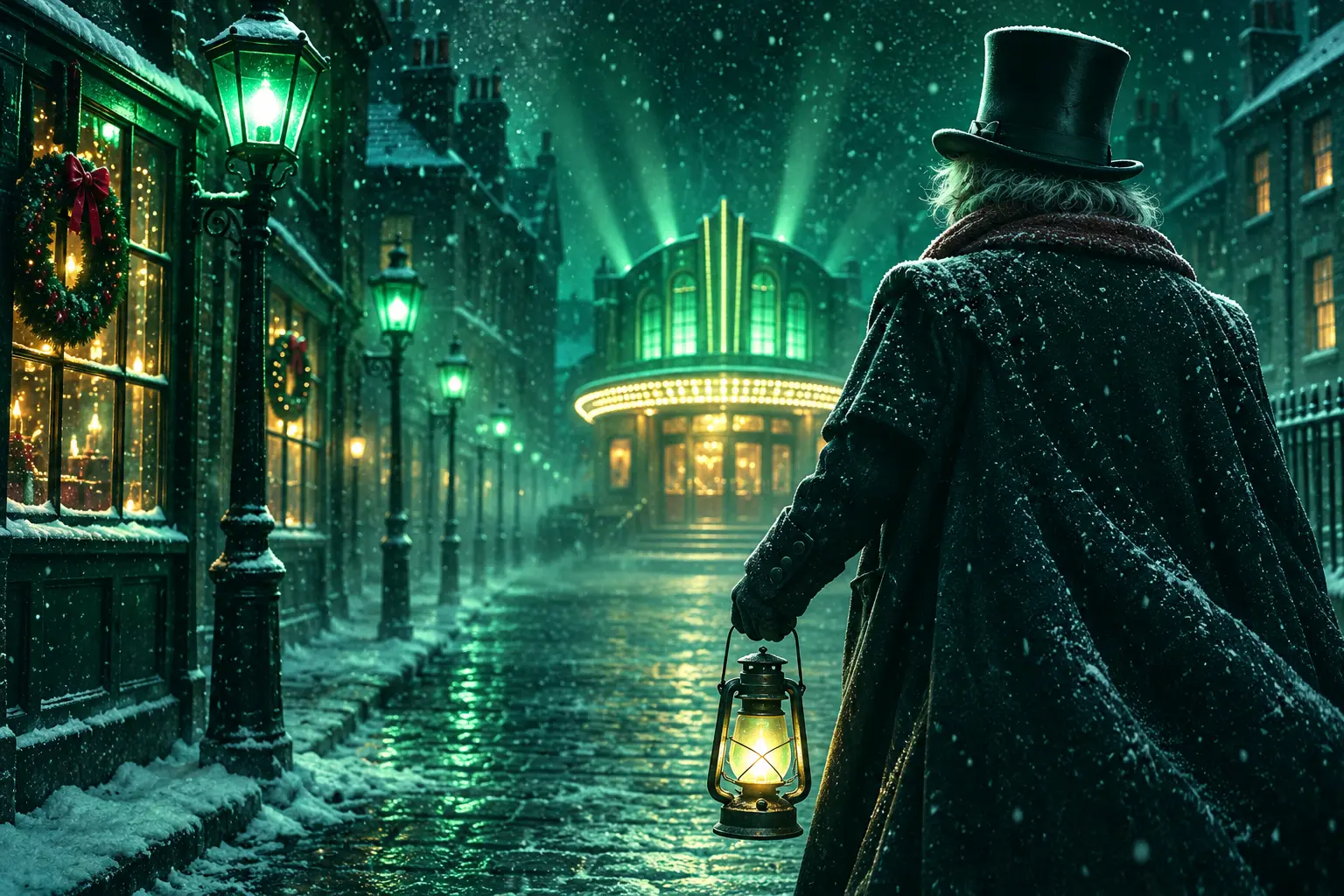
“It’s very hard to photograph ‘he was dead to begin with,’” West said. The Hammer-horror candles on his sets were meant to be really red, really green, really blue, the kind of choice that looks preposterous until the frame holds. The campaign that followed kept repeating the same dare. Think you know his story. Think again.
The 50 Percent Score Meets 3,500 Screens
The notices that landed on November 12 split along a clean line. Craft and the ghosts get the kind words. Depp’s size, the makeup, and the known plot get the knocks. Metacritic’s average is 46 from 32 reviews, with 6 marked positive, 18 mixed and 8 negative. Rotten Tomatoes, on the page checked November 13, sat at 50 percent from 68 reviews. The audience meter had not yet opened.
THE OPENING-DAY SCOREBOARD
- Tomatometer: 50 percent from 68 reviews on Rotten Tomatoes.
- Metascore: 46 from 32 reviews, listed as mixed or average.
- Pinpoint: $23.5 million for Friday through Sunday, per Box Office Theory.
- Screens: about 3,500 locations in North America.
Some notices call the film a solid Carol that does not change the game. Others call Depp cartoonish, overtheatrical, even the weakest Scrooge they have seen, and argue that West’s grounded ghosts are doing one movie while the lead is doing another. Riseborough and Tillman keep being named as the work that lingers. McKellen’s Marley is the other constant.
Opening-day argument has already drifted away from Dickens. Critic scores are being read as a verdict on Depp, and his supporters are pushing audience ratings as a reply. That may put bodies in seats on Friday. It also means the film’s actual bets, the hard-PG ghosts and the gray miser, can get less air than the man in the hat.
Dickens Put Ghosts on the Title Page
Charles Dickens published the book on December 19, 1843, under a title that did not hide the genre: A Christmas Carol. In Prose. Being a Ghost Story of Christmas. He wrote it in six weeks after the poor showing of Martin Chuzzlewit, walking London at night and paying for a lavish first edition himself. Chapman & Hall issued it. The first printing of 6,000 copies sold out by Christmas Eve.
The Morgan Library in New York still shows Dickens’s original Christmas Carol manuscript each holiday season, bound in red goatskin for his solicitor. On the page, Marley’s face finds the door knocker, a disused bell starts ringing, and Scrooge is told to understand that the man was dead or nothing wonderful can follow. West is not inventing the scare. He is putting back a register later Carols sanded off for family nights and school plays.
Before the fiction, Dickens had planned a pamphlet, “An Appeal to the People of England, on behalf of the Poor Man’s Child.” He switched to a story because he thought a tale would land like a sledge hammer with twenty times the force. That hammer is why the book keeps being filmed. It is also why a version that gives Scrooge extra logic will be read as a political choice, whether West wants the macro argument or not.
Screen Scrooges Go Back to 1901
Cinema got to Scrooge almost as soon as it could tell a ghost story at all. The Victorian Web’s survey of the Carol on film starts with the 1901 short Scrooge, or Marley’s Ghost. Alastair Sim’s 1951 Scrooge became the version actors still chase. George C. Scott’s 1984 film is the one that scared West. Bill Murray’s Scrooged took $60.3 million in 1988. The Muppet Christmas Carol, with Michael Caine, took $27.38 million in 1992. Disney’s 2009 motion-capture Carol with Jim Carrey took $137.85 million domestic, the modern ceiling for this plot as a tentpole.
A SHORT HISTORY OF THIS GHOST STORY
- December 19, 1843: Dickens publishes the novella as a ghost story of Christmas, and the first 6,000 copies are gone by Christmas Eve.
- 1901: Scrooge, or Marley’s Ghost reaches the screen, the first known film take.
- 1951: Alastair Sim plays Scrooge, the performance Depp still calls unbeatable.
- 1984: George C. Scott’s Marley sequence becomes West’s childhood scare.
- November 13, 2026: Paramount opens Ebenezer in about 3,500 theaters.
West’s defense of yet another pass is blunt. He says the story is rock solid and the interest lives in who is doing it, that the book can hold Murray, the Muppets and Depp. Depp grew up on Sim, watched that film on loops, and treated the offer as a smile and a problem. If Sim is perfect, the job is to find another angle. His first meeting with West was by candlelight, the two of them at a table in the dark, which both men later described as the least method people having the most method sit-down of the shoot.
The New Scrooge Has Arguments Ready
The angle they found is the one that will follow the movie past opening weekend. West and Halpern wanted a Scrooge who is not the only sinner in the room. Charity men in this London look well fed. Some street appeals look staged. When Depp’s miser cuts someone down or walks away from a collection, the film asks you to see why he is doing it, even if you should not agree.
WHERE WEST PUTS GRAY INTO SCROOGE
- The collectors: West films charity workers who take donations and spend on their own coats, so Scrooge’s refusal has a scene to hang on.
- The street: Some beggars are shown faking injury, a Victorian suspicion the book does not pamper.
- The logic: West said he wanted Scrooge to have a good argument, so that when he makes a financial point he is not simply wrong.
- The turn: The director still wants the miser to change by morning, only by a slightly different path.
Give Scrooge a clean case about charity, and some viewers will hear a sermon Dickens never wrote. When West’s quote about logic and a good argument circulated in September, it was immediately recast as a joke about a miser destroying the poor with facts. That reading will sit in the theater with the PG-13 scares. West says he does not agree with the character. He also says he knows where the man is coming from, and that putting the audience in Scrooge’s head is the point of a subjective ghost story. The bet is that viewers will stay for the turn after an hour of finding the miser almost reasonable.
Depp has been selling a softer interior. He calls Scrooge more tragic than hateful, a man who stopped caring because caring hurt, then went inward. A broken human being, in his words, who gets one night to look at the life that made him. That is closer to Sim than to a culture-war mascot. Whether the finished film holds both ideas at once is the question the $38 million cannot answer. Only the footage can.
Riseborough, Tillman and an Elm Street Bed
Andrea Riseborough plays the Ghost of Christmas Past under heavy corpse makeup, a pale figure with pupilless eyes and a clipped, almost one-word manner of speech. Tramell Tillman, from Severance, is Christmas Present, an ailing, antagonistic spirit whose skin cracks as the visit goes on. Robert Strange, a creature actor, plays Christmas Future and is asked to say nothing. Rupert Grint is Bob Cratchit. Sam Claflin is nephew Fred. Daisy Ridley is Clara, Fred’s wife. Ellie Bamber is Belle. Arthur Conti is young Ebenezer. Freddie Lee-Grey is Tiny Tim. Checco Varese shot it. Eve Stewart designed it. Tyler Bates wrote the score.
The showpiece gag is a bed that swallows Scrooge as a road into the past. West and Halpern put it in the script because they liked A Nightmare on Elm Street. They had not met Depp. When he said yes, West panicked, because Depp’s first film was that Wes Craven picture, and a self-quote that fat can look like a wink. He called Depp and offered to cut it. Depp told him to keep it. “No, man, that’s my first movie. I think we gotta do it.”
The character is more tragic than hateful, more a product of certain experiences and his upbringing. A broken human being.
Johnny Depp
Depp’s last major studio franchise film was Fantastic Beasts: The Crimes of Grindelwald in 2018. He kept working abroad after his 2022 defamation trial. This is the first Hollywood tentpole to put his name above a wide release since that case, which is why Paramount sent him to San Diego in costume and, on November 2, had him knock a Christmas tree around Bryant Park for cameras. The official account spent November 13 doing less. It posted that Ebenezer was now playing and told people to buy tickets.
Don’t let this downtime go to waste. Get tickets now for #EbenezerMovie – NOW PLAYING in theatres. pic.twitter.com/njNrRH3sGl
— Ebenezer (@ebenezermovie) November 13, 2026
The three-day number after Sunday, November 15, is the one that will tell Paramount if a $38 million hard-PG Carol cleared. Until then the film is what the studio paid for: Depp in the hat, West’s ghosts in the room, and a story whose ending was never the secret.

One UI 9.5 Beta Puts the Galaxy S26 on Last Year’s Clock

DBS Puts a 24/7 USDC Window Inside the Bank

European Startups Head for $81 Billion as First Checks Shrink

US Stocks Lost $1.3 Trillion Before Nvidia’s Beat

Home Depot Bets on Finance Chief Richard McPhail as CEO

Aramco Crash Kills 14 Two Days After Oil Restart

Salah Captained Egypt to Their First World Cup Win

Zelda’s 40th Switch 2 Ships Without a Zelda Game

Apple Labor Day Deals Hide June’s Memory Price Hike

El Niño Puts Israel’s Needed Winter Rain on a Flood Clock
-
 BUSINESS5 months ago
Aramco Crash Kills 14 Two Days After Oil Restart
-
 NEWS6 months ago
Salah Captained Egypt to Their First World Cup Win
-
 GAMING2 months ago
Zelda’s 40th Switch 2 Ships Without a Zelda Game
-
 NEWS3 months ago
Apple Labor Day Deals Hide June’s Memory Price Hike
-
 NEWS4 months ago
El Niño Puts Israel’s Needed Winter Rain on a Flood Clock
-

 GAMING2 months ago
Palworld 1.0.4 Adds Palpedia Search After the 1.0 Launch
-

 NEWS4 months ago
Saudi Visa Routes Split Nigerian Travelers Into Two Speeds
-

 BUSINESS9 months ago
BAE’s 60-Year Saudi Franchise Now Runs Through Taif