
NEWS
Google Tabletop Puts Generated Apps on the Group Table
Google Labs opened Tabletop on November 11, 2026, a shared space that builds group tools from a prompt after Wave died as a standalone product.

Google Labs opened a United States waitlist on November 11, 2026 for Tabletop, an experiment that builds shared planning tools from a prompt. Roman Nurik, design and engineering lead at Google Labs, said groups add links, files and ideas, then prompt @tabletop or pick a starter template to make live itineraries, dinner polls, expense splitters and tournament brackets.
The invite link is meant to drop into the chat the group already uses. Everyone then works in one space at the same time, the way they would in a Google Doc. Sign-ups are limited to people 18 and older in the United States.
A Shared Hub for Pickleball, Potlucks and Brackets
Google Labs framed the job in plain language: get a crew from “we should totally do that” to “we’re actually doing this.” The pitch is not a new chatbot. It is a room with built-in group chat where the software the group needs can be made on the spot, then used together.
🚨 NEW LABS EXPERIMENT 🚨
Introducing Tabletop 🎲— our newest experiment built to get your crew from "we should totally do that" to "we’re actually doing this."
Drop links and files into one shared space, add your crew, and ask Tabletop for whatever you need to create custom… pic.twitter.com/EHFLWOCwdk
— Google Labs (@GoogleLabs) November 11, 2026
The launch post lists interactive road-trip maps, dinner-decider wheels, live pickleball brackets, merch voting boards and drag-and-drop seating charts. Nurik later walked through his own family’s space, with chore charts, piggy banks, a rainy-day scavenger hunt with live scoring, on-the-whim LEGO maps and a fantasy-book New York trip. He also confirmed that, by default, any member of a space can make changes.
That last detail is the product’s real bet. Group tools usually rot when the one person who set them up stops tending them. If anyone in the room can rewrite a rule or rebuild a board, the space can survive a messy group chat. If the organizer still fills every field for everyone else, the AI only sped up the write-up and the coordination work stayed put.
What Tabletop Builds From a Prompt
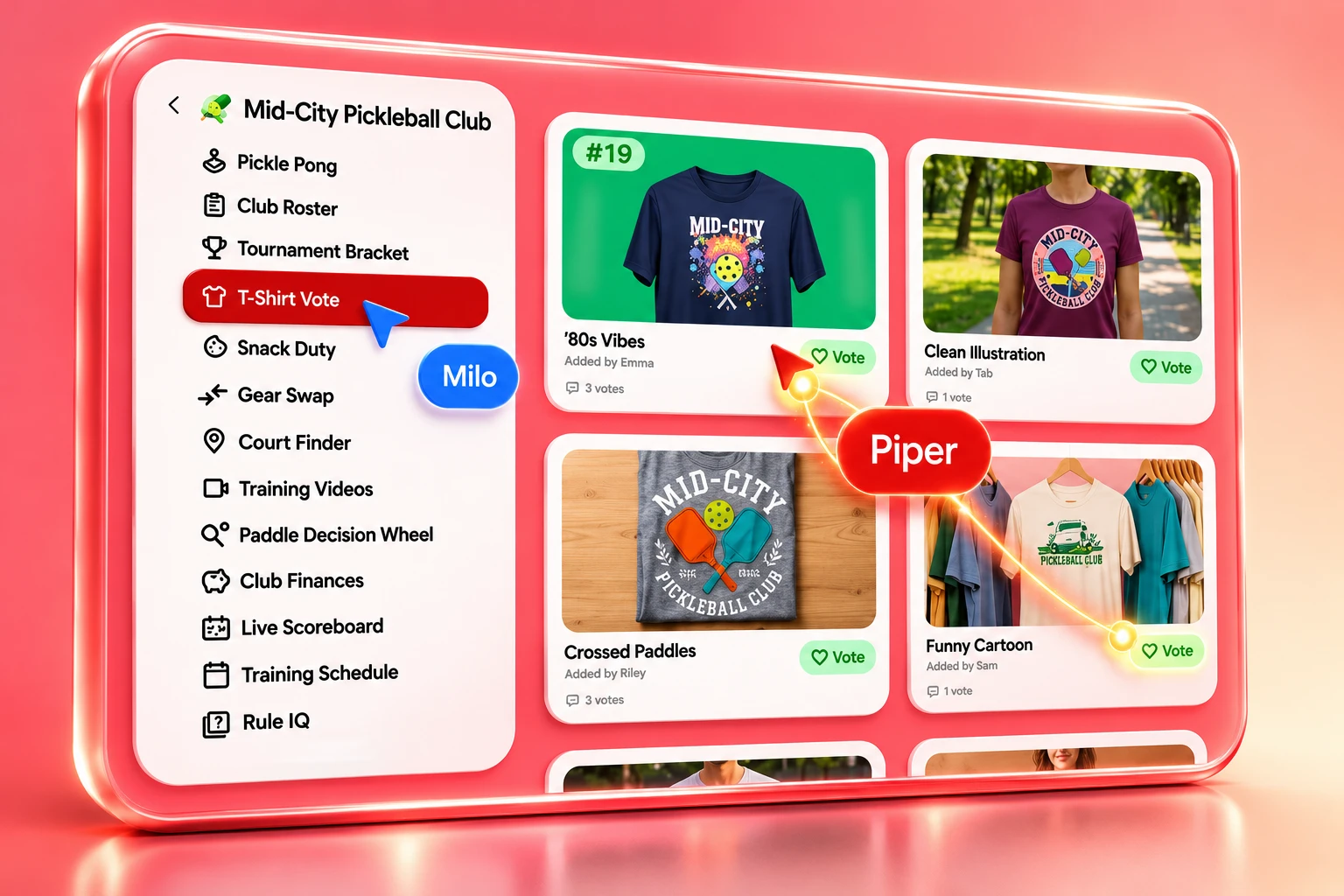
The official 1:07 video, titled “Meet Tabletop: Plan, Play & Build Together,” shows a pickleball club spinning up an interactive tournament bracket with a random matchup generator, then a logo vote. The closer is the collaboration rule: build whatever you want, then let someone else make it even better.
The YouTube description is more specific than the short blog post. A space comes with built-in group chat. People drop in links or files and prompt Tabletop to build custom mini-apps on the fly, from live tournament brackets and spin wheels to trip planners, budget trackers and multiplayer games. A product demo on Google’s own page even turns a Pong game into Pickle Pong, with a live scoreboard, after a text request.
STARTER TOOLS IN THE DEMOS
- Trip pages: Interactive road-trip maps, itineraries and a fantasy-book New York plan sit in the same shared space as the chat.
- Decision tools: Dinner-decider wheels, live dinner polls, merch votes and logo votes are built so the group can pick without another thread of screenshots.
- Money and chores: Expense splitters, piggy banks and chore charts are shown as live boards, not static lists pasted into a spreadsheet.
- Play layers: Pickleball brackets, a scavenger hunt with live scoring, LEGO maps, seating charts and even a rewritten Pong game treat the space as a table, not a document.
Workplace boards such as Asana are the visual comparison people will reach for, because the layout looks like cards and lists. The difference Google is selling is speed of change. Anyone in the room can ask @tabletop to adjust a rule, turn a chore list into a points game or make a seating chart draggable without rebuilding the space from scratch.
Google Wave Died After the Standing Ovation
Google has shipped this shape of product before. On May 28, 2009, it demoed Wave at I/O as a live canvas that mixed chat, documents, gadgets and bots. Developers stood and cheered. Google later wrote that it was “jazzed” internally even though it was not sure how people would respond to that kind of communication.
On August 4, 2010, the company stopped Wave as a standalone product. The post said Wave has not seen the user adoption we would have liked. The live typing and simultaneous editing did not vanish. They moved into Google Docs, which became the ordinary way millions of people write together. Wave itself was the thing people could not explain to a friend.
Tabletop tries to dodge that trap by naming the job up front. A rec league, a potluck, a family trip. The empty canvas is still there, because @tabletop will build “pretty much anything,” in the video’s words. The starter list is the on-ramp Wave never really had.
GOOGLE’S SHARED-ROOM CLOCK
- May 28, 2009: Google demos Wave at I/O as a live canvas for chat, documents and gadgets.
- August 4, 2010: Google stops Wave as a standalone product and says it will fold the technology into other work.
- September 28, 2023: Google says it will wind down Jamboard and point Workspace users to partner whiteboards.
- October 1, 2024: The Jamboard app becomes view-only; new Jams and edits stop.
- December 31, 2024: The Jamboard app ends and Jam files are deleted after a backup window.
- November 18, 2025: Google Research rolls generative UI into Gemini and Search, building tools and pages per prompt.
- July 16, 2026: Google renames NotebookLM, the Labs research tool that stuck, to Gemini Notebook.
- November 11, 2026: Google Labs opens the Tabletop waitlist in the United States for people 18 and older.
Labs experiments die often. The ones that last, such as Project Tailwind in 2023, which became NotebookLM and then Gemini Notebook, do it by staying useful after the demo glow fades. Tabletop is at the waitlist stage of that clock.
The Whiteboard Google Handed to Partners
Jamboard is the closer cousin than Wave, because it was already a shared visual board. Google announced in a September 28, 2023 Workspace update that it would wind down the Jamboard whiteboarding app in late 2024, along with support for the Jamboard device. Customers, Google said, preferred partner tools such as FigJam, Lucidspark and Miro, with infinite canvases, templates and voting. Google said it would focus on Docs, Sheets and Slides.
The app went view-only on October 1, 2024 and ended on December 31, 2024. Google did not replace that board with another Google-made whiteboard. Tabletop now walks back into the same gap from the consumer side, with voting boards and seating charts as opening acts, and with no Workspace admin console in the launch post.
That split is the risk. Docs, Sheets and chat already hold the group’s files. A new Labs URL has to be better than the spreadsheet someone already opened, or it becomes another tab people forget to refresh.
Interfaces Now Arrive on the Fly
The technical parent is not a new chat model. It is Google’s push to generate the interface itself. On November 18, 2025, Google Research described generative UI as a way for models to create tools, games and pages for any prompt, rolling into the Gemini app and Search.
This work represents a first step toward fully AI-generated user experiences, where users automatically get dynamic interfaces tailored to their needs, rather than having to select from an existing catalog of applications.
Yaniv Leviathan, Google Fellow, Google Research blog
The research post says the system produces interfaces generated completely on the fly. Human raters preferred those interfaces to plain text or markdown when speed was ignored. Google has not said which model sits behind Tabletop. Naming Gemini 3 Pro for this product would be a guess; the company left the model off the Tabletop blog.
Six days before the waitlist, on November 5, 2026, Google showed Gemini Canvas turning a photo of a paper sketch into a live app preview. Canvas already lets people describe an idea and get code they can share. Tabletop takes that same generated-app habit and puts it in a room with other people, which is the part Canvas demos usually skip.
Roman Nurik Left Developer Tools for Family Chores
Nurik’s own site lists the work that came before the chore chart. He was a founding designer and engineer on Project IDX, later Firebase Studio, from 2021 to 2025, and a design lead and manager on Firebase from 2015 to 2025. Earlier he led design on the Google I/O Android app and built designer tools such as Android Asset Studio and IconKitchen. Tabletop is a turn away from that audience.
Been working on something fun, quirky and distinctly not developer-focused for the past few months, and more intently for the past few weeks.
Roman Nurik, Design and Engineering Lead, Google Labs, on X
He told people to join at tabletop.google. Google’s blog sends the same waitlist to labs.google/tabletop. The family tour is the tell: piggy banks and scavenger hunts are the product, not a side example. The age floor still blocks the kids those demos imply, which is a testing choice Google can reverse later and has not reversed yet.
ChatGPT Group Chats Stay in the Thread
OpenAI spent November 2025 turning ChatGPT into a shared conversation. A November 13, 2025 pilot in Japan, New Zealand, South Korea and Taiwan became a global rollout on November 20, 2025 for logged-in Free, Go, Plus and Pro users. OpenAI said people can collaborate with each other and ChatGPT in the same thread, with invites for up to 20 people. Personal memory stays out of the group. ChatGPT is trained to talk when it helps and stay quiet when it does not.
That is the opposite layout. ChatGPT keeps the group inside a thread and lets the model jump in. Tabletop keeps a thread, then spends the rest of the product on boards the group can poke. Google is wagering that a live bracket beats a better paragraph about the bracket.
HOW THE GROUP AI PRODUCTS DIFFER
| Product | Who can join now | What the group shares | How the AI shows up |
|---|---|---|---|
| Tabletop | United States waitlist, 18 and older | A space with chat plus live tools | @tabletop builds and rewrites mini-apps |
| ChatGPT group chats | Global, Free through Pro | One conversation, up to 20 people | ChatGPT speaks inside the thread |
| Gemini Canvas | Gemini app users | A generated app, page or doc | Canvas writes code from a prompt or sketch |
Canvas can already share an app through a public link. Tabletop’s difference is the default: the tool is born inside a group, and any member can change it. ChatGPT’s difference is reach. It is already in the apps people open every day, with no Labs waitlist.
Who Gets Into Tabletop First?
Google has not published a price, a country list beyond the United States, or a date when the 18-and-older rule might move. It also has not said how a space is moderated when every member can edit, beyond Nurik’s default that they can. Those gaps are normal for Labs. They are also the exact gaps that made Wave painful when invitations outran basic controls.
WHAT WE KNOW
- The door: Tabletop is a Google Labs experiment with a waitlist at labs.google/tabletop for people 18 and older in the United States.
- The loop: A group drops links and files into a space, prompts @tabletop or picks a template, then shares an invite link.
WHAT IS UNCONFIRMED
- The model: Google has not named the model that builds the tools, and has not said whether Tabletop will stay a separate site or fold into Gemini.
- The terms: Price, international access and any plan for users under 18 are unstated, even though the demos lean on family chores and school-age play.
Nurik’s scavenger hunt still needs an adult in the United States to open the room. Until Google names a model, a price and a path out of Labs, Tabletop is a well-aimed experiment sitting on the same graveyard map as Wave and Jamboard, with a tighter job and a generated board instead of a blank one.

One UI 9.5 Beta Puts the Galaxy S26 on Last Year’s Clock

DBS Puts a 24/7 USDC Window Inside the Bank

European Startups Head for $81 Billion as First Checks Shrink

US Stocks Lost $1.3 Trillion Before Nvidia’s Beat

Home Depot Bets on Finance Chief Richard McPhail as CEO

Aramco Crash Kills 14 Two Days After Oil Restart

Salah Captained Egypt to Their First World Cup Win

Zelda’s 40th Switch 2 Ships Without a Zelda Game

Apple Labor Day Deals Hide June’s Memory Price Hike

El Niño Puts Israel’s Needed Winter Rain on a Flood Clock
-
 BUSINESS5 months ago
Aramco Crash Kills 14 Two Days After Oil Restart
-
 NEWS6 months ago
Salah Captained Egypt to Their First World Cup Win
-
 GAMING2 months ago
Zelda’s 40th Switch 2 Ships Without a Zelda Game
-
 NEWS3 months ago
Apple Labor Day Deals Hide June’s Memory Price Hike
-
 NEWS4 months ago
El Niño Puts Israel’s Needed Winter Rain on a Flood Clock
-

 GAMING2 months ago
Palworld 1.0.4 Adds Palpedia Search After the 1.0 Launch
-

 NEWS4 months ago
Saudi Visa Routes Split Nigerian Travelers Into Two Speeds
-

 BUSINESS9 months ago
BAE’s 60-Year Saudi Franchise Now Runs Through Taif