
AUTO
Toyota Puts Scion Back on a 25-Mph Kei Truck
Toyota revives Scion with the Indiana-built KEI-01, a 25-mph fleet kei truck for 2027 that most drivers still cannot buy.

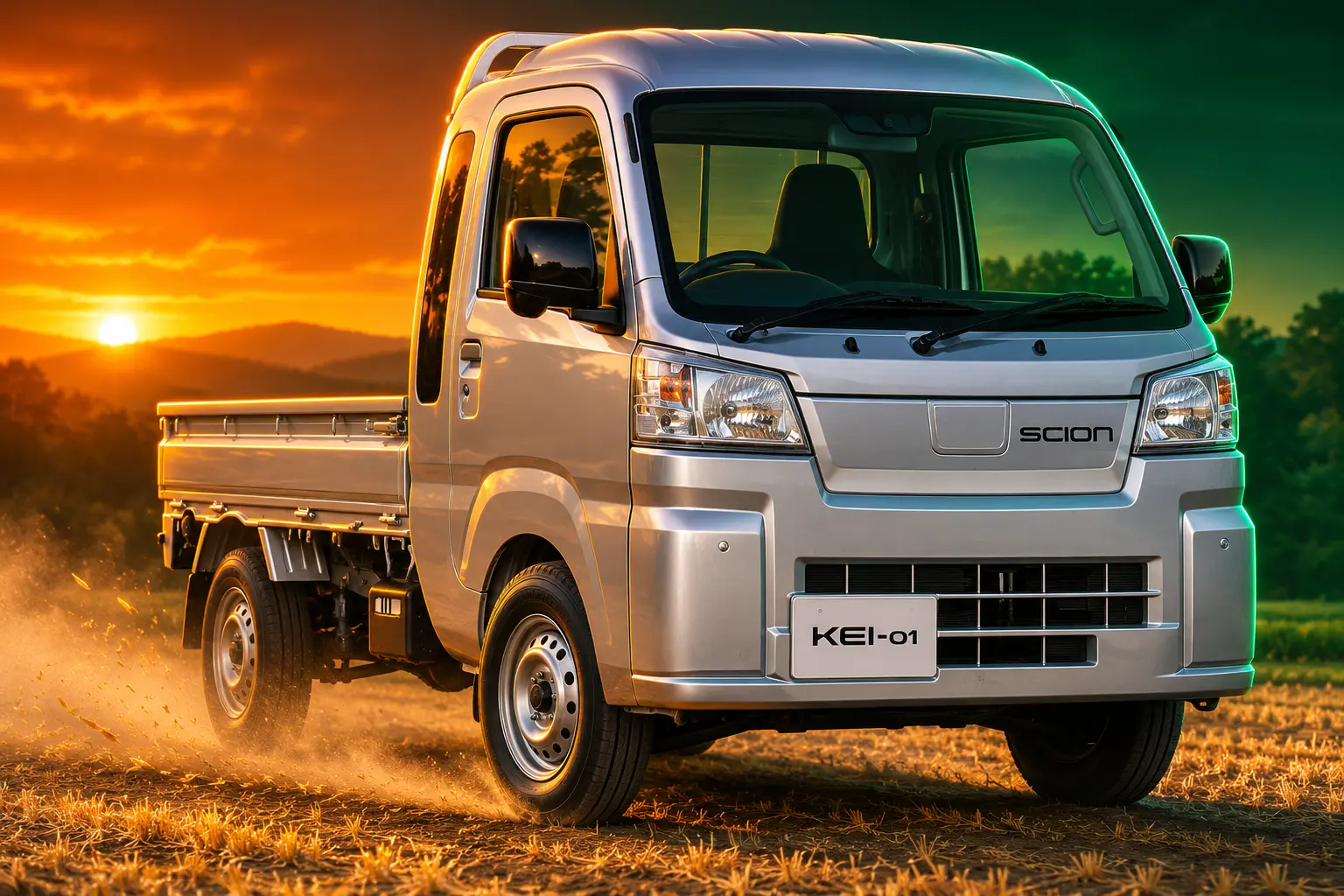
Toyota unveiled the Scion KEI-01 on November 9, a 25-mph kei truck fleets can order from Indiana in the second half of 2027. The truck is right-hand drive, with a 660cc three-cylinder engine, a CVT and four-wheel drive. First sales go through selected Toyota dealers, not a public lot.
The name on the nose is Scion by Toyota, a label the company now calls a “freedom lab.” The vehicle under it is built to the federal low-speed class, so it cannot use a highway. People who wanted a new mini truck they can register and drive at ordinary speeds still have to import a 25-year-old one.
The Speed Cap That Makes It Legal
Toyota says the KEI-01 is designed to comply with FMVSS No. 500, the low-speed vehicle safety standard. That rule is the whole product. A low-speed vehicle has four wheels, a gross weight rating under 3,000 pounds, and a top speed of more than 20 mph and no more than 25 mph in a one-mile test.
Clear that 25 mph mark and the truck stops being an LSV. It would have to meet the crash, brake and airbag rules that apply to a regular pickup, which a 660cc cab-over is not built to pass. Keep it at 25 mph and the federal kit is short: lights, reflectors, mirrors, a parking brake, a proper windshield, a VIN and a seat belt at every seat.
States then decide which roads an LSV may use, and they almost always keep it off fast arterials. The KEI-01 is legal in a way a brand-new Japanese kei truck is not, because it never tries to be a highway vehicle. That is also why a used Honda Acty with plates in Texas is a different machine.
Four-Wheel Drive, a Fold-Down Bed, No Horsepower Figure
Toyota’s spec sheet is short on drama and long on farm-yard jobs. The engine sits at 660cc, the size Japan has used for kei trucks since 1990, and it drives all four wheels through a CVT. The transfer case has an auto mode and a push-button lock for mud, snow and ruts.
THE KEI-01 AS TOYOTA LISTS IT
- Powertrain: A 660cc three-cylinder engine mated to a continuously variable transmission.
- Drive: Selectable four-wheel drive with auto mode and push-button lock.
- Size: Just over 11 feet long and under 5 feet wide.
- Bed: Three-way fold-down sides and a 600-pound payload rating.
- Cabin: Extended, raised roof with reclining, sliding seats, heat and air conditioning.
- Steering: Right-hand drive, with a 25 mph maximum speed.
The raised cab is the Jumbo pattern Japanese makers use when they want space behind the seats. Product watchers matched that cab, the 660cc triple and the right-hand drive to the mini truck Toyota already sells at home as the Pixis, itself a badge on Daihatsu’s Hijet. Toyota’s own release never names either truck.
Horsepower is unlisted. So is a tow rating, though Toyota says the frame can handle small trailers. Price is unlisted too. For a vehicle this small, 600 pounds in the bed is honest work, but it sits below Japan’s kei-truck load rating of 350 kg, about 770 pounds.
Fleet Lots Get the Keys First
Toyota calls the KEI-01 an “intentionally low-volume, niche vehicle.” First deliveries run through a fleet-focused pilot program at Scion by Toyota dealers chosen from the current Toyota network. Limited retail sales may follow later, the company says, based on demand and how the line actually runs.
WHO TOYOTA SAYS THE TRUCK IS FOR
- Small firms: Owners who want a cheap urban commercial vehicle.
- Farms and ranches: Daily chores that do not need a full-size pickup.
- Campuses: Cities, universities and corporate grounds that already run slow fleets.
- Delivery routes: Service work in tight streets.
- Hobby use: Outdoor work that sits between an ATV and a truck.
Private buyers who spent a decade asking Toyota for a new kei truck are last in that line, if they get in at all. Right-hand drive also tells you who this is for. On US streets it puts the driver on the curb side of oncoming traffic. On a farm lane it puts the driver on the ditch side, which is how these trucks are used in Japan.
Princeton Will Build It Next to Highlanders
Assembly starts in the second half of 2027 at Toyota Motor Manufacturing Indiana in Princeton. Indiana Gov. Mike Braun announced the line on November 10, a day after the twin unveil in Ypsilanti Township, Michigan, and Frisco, Texas. The add-on is $34 million and about 50 jobs for new assembly gear and logistics.
THE PRINCETON LINE IN NUMBERS
- The check: $34 million to stand up KEI-01 assembly.
- New jobs: About 50, on a plant Toyota lists at more than 7,380 people.
- Sunk cost: $8.2 billion invested since the 1996 groundbreaking.
- Current products: Highlander, Sienna Hybrid and Lexus TX, plus Grand Highlander and Highlander Hybrid.
“Toyota’s continued investment in Indiana is a testament to the strength of our manufacturing sector and the skill of our Hoosier workforce,” Braun said. The KEI-01 will share floor space with three-row crossovers, not with other mini trucks. Two other Scion by Toyota vehicles, the SxS and the BKE, are not assigned to Princeton.
Scion’s First Life Peaked in 2006
The original Scion launched in 2003 as Toyota’s no-haggle youth brand, selling boxy xBs and cheap coupes beside the Camrys that younger buyers would not touch. It worked, then it did not.
SCION’S TWO LIVES
- 2003: Scion goes on sale in the United States as a separate Toyota marque.
- 2006: Sales peak at 173,034 vehicles.
- 2015: Volume falls to about 56,000.
- February 3, 2016: Toyota says the brand will be wound down.
- August 2016: The nameplate ends; the FR-S, iA and iM move onto Toyota badges.
- November 9, 2026: Scion by Toyota is introduced with the KEI-01.
- Second half of 2027: Indiana assembly is scheduled to start.
Toyota sold more than 1 million Scions in that first run. The company said 70% of those buyers were new to Toyota, and half were under 35. When the brand died, remaining cars became the Toyota 86, Yaris iA and Corolla iM; the tC was dropped. The C-HR that had been shown as a Scion arrived as a Toyota.
The new badge is not that store. There is no pure-price poster, no tC, no xB. Simon Humphries, Toyota’s chief branding officer and head of design, is selling a lab, not a youth garage.
The future of mobility will not be defined by one vehicle, one technology or one way of thinking. Scion by Toyota gives us a place to challenge conventional thinking, explore new possibilities and create mobility in new ways. The KEI-01, SxS and BKE concepts each represent a different possibility, and together, they show what can happen when curiosity leads the way.
Simon Humphries, Chief Branding Officer and Head of Design, Toyota Motor Corporation
That is a long walk from the 2004 xB. The experimental brief is the same sentence Toyota used when it folded Scion the first time: try odd products, learn, keep the ones that sell.
Used Kei Trucks Already Fill the Same Job
Americans who want a 660cc cab-over already buy one. Federal law lets a vehicle in once it is 25 years old, counted from the build month, without meeting current crash rules. The EPA’s 21-year exemption is already met by then. A 25% “chicken tax” still applies because Customs treats kei trucks as light trucks, not cars.
Road use is the state layer. A 50-state tally published in October 2026 counted 22 states that register a 25-year-old kei truck for ordinary road use, 20 that allow it with speed, road or permit limits, and 8 that refuse on-road plates. Those used trucks are not governed to 25 mph unless a state makes them so.
US lots in 2026 ask about $6,000 to $12,000 for a running example. Toyota has not said what a new KEI-01 will cost, only that it should undercut a conventional pickup.
KEI-01 VERSUS A 25-YEAR IMPORT
| Point | Scion KEI-01 | Typical 25-year kei truck |
|---|---|---|
| Top speed | 25 mph by design | Ordinary road speeds where plated |
| Who buys first | Fleets, through selected dealers | Anyone who imports or finds a US lot |
| Legal path | New LSV under FMVSS No. 500 | 25-year import exemption |
| Payload | 600 pounds | About 770 pounds (350 kg kei rating) |
| Age at sale | New, from late 2027 | 25 years or older |
| Where it is built | Princeton, Indiana | Japan, then shipped used |
The import route is messy, state by state, and the trucks are old. The Toyota route is a warranty, a dealer, and a governor. People who already run Actys, Carrys and Hijets keep pointing at that gap: they wanted a new kei truck they could drive at road speed, and they got a campus vehicle with a famous badge.
Two Concepts Stay Off the Order Form
The KEI-01 shared the stage with two show vehicles that are not for sale. The SxS Concept, first shown at the 2025 SEMA Show, is a side-by-side from Toyota’s North American engineering group. It uses a turbocharged four-cylinder hybrid rated at more than 300 horsepower, plus a Silent Mode that runs on electric power. Toyota says it will keep working on the idea. It has not set a launch.
The BKE Concept is a small personal-mobility machine Toyota describes as sitting between the KEI-01’s chores and the SxS’s off-road brief. Neither vehicle is assigned a plant, a price or a year. They exist to make Scion by Toyota look like a lab with more than one bench.
What the lab will actually ship is the slow truck. Indiana gets a short new line. Fleet managers get a 25-mph four-wheel-drive cab-over with heat, air conditioning and a 600-pound bed. Importers keep selling 25-year-old Japanese trucks to people who want to go faster than a golf cart. And the Scion name, quiet since August 2016, comes back on a vehicle most of the people who remember it still cannot buy.

One UI 9.5 Beta Puts the Galaxy S26 on Last Year’s Clock

DBS Puts a 24/7 USDC Window Inside the Bank

European Startups Head for $81 Billion as First Checks Shrink

US Stocks Lost $1.3 Trillion Before Nvidia’s Beat

Home Depot Bets on Finance Chief Richard McPhail as CEO

Aramco Crash Kills 14 Two Days After Oil Restart

Salah Captained Egypt to Their First World Cup Win

Zelda’s 40th Switch 2 Ships Without a Zelda Game

Apple Labor Day Deals Hide June’s Memory Price Hike

El Niño Puts Israel’s Needed Winter Rain on a Flood Clock
-
 BUSINESS5 months ago
Aramco Crash Kills 14 Two Days After Oil Restart
-
 NEWS6 months ago
Salah Captained Egypt to Their First World Cup Win
-
 GAMING2 months ago
Zelda’s 40th Switch 2 Ships Without a Zelda Game
-
 NEWS3 months ago
Apple Labor Day Deals Hide June’s Memory Price Hike
-
 NEWS4 months ago
El Niño Puts Israel’s Needed Winter Rain on a Flood Clock
-

 GAMING2 months ago
Palworld 1.0.4 Adds Palpedia Search After the 1.0 Launch
-

 NEWS4 months ago
Saudi Visa Routes Split Nigerian Travelers Into Two Speeds
-

 BUSINESS9 months ago
BAE’s 60-Year Saudi Franchise Now Runs Through Taif