
NEWS
Samsung Memory Turns Screenshots Into a Cloud Archive
Samsung’s leaked Memory app for One UI 9.5 stores screenshots, voice, and links in a cloud archive running Google’s Gemma 4.

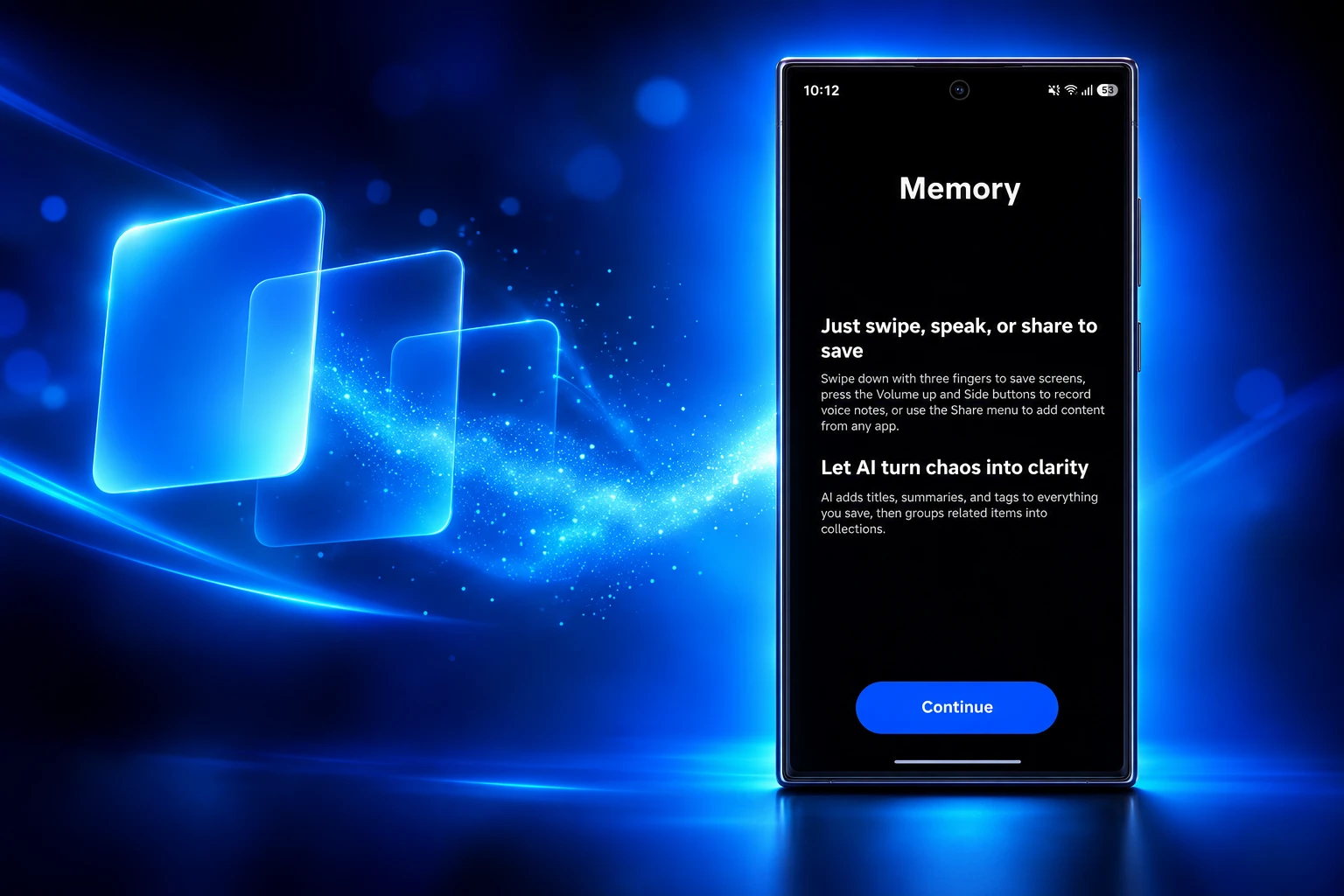
Samsung is building a Galaxy AI app called Memory that files screenshots, voice notes, copied text, and links into one searchable archive for One UI 9.5.
Josh Skinner, who examined an unreleased build, posted the first look on November 8, 2026. Samsung has not announced the app.
A Vault for Screenshots, Voice, and Copied Text
The leaked onboarding screens tell people to “Save memories from anywhere.” In the build Skinner walked through, that means a screenshot, a photo from Gallery, a block of text, a file, a link, or a voice note, then an AI pass that names the item, writes a description, and sticks on tags.
Saved items sort by the app they came from, so Instagram memes land in one pile and Messages shots in another. People can group those piles into collections and get an AI summary of the whole set. They can edit a title, mark a favourite, lock an entry, or delete it.
If the shot is a webpage, Memory tries to recover the original link. If someone pastes a URL, the app pulls a title, writes a short description, and tags the page so it is easier to find later. That is the gap a Gallery folder never filled: the picture of a site is useless if the URL is gone.
MEMORY AGAINST THE APPS IT IS CHASING
| App | What it stores | How you save | Where the AI runs |
|---|---|---|---|
| Samsung Memory | Screenshots, Gallery photos, text, voice notes, files, links | Three-finger swipe, Side and Volume Up, Share sheet, paste | Samsung SPAC cloud, Gemma 4 31B, Gemini 3.1 Flash Lite fallback |
| Pixel Screenshots | Screenshots, with titles, summaries, and collections | The phone’s usual screenshot | On the Pixel, or in Google’s cloud |
| OPPO Mind Space | Screen snaps, photos, text, voice memos | Three-finger swipe or Snap Key | OPPO’s on-phone AI tools |
| Samsung Collection (China) | Text, images, documents, sorted by app and type | Android Share sheet | Galaxy AI summaries, China software |
Pixel Screenshots still lives on screenshots. Memory is built as a dump for anything a person wants to keep, including a spoken thought. That is a different product, even if the search box looks familiar.
Three Gestures Lock the App to One UI 9.5
Skinner found no extra hardware gate in the build he saw. The catch is the operating system. The new capture shortcuts need One UI 9.5, so sideloading the app onto a phone that is still on One UI 9 is only half of the trick.
Ice Universe, the Samsung leaker, said the three-finger swipe still failed on his Galaxy S26 Ultra. The leaked package can open. The system gesture does not, until the OS underneath knows it.
FOUR WAYS TO SAVE A MEMORY
- Three-finger swipe: Swipe down with three fingers to grab whatever is on screen, with a new ripple animation in the leak.
- Hardware buttons: Hold Side and Volume Up to start a voice note, under the prompt “Say what’s on your mind.”
- Share sheet: Send an image, a file, or a link from any app into Memory.
- Copy and paste: Drop a URL or a text block straight into the app, which then titles and tags it.
After a voice note, the app is supposed to turn the recording into a titled, summarised, tagged memory. That path matters more than the swipe. A screenshot is already a habit. A button combo that files a spoken reminder is a new habit, and habits are what keep an archive alive.
A first One UI 9.5 beta firmware for the Galaxy S26 Ultra, build S948BXXU6ZZK3, showed up on Samsung’s servers on November 4, 2026. Public testing is still unsigned. The stable train is widely tied to the Galaxy S27 series in early 2027. Memory is travelling with that software, not as a Play Store extra that lands tomorrow.
What Pixel Screenshots Already Does on Pixel Phones
Pixel Screenshots shipped with the Pixel 9 in 2024 and now sits on Pixel 9, Pixel 10, and Pixel 11 phones in English, German, and Japanese. Google’s help pages say owners can search screenshots with natural language, generate titles and summaries, build collections, and tap action chips, including a path into NotebookLM. A setting can also surface screenshot hints in apps such as Maps and YouTube Music.
The original pitch was on-device AI. Google’s help pages now say screenshot data is protected in a secure isolated environment in the cloud or on the phone. That wording arrived with a June 2026 app change. Offline processing still works, but the privacy story is no longer “this never leaves the handset.”
Private AI Compute in the cloud is a new AI processing platform that combines our most capable Gemini models from the cloud with the same security and privacy assurances you expect from on-device processing.
Jay Yagnik, Vice President of AI Innovation and Research, Google
Yagnik’s November 11, 2025 note said the sealed environment is designed so that even Google cannot read the data. Pixel owners still had to notice a settings rewrite that dropped the old “on-device” label. Samsung is arriving after that fight, not before it, and it is arriving with a wider net: voice, pasted text, and files, not only screenshots.
China’s Collection App Never Went Global
Memory is not Samsung’s first attempt at this pile. Collection, a China-only Galaxy app on Android 14 and One UI 6 or later, already stores text, images, and documents in one hub and sorts them by type and by source app. Save text from Chrome and it lands under Chrome. Galaxy AI can summarise saved text, including text that lives inside an image.
An APK circulated on August 29, 2025 so people outside China could install it. Officially it stayed a China feature. On One UI 8 the summary tools showed up while the drag-and-drop app panel did not. On One UI 7 the panel worked and the summary did not. Calendar and reminder suggestions that Samsung describes for Chinese users also failed outside that market.
Collection never became a global Galaxy AI headline. Memory looks like the rewrite that might. It keeps the collections idea, adds voice capture and system gestures, and shows up as a toggle in the Galaxy AI page of Settings in the leaked shots. That last detail is the tell. Samsung is treating this as a platform feature, not a side APK.
Samsung’s Cloud Runs Google’s Gemma 4
Skinner wrote that Memory’s AI work targets Samsung’s SPAC cloud and the Gemma 4 31B open model, then falls back to Gemini 3.1 Flash Lite if that path fails. He saw no sign, in that build, that the app is tied to the Galaxy AI Premium plan Samsung is also testing.
THE MODEL BEHIND THE TITLES
- Gemma 4 31B: Google DeepMind’s dense open model in the Gemma 4 family, built from Gemini 3 research, used here for titles, tags, and summaries.
- Fallback path: Gemini 3.1 Flash Lite, named in the leak, if the Gemma job does not complete.
- SPAC cloud: The Samsung cloud target Skinner listed, so the heavy reading is not described as a fully on-phone job.
- Semantic search: The leaked app is also meant to find a memory by meaning, not by filename.
Google built Gemma 4 as open models people can run on their own hardware. Samsung’s leak points the other way. The 31B dense model is the large member of that family, the one DeepMind pitches for heavy reasoning, and Memory is sending personal screenshots, voice clips, and copied text at it through Samsung’s cloud. A Pixel-style archive that once sold itself as local AI is, on Galaxy, a cloud job from the first build anyone has seen.
That is the second effect hiding under the clone talk. Whoever stores the searchable copy of a person’s saved screen, voice, and links holds a map of what that person meant to remember. Samsung already has Notes, Gallery, and Voice Recorder. Memory sits above them as the index. If the index lives on SPAC, the convenience is real, and so is the new place that data goes.
The Same Build Is Testing Paid Galaxy AI
The One UI 9.5 work also contains strings for a Galaxy AI Premium plan at $4.99 a month or $47.99 a year. Those figures are test copy, not a shop page. The same leaks say today’s Galaxy AI tools stay free, with usage caps, while new items such as Gen Video, Bixby Action, and Daily Briefing sit on the paid side, plus extra credits.
Skinner was clear that Memory is not on that paid list in the evidence he has. That can change. A cloud archive that titles voice notes and summarises collections is the kind of job that burns credits. For now the honest line is simpler: the paywall and the archive are being tried in the same software wave, and they are not yet wired together in public.
WHAT WE KNOW
- The name: Memory, listed with Galaxy AI in the leaked Settings shots.
- The OS hook: Capture gestures need One UI 9.5; Skinner saw no separate device gate.
- The stack: SPAC cloud, Gemma 4 31B, Gemini 3.1 Flash Lite as backup.
- The ancestor: Collection remains the China hub this global app is evolving from.
WHAT IS UNCONFIRMED
- Ship date: Samsung has not set a public launch day for Memory or for One UI 9.5.
- Paid tie-in: No evidence yet that Memory requires Galaxy AI Premium.
- On-device switch: The leak describes a cloud target, not a user toggle for local-only processing.
- Device list: No official roster beyond the One UI 9.5 requirement for gestures.
Until Samsung publishes those four points, every comparison with Pixel Screenshots is provisional. The leaked app can still shrink, move on-device, or land only on a flagship slice. It can also ship as a free Galaxy AI tool and later grow a credit meter. The build only shows intent.
The Ripple Drew the Crowd Before the Archive
The clip that travelled was not a search demo. It was the ripple effect on three-finger save, the little wave that runs across the display when Memory grabs the screen.
It’s a small detail, but it makes the interaction feel much more fluid and alive.
Ice Universe, leaker, on X
That is the easy part of One UI. Motion has rarely been why people leave Samsung software. The harder part is whether Memory becomes the place they actually put a flight screenshot, a pasted address, and a 20-second voice note, instead of dumping all three into Gallery and hoping search gets lucky.
Leaked packages are already being installed, and small launchers have been cobbled together so the capture screen opens on One UI 9. The swipe still belongs to 9.5. Until that update is public, Memory is a workspace with most of the doors locked, and a very pretty way of walking through the one door that opens.
Samsung has not put a date on Memory, and it has not put a date on One UI 9.5. The firmware is on the servers for the Galaxy S26 Ultra, the archive is in that wave, and the AI that reads it is built to run in Samsung’s cloud on a Google model. That is the product in the leak, ripple and all.

One UI 9.5 Beta Puts the Galaxy S26 on Last Year’s Clock

DBS Puts a 24/7 USDC Window Inside the Bank

European Startups Head for $81 Billion as First Checks Shrink

US Stocks Lost $1.3 Trillion Before Nvidia’s Beat

Home Depot Bets on Finance Chief Richard McPhail as CEO

Aramco Crash Kills 14 Two Days After Oil Restart

Salah Captained Egypt to Their First World Cup Win

Zelda’s 40th Switch 2 Ships Without a Zelda Game

Apple Labor Day Deals Hide June’s Memory Price Hike

El Niño Puts Israel’s Needed Winter Rain on a Flood Clock
-
 BUSINESS5 months ago
Aramco Crash Kills 14 Two Days After Oil Restart
-
 NEWS6 months ago
Salah Captained Egypt to Their First World Cup Win
-
 GAMING2 months ago
Zelda’s 40th Switch 2 Ships Without a Zelda Game
-
 NEWS3 months ago
Apple Labor Day Deals Hide June’s Memory Price Hike
-
 NEWS4 months ago
El Niño Puts Israel’s Needed Winter Rain on a Flood Clock
-

 GAMING2 months ago
Palworld 1.0.4 Adds Palpedia Search After the 1.0 Launch
-

 NEWS4 months ago
Saudi Visa Routes Split Nigerian Travelers Into Two Speeds
-

 BUSINESS9 months ago
BAE’s 60-Year Saudi Franchise Now Runs Through Taif