
NEWS
1nhaler’s £2.2m Round Sends a Cardboard Inhaler to Clinic
1nhaler’s £2.2 million round funds a small salbutamol trial of its 2g cardboard inhaler, a platform bet aimed at partners and a late 2027 filing.

1nhaler has raised £2.2 million to move its credit-card cardboard inhaler into a small clinical trial, with a UK filing aimed at late 2027.
Archangels led the round on 3 November 2026, with Scottish Enterprise and BBB Investments writing cheques again. The lead product, 1nhaler Salbutamol, puts a well-known asthma reliever on a 2g pop-up card so the company can test the device in people, then talk to partners about every other dry powder that might ride the same chassis.
A Credit-Card Device That Weighs 2 Grams
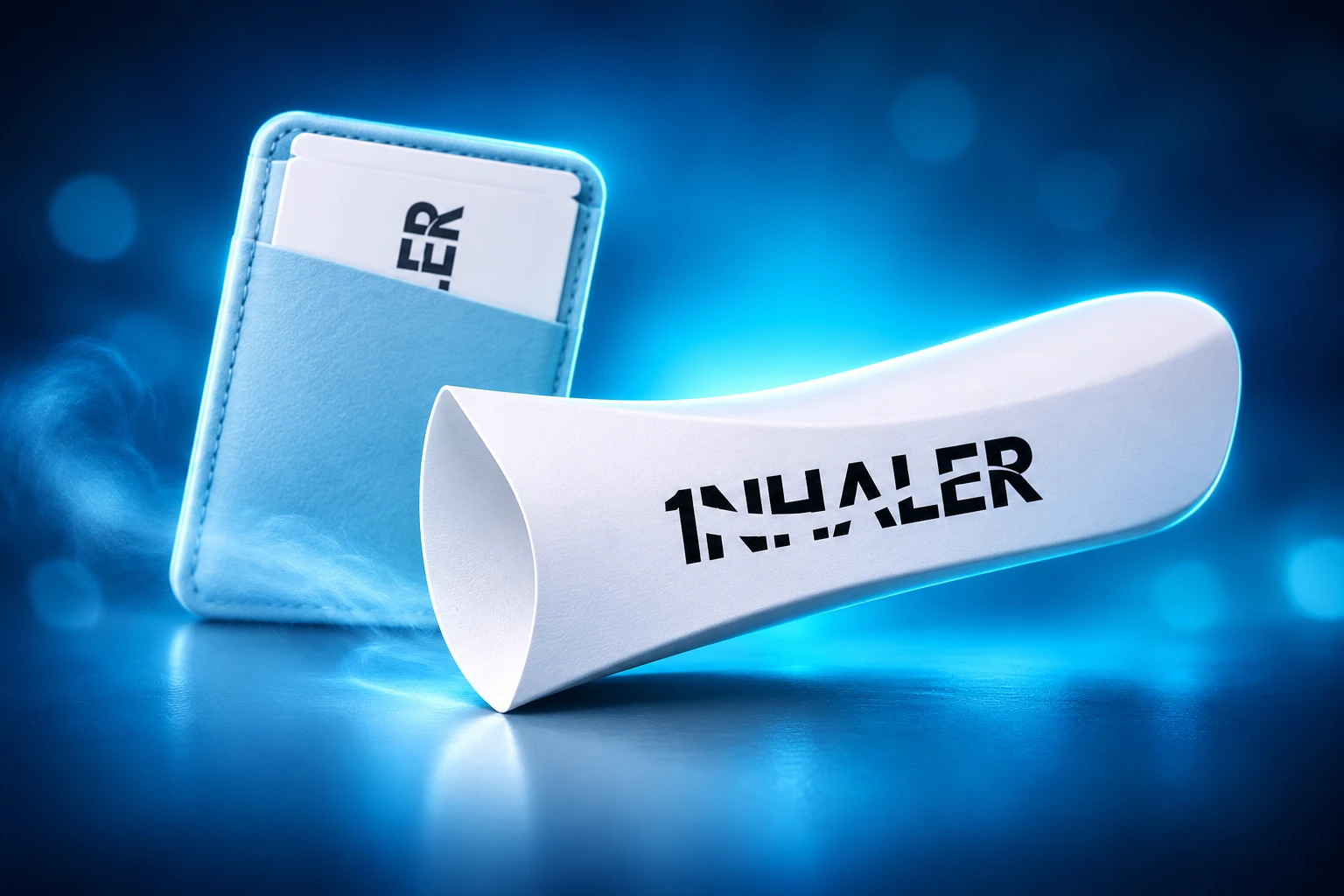
The 1nhaler starts as a flat card. Flex it and two cardboard walls open into a short airway, with a patent-protected membrane spanning the gap. A single dry-powder dose sits on that membrane. A breath pulls it off. There is no canister, no counter and no battery.
Edinburgh-based 1nhaler, founded in 2017 by inventor Don Smith and chief executive Lisa McMyn, says the unit is about 90% FSC-certified cardboard and weighs 2g. It is propellant-free and electronics-free, and the company has said the powder is carrier-free, so the dose is the drug on the membrane rather than a blend packed into a capsule or blister.
THE DEVICE IN FIGURES
- Mass: 2g per unit, light enough to sit in a wallet with a bank card.
- Material: About 90% FSC-certified cardboard, with no propellant and no electronics.
- Dose: One dry-powder shot on a membrane, breath-activated, then thrown away.
- Shape: Credit-card flat in a pocket, then popped into a three-dimensional mouthpiece.
That last point is the product, not a slogan. Multi-dose plastic inhalers still ask a patient to carry tens or hundreds of shots because missing a rescue dose is dangerous. A former Propeller Health chief executive, David Van Sickle, put the oddness plainly in 2024 when he wrote that a person with chronic lung disease still has to carry around hundreds of doses of their medicine all the time. A wallet card is a different object: one shot, on you, for the moment you actually need it.
It is my belief the 1nhaler will appeal most to patients and prescribers where acute and relatively rare use is expected.
Lars Larsson, Chief Medical Officer, 1nhaler
Larsson, formerly medical director for licensing at AstraZeneca and head of clinical research at Novartis, named the uses he has in mind: asthma symptoms in people whose disease is otherwise stable, anaphylaxis and migraine. The card is built for occasional work. It is not a twice-daily preventer in a smaller box.
Salbutamol Is How They Prove the Device
Salbutamol is the most established respiratory drug in the world, which is why it is the first payload. 1nhaler does not need to prove a new molecule. It needs regulators to accept that a cardboard membrane can put a known powder in the lung as well as the plastic devices already on the market.
Chief scientific officer Helen Muirhead, who ran GSK’s Respiratory Centre of Excellence and worked on the Diskus and Ellipta inhalers, said on the company site that current performance data shows comparability with the market-leading product, including lung deposition for salbutamol. A 17 November 2025 funding note went further, saying results sit on par with leading multidose inhalers.
Those figures are still in-house. The new money pays for contract-made clinical material and a small study whose data is meant to sit in a Marketing Authorisation Application in late 2027. Until patients are dosed, “comparable” remains a lab claim, which is why McMyn called human testing the milestone that matters.
The choice of drug also sets a trap the company will have to explain. UK guidance keeps warning that people over-order salbutamol metered-dose inhalers, and that poor control drives that habit. A disposable single-dose card could be a spare in a bag. It could also become another reliever people collect. The trial will have to show the card delivers the drug. It will not, on its own, show how the NHS should prescribe it.
Scotland Still Gets Most Inhaler Carbon From Propellant
The easy version of this story is that cardboard beats plastic. The numbers on Scotland’s own books are more specific than that. The carbon problem in inhalers is the propellant in pressurised metered-dose inhalers, not the polymer shell of a dry-powder device.
A Scottish Government prescribing guide published on 22 April 2024 estimated NHS Scotland produced 81,072 tonnes of carbon dioxide equivalent from inhaler propellant in 2022/23, about the same as 81,000 people flying from London to New York. Metered-dose inhalers make up about 3% of NHS Scotland’s carbon, more than the fleet and waste combined. Salbutamol accounts for two thirds of that pMDI carbon, and salbutamol metered-dose inhalers alone account for 66% of carbon from inhalers as a whole.
In 2020/21, 68% of inhalers dispensed in NHS Scotland were pMDIs and 32% were dry-powder or soft-mist devices. The UK sits near 70% pMDI. The rest of Europe is under 50%. Scandinavia is 10% to 30%. The hydrofluoroalkane gases in those canisters, HFA-134a and HFA-227ea, are about 1300 times and 3350 times more potent than carbon dioxide. NHS Scotland set cuts of 25% by the end of 2024, 50% by 2026 and 70% by the end of 2028, on the way to net zero in 2040.
CARBON PER INHALER, SAME STUDY
| Inhaler type | kg CO2e per inhaler | Propellant |
|---|---|---|
| HFA-134a salbutamol pMDI | 26.91 | Yes |
| HFA-152a salbutamol pMDI | 2.06 | Yes |
| Dry-powder inhaler | 0.69 | No |
Those three figures come from a Carbon Trust-verified life-cycle comparison of salbutamol devices. A switch from today’s HFA-134a pMDI to an HFA-152a pMDI is a 92.3% cut. A switch from that same pMDI to a dry-powder inhaler is a 97.4% cut. Plastic DPIs already do almost all of the climate work the cardboard card is being asked to advertise.
What the card still buys, if it works, is mass, packing volume and a one-shot format. A 2g flat pack is a different logistics object from a moulded multi-dose body, which is the opening 1nhaler actually has against Ellipta and Easyhaler. The government guide is blunt about another limit: the most environmentally friendly inhaler is the one the patient can, will and does use correctly. A blanket switch is not advised, because some people cannot raise the inspiratory flow a dry-powder device needs.
The £2.2m Pays for a Factory and a Trial
Archangels published the round as £2.2 million in follow-on funding. It is the third equity cheque in three years from the same core group, and it is still a small sum for taking a drug-device combination through human testing and toward a commercial line.
THE CHEQUES SINCE 2023
- November 2023: Raises £2 million, led by Archangels, with Dr Yusuf Hamied, then non-executive chair of Cipla, British Business Investments and seed investors.
- July 2024: Scottish Enterprise confirms a £765,000 development grant to prepare for early trials, and Jane Gaddum becomes board chair.
- 17 November 2025: Raises £1.5 million, again led by Archangels with Scottish Enterprise and BBB Investments, aimed at a late 2027 marketing application.
- 3 November 2026: Raises £2.2 million from the same three backers to transfer the salbutamol product into a contract manufacturer and run a small trial.
Disclosed equity across the three rounds is £5.7 million, with the grant on top. A 2024 plan for an early-stage clinical phase in 2025 did not produce a filing. The target on the page now is late 2027.
WHERE THIS ROUND GOES
- Contract transfer: Move 1nhaler Salbutamol into a contract manufacturer so trial packs can be made under controlled conditions.
- Clinical packs: Produce the material for a small study meant to support the late 2027 filing.
- The study itself: Run that small trial in people, the step McMyn called the milestone of the journey.
- Scale-up kit: Pay for a manufacturing engineering study with Harro Höfliger on commercial output of the dry-powder inhaler.
- Partner talks: Keep business-development meetings going with groups that want the platform or the salbutamol product.
By November 2025 the company had already named Upperton for clinical manufacture and Harro Höfliger for large-scale process development. Höfliger is the German machine builder other inhaled-product lines already use to take powder fill from a lab bench to a qualified factory. Cardboard that pops open is a converting problem as much as a medical one, which is why a slice of a £2.2 million round is going to an engineering study rather than to more lab work on salbutamol.
Archangels, citing Grand View Research, put the global inhalable-drugs market at about US$38 billion in 2026, with a published band of US$40 billion to US$68 billion by 2033-35. 1nhaler is not raising against that whole pile. It is raising to own a cheap, single-dose way into it.
Who Built This After Diskus and Ellipta
The payroll reads like a reunion from the companies that already sell the devices 1nhaler wants to sit beside. Muirhead came from GSK’s respiratory centre. Andrew Walker, on device development, was vice president of device development at Vectura and head of device technology at GSK. Paul Trusty, the materials scientist, was a senior technical director and global product head at GSK and Haleon. Indre Statkeviciene led technical projects at GSK and Mundipharma. Frank Chambers, of Inhalytic, worked at AstraZeneca and Mylan on inhaled-product analysis.
On the board, Gaddum was vice president for emerging brands in AstraZeneca’s global marketing group and joined as chair on 1 July 2024. Gordon Muirhead, formerly vice president for new product introduction and technical lead for global supply at GSK, moved from long-time adviser to non-executive director on the same day. Joanne Kelley, formerly vice president of business development at AstraZeneca, was already a director. Larsson holds the chief medical officer seat.
That is a lot of Diskus, Ellipta and AstraZeneca muscle for a five-person-scale Edinburgh shop whose first commercial object is a piece of card. It is also a tell. People who have already taken blockbuster inhalers through factories and formularies do not join a cardboard startup to reprint Ventolin. They join because they think a missing format, the single-dose disposable, is still unbuilt.
McMyn said the new money takes 1nhaler to one of the most important milestones in its journey, testing its own lead product in people, and that the continued backing reflects a year of technical and commercial progress. Nine years after founding, the company is still pre-clinic. The bench is no longer the bottleneck. Making packs a regulator will accept is.
Partners Want Powders the Card Has Never Held
Dr Sarah Hardy, director and head of new investments at Archangels, has backed 1nhaler since 2023. In the 3 November 2026 note she went past the usual climate line and named the thing her firm is actually underwriting: interest from potential partners across a broader range of drugs than the syndicate first expected.
We are particularly excited by the commercial traction and interest from potential partners across a broader range of drugs than we initially anticipated, highlighting the platform’s versatility and market potential.
Dr Sarah Hardy, Director and Head of New Investments, Archangels
The company’s own list already runs beyond asthma and COPD: influenza, epilepsy, depression, Parkinson’s, anaphylaxis, pain relief and vaccines. Rescue drugs, anti-infectives and vaccines, McMyn’s site argues, would all benefit from a dose a person can take without a needle. The same page says bulky plastic capsule inhalers are still the default in clinical trials, which is a quieter market than asthma and maybe an easier first customer.
Hamied’s cheque in 2023 pointed at another buyer. As non-executive chair of Cipla he spent a career on cheap medicines for countries that cannot pay Western device prices. A flat card that ships in envelopes is a better aid-and-procurement object than a moulded multi-dose body, if the dose comes out of the membrane the same way in a humid warehouse as it does in an Edinburgh lab. That remains unproven in people.
Don Smith has said the portable, low-cost device will help extend inhalable dry powders to more people around the world. Scottish Enterprise’s Derek Shaw, director of company funding and investment, called 1nhaler the kind of human-health firm Scotland wants to scale into global markets. Hardy said taking the product into a clinical study is the step that shows how it performs in patients.
The filing date on the page is late 2027. Between 3 November 2026 and that date sits a technical transfer, a small trial and a German engineering study, paid for with £2.2 million. The card is still cardboard until someone with asthma, a migraine or a vaccine protocol actually breathes through it.
Disclaimer: This article is news reporting on a company funding round and an unapproved drug-delivery device. It is for information only and is not medical advice, prescribing advice or investment advice. Readers should speak with a qualified doctor or pharmacist before changing any inhaler or inhaled medicine, and with a regulated financial adviser before making any investment decision linked to private companies or health-tech firms. Trial plans, regulatory timelines, performance claims and carbon figures reflect company, investor and government statements as of the article’s date and may change as studies run and filings are prepared.

One UI 9.5 Beta Puts the Galaxy S26 on Last Year’s Clock

DBS Puts a 24/7 USDC Window Inside the Bank

European Startups Head for $81 Billion as First Checks Shrink

US Stocks Lost $1.3 Trillion Before Nvidia’s Beat

Home Depot Bets on Finance Chief Richard McPhail as CEO

Aramco Crash Kills 14 Two Days After Oil Restart

Salah Captained Egypt to Their First World Cup Win

Zelda’s 40th Switch 2 Ships Without a Zelda Game

Apple Labor Day Deals Hide June’s Memory Price Hike

El Niño Puts Israel’s Needed Winter Rain on a Flood Clock
-
 BUSINESS5 months ago
Aramco Crash Kills 14 Two Days After Oil Restart
-
 NEWS6 months ago
Salah Captained Egypt to Their First World Cup Win
-
 GAMING2 months ago
Zelda’s 40th Switch 2 Ships Without a Zelda Game
-
 NEWS3 months ago
Apple Labor Day Deals Hide June’s Memory Price Hike
-
 NEWS4 months ago
El Niño Puts Israel’s Needed Winter Rain on a Flood Clock
-

 GAMING2 months ago
Palworld 1.0.4 Adds Palpedia Search After the 1.0 Launch
-

 NEWS4 months ago
Saudi Visa Routes Split Nigerian Travelers Into Two Speeds
-

 BUSINESS9 months ago
BAE’s 60-Year Saudi Franchise Now Runs Through Taif