
NEWS
Googlebook Detachables Follow a Path Google Already Left
Google confirmed detachable Googlebooks on October 28, a day after Lenovo’s keyboard cleared the FCC, and weeks after the Pixel Tablet left the store.

Google told developers on October 28 that Googlebooks will span clamshells, convertibles, and soon detachables. It named no model, no partner, and no price.
The sentence landed one day after Lenovo’s detachable keyboard cleared the U.S. FCC, and 49 days after Google pulled the Pixel Tablet from its store. The company is walking back onto a tablet path it has left more than once, this time with a desktop OS that still will not stand up in portrait.
Detachables Join Clamshells and Convertibles
The line came in the Android Dev Summit 2026 keynote, in a chapter on large screens. Google did not show a slate, fold a hinge on stage, or put a ship window on the slide.
Google Books spans across large screen form factors from clamshells, convertibles, and soon detachables.
Google, Android Dev Summit 2026 keynote
The same talk set the floor the first machines already had to hit: 16 GB of memory and an on-device NPU pushing over 45 TOPS. John Solomon, vice president and general manager of laptops, tablets, and Android enterprise, had already put that floor in writing when pre-orders opened.
The official Android Developers stream carries the Googlebook chapter, which starts near the 36-minute mark.
Solomon’s September 21 launch post described Googlebook as laptops built on the Android stack with desktop pieces from ChromeOS, sold with Acer, ASUS, Dell, HP, and Lenovo. Devices start at $899, with dedicated NPUs capable of over 45 TOPS, Glowbar lighting on the chassis, and feature drops for up to 10 years. U.S. shelves opened on October 4. Canada, the U.K., Ireland, France, Germany, and Australia followed on October 5, a 13-day hop from pre-order to retail.
That first wave was a laptop launch. Four of the five bodies are clamshells. Only Acer’s Googlebook 14 uses a hinge that folds into tent and tablet poses. A detachable is a different machine: the screen comes off the keys and has to work as a tablet, not a laptop folded flat.
Lenovo’s Keyboard Cleared the FCC First
Google’s “soon” was not the first hard document in the file. On October 27, Lenovo (Shanghai) Electronics Technology Co., Ltd. received an equipment grant for a Bluetooth keyboard under FCC ID O57DUET13BTKB, model DUET13BTKB. The Lenovo dual-mode Bluetooth keyboard filing lists a 2.402 to 2.48 GHz radio at 1 mW, pogo-pin contacts along the top edge, and Googlebook branding on the left palm rest.
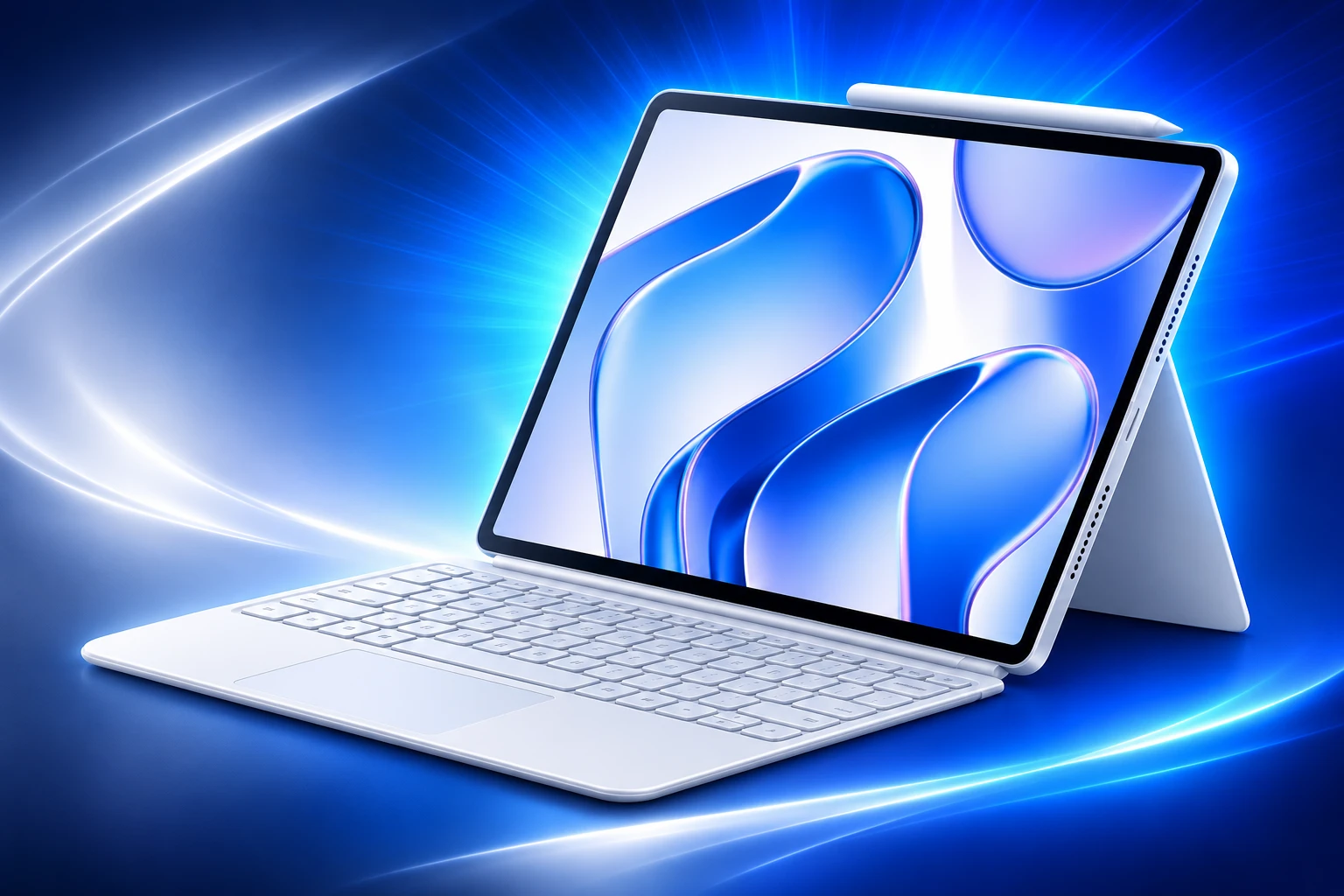
The design matches months of leaked marketing shots of an unreleased Lenovo slate tracked as the Googlebook Duet m, internally called Sapphire. Those images, first published in late July and early August, show a compact aluminum tablet with a kickstand, a magnetic stylus on the top edge, and a Glowbar strip in a pill housing next to the rear camera. A later set from leaker Evan Blass added a physical switch on the keyboard that appears to cut the keys when the board is used away from the glass.
The keyboard is built to work two ways. Snapped on, the pogo pins carry the link. Pulled off, an internal battery and Bluetooth keep the keys alive, so the screen can sit farther back on a desk while the board stays in your lap. That is the point of a true detachable, and it is already in the FCC drawings.
THE 2026 HARDWARE TRAIL
- July 7, 2026: The Lenovo Pen Pro for Googlebook receives its FCC grant under ID A5M-SE01, with a user manual that shows the pen magnet-charging on a tablet back.
- July 31, 2026: Leaked Lenovo shots show two white clamshells and a kickstand tablet with Googlebook on the palm rest and a G key where a Windows key would sit.
- September 9, 2026: Google removes the Pixel Tablet product page and the Tablets section from the Google Store.
- September 21, 2026: Pre-orders open for five Googlebook laptops. The Duet m is not in the set.
- October 4, 2026: The clamshells and Acer’s convertible reach U.S. shelves.
- October 27, 2026: Lenovo’s DUET13BTKB keyboard is granted at the FCC.
- October 28, 2026: Google tells developers detachables are coming soon, 24 days after the first Googlebooks went on sale.
Lenovo already sells a Googlebook 15, a 15-inch clamshell. The Duet m is a separate product that missed that launch. Hardware trackers have had the accessories in regulatory queues since summer. The missing piece on October 28 was not a sketch of a kickstand. It was Google saying the form factor is on the platform roadmap.
Portrait Mode Still Stops at Fullscreen Apps
Pulling a keyboard off a screen only makes a tablet if the software rotates with your hands. On current Googlebook OS builds, that work is half done.
WHERE THE SHELL STILL LOCKS
- Fullscreen apps: They open in portrait tablet mode without an obvious stall.
- Desktop home screen: It stays locked in landscape.
- Overview: The multitasking view does not stand up with the glass.
- App tray: The drawer stays landscape even when a full-screen app does not.
Detaching the keys therefore solves only half the tablet problem. You can hold the panel like a slate and run one app. You cannot turn the actual desktop, the window picker, or the app list with it. Touch habits people bring from a tablet still break in places, including the swipe that should take YouTube into fullscreen.
Shipping Googlebooks already show how unfinished the software can feel on OLED panels, including OLED blacks that go gray after boot. Reviewers living on the Lenovo Googlebook 15 and ASUS Googlebook 14 have also been waiting on desktop parity in Virtual Desks and the Files app, on ordinary clamshells that never leave landscape. A flagship detachable has to do that job and then snap into a touch-first mode the instant the keyboard comes off. Google did not put a software date next to “soon.”
The Pixel Slate Already Tested This Idea
Google has sold this shape before. It did not stay with it.
A Chrome OS Slate, Then a Retreat
The Pixel Slate arrived on October 9, 2018, as a 12.3-inch Chrome OS tablet with a keyboard cover and a pen, aimed at the same desk as a Surface. Configurations ran from a Celeron up to a Core i7. Google priced the board extra. When the keys came off, Chrome OS switched into a touch launcher with split-screen. When they snapped back, it was a desktop again.
In June 2019, Google said it would focus its own Chrome OS hardware on laptops and keep supporting the Slate. Two smaller follow-on tablets in the works, later tracked under the Flapjack name, were dropped. The Pixelbook Go shipped as a laptop with no tablet pretence. The Slate listing left the Google Store on January 20, 2021. Standalone Chrome OS tablets never became a real third category beside convertibles and clamshells.
Before the Slate, the Pixel C in 2015 had been Google’s Android tablet with a keyboard. After the Slate, Google tried Android again.
The Pixel Tablet Leaves the Store
The Pixel Tablet landed in 2023 as a 10.95-inch Android slate bundled with a charging speaker dock, a hybrid of a tablet and a Nest Hub. It never got a sequel. Google paused work on a second model, then, on September 9, 2026, removed the product page and the Tablets section from the Google Store in the U.S., Canada, and the U.K. Updates for people who already own one still run through 2028. Sales do not.
Twelve days later, Google opened Googlebook pre-orders as a laptop category. Solomon’s title still includes tablets. The store no longer does. The October 28 detachable line is the first public move that puts a Google-backed slate back in the plan, and it does so under Googlebook OS rather than the phone-derived Android that ran the Pixel Tablet.
The stack is heavier this time. Every Googlebook has to ship 16 GB of RAM, a Titan hardware root of trust, and an NPU over 45 TOPS, with up to 10 years of updates. That is a different machine from a Celeron Slate or a dock-first Pixel Tablet. The form factor is not different. It is a screen you can unclip, a kickstand, a pen, and a promise that the OS will behave when the keys are gone.
Five Laptops Shipped Without a True Tablet
Until a detachable lands, the only Googlebook you can fold into a tablet pose is Acer’s convertible. Folding a hinge and pulling a keyboard off are not the same act. One keeps the keys attached through every mode. The other asks the OS to be a desktop and a slate on the same panel.
THE FIRST GOOGLEBOOK FLEET
| Model | Body | Status |
|---|---|---|
| ASUS Googlebook 14 | Clamshell | On sale |
| Dell XPS Googlebook | Clamshell | On sale |
| HP Googlebook 14 | Clamshell | On sale |
| Lenovo Googlebook 15 | Clamshell | On sale |
| Acer Googlebook 14 | Convertible hinge | On sale, from $899 |
| Detachable Googlebook | Tablet plus removable keyboard | Confirmed, no date |
Acer’s Googlebook 14 is the cheap seat in the row, a 14-inch 2.8K OLED touch machine with Intel Core Ultra silicon and the 16 GB floor. Google published the $899 entry point and left industrial design to the five vendors, on the condition they hit the RAM, NPU, touch, and materials bar. Glowbar is part of that bar. On the laptops it lives on the lid. On the leaked Lenovo slate it moves into the camera pill, so the light still shows when the keyboard is in a bag.
MediaTek used the September 21 launch day to unveil a Dimensity CX C10 Max chip aimed at later Googlebooks, with an NPU rated up to 55 TOPS. Hardware trackers have tied that part to the Duet m. Lenovo has not confirmed the chip, the panel, or a price.
What Happens to High-End Android Tablets?
A desktop window manager, a taskbar, virtual desks, and the full Chrome browser on a panel you can hold is a different product from a large-screen phone OS with extra split views. If Googlebook OS ever rotates properly, high-end Android tablets will sit next to a device that runs the same Play catalog with a real desktop on top. Google has not said those Android slates go away. It has said the next Googlebook body is a detachable, and it said that after it stopped selling its own Android tablet.
WHAT WE KNOW
- The promise: Google has put detachables on the Googlebook form-factor list in a public keynote.
- The accessory file: Lenovo’s DUET13BTKB keyboard and the Pen Pro have FCC grants, with pogo pins, Bluetooth, and Googlebook branding in the drawings.
- The leak: Images show a kickstand Lenovo tablet with Glowbar, a magnetic stylus, and a G key on the board.
WHAT IS UNCONFIRMED
- Retail date: Google has not named a quarter. Lenovo has not named a day.
- Price: No detachable is on the Google Store, and $899 is the laptop floor, not a slate tag.
- The sheet: A 13-inch OLED panel, 16 GB of LPDDR5X, UFS 4.0 storage, dual USB-C, Wi-Fi 7, and a Dimensity CX C10 Max are tracker claims, not a Lenovo spec page.
Lenovo can finish a keyboard through the FCC while Google still owes developers a portrait desktop. The company did not give a software date to match the hardware line on stage.

One UI 9.5 Beta Puts the Galaxy S26 on Last Year’s Clock

DBS Puts a 24/7 USDC Window Inside the Bank

European Startups Head for $81 Billion as First Checks Shrink

US Stocks Lost $1.3 Trillion Before Nvidia’s Beat

Home Depot Bets on Finance Chief Richard McPhail as CEO

Aramco Crash Kills 14 Two Days After Oil Restart

Salah Captained Egypt to Their First World Cup Win

Zelda’s 40th Switch 2 Ships Without a Zelda Game

Apple Labor Day Deals Hide June’s Memory Price Hike

El Niño Puts Israel’s Needed Winter Rain on a Flood Clock
-
 BUSINESS5 months ago
Aramco Crash Kills 14 Two Days After Oil Restart
-
 NEWS6 months ago
Salah Captained Egypt to Their First World Cup Win
-
 GAMING2 months ago
Zelda’s 40th Switch 2 Ships Without a Zelda Game
-
 NEWS3 months ago
Apple Labor Day Deals Hide June’s Memory Price Hike
-
 NEWS4 months ago
El Niño Puts Israel’s Needed Winter Rain on a Flood Clock
-

 GAMING2 months ago
Palworld 1.0.4 Adds Palpedia Search After the 1.0 Launch
-

 NEWS4 months ago
Saudi Visa Routes Split Nigerian Travelers Into Two Speeds
-

 BUSINESS9 months ago
BAE’s 60-Year Saudi Franchise Now Runs Through Taif