
NEWS
OpenAI’s Campus Name Is a Bid to Price Local Consent
OpenAI packaged compute campuses with a 1,000-megawatt Georgia grid cut, setting a ratepayer price other AI builders now have to meet.

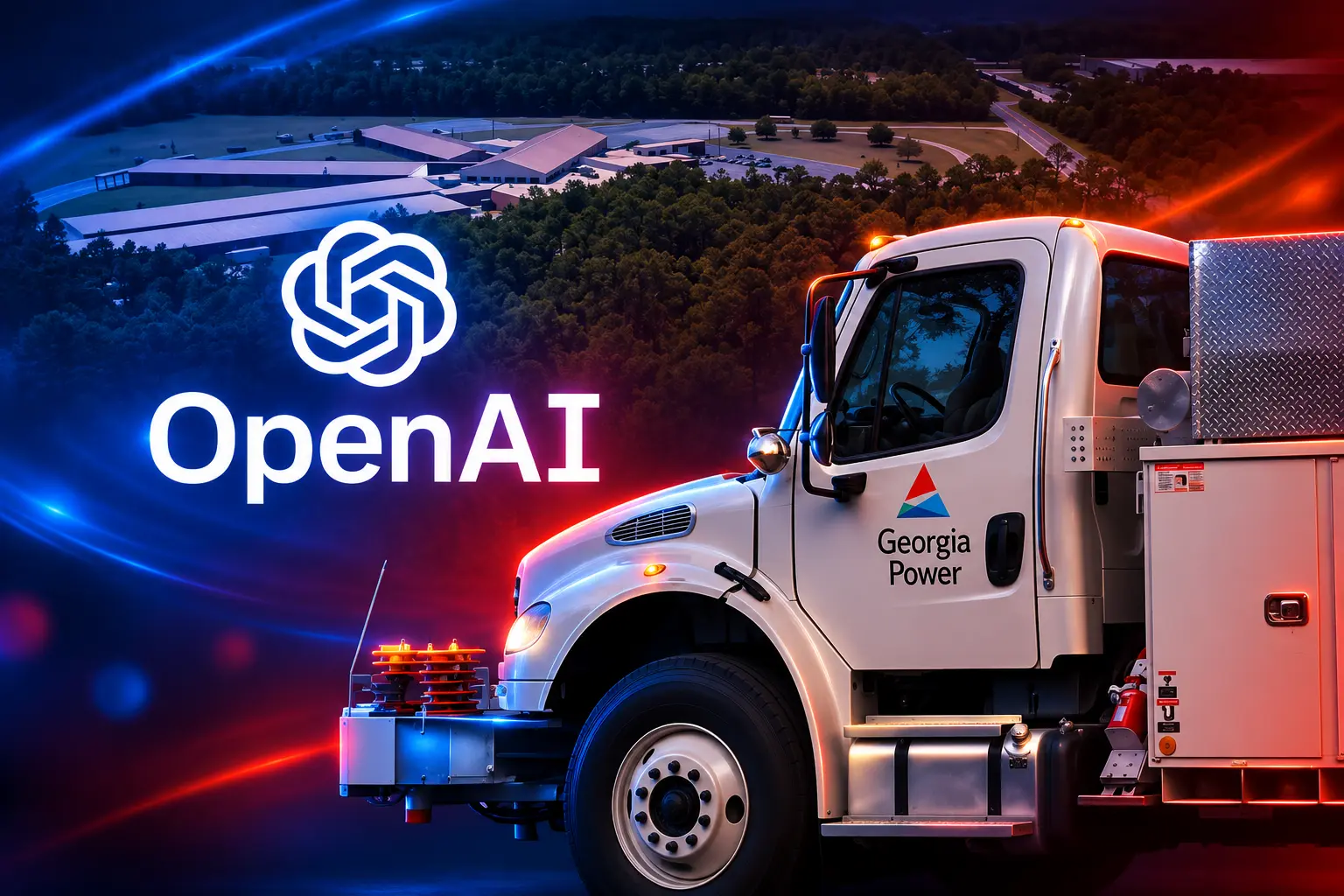
OpenAI launched the Grid Protectors Program on Nov. 2, tying its planned Effingham County, Georgia, site to a 1,000-megawatt cut when the grid is stressed. It wants the buildings called compute campuses. The political product is a ratepayer deal other builders now have to beat.
What OpenAI’s Grid Protectors Program Covers in Georgia
Grid Protectors is a national pitch for sites OpenAI develops itself. Utilities would get the right to pull the campus down when homes need the electrons more. The first test is Project Camellia, still being designed, with power due in phases from 2028 to 2032. The campus is not running yet, so the cut is a contract term, not a measured drop.
Georgia Power says the file that cleared the Georgia Public Service Commission process on Aug. 26, 2026, covers 3,200 megawatts of new demand. OpenAI will pay the full infrastructure and electric-service costs required to serve it. The same agreement gives the utility up to 1,000 megawatts of flexible demand, which OpenAI says is on the scale of the average draw of roughly 700,000 households.
THE GEORGIA POWER DEAL
- Contracted load: 3,200 megawatts of new demand, with service phased from 2028 to 2032.
- Peak cut: Up to 1,000 megawatts the utility can take off the campus when demand spikes.
- Household scale: OpenAI puts that cut at the average demand of about 700,000 households.
- Bill claim: Georgia Power projects at least $15 a month off a typical 1,000-kilowatt-hour bill from 2029, or $180 a year, from its whole large-load book, not from this campus alone.
The $15 figure is an increase from a December 2025 pledge of $102 a year. Georgia Power ties the higher number to projected incremental revenue from new large-load customers, a book it says will deliver about $950 million a year in savings beginning in 2029, or $2.847 billion across 2029 through 2031. Project Camellia is inside that portfolio. It is not the sole source of the $15.
Data centers are paying more so families and small businesses can pay less, and our goal with every contract we sign under this framework is to deliver value for them.
Kim Greene, chairman, president and CEO, Georgia Power statement, Aug. 26, 2026
Greene also said the company’s average rates have stayed 15 percent below the national average since 1990, and that it serves 2.8 million customers. OpenAI, on its own page, put the neighbor rule in blunter terms: families and small businesses should not be asked to subsidize a compute campus’s electricity needs. Long-term contracts and financial assurances, it added, can protect other customers if a project is delayed, reduced, or canceled.
Campus Language Wraps a Curtailment Contract
The Nov. 2 post is where compute campus took over OpenAI’s public vocabulary. An OpenAI spokesperson said compute campuses better describe the scale and role of the infrastructure the company is building. The July 22 Effingham note still called Camellia a datacenter project. The new label arrived with Grid Protectors, not instead of it.
Chris Lehane, OpenAI’s chief global affairs officer, has been stacking a wider packet: community deals, state siting bills that give residents a say, and what he calls speed limits on the most powerful systems. “You’re going to see us talk more and more about the concept of speed limits,” Lehane said. He has also said AI is going to be the issue in 2028. The company flagged the lame-duck session that opens on Nov. 9 as the next window in Congress. It did not wait for the Nov. 3 midterms to publish the campus language.
Nvidia chief executive Jensen Huang has been running a cousin of the same naming fight, calling the halls superintelligence factories because they produce something of economic value. OpenAI is selling a softer noun. A campus sounds like a neighbor. A factory sounds like a shift.
Holly Elmore, founder and executive director of PauseAI US, treated the swap as a read on public mood, not on physics.
OpenAI is clearly responding to the unpopularity of data centers. Communities that despise them will not be fooled into thinking they have transformed into something else.
Holly Elmore, founder and executive director, PauseAI US
Abre’ Conner, director of the NAACP’s Center for Environmental and Climate Justice, called the move an empty solution to an existing issue, which is that the data center infrastructure causes real harm. Heat, water, and night-time fans do not care what the site is named. The part of the package a county can take to a utility docket is the bill and the curtailment, and that is the part other labs are now being forced to match.
73% of Voters Want These Buildings Somewhere Else
A Quinnipiac University poll of 1,032 registered voters, taken Sept. 24 through Sept. 27, found that 73% would oppose building an AI data center in their community. Twenty-one percent would support one. The same survey shop has been tracking a broader fear of harm from advanced systems, and the siting number is the one that lands on a county commission agenda.
That is the weather OpenAI is building in. Local fights over noise, water, and power have been crossing party lines for a year, and the midterm calendar made the buildings a doorstep issue. Lehane’s packet is a bet that a town will still take the hall if the power bill is ring-fenced and the campus can be turned down in a heat wave. The poll says most voters start from no.
OpenAI, citing BloombergNEF, said U.S. data center capacity past 100 gigawatts is the 2030 outlook it is planning against. If that build arrives, every new campus becomes a vote about who pays for the next substation. Grid Protectors is an attempt to answer that vote in advance, in the company’s own words, before a legislature writes the answer for it.
Anthropic Put Ratepayer Coverage on Paper in February
OpenAI is not first to the ratepayer line. On Feb. 11, 2026, Anthropic said AI companies should not leave American ratepayers to pick up the tab, and it listed four promises for sites it develops. Where it only leases capacity, it said it is still looking at how to handle the effect of its own workloads.
ANTHROPIC’S RATEPAYER PLEDGE
- Grid upgrades: It will pay for 100% of the grid upgrades needed to interconnect its data centers, including shares that would otherwise land on consumers.
- New supply: It will work to bring net-new generation online to match its load, and where that power is not yet on, cover estimated demand-driven price effects.
- Peak strain: It is investing in curtailment systems that cut usage at peak, plus tools it says help keep prices lower.
- Neighbors: It points to hundreds of permanent jobs, thousands of construction jobs, and water-efficient cooling on current projects.
Anthropic also put a floor under the industry’s appetite. Training a single frontier model, it said, will soon take gigawatts, and the U.S. AI sector will need at least 50 gigawatts of capacity over the next several years. That is the same bind OpenAI is writing Grid Protectors against. The difference in Georgia is specificity: a named utility, a named megawatt cap, and a commission process that already treated the file as a large-load contract with collateral and minimum bills.
Other labs can now be asked a simpler question in the next town. Will you eat the upgrade costs, and how many megawatts can the utility take off you at 5 p.m. in July? A slogan will not answer it. A contract might.
Loudoun Took Land Instead of Four More Halls
Amazon spent the same political season on the other side of the ledger. On Oct. 21, 2026, it withdrew a plan for four data center buildings totaling 800,000 square feet on the former George Washington University campus in Ashburn, Virginia. Amazon Data Services had bought the 122-acre property for $427 million earlier in the year. Loudoun County Board of Supervisors Chair Phyllis Randall said it was the wrong location, and that the community had been vocal and strong that it did not want data centers there.
Amazon executive Josh Weissman said the company saw the site’s legal development potential differently than the county did, and that it chose a shared vision rather than costly litigation. Under the deal Randall’s office called Project Potomac Promise, Amazon agreed to drop the halls and to forgo legal action that could have forced them onto the land. The rest of the acreage is slated for mixed-use development with housing as the main use.
Ashburn sits in the densest data center market in the country, which is why the fold landed. If a builder can lose a fight in Loudoun, it can lose one in a Georgia county that has never hosted a 3,200-megawatt load. OpenAI’s answer is to arrive with a utility co-signature. Amazon’s answer, on that parcel, was to stop.
A Full Cut Still Leaves 2,200 Megawatts Drawing
The neighbor pitch is the 1,000-megawatt slice. The industrial fact is the rest. Even if Georgia Power took the full flexible block, 2,200 megawatts would still be sitting on the campus. That is the load that remains after the gift to air conditioners, and it is why a renaming argument keeps missing the people who live next door.
Demand response is the term a town can actually cash. Throttling when the grid is stressed is a fair thing to put in a compact, because a regulator can write the trigger, the ramp time, and the duration. A campus sign is not that. The scoff that followed OpenAI’s wording treated the halls as the same warehouses with a nicer brochure, and that read is hard to shake while 2,200 megawatts stay on the line.
WHO IS PUTTING WHAT ON THE TABLE
| Company | Location | The local offer | Date |
|---|---|---|---|
| OpenAI | Effingham County, Georgia | Pays full infrastructure and electric-service costs; up to 1,000 MW can be cut | Aug. 26, 2026 contract clearance |
| Anthropic | U.S. sites it develops | Pays 100% of interconnection upgrades and estimated price effects | Feb. 11, 2026 pledge |
| Amazon | Ashburn, Virginia | Withdrew the four-building plan; 25 acres valued at about $65 million plus $5 million for housing | Oct. 21, 2026 agreement |
OpenAI says these compute facilities are much different than data centers built even a few years ago, which is the technical claim underneath Grid Protectors. If the racks can drop load fast enough to help in a heat wave, the utility has a new peaking resource that does not have to be a gas plant. If they cannot, Georgia Power still has a 3,200-megawatt customer that paid for its own wires and still needs feeding 12 months a year.
Effingham Gets Closed-Loop Cooling and $80 Million
Effingham County officials announced Project Camellia as a $20 billion, 1,400-acre campus inside the Savannah Gateway Industrial Hub, a site already zoned for industrial warehouses. The county’s figure for long-term jobs is 400. OpenAI says the project will create thousands of construction and permanent on-site jobs and that it expects to be the largest taxpayer in the county. Those are different counts, and both are still promises. Power does not arrive until 2028 at the earliest.
On water, OpenAI says the plant will use a closed-loop system that recirculates rather than running a constant withdraw-and-dump cycle, like a car radiator, with ongoing use closer to an office of the same headcount. It also pledged an annual public audit by an independent firm, and a Georgia Community Compact as the project develops. Separate from tax revenue, it will provide $80 million in community benefits over the life of the project, plus up to $71 million in Codex credits for eligible Georgia college, community college, and technical school students, at $100 per student through ChatGPT.
THE CAMELLIA FILE
- July 22, 2026: OpenAI posts its Effingham commitments, including closed-loop water, the $80 million community fund, and a promise that residents will not subsidize the power bill.
- Aug. 26, 2026: Georgia Power says the 3,200-megawatt contract has cleared the PSC process, with up to 1,000 megawatts of flexible demand.
- Nov. 2, 2026: OpenAI launches Grid Protectors, names Effingham as the pilot, and puts compute campus into national use.
- Nov. 9, 2026: The lame-duck session of Congress opens, the window OpenAI has flagged for the rest of the policy packet.
Camellia still has to clear county and state permits on setbacks, stormwater, wetlands, and fire safety. The Grid Protectors cut only applies once the campus is operating. Until then, OpenAI is selling a standard: pay the wires, drop load on peak, write the neighbor check, and call the hall a campus. The next county that wants an AI site can demand that package without adopting the noun. The noun was never going to move a power bill. The 1,000 megawatts might.

One UI 9.5 Beta Puts the Galaxy S26 on Last Year’s Clock

DBS Puts a 24/7 USDC Window Inside the Bank

European Startups Head for $81 Billion as First Checks Shrink

US Stocks Lost $1.3 Trillion Before Nvidia’s Beat

Home Depot Bets on Finance Chief Richard McPhail as CEO

Aramco Crash Kills 14 Two Days After Oil Restart

Salah Captained Egypt to Their First World Cup Win

Zelda’s 40th Switch 2 Ships Without a Zelda Game

Apple Labor Day Deals Hide June’s Memory Price Hike

El Niño Puts Israel’s Needed Winter Rain on a Flood Clock
-
 BUSINESS5 months ago
Aramco Crash Kills 14 Two Days After Oil Restart
-
 NEWS6 months ago
Salah Captained Egypt to Their First World Cup Win
-
 GAMING2 months ago
Zelda’s 40th Switch 2 Ships Without a Zelda Game
-
 NEWS3 months ago
Apple Labor Day Deals Hide June’s Memory Price Hike
-
 NEWS4 months ago
El Niño Puts Israel’s Needed Winter Rain on a Flood Clock
-

 GAMING2 months ago
Palworld 1.0.4 Adds Palpedia Search After the 1.0 Launch
-

 NEWS4 months ago
Saudi Visa Routes Split Nigerian Travelers Into Two Speeds
-

 BUSINESS9 months ago
BAE’s 60-Year Saudi Franchise Now Runs Through Taif