
NEWS
Apple Splits MacBook Pro, Putting Touch at $2,899
Apple’s first touchscreen MacBook Pro starts at $2,899, while a Mini-LED MacBook Pro remains on sale from $1,999 without touch or a stylus.

Apple’s first touchscreen MacBook Pro starts at $2,899, and a Mini-LED MacBook Pro remains on sale from $1,999. Pre-orders opened October 28, 2026, with the tandem OLED machines due to arrive November 6.
The company did not flip the whole Pro line to glass you can poke. It added a second family, PROLED XDR Display, and left the cheaper clamshell in the store without Touch.
Apple Still Sells a $1,999 MacBook Pro Without Touch
Apple’s MacBook Pro hub now shows two products. The new one is the 14.2-inch or 16.3-inch PROLED XDR model with tandem OLED, a touch sensor in the panel, and M5 Pro or M5 Max. Beside it sits a Mini-LED MacBook Pro from $1,999 with M6, M5 Pro, or M5 Max, a 14.2-inch or 16.2-inch Liquid Retina XDR screen, and a line that reads “Touch display not applicable.”
That $900 gap is the decision. On October 27 the 14-inch Mini-LED Pro took the M6 chip at $1,999. A day later the OLED Touch machine landed at $2,899 with last spring’s M5 Pro, not M6. When those M5 Pro chips debuted on March 3, the 14-inch Mini-LED model started at $2,199. The OLED tax on the same generation of silicon is $700 before you add memory or glass.
In June, Tim Cook said component costs had forced Apple to raise Mac and iPad prices. Those increases already lifted other notebooks, and some shoppers can still find a MacBook Air below post-hike list. The Touch MacBook Pro does not unwind that. It sits on top of it.
HOW THE LINEUP SPLIT
- March 3, 2026: Apple launches Mini-LED MacBook Pro with M5 Pro and M5 Max, 14-inch from $2,199.
- June 25, 2026: Cook says memory and storage costs force Mac and iPad price increases.
- October 27, 2026: 14-inch Mini-LED Pro with M6 starts at $1,999.
- October 28, 2026: MacBook Pro with PROLED XDR Display and Touch opens at $2,899.
- November 6, 2026: First customer units of both new machines are due.
Johny Srouji, Apple’s chief hardware officer, framed the OLED machine as a new way for pros to handle 3D models and on-screen instruments, not as a replacement for the $1,999 Pro.
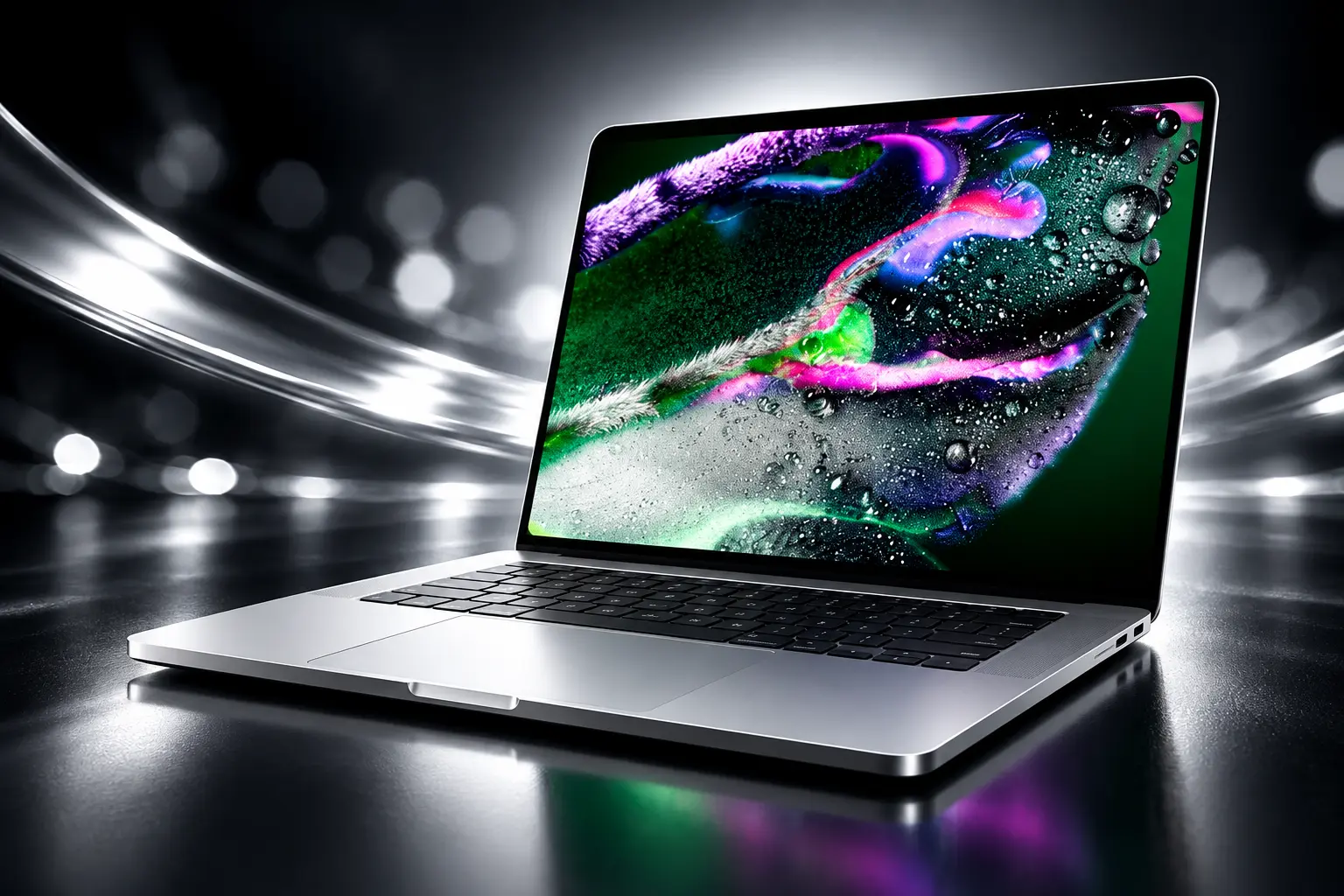
What the Touchscreen MacBook Pro Costs
Apple lists four US starting prices for PROLED XDR, then lets the configurator run. The 14-inch M5 Pro at $2,899 is the door. It ships with a 15-core CPU, a 16-core GPU, 24GB of unified memory, and a 1TB SSD. The 16-inch M5 Pro is $500 more at $3,399. M5 Max starts at $4,499 for 14-inch and $4,799 for 16-inch, a $300 size gap.
THE US STARTING PRICES
| Model | Chip | US price |
|---|---|---|
| 14-inch Mini-LED | M6 | $1,999 |
| 14-inch PROLED | M5 Pro | $2,899 |
| 16-inch PROLED | M5 Pro | $3,399 |
| 14-inch PROLED | M5 Max | $4,499 |
| 16-inch PROLED | M5 Max | $4,799 |
A 16-inch M5 Max with 128GB of memory, a 16TB SSD, and nano-texture glass is listed at $14,549. That is a build Apple’s store will sell and almost nobody needs. M5 Max memory bandwidth reaches 614GB/s on the 40-core GPU. Storage on Max now climbs to 16TB, which is new for this chassis.
Apple opened pre-order starting October 28 in 30 countries and regions, including the United States. Space Black and Silver are the finishes. Three Thunderbolt 5 ports, HDMI, SDXC, MagSafe, and a headphone jack carry over. M5 Max can drive four external displays.
Fingers Are Welcome, the Pencil Stays on iPad
Touch is built into the OLED stack, not stuck on as a film, which Apple says cuts latency. A stiffer hinge is there so a tap does not bounce a 3-pound lid. macOS 27 maps a finger press to a click, so older apps still respond. New gesture APIs let developers draw for Touch on purpose.
TOUCH MOVES APPLE NAMED
- Scroll: Slide a finger across a page or timeline.
- Zoom: Pinch photos, documents, and web pages.
- Windows: Double-tap to fill the screen, or flick a window into a tile.
- Canvas: Draw and drag across the full panel instead of the trackpad.
- Music: Play software instruments on the glass, including in djay Pro.
- Apps: Test iOS and iPadOS Touch behavior on the Mac panel.
Adobe Lightroom, DaVinci Resolve, Blender, Cinema 4D, ZBrush, Shapr3D, Notion, Canva, Zoom, and Microsoft Word, Excel, PowerPoint, and Outlook are on Apple’s day-one list. Graphic work is the pitch. So is checking an iPhone layout without grabbing a phone.
The new MacBook Pro with PROLED XDR Display is a monumental step forward for the Mac. PROLED XDR is the world’s best laptop display. It pairs state-of-the-art tandem OLED technology with advanced algorithms in our display engine to deliver the kind of visual fidelity pros have been dreaming of. And with the magic of Touch coming to MacBook Pro, combined with the game-changing performance of M5 Pro and M5 Max, we’ve created a whole new way for pros to interact with their content.
Johny Srouji, chief hardware officer, Apple newsroom
Apple Pencil is absent. The company’s Pencil compatibility page, updated October 27, still names iPad models only. iPad Pro itself still starts at $999, with Pencil Pro as the drawing tool. That is how the tablet keeps a job the $2,899 clamshell does not take.
Tim Cook posted the line the launch wanted.
We brought Touch to the Mac!
From the all-new iPad mini to the 14-inch MacBook Pro and iMac… and now MacBook Pro with PROLED XDR Display and Touch, creators have new tools to do their best work yet. pic.twitter.com/6oJlc1vaUR
— Tim Cook (@tim_cook) October 28, 2026
Half a Pound Lighter, Ten Times the Contrast
OLED let Apple thin the stack. The 14-inch M5 Pro is 3 pounds, half a pound under the Mini-LED 14-inch at 3.5 pounds. The 16-inch is 4 pounds, 0.7 pounds lighter than the Mini-LED 16-inch. Apple says the 14-inch is half a millimetre thinner and the 16-inch nearly a millimetre thinner. Warm exhaust is steered off the panel so the lighter body can still hold M5 Pro and M5 Max clocks.
PROLED XDR uses two self-lighting pixel layers. Peak brightness is 2000 nits for HDR and for SDR outdoors. Sustained full-screen brightness is 1000 nits. Contrast is 10,000,000:1, ten times the Mini-LED panel’s 1,000,000:1. Each pixel can go dark beside a specular highlight, so the blooming Mini-LED owners know is gone. The 14.2-inch panel is 3024-by-1986 at 254 ppi. The 16.3-inch panel is 3472-by-2266 at the same density, a hair larger than the 16.2-inch Mini-LED screen because the bezels shrank.
PROLED XDR AT A GLANCE
- Peak light: 2000 nits HDR and SDR, 1000 nits full screen, 1 nit minimum.
- Motion: ProMotion from 10Hz to 120Hz, plus cinema-style fixed rates.
- Color: P3 and Adobe RGB in one default preset, one billion colors.
- Battery: 72.6Wh on 14-inch; up to 22 hours of video on M5 Pro, 20 hours on M5 Max; up to 24 hours advertised on the line.
Nano-texture is etched into the cover glass, not a film. An oleophobic coat is supposed to fight fingerprints. The Dynamic Island, a pill for the 12-megapixel Center Stage camera, now holds Spotlight, Live Activities, and Siri AI. Authentication stays on Touch ID. Six speakers get a new woofer that Apple says delivers 50 percent deeper bass, and a lid-closed tuning profile kicks in when the machine drives an external screen. The Apple mark on the lid glows again, a detail last seen before the 12-inch MacBook of 2015, a machine that has now reached the end of official repair.
Jobs Called Vertical Touch Ergonomically Terrible
The Mac avoided a touch panel for a reason Apple used to state in public. In October 2010, Steve Jobs said vertical glass failed Apple’s own tests.
We’ve done tons of user testing on this, and it turns out it doesn’t work. Touch surfaces don’t want to be vertical. It gives great demo but after a short period of time, you start to fatigue and after an extended period of time, your arm wants to fall off. It doesn’t work, it’s ergonomically terrible.
Steve Jobs, then Apple CEO, October 2010
In 2018, software chief Craig Federighi still said lifting an arm to poke a screen is “a pretty fatiguing thing to do.” The 2021 M1 Pro design then froze the Pro’s shape for five years. Touch arrives as a short, in-cell gesture layer on a laptop that still wants hands on the keyboard. You can turn Touch off under Accessibility if you bought the panel for black levels and never want a smear in a timeline.
The Piano Clip Meets Finger Oil on OLED
Apple’s launch film puts a hand on virtual keys. A clamshell that cannot fold flat is a weak piano. It is a fine way to nudge a 3D orbit or to scrub a clip you are already sitting at. It is a poor way to replace a MIDI keyboard, and it is a worse way to replace an iPad and a Pencil. Sweaty typists will wipe the glass. OLED shows oil faster than Mini-LED, which is why the oleophobic coat is doing real work on day one.
The $1,999 Mini-LED M6 remains the machine for people who wanted a faster 14-inch Pro and not a new input model. The $2,899 PROLED unit is for color work, for developers who test Touch on the same laptop they compile on, and for anyone who has been stabbing a MacBook screen out of iPad habit. Boxes are due November 6. Bring a cloth.
Frequently Asked Questions
How Much Does the Touchscreen MacBook Pro Cost?
Education pricing is $2,749 for the 14-inch M5 Pro, $3,199 for the 16-inch M5 Pro, $4,199 for the 14-inch M5 Max, and $4,499 for the 16-inch M5 Max. Apple also lists $241.58 a month for 12 months, or $55.99 a month for 36 months with Apple Upgrade, on the $2,899 machine.
Does the MacBook Pro Work With Apple Pencil?
No current Apple Pencil is rated for Mac. The October 27 compatibility list covers iPad lines and, for Apple Pencil (USB-C), iPhone Duo. Hands-on units include an Accessibility switch that disables Touch entirely, which is the path if you want the OLED panel and a clean trackpad-only Mac.
What Is the Difference Between the M6 and PROLED Models?
The Mini-LED family keeps a 16.2-inch size, 1600 nits peak HDR, a 1,000,000:1 contrast ratio, and a 3.5-pound 14-inch starting weight, and it can be ordered with M6, M5 Pro, or M5 Max. PROLED is M5 Pro or M5 Max only, 16.3 inches on the large model, 2000 nits peak, 10,000,000:1 contrast, and 3 pounds on the 14-inch M5 Pro.
Which Chips Are in the PROLED MacBook Pro?
The 15-core M5 Pro uses 5 super cores and 10 performance cores, a 16-core GPU, and 307GB/s of memory bandwidth. The 18-core M5 Pro pairs 6 super cores and 12 performance cores with a 20-core GPU. M5 Max keeps the 18-core CPU and adds a 32-core GPU at 460GB/s or a 40-core GPU at 614GB/s, with unified memory from 36GB to 128GB.

One UI 9.5 Beta Puts the Galaxy S26 on Last Year’s Clock

DBS Puts a 24/7 USDC Window Inside the Bank

European Startups Head for $81 Billion as First Checks Shrink

US Stocks Lost $1.3 Trillion Before Nvidia’s Beat

Home Depot Bets on Finance Chief Richard McPhail as CEO

Aramco Crash Kills 14 Two Days After Oil Restart

Salah Captained Egypt to Their First World Cup Win

Zelda’s 40th Switch 2 Ships Without a Zelda Game

Apple Labor Day Deals Hide June’s Memory Price Hike

El Niño Puts Israel’s Needed Winter Rain on a Flood Clock
-
 BUSINESS5 months ago
Aramco Crash Kills 14 Two Days After Oil Restart
-
 NEWS6 months ago
Salah Captained Egypt to Their First World Cup Win
-
 GAMING2 months ago
Zelda’s 40th Switch 2 Ships Without a Zelda Game
-
 NEWS3 months ago
Apple Labor Day Deals Hide June’s Memory Price Hike
-
 NEWS4 months ago
El Niño Puts Israel’s Needed Winter Rain on a Flood Clock
-

 GAMING2 months ago
Palworld 1.0.4 Adds Palpedia Search After the 1.0 Launch
-

 NEWS4 months ago
Saudi Visa Routes Split Nigerian Travelers Into Two Speeds
-

 BUSINESS9 months ago
BAE’s 60-Year Saudi Franchise Now Runs Through Taif