
NEWS
P101 Bets €4.3 Million on Hospital Data That Stays
P101 and the Mussetto family put €4.3 million behind Agora Labs’ wager that hospitals, not data brokers, will own the next wave of real world evidence.

Agora Labs raised €4.3 million on October 27, 2026, to double a 50-hospital network that keeps patient files inside each clinic. P101 SGR led the round. The Mussetto family, through Turin holding Infinite Five, joined it.
The money is a bet that real world evidence will be built from GPU boxes that stay in hospital rooms, with clinics paid for the work and research groups taking only model outputs.
P101 Is Betting on Data That Never Leaves
Agora Labs, based in Rome and Collevecchio, sells a way for hospitals to make routine clinical files usable for research without sending those files off site. Davide Zaccagnini, a former vascular surgeon and MIT-trained biomedical informatician, is chief executive. Fabio Giulietto, an engineer with an Imperial College MBA, is chief business officer and is named as a co-founder in the funding announcements.
P101 partner Stefano Guidotti said the firm’s healthcare thesis is that AI can cut the friction between where clinical data is produced and how it is used for research and for running health systems. He called Agora’s mix of in-house tech, clinical know-how, and an international hospital network unique in Europe, and said global companies of this kind can be built in Italy.
The cheque sits just under the average ticket on P101’s €250 million Programma 103 fund, which the Milan firm closed in April 2025 at a stated average of €5 million. Infinite Five is a 2023 vehicle set up by Enrico and Vincenzo Mussetto, loyalty and marketing-data operators who have been buying tools that let brands share data without handing over the underlying files. That is the same shape of problem, now aimed at wards rather than shops.
THE ROUND IN FOUR FIGURES
- The cheque: €4.3 million, led by P101 SGR, with the Mussetto family through Infinite Five.
- The network: 50 healthcare sites now, with a plan to reach 100 in the coming months.
- The payroll: about 20 technical and commercial hires to support Europe, the United States, the Middle East, and India.
- The sales line: Zaccagnini said revenue has quintupled against the prior year, with no absolute figure given.
Zaccagnini said P101 and Infinite Five were brought in to scale the data network faster and to switch on global-scale projects on top of it. Resources matter, he said, but experience, market knowledge, international credibility, and real work on the board matter more.
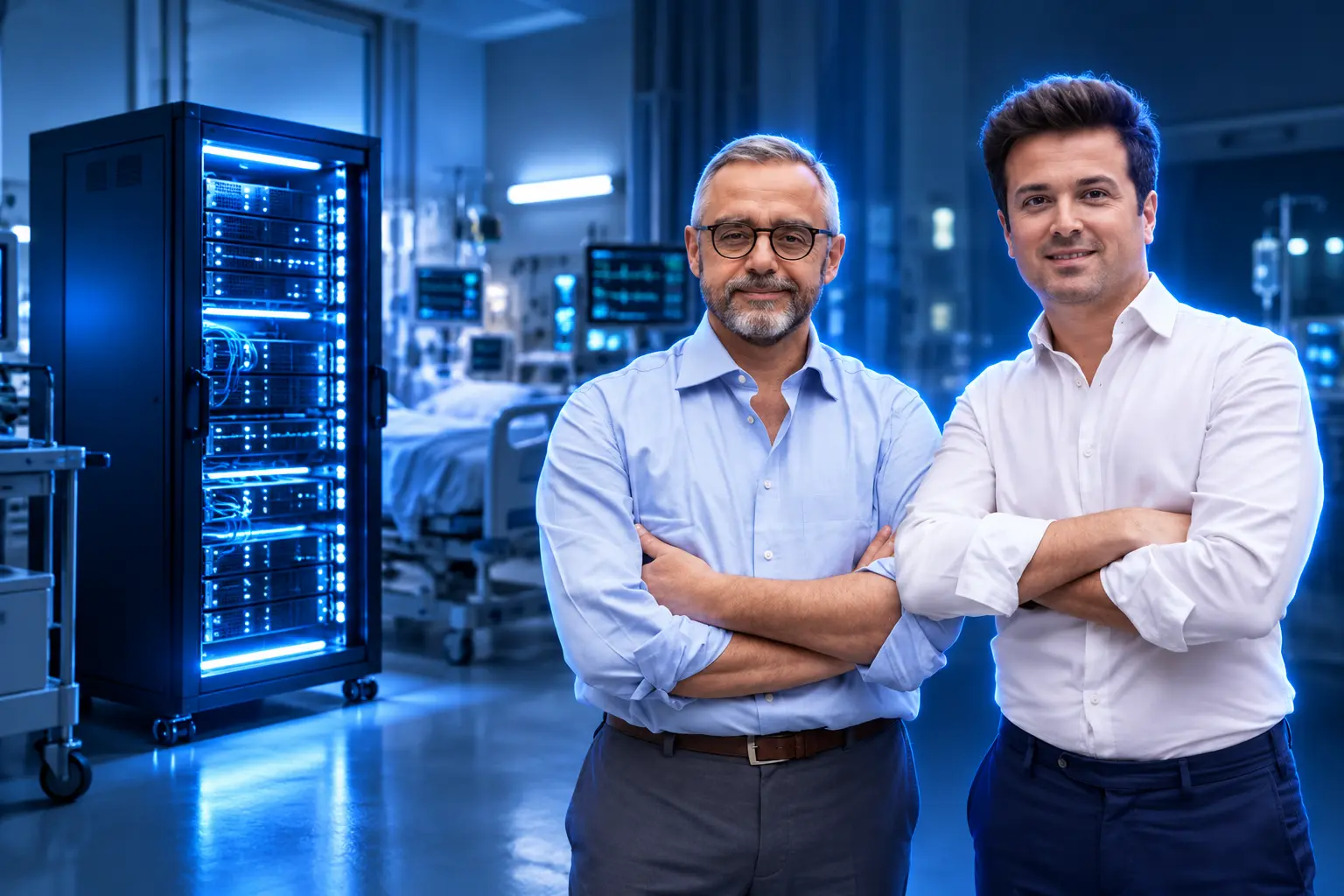
What the NVIDIA Node Does in Each Hospital
Hospitals sit on years of notes, scans, and lab lines that researchers want. The files are split across old systems and often sit as unstructured text, so they are hard to query and legally painful to move. Agora’s answer is a dedicated on-premise computing node at each site, built around GPUs from Nvidia, the chips that already run much of Europe’s AI.
The company says specialised large language models then structure and standardise what is on the node. Irreversible mathematical anonymization is applied next, with a claim that the method is designed to hold even against quantum computers. Original records stay inside the hospital’s own infrastructure. Federated algorithms then let research centres and drug makers run multi-centre studies on populations that span the countries on the network, while only outputs and inferences move.
HOW A SITE JOINS THE NETWORK
- The box: A GPU node is installed on hospital premises and never needs the raw file to leave the building.
- The cleanup: Language models turn messy clinical text into a standard form the rest of the network can query.
- The lock: Anonymization is applied on site; Agora says its own staff have no access to the underlying patient data.
- The study: Models can be trained and checked locally, and only inferences are shared for a named research purpose.
That last step is federated learning, the method that lets institutions train models without pooling patient files. Cancer groups have already used it on real hospital slides. Agora is selling a version aimed at messy routine records, with the hospital still choosing what is offered, to whom, for how long, and for what purpose.
Hospitals Keep Most of the Project Value
The commercial design is the part of the wager most funding notes skip. Zaccagnini said most of the economic value of each project stays with the clinical centres that put up the information, while Agora Labs keeps a cut. He has also said the worth of the network is not only the information, but the collaborations it can set up between hospitals and companies.
Privacy is an integral part of medical ethics that I swore to as a physician. My vision is for Agora to be the guardian of privacy whilst enabling the global use of medical data to fuel research and innovation.
Davide Zaccagnini, co-founder and CEO, Agora Labs
In a February 10, 2026 interview with the Health Innovation Network, he put the same idea in operational terms. The clinical centre decides. Agora’s team does not see the files. The stated aim is a “direct-from-hospital” path that lets sites join research and industry work while cutting their need for data brokers.
That is the wager against the incumbent real-world-evidence trade, which has grown by assembling claims, electronic records, and pharmacy files into products drug makers can license. If hospitals can be paid to keep the asset and still host a study, the broker’s inventory is worth less. If hospitals stall on installing boxes, or if pharma still prefers one contract with a giant data firm, the commission model stays a slide.
From Harvard Medical School to San Raffaele
Funding announcements name Harvard Medical School and San Raffaele Hospital in Milan among the 50 sites. The company has a signed support agreement with Health Innovation North West Coast, working with NHS Secure Data Environments and hospital staff. In that February interview, Zaccagnini described a global install base spanning France to Saudi Arabia, which means the Middle East is an extension of work already on the ground, not a blank map.
WHERE THE 50 SITES STAND
| Region | What is named | What the new money is for |
|---|---|---|
| Europe | San Raffaele in Milan; NHS North West Coast support | Hold and grow the base toward 100 sites |
| United States | Harvard Medical School, as named in the round | Use P101’s U.S. industrial ties to go deeper |
| Middle East | Install base described as far as Saudi Arabia | Open more of the region |
| India | Not named as a current site | Enter as a new market |
Zaccagnini told an Italian business daily that P101 brings institutional weight and market relationships the company needs to scale abroad, including in the United States. The public list of named hospitals is still short. A network of 50 is a sales fact the company is willing to put on the round; it is not a published roster of GPU racks, and Harvard’s exact role is described only as membership in that network.
The Round Faces a $6.22 Billion Evidence Market
Agora Labs sells into real world evidence, the use of data collected in ordinary care to support research, approvals, and new tools. MarketsandMarkets puts the global real-world-evidence solutions market at $6.22 billion in 2026, heading for $12.44 billion by 2031 at a 14.9 percent compound rate. That is the field a €4.3 million round is walking into, not a niche that is empty.
Regulators are already using this kind of evidence. FDA data cited in that same market note show NDA and BLA submissions containing real world evidence rising from 4 in FY2023 to 10 in FY2025, with the agency using it in decisions on Onapgo, Isturisa, and Gamifant in 2025. In Europe, the EMA’s DARWIN EU network has reached 40 data partners in 18 countries, with access to data from about 250 million patients and 88 studies completed. IQVIA said in 2025 that its U.S. real-world-evidence network covered more than 318 million lives.
The large vendors on that map are IQVIA, Optum, ICON, and Flatiron Health, firms that win by covering lives at national scale. Owkin is already in the federated-hospital lane, with published multi-centre work and a cancer-heavy network. Agora’s opening is narrower: unstructured hospital text, an on-site Nvidia node, and a split of project fees that favours the clinic. It is a credible commercial position. It is not an empty category, and €4.3 million does not buy IQVIA’s coverage.
Europe’s Health Data Rules Come Into Force in 2027
The company presents itself as a spin-off from seven-year European research programs on blockchain, privacy-preserving computation, and federated learning, work that began from the need to share health data under the GDPR. Commercial operations started in 2023. Minos Garofalakis, a cryptography and privacy specialist, is named on the company site as a 2022 co-founder and now sits as a research advisor.
THE PATH FROM LAB PROJECT TO THIS ROUND
- 2018 onward: EU research on sharing clinical data after the GDPR took effect, later described as programs spanning seven years.
- 2022: Agora Labs is founded, with Zaccagnini as clinician-chief executive.
- 2023: Commercial activity starts after the technology is validated.
- February 10, 2026: Zaccagnini describes the NHS support agreement and an install base from France to Saudi Arabia.
- October 27, 2026: P101 leads the €4.3 million round to push the network from 50 sites toward 100.
The public rails are still being built. Regulation (EU) 2025/327, the European Health Data Space rules, was published on March 5, 2025, and entered into force on March 26, 2025. Application begins on March 26, 2027. Rules on secondary use of most electronic health-record categories follow in March 2029, with remaining categories, including genomic data, in March 2031. Agora is selling a private network in the years before those public pipes are required to work. If the Health Data Space makes cross-border secondary use ordinary, a 100-site private mesh has to prove it is still the faster way to run a study. If the public system is slow, the private nodes are the path drug makers can buy now.
Rome Wants the Next 50 Hospitals Online
The plan attached to the round is blunt. Double the network from 50 to 100 sites in the coming months. Add about 20 technical and commercial people. Hold Europe and the United States. Push further into the Middle East and open India. Zaccagnini’s own test, from the NHS work, is that sites join faster when privacy, infrastructure, and day-to-day operations are solved together, and that conflicting installs and weak monitoring kill trust faster than a weak model does.
Fifty more nodes means fifty more hospital IT teams, fifty more GPU installs, and fifty more arguments about who may query a ward’s files. India and Gulf regulators will not copy the GDPR clause for clause. Pharma buyers already have IQVIA-scale contracts and federated cancer networks on the table. The €4.3 million has to cover boxes, people, and those sales cycles at once.
P101 and the Mussetto family are paying for a network in which the valuable thing never moves. The next 50 hospitals will decide whether that is a product or a pilot with a new letterhead.
Disclaimer: This article is news reporting and analysis of a completed private funding round and of Agora Labs’ stated product and expansion plans. It is for information only and is not investment advice, a solicitation to buy or sell any security, or medical, clinical, or data-protection advice. Readers considering an investment in private companies, venture funds, or health-data vendors should consult a licensed financial adviser, and hospitals or researchers considering a deployment should consult qualified clinical, legal, and privacy counsel in their own jurisdiction. Figures, headcounts, site counts, and regulatory dates reflect the company, investor, and market sources cited as of October 27, 2026, and may change as the network, the round’s use of proceeds, and EU health-data rules move on.

One UI 9.5 Beta Puts the Galaxy S26 on Last Year’s Clock

DBS Puts a 24/7 USDC Window Inside the Bank

European Startups Head for $81 Billion as First Checks Shrink

US Stocks Lost $1.3 Trillion Before Nvidia’s Beat

Home Depot Bets on Finance Chief Richard McPhail as CEO

Aramco Crash Kills 14 Two Days After Oil Restart

Salah Captained Egypt to Their First World Cup Win

Zelda’s 40th Switch 2 Ships Without a Zelda Game

Apple Labor Day Deals Hide June’s Memory Price Hike

El Niño Puts Israel’s Needed Winter Rain on a Flood Clock
-
 BUSINESS5 months ago
Aramco Crash Kills 14 Two Days After Oil Restart
-
 NEWS6 months ago
Salah Captained Egypt to Their First World Cup Win
-
 GAMING2 months ago
Zelda’s 40th Switch 2 Ships Without a Zelda Game
-
 NEWS3 months ago
Apple Labor Day Deals Hide June’s Memory Price Hike
-
 NEWS4 months ago
El Niño Puts Israel’s Needed Winter Rain on a Flood Clock
-

 GAMING2 months ago
Palworld 1.0.4 Adds Palpedia Search After the 1.0 Launch
-

 NEWS4 months ago
Saudi Visa Routes Split Nigerian Travelers Into Two Speeds
-

 BUSINESS9 months ago
BAE’s 60-Year Saudi Franchise Now Runs Through Taif