
AUTO
Audi Built the Q9 as America’s Matrix-Lit Flagship
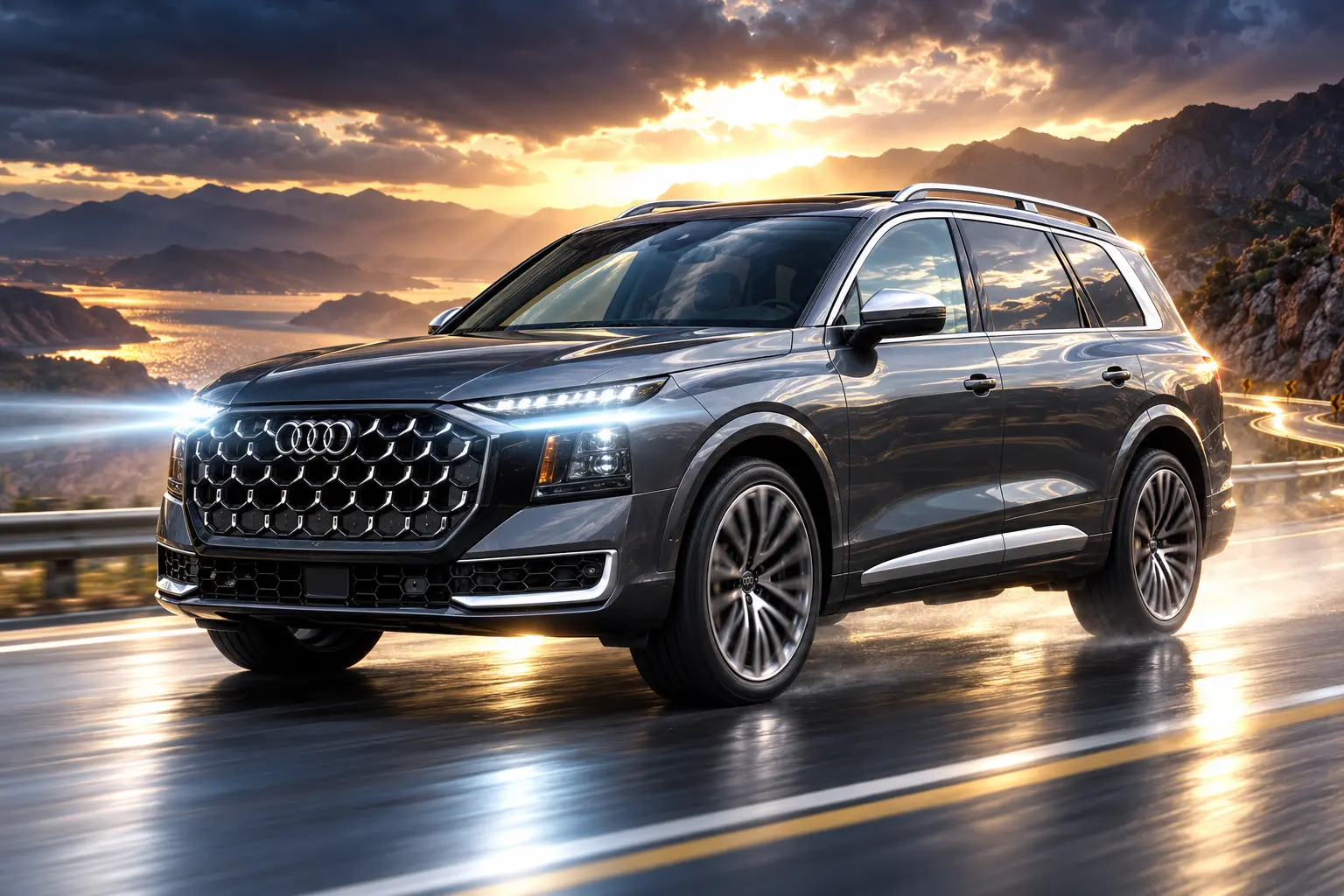
The 2027 Audi Q9 is a U.S.-first three-row flagship that finally certifies Digital Matrix headlights and hands-free driving against BMW and Mercedes money.

The 2027 Audi Q9 is Audi’s first full-size three-row SUV, and Audi expects 65 percent of global sales to land in the United States. U.S. deliveries begin in the fourth quarter of 2026, with the Q9 starting at $87,700 and the SQ9 at $118,000 before a $1,395 destination fee.
Audi sized the flagship for the country that will buy most of them, then put two delayed Volkswagen Group systems on that truck: Digital Matrix headlights, sold in Europe since 2013, and the group’s first hands-free highway assistant. Both arrive in a class BMW and Mercedes already occupy at similar money.
Audi Built This Flagship Around American Volume
On July 28, 2026, Audi of America called the SQ9 a spacious three-row SUV built for the U.S. market and the performance halo of the Q9 family. That line is the product brief. North America is scheduled to take the vehicle first, a first for the brand, and the plant in Bratislava, Slovakia, is expected to send about two-thirds of output this way.
Vito Paladino, named president of Audi of America in April 2026, has said SUVs already make up 80 percent of the brand’s U.S. sales. Filip Brabec, senior vice president of product planning, has framed the engines and the cupholders as American asks. With no firm plan yet to replace the A8 sedan, the Q9 is the new range-topper on these shores.
The body matches that brief. The Q9 stretches 209.0 inches on a 123.5-inch wheelbase; the SQ9 is 208.9 inches long. Seven seats are standard, and captain’s chairs in the second row turn it into a six-seater. Adaptive air suspension is part of the full-size kit, with about 3.5 inches of ride-height range and a maximum 10 inches of ground clearance. Rear-axle steering, standard on the SQ9 and fitted on the Utah press cars, turns the rear wheels up to five degrees to shrink the turning circle at parking speeds and keep the rear in phase on a fast sweep.
The Full-Size Hole the Q7 Never Filled
The Q7 has offered a third row for years, but it was packaged for Europe. Adults fit back there only in a pinch, and the truck sat below the BMW X7 and Mercedes-Benz GLS in length and cargo. The Q9 is nearly 10 inches longer than the latest Q7 and sits on Volkswagen Group’s Premium Platform Combustion, the same architecture under the new Q7, Q5, and A5.
Cargo is the proof of the stretch. With the third row up, Audi lists 19.3 cubic feet behind it, which the company calls best in class. Fold that row and the well opens to 50 cubic feet. Fold the second row too and the cabin claims up to 87.7 cubic feet of cargo. Both models are rated to tow 7,700 pounds with the optional hitch.
On the global media drive in southwestern Utah, a six-foot-one passenger sat behind a six-foot-four driver in the second-row captain’s chairs without folding himself in half. The third row is still a place for shorter trips if the people up there are tall. Eight USB ports and available five-zone climate, with third-row controls in the roof, are the family-hauler details Audi did not have to invent, but did have to fit.
Matrix Lights Finally Meet U.S. Glare Rules
The lighting is the system Audi could not sell here for more than a decade, and the Q9 is the vehicle that carries the U.S. certificate. Digital Matrix LED headlights are standard on the SQ9 and available on the Q9, with the richer functions packed into higher trims. Each lamp uses a micro-LED array of 25,600 individual micro-LEDs per module about 13 millimeters wide. Each diode is about 40 micrometers across, roughly half the thickness of a human hair.
Cameras pick out traffic and signs. The beam stays at high-beam intensity except in moving dark boxes around other cars, so the driver keeps far light without glaring oncoming traffic. On a dark two-lane during the first drives, testers watched those cutouts track other vehicles while the shoulders stayed lit. Lane lighting, rural orientation paths, and turn-signal projection onto the pavement are part of the same module, within the system’s limits.
THE ROAD TO U.S. MATRIX LIGHTS
- 2013: Audi puts Matrix headlights into European production on the A8, the same year Toyota petitions U.S. regulators to allow adaptive driving beams.
- February 22, 2022: NHTSA issues its February 2022 rule on adaptive driving beams, amending FMVSS No. 108 so makers can certify ADB lamps that hold glare to low-beam limits.
- May 21, 2026: Audi of America says the Q9 and SQ9 will be the first U.S. Audis with Digital Matrix LED headlights that meet Department of Transportation glare tests.
- July 28, 2026: The Q9 family debuts, with Matrix lighting standard on the SQ9 and available on the Q9.
- Fourth quarter of 2026: U.S. dealer deliveries begin, 13 years after the European launch.
The 2022 rule opened the door; it did not put lamps on cars. Audi says other makers still struggled with the track and lab glare tests, and that its own certification took about a year of driving and bench work. Volkswagen Group and BMW had even sought temporary exemptions from FMVSS No. 108 before the final rule landed, and NHTSA denied those petitions the same day it published the new standard.
We are very excited to be able to offer Digital Matrix LED lighting functions to our U.S. customers for the first time. It’s a technology that will benefit all road users by providing better lighting and less glare for all.
Filip Brabec, Senior Vice President of Product Planning, Audi of America
Out back, third-generation digital OLED taillights can curve with the body for the first time in series production. Six panels hold 512 segments on glass only 0.1 millimeters thick, bent to a radius of up to 200 millimeters. The outer panel, 99 segments, is the largest OLED Audi has put on a car. Available advanced turn signals throw a stylized arrow onto the road at night, timed with the front and rear sequential lamps. An illuminated Singleframe grille and lit rings are North American signatures. Stefan Berlitz, head of lighting development at AUDI AG, put the brief in one line: at Audi, light means safety first, seeing and being seen.
When the Q9 was revealed, the loud argument was not this lighting wait. It was the grille and the screen stack, with more than a few people saying the face read like a Hyundai Santa Fe. Audi spent 13 years getting the lamps through U.S. rules and still launched a flagship whose styling, by its own first-drive verdict, does not immediately read as an Audi.
Why Hands-Free Driving Stops at Mapped Highways
Adaptive Driving Assistant Plus is Volkswagen Group’s first hands-free highway system, and it is standard on Q9 Premium Plus and Prestige and on the SQ9. On approved highway segments in the United States, Canada, and Germany, it steers, brakes, and accelerates while a camera on the steering column watches the driver’s eyes and head. In the U.S. and Canada the cap is 85 mph; in Germany it is 130 km/h. Tap the turn signal and the truck will change lanes if the sensors agree the gap is clean. Ignore the attention prompts long enough and Emergency Assist brings the SUV to a controlled stop. The driver stays responsible the entire time.
Audi has mapped about 130,000 miles of U.S. roads. That is a thin net next to the maps GM quotes for Super Cruise, about 750,000 miles in the U.S. and Canada, and the roughly 500,000 miles Ford lists for BlueCruise. There is no automatic pass-and-return, and no interchange navigation. Rural Utah in hard weather was a poor demo: the system balked in storms and on unmapped stretches, then settled down on flatter, charted highway. Audi walked away from Level 3 Traffic Jam Pilot after the 2017 A8; this is the quieter Level 2+ replacement, years later, on a family SUV rather than a flagship sedan.
HANDS-FREE LIMITS ON THE Q9
- Speed cap: Hands-off operation is limited to 85 mph in the United States and Canada, and 130 km/h in Germany.
- Mapped roads: The system works only on approved highway segments; Audi’s U.S. map covers about 130,000 miles.
- Driver monitor: A camera on the steering column tracks eyes and head and nags if attention drops.
- Lane changes: Automated moves start only after the driver taps the turn signal, and only if the sensors call the gap safe.
- Fallback: Unanswered prompts lead to a controlled stop, and the driver remains responsible at all times.
A long road trip on interstates the map already knows is the job this system was written for. City streets and unmapped two-lanes are still ordinary assisted driving, hands on the wheel.
A 429-hp V6 and a 591-hp V8
Every Q9 uses a twin-turbo 2.9-liter V6 rated at 429 horsepower and 442 lb-ft, sent through an eight-speed Tiptronic and a new quattro setup. Audi added four springs to the center Torsen differential so the front and rear axles stay coupled even when a gear-type diff would unload. Manufacturer 0-60 mph is 4.9 seconds. Curb weight is 5,302 pounds. Top speed is 130 mph. EPA figures are still TBA.
The SQ9 takes the 4.0-liter twin-turbo V8 used across the group, here at 591 horsepower and 590 lb-ft. Audi quotes 3.8 seconds to 60 mph and calls that the quickest three-row in the class. Spec sheets list 5,556 pounds. Quattro here is a different machine: a clutch-based center coupling with a rear bias, an electronically controlled rear-axle lock, and the ability to send almost all torque aft. Brakes are 16.5-inch discs with six-piston calipers up front and 15-inch discs at the rear. Staggered 22-inch wheels are standard, 23s optional, with 10-inch-wide fronts and 11.5-inch-wide rears.
Q9 AND SQ9 AT A GLANCE
| Spec | Q9 | SQ9 |
|---|---|---|
| Starting MSRP | $87,700 | $118,000 |
| Engine | 2.9L twin-turbo V6 | 4.0L twin-turbo V8 |
| Horsepower / torque | 429 hp / 442 lb-ft | 591 hp / 590 lb-ft |
| 0-60 mph (mfr.) | 4.9 sec | 3.8 sec |
| Curb weight | 5,302 lb | 5,556 lb |
| Quattro layout | Torsen center with added springs | Rear-biased clutch, locking rear diff |
In Utah the V6 got into boost quickly and the ZF gearbox snapped off clean shifts, while air springs and adaptive dampers on 22-inch wheels swallowed broken pavement at a curb weight just over 5,300 pounds. Audi kept passive sway bars on purpose, arguing a little roll makes the body feel solid. The SQ9, once moving, used the rear-biased quattro to make 5,500-plus pounds feel awake on wet mountain pavement. Launch control was another story: traction control kept cutting in, so the 3.8-second claim is a number for a dry, prepped run, not a school-run getaway.
The cabin is the other half of the American brief. The shifter lives on the steering column, which frees a pair of wireless charge pads that actually hold a phone on rough roads and keep it only warm, not hot. Dual-zone climate in the second row suits captain’s chairs. The panoramic roof, more than 16 square feet and the largest Audi has fitted, uses electrochromatic tint in nine segments and has no conventional shade. Piano-black plastic is still in the climate stack under the OLED screen. A Bang & Olufsen setup with 22 speakers and 1,360 watts, plus seat exciters, is a $950 option; several drivers on the press trip wanted more bass from the speakers and less buzz in the cushions.
Loaded Stickers Climb Past $110,000 Fast
The Q9 Premium opens at $87,700, which is $89,095 once destination is added. Prestige is listed at $102,400 before that fee. The SQ9 is a single trim at $118,000. Those starts sit next to a 2027 BMW X7 from $89,050, a Mercedes-Benz GLS from $90,250, and a Cadillac Escalade from $91,100, so the door price is not the outlier. Options are.
A Q9 Prestige Plus on the Utah drive stickered at $110,095. The SQ9 on that same trip ran to $128,045. Tick every box in the U.S. configurator, including destination, and one SQ9 build reached $130,245. The $4,750 Luxury package is the heavy hit, bundling power-assisted doors, the illuminated grille, customizable daytime running lights, curved OLED tails, and an air-quality pack. Captain’s chairs are $450 on the SQ9.
PRICE RUNGS ON THE Q9 FAMILY
- Q9 Premium: $87,700 before the $1,395 destination charge, or $89,095 as delivered.
- Q9 Prestige: $102,400 before destination, with Matrix lighting and the richer cabin kit.
- SQ9: $118,000 before destination, V8 and rear-biased quattro included.
- As tested: $110,095 for a Q9 Prestige Plus and $128,045 for the press SQ9; a maxed configurator SQ9 hit $130,245.
Brabec called the V8 “RS-level performance for an S price tag” and “a fantastic value.” That holds only if the comparison is an RS6 or an AMG GLS 63, not a loaded Q9 that has already crossed $110,000. Matrix lighting, hands-free driving, and the curved OLEDs are the features you cannot buy on last year’s Q7 at any price, and they are the reason this truck exists as a U.S. flagship rather than as a stretched Q7. Dealers begin taking the 2027 Audi Q9 and SQ9 in the fourth quarter of 2026.

One UI 9.5 Beta Puts the Galaxy S26 on Last Year’s Clock

DBS Puts a 24/7 USDC Window Inside the Bank

European Startups Head for $81 Billion as First Checks Shrink

US Stocks Lost $1.3 Trillion Before Nvidia’s Beat

Home Depot Bets on Finance Chief Richard McPhail as CEO

Aramco Crash Kills 14 Two Days After Oil Restart

Salah Captained Egypt to Their First World Cup Win

Zelda’s 40th Switch 2 Ships Without a Zelda Game

Apple Labor Day Deals Hide June’s Memory Price Hike

El Niño Puts Israel’s Needed Winter Rain on a Flood Clock
-
 BUSINESS5 months ago
Aramco Crash Kills 14 Two Days After Oil Restart
-
 NEWS6 months ago
Salah Captained Egypt to Their First World Cup Win
-
 GAMING2 months ago
Zelda’s 40th Switch 2 Ships Without a Zelda Game
-
 NEWS3 months ago
Apple Labor Day Deals Hide June’s Memory Price Hike
-
 NEWS4 months ago
El Niño Puts Israel’s Needed Winter Rain on a Flood Clock
-

 GAMING2 months ago
Palworld 1.0.4 Adds Palpedia Search After the 1.0 Launch
-

 NEWS4 months ago
Saudi Visa Routes Split Nigerian Travelers Into Two Speeds
-

 BUSINESS9 months ago
BAE’s 60-Year Saudi Franchise Now Runs Through Taif