
BUSINESS
Crypto Markets Price a Democratic House After the Bill Died
Polymarket prices Democrats at 92 percent for the House, even after Democrats blocked crypto’s market-structure bill.

Polymarket prices Democrats at 92 percent to win the House in the November 3 midterms. Kalshi’s Senate book is the race that still trades like a fight, not a formality.
The platforms crypto built are now the forecast Washington watches, and they are pricing a Democratic House after every voting Democrat helped block the industry’s market-structure bill in September.
Markets Treat the House as Already Decided
Republicans still run both chambers, but the majorities are thin enough that a handful of seats would change the gavel. Kalshi’s own midterm guide, last updated October 21, puts the House at 218 to 214 in the House, with one independent, Rep. Kevin Kiley of California, caucusing with Republicans and two seats vacant. A majority is 218. Democrats hold 214, so they need four more.
The Senate is 53 Republicans, 45 Democrats, and two independents, Angus King of Maine and Bernie Sanders of Vermont, who caucus with Democrats, for a 53 to 47 split. Democrats need a net gain of four seats to reach 51. A 50-50 chamber would stay Republican because Vice President JD Vance breaks ties. Unified Republican control has held since January 2025, with Donald Trump in the White House, Mike Johnson as speaker, and John Thune as Senate majority leader.
That math is why the House contract is lopsided and the Senate contract is not. As of October 27, Polymarket’s House book had Democrats at 92 percent, with $23.8 million in notional volume. Kalshi’s matching House contract has been near 91 percent, with 73.4 million contracts traded. On October 28, Kalshi’s live Senate market showed Democrats a 64 percent chance of winning control and more than $95 million in volume.
CHAMBER CONTROL PRICES
| Outcome | Polymarket (Oct. 27) | Kalshi |
|---|---|---|
| Democratic House | 92% | 91% |
| Democratic Senate | 65.5% | 64% |
| Democratic sweep | 65.5% | 62% |
| Democratic House, Republican Senate | 26.5% | 29% |
| Republican sweep | 7.5% | 9% |
Kalshi’s House figure is from its October 21 control guide. The Senate, sweep, split, and Republican-sweep prices are from the live book on October 28. A Republican House with a Democratic Senate is a rounding error in both books, at well under 2 percent.
Those sweep odds have moved a long way this year. In January, Kalshi traders still gave Republicans about a two-in-three shot at holding the Senate. By mid-March, Democrats had edged ahead at 51 percent in the Senate and 84 percent in the House, with a sweep at 50 percent. The House then ran away. The Senate did not.
History is doing some of that work. The president’s party has lost ground in 20 of the last 22 midterms, and the average House loss since 1946 is about 27 seats. A 92 percent House price is what that pattern looks like when the majority is already four seats from breaking. The Senate map is harsher. Republicans are defending 22 of the 35 seats on the ballot, but many of those seats sit in states that vote Republican in presidential years, which is why 64 percent is not 92 percent.
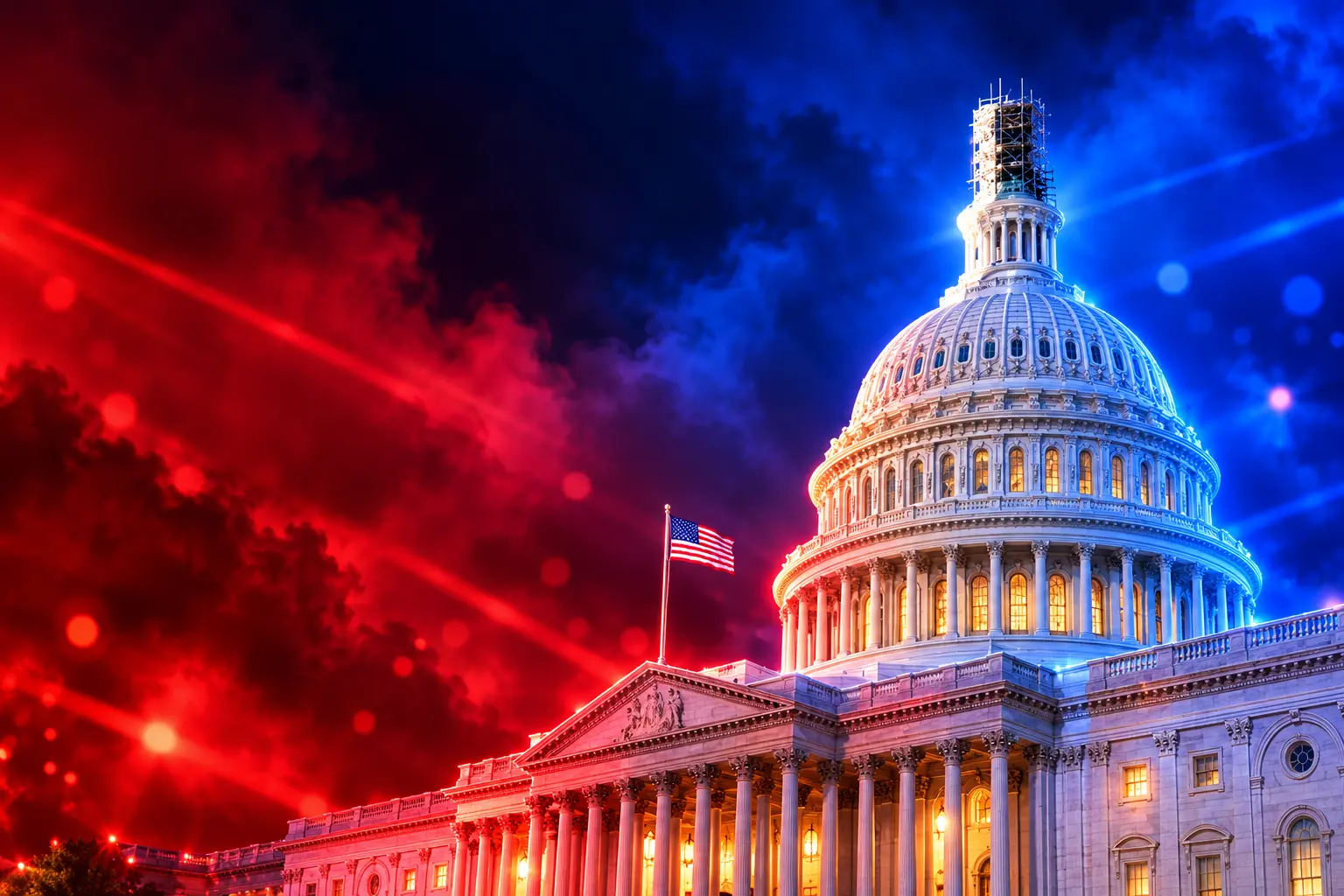
A 49-50 Vote and an Empty Floor
The Digital Asset Market Clarity Act, H.R. 3633, is the bill the industry spent the year trying to turn into law. It would put digital commodities chiefly under the Commodity Futures Trading Commission and leave the Securities and Exchange Commission with a narrower role over some initial sales. The House already passed its version in July 2025, 294 to 134. The Senate Banking Committee cleared a version in May 2026, 15 to 9, with two Democrats joining Republicans.
The floor was the problem. Ethics rules aimed at senior officials’ crypto profits, bank pushback on stablecoin rewards, and fights over DeFi language stalled a unified Senate text through the summer. On September 14, Sens. Cynthia Lummis, John Boozman, and Tim Scott released a final draft that Republicans said folded in 126 substantive changes requested by Democrats. The next afternoon, the Senate voted anyway.
HOW THE CLARITY ACT STALLED
- July 2025: The House passes its Clarity Act text, 294 to 134.
- May 2026: Senate Banking approves a version 15 to 9, with two Democrats in the yes column.
- September 14, 2026: GOP sponsors release final Senate text and claim 126 Democratic-requested edits.
- September 15, 2026: Cloture on the motion to proceed fails 49 to 50 at 2:19 p.m. ET, 11 votes short of 60.
- September 15, 2026: Sen. Thom Tillis of North Carolina switches from yes to no and files a motion to reconsider.
The 49 to 50 cloture vote was not a vote on the bill’s final text. It was a vote on whether to open debate. All 49 yes votes came from Republicans. Every voting Democrat and independent opposed cloture. Four Republicans joined them: Susan Collins of Maine, Josh Hawley of Missouri, Jerry Moran of Kansas, and Tillis. The motion needed 60 votes. It finished 11 short.
CFTC Chair Michael Selig later said he was disappointed Congress did not send the bill to the president. The agency, he has argued, would have gained a clearer mandate to register platforms and write customer-protection rules. Instead, both the SEC and the CFTC are writing around the hole with staff relief and proposed rules that can be rewritten by the next chair.
Spending Dropped After the Vote Failed
Coinbase’s estimated federal lobbying spend fell to $1.04 million in the third quarter, covering July 1 through September 30, down $120,000, or 10.3 percent, from a $1.16 million second-quarter estimate. The filing is a good-faith estimate rounded to $10,000 increments and does not break out September 15. In the first half of 2026, Coinbase spent about $2.2 million on lobbying that included the bill. Kraken spent close to $1 million over the same six months.
Crypto firms and trade groups spent more than $13 million lobbying in the first half, with roughly $8 million tied through disclosure language to market-structure work. Combined industry lobbying still cleared $4 million in the third quarter for a sixth straight quarter, even as some outside firms dropped crypto clients. The campaign-side money did not pause with the cloture loss. TD Cowen, in a midterm note, put crypto political spending at $176 million across more than 100 races.
Sen. Kirsten Gillibrand and colleagues put out a statement saying they still wanted a deal. No new cloture vote has been scheduled. The Senate is away until November 6. Tillis’s motion to reconsider is the formal path back, and 60 votes are still the price of admission.
Iowa’s Open Seat Can Still Break the Sweep
If the House is a 92 percent story, the Senate is an Iowa story with six other names attached. Kalshi lists Texas, Maine, Michigan, Ohio, Iowa, South Carolina, and Kansas as the races most likely to decide control. Democrats must hold all 13 of their seats on the ballot and take four Republican-held ones. Iowa is the open seat in that set: Sen. Joni Ernst, a Republican, is not running.
IOWA’S OPEN SENATE SEAT
- The book: On October 28 Kalshi priced Rep. Ashley Hinson, the Republican, at 59 percent and Democrat Josh Turek at 41 percent, on $6.09 million of volume.
- The money: Hinson had raised $13.5 million to Turek’s $6.3 million, with Turek drawing a much higher share of donations of $200 or less.
- The polls: October surveys have the race inside a few points either way, which is why the seat still trades as a toss-up even with Hinson ahead in the book.
Kalshi Politics posted the same Iowa split a few days earlier, Hinson 57 percent and Turek 43 percent, before the live book ticked toward Hinson.
IOWA SENATE ODDS:
🟥 Ashley Hinson: 57%
🟦 Josh Turek: 43% pic.twitter.com/1V5oLvlIgG— Kalshi Politics (@KalshiPolitics) October 25, 2026
A 64 percent Senate price is not a lock. It is roughly one outcome in three in which Republicans keep the chamber, and that is the scenario both books still treat as the main alternative to a sweep: a Democratic House and a Republican Senate, 26.5 percent on Polymarket as of October 27 and 29 percent on Kalshi on October 28.
SENATE RACES KALSHI SAYS CAN DECIDE CONTROL
- Texas: Talarico versus Paxton, priced as a tipping-point seat in several models.
- Maine: Collins, who voted no on Clarity cloture, versus Jackson.
- Michigan: El-Sayed versus Rogers, an open-seat fight in a state Trump won in 2024.
- Ohio: The special election, Brown versus Husted.
- Iowa: Hinson versus Turek, the open Ernst seat.
- South Carolina: Graham versus Andrews.
- Kansas: Marshall versus Hamilton, moved from Lean Republican to toss-up on Kalshi’s hub on October 28 even as Polymarket still had Marshall near 60.5 percent.
That Kansas tick is the tell on how these books work late. A ratings desk can print toss-up while the money is still with the Republican. The House contract has barely moved. The Senate contract is where a single state can still change who writes the next market-structure draft.
The Exchanges Pricing Congress Are on Trial in Utah
The same week the House contract sat at 92 percent, the CFTC and the NBA signed a memorandum of understanding on basketball-related event contracts, and the NBA named Kalshi and Polymarket its preferred prediction-market exchanges. The NBA is the third major league to sign that kind of pact, after MLB and the NHL. The NFL has not. Scott Kaufman-Ross, the NBA’s head of media distribution and partnerships, said the league wanted safeguards in place as the category grows. CFTC Chair Selig praised the data-sharing deal.
Utah’s attorney general filed the opposite document six days earlier. On October 20, Derek Brown sued Kalshi in Third District Court in Salt Lake City, calling the platform illegal gambling and asking a judge to shut it off for Utah users, force geolocation blocking, and claw back fees the state estimates at $30.6 million to $61.2 million. The complaint said that as of February 2026, 55,819 Kalshi accounts used a Utah address and 32,940 had completed signup.
Kalshi runs an online casino in Utah and calls it a prediction market. That violates Utah law.
Derek Brown, Utah attorney general, October 20 news conference
Kalshi’s answer is federal preemption. Spokesperson Jacki McGavick said the firm is a CFTC-regulated derivatives exchange, that customers trade with each other, and that no single state should hold a veto. On October 26, the same day as the NBA memorandum, the CFTC sued Utah and Brown to block the state’s enforcement, the 10th state in which the commission has taken that step. The others include Arizona, Connecticut, Illinois, Kentucky, Minnesota, New Mexico, New York, Rhode Island, and Wisconsin.
A federal judge in Utah had already granted the state summary judgment on August 4, holding that the Commodity Exchange Act does not preempt Utah’s anti-gambling laws. Kalshi appealed to the 10th Circuit. The midterm House contract and the Utah complaint are now the same business, priced in public and tried in court at once.
How Crypto Policy Moves If the House Flips
A Democratic House would give Minority Leader Hakeem Jeffries the speaker’s race and the committee gavels that decide which bills get hearings, which officials get subpoenas, and which market-structure draft, if any, comes to the floor in 2027. The current Clarity text does not travel with the gavel. If it is not signed by January 3, 2027, it dies with the 119th Congress and starts again in committee, likely under Democratic chairs.
TD Cowen’s midterm note sketched three paths that match the books. A Democratic sweep, the most probable, would stall Clarity and leave agencies to keep writing rules on tokenization, perpetual futures, and stablecoins. A split with Republicans holding the Senate would still block bills a Democratic House might send to the president. A Republican sweep, about 9 percent on Kalshi, is the path the firm called best for crypto legislation, with the margin still mattering because 60 Senate votes do not appear by magic.
The House taking Democratic control would also reopen oversight of the Trump administration, including the White House’s crypto holdings that helped sink the September ethics fight. Impeachment talk is already in the bloodstream around a 92 percent House price. Conviction still takes two-thirds of the Senate. Even a Democratic Senate at 51 does not get there without a large Republican break, which is why the Senate book is the constraint on that scenario too.
Agency work will not wait on the speaker’s race. On September 17 the SEC issued a five-year “innovation exemption” for tokenized stock venues, and the CFTC broadened no-action relief for providers of “passive software.” GraniteShares on October 26 pushed the effective date of leveraged XRP, bitcoin, ether, and solana funds to November 30 under Rule 485(b), with no election language in the filing. The GENIUS Act’s stablecoin rules are separately set to take effect January 18, 2027. That is the stack Coinbase is lobbying toward while its quarterly Capitol Hill line item shrinks.
Single-Digit Odds on a Crypto Law This Year
Polymarket’s contract on whether H.R. 3633 is signed in 2026 now gives the bill a 6 percent chance of becoming law, with the No side at 94 percent and about $23 million traded. That is a different market from the 92 percent House contract, and it is the one that tells you what traders think this Congress will actually finish.
The Senate returns November 6. A lame-duck window exists on paper, with Tillis’s reconsideration motion and Gillibrand’s open line. The calendar after an election is also where must-pass funding fights eat floor time. Kalshi’s dated market-structure contracts had already crushed the odds of a law before November 1. The live 6 percent print is the same judgment with a later timestamp.
So the irony sits in two numbers that do not contradict each other. Democrats are 92 percent to take the House on Polymarket. The bill that would have written crypto into the CFTC’s statute is a 6 percent proposition for 2026, after a 49 to 50 vote in which no Democrat voted to start debate. The platforms that produce those prices just got an NBA handshake and a 10-state fight with the CFTC at their back. The new Congress is sworn in on January 3, 2027. Whatever is unsigned that morning dies with the old one.
Disclaimer: This article is news reporting and analysis of prediction-market prices, election math, and pending legislation. It is for information only and is not investment advice, trading advice, legal advice, or a recommendation to buy or sell any event contract, security, or digital asset. Readers who are considering a trade or a political contribution should consult a licensed financial adviser, attorney, or compliance professional who can review their own facts. Market prices, polling, lawsuit status, and bill language can change, and the figures here reflect the cited books and filings as of late October 2026.

One UI 9.5 Beta Puts the Galaxy S26 on Last Year’s Clock

DBS Puts a 24/7 USDC Window Inside the Bank

European Startups Head for $81 Billion as First Checks Shrink

US Stocks Lost $1.3 Trillion Before Nvidia’s Beat

Home Depot Bets on Finance Chief Richard McPhail as CEO

Aramco Crash Kills 14 Two Days After Oil Restart

Salah Captained Egypt to Their First World Cup Win

Zelda’s 40th Switch 2 Ships Without a Zelda Game

Apple Labor Day Deals Hide June’s Memory Price Hike

El Niño Puts Israel’s Needed Winter Rain on a Flood Clock
-
 BUSINESS5 months ago
Aramco Crash Kills 14 Two Days After Oil Restart
-
 NEWS6 months ago
Salah Captained Egypt to Their First World Cup Win
-
 GAMING2 months ago
Zelda’s 40th Switch 2 Ships Without a Zelda Game
-
 NEWS3 months ago
Apple Labor Day Deals Hide June’s Memory Price Hike
-
 NEWS4 months ago
El Niño Puts Israel’s Needed Winter Rain on a Flood Clock
-

 GAMING2 months ago
Palworld 1.0.4 Adds Palpedia Search After the 1.0 Launch
-

 NEWS4 months ago
Saudi Visa Routes Split Nigerian Travelers Into Two Speeds
-

 BUSINESS9 months ago
BAE’s 60-Year Saudi Franchise Now Runs Through Taif