
NEWS
A Winding Chip Turns Dean’s Instability Into a Drug Mixer
HKUST’s tortuous microchannel triggered extra Dean vortices at 1000 μL/min, then shrank prednisolone particles to 46 nm in a 2024 mixer built on that bend.

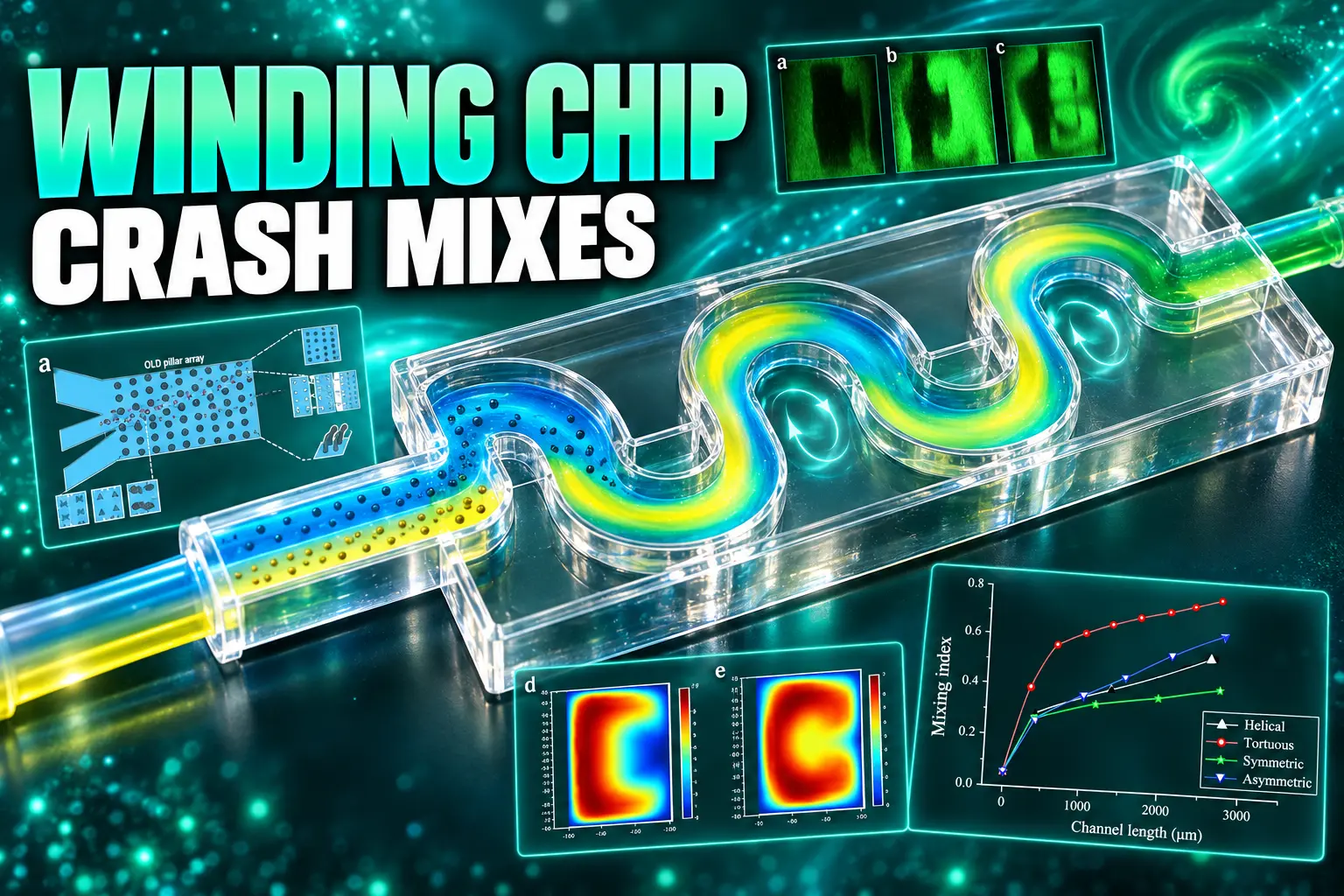
A Hong Kong team has recorded Dean’s instability inside 60 μm-wide, high-aspect-ratio microchannels, the first such run at the deka-micron scale. Yu Ching Wong, Weijia Wen and four colleagues compared four layouts and found a tortuous channel, three bend radii per unit, formed extra vortices at 1000 μL/min.
That flow is half the 2000 μL/min they needed before a symmetric bend reached De > 162. Six months later the same group used an optimized version of the bend to crash-mix a steroid into nanoparticles, which is the part of the work that leaves the mixing graph behind.
Four Layouts and an Extra Pair of Vortices
The first deka-micron Dean instability experiments used four planar chips with the same 60 μm width and aspect ratio 1.5, later given as 90 μm in height. Wong, Cheng Dai, Qingyue Xian, Zhaoxu Yan, Ziyi Zhang and Wen, working from the Hong Kong University of Science and Technology with nodes in Guangzhou and Shenzhen, named the layouts symmetric, asymmetric, helical and tortuous.
Dean’s flow is the familiar pair of counter-rotating rolls that appear in a bend when the fast core is thrown outward. Dean’s instability is the next step. Once the Dean number passes a threshold, a radial pressure gradient near the outer wall starts a second pair of rolls, so four vortices share the cross-section instead of two.
Confocal images at Reynolds number 444, Dean number 162 in the symmetric chip, already show that second pair after the flow has time to develop. A 1992 curved-duct study the team cites found about 240 degrees of bend were needed to reach a fully developed state at Dean number 150, and their first observation point sits at 90 degrees, so the first turn still looks unfinished.
FOUR CHANNELS AT A GLANCE
| Layout | Bend that sets the local Dean number | Extra vortices at 1000 μL/min | Mixing index per unit length |
|---|---|---|---|
| Symmetric | A single-radius turn, Dean number 162 at Reynolds number 444 | No, in the opening simulation | 1.31×10⁻⁴ |
| Asymmetric | A tighter second turn, about 150 μm, Dean number 218 | No | 1.90×10⁻⁴ |
| Helical | Same radius class as the symmetric chip, 270-degree later turns | No | 1.88×10⁻⁴ |
| Tortuous | 270 μm, 60 μm and 240 μm in each unit | Yes, four vortices at the end of the first unit | 2.48×10⁻⁴ |
They drove the chips at 1000, 1500 and 2000 μL/min, which they map to Reynolds numbers 222, 333 and 444. Only the tortuous layout showed the extra rolls in the first simulation at 1000 μL/min, so that rate became the floor for the lab runs. At Reynolds number 333 the other three chips look as if they are just crossing from Dean’s flow into instability. The tortuous chip already holds four vortices at the end of the first unit at the lower rate, though the pattern is no longer symmetric.
Dean Mapped Curved Flow Almost a Century Earlier
W. R. Dean’s 1928 analysis of flow in a curved channel treated motion between concentric walls and asked why a bend does not show the same sudden jump in head loss that a straight pipe shows at the laminar-turbulent switch. G. I. Taylor had already written down a related instability for curved streamlines. Dean and, later, W. H. Reid took the thin-gap pipe, diameter much smaller than the bend radius, and made the Dean number the control knob.
Most later pictures of the extra vortices were taken in lab-scale ducts, where a camera can stare straight at the cross-section. Bara and colleagues used a 1.27 cm square duct at Dean numbers 125, 137 and 150. Sugiyama’s group went down to 25 μm-wide rectangles, aspect ratios 0.5 to 2.5, but still not the tall, 60 μm-class chips now common in inertial sorting. At chip scale, confocal microscopy is the usual way to cut the channel optically, and that is what Wong used.
THE DEAN INSTABILITY CLOCK
- 1928: Dean publishes the curved-channel analysis that still names the Dean number.
- 10 March 2017: Nivedita, Ligrani and Papautsky image extra vortices in low-aspect-ratio spiral chips at Reynolds numbers above 100.
- 19 October 2023: Wong and Wen report the high-aspect-ratio, deka-micron case and the tortuous layout.
- 9 April 2024: Wong, Siyu Yang and Wen run the optimized tortuous chip as a prednisolone nanoprecipitation mixer.
- 21 June 2024: The HKUST physics department posts Wong’s thesis talk tying the flow study and the particle work into one project.
Wen, Professor Emeritus of physics at HKUST and dean of the Function Hub at HKUST (Guangzhou), has a long record in soft matter, PDMS chips and nanoparticle making, which is why a geometry paper from his group did not stay a geometry paper for long.
Why Three Radii Beat a Simple Helix
The Dean number in the paper is Reynolds number times the square root of channel height over twice the bend radius, so a tighter bend raises De at the same speed. The tortuous unit stacks three radii, 270 μm, 60 μm and 240 μm, and the middle one is the perturbation. Fluid that has just been thrown one way is yanked the other way through a much smaller radius, which the team describes as a rolled-up velocity profile: the fast core is no longer a simple parabola sitting in the middle of the duct.
They track that contest with a ratio they call Ω, radial pressure gradient over centrifugal force. In the symmetric chip the average Ω is 1.19 in the first turn and 1.18 the other way in the second, the sign flip coming after 180 degrees. The helical chip is almost the same, 1.19 then 1.17. The asymmetric chip, with a tighter second turn, jumps to 1.86 in magnitude on that turn, and the outer-wall rolls grow relative to the inner ones, a size ratio of 1.632 against 1.399 in the symmetric layout and 1.44 in the helical one.
The helical chip still shares the first-turn geometry with the other two standard layouts, so the team built a variant whose first turn is 270 degrees instead of 180. Two vortex pairs then appear in that first turn, because the observation point has moved from 90 degrees to 135 degrees and the flow has had more bend in which to develop. Geometry, not just speed, is doing the work.
Perturbation of smaller radii creates a different flow behaviour and makes the tortuous channel superior to the other channels regarding Dean’s instability creation at a lower Re and better mixing performance.
Yu Ching Wong, Cheng Dai, Qingyue Xian, Zhaoxu Yan, Ziyi Zhang and Weijia Wen, Scientific Reports 13, 17896
One oddity in the asymmetric chip is not about radius at all. A vortex at the top corner near the inner wall disappears. The team points at the walls: the floor is hydrophilic glass and the roof is hydrophobic PDMS, so the two corners are not the same surface. That is a fabrication detail, not a Dean-number effect, and it is a reminder that a PDMS-on-glass stack is not a mathematically clean duct.
Mixing Index Climbs Fastest in the Tortuous Unit
They scored mixing from simulated concentration fields along the channel, then checked the slope of mixing index against length. The tortuous curve jumps first, slope 91.7×10⁻⁵, then settles to 8.11×10⁻⁵. Per unit length, the tortuous chip reaches 2.48×10⁻⁴, nearly twice the symmetric value and still above the asymmetric and helical chips, which sit within a hair of each other.
MIXING INDEX PER UNIT LENGTH
| Channel | Mixing index per unit length |
|---|---|
| Symmetric | 1.31×10⁻⁴ |
| Helical | 1.88×10⁻⁴ |
| Asymmetric | 1.90×10⁻⁴ |
| Tortuous | 2.48×10⁻⁴ |
The paper’s reading is blunt. The tortuous layout stacks a stronger centrifugal throw with the swirl from that second, tighter turn, so the extra rolls appear at a lower Reynolds number and keep folding the two streams. For a lab-on-a-chip mixer that is the practical claim: more folding without doubling the pump rate. It is still a passive mixer. Nothing on the chip moves except the liquid.
Steroid Particles Down to 46 Nanometers
On 9 April 2024, Wong, Yang and Wen published the follow-up in Nanomaterials. They call it an ice-breaker for real use of Dean instability, and they mean a specific job: organic nanoparticle synthesis at Dean numbers up to 198. The channel is still tortuous, still 60 μm by 90 μm, but the middle and third radii are now 50 μm and 200 μm after a simulation sweep. The best two-unit pattern in that sweep, 50 μm then 200 μm, hits a mixing index of 0.988.
Water and a prednisolone solution meet at a flow ratio of 1:2.5, solvent to water held constant, on a Harvard PHD 2000 syringe pump. Two lengths were cut, 3227 μm and twice that at 6454 μm. Particle size fell as the flow crossed from Dean’s flow into instability, and extra length did little once that regime was on. Scanning electron images show the most abundant particles down to 100 nm as Reynolds and Dean numbers rise, and prednisolone particles as small as 46 nm.
FLOW SETTINGS FOR THE PREDNISOLONE RUNS
- 175 μL/min: Reynolds number 39, Dean number 33, still in the Dean-flow range.
- 250 μL/min: Reynolds number 56, Dean number 48.
- 525 μL/min: Reynolds number 117, Dean number 99.
- 700 μL/min: Reynolds number 156, Dean number 132.
- 875 μL/min: Reynolds number 194, Dean number 165, into the instability window of the 2023 paper.
- 1050 μL/min: Reynolds number 233, Dean number 198, the top of the particle series.
Flash nanoprecipitation is unforgiving about mix time. If the antisolvent and the drug stream stay layered, particles grow. If they are folded in a few milliseconds, the solid crashes out small. The 2023 geometry paper did not mention prednisolone. The 2024 mixer is that paper with the radii trimmed and a drug in one inlet. In Wong’s thesis talk on Dean mixing, posted by the HKUST physics department on 21 June 2024, the flow study and the particle work are one project, not two isolated notes.
Nivedita’s Wide Chips and the Same Extra Vortices
Wong’s introduction is careful about who saw the extra rolls first at chip scale. In 2017 Nivedita Nivedita, Phillip Ligrani and Ian Papautsky published confocal and numerical evidence of secondary vortices in low-aspect spirals at Reynolds numbers above 100, work they framed as the first microchannel Dean-flow study in that range. Their spirals were wide and shallow: aspect ratios 0.6 (250 μm by 150 μm), 0.4 (250 μm by 100 μm) and 0.2 (500 μm by 100 μm), hecto-micron in the long direction.
They introduced a critical Dean number for the onset of the extra pair and found that a higher aspect ratio lowered that threshold, scaling roughly as the inverse square root of aspect ratio. Blood cells in those chips did not sit where a two-vortex model said they should once the flow was fast, which is how the extra rolls announced themselves in a sorter. Wong’s chips invert the proportions, 90 μm tall and 60 μm wide, and shrink the width into the tens of microns. The instability is the same family of rolls. The manufacturing constraint is not.
A wide spiral is a natural cell sorter. A tall, 60 μm tortuous unit is a natural mixer, because the extra folds sit in a short repeating cell instead of a long Archimedean coil. That is the design fork the two papers actually mark, even though both wave at mixing and sorting in the abstract.
The Mixer Still Needs a Syringe Pump
Passive mixers sell themselves as chips without moving parts, which is true of the channel and false of the bench. Every rate in both papers comes from a syringe pump. 1000 μL/min through a 60 μm by 90 μm duct is a hard push, Reynolds number 222, and the 2023 instability pictures at Dean number 162 sit at 2000 μL/min in the symmetric layout. Disposable point-of-care cartridges rarely live at those rates. The tortuous unit’s gain is that it brings the extra rolls down to 1000 μL/min, not that it brings them down to a finger pump.
LIMITS THAT STAY ON THE BENCH
- Wall materials: A PDMS roof and a glass floor can wipe out a corner vortex, so a production plastic chip would need its own check.
- Length: Once instability is on, doubling the mixer from 3227 μm to 6454 μm does little to particle size.
- Job split: Nivedita’s spirals still own wide-channel sorting; this layout is a mixer and a precipitator.
- Adoption: The 2024 paper is explicit that Dean instability had almost no real mixing use at chip scale before the prednisolone run.
The geometry is now specified, the extra rolls are photographed, and a steroid has been crashed to 46 nm in the same family of bends. What has not happened is a swap-out of herringbone and serpentine mixers on commercial cartridges. The second-order result is still a lab result: a three-radius unit that starts Dean’s extra vortices at a lower pump setting, then uses that fold to make small particles, while the pump itself stays on the table.
Frequently Asked Questions
What is the Dean number in a curved microchannel?
Wong’s paper writes it as Reynolds number times the square root of channel height divided by twice the bend radius, so tightening the bend raises De without raising speed. Other groups use hydraulic diameter instead of height, and a 2023 review of Dean vortices notes that those two habits make published De values hard to compare until they are recomputed on one formula.
How does Dean’s instability differ from ordinary Dean flow?
Ordinary Dean flow is one pair of counter-rotating rolls driven by centrifugal throw of the fast core. Instability adds a second pair in the pressure-dominated zone near the outer wall, so four vortices occupy the cross-section, which is the pattern Wong photographed once De exceeded 162 in the high-aspect chips.
Why does a high-aspect-ratio channel change the picture?
Nivedita’s 2017 spirals were low-aspect, wide and shallow, and their critical Dean number fell as aspect ratio rose, roughly as AR to the power minus one half. Wong’s 1.5-aspect, 60 μm by 90 μm ducts sit on the tall side of that trend and pack the extra rolls into a repeating planar unit instead of a long spiral, which is why the same instability shows up as a mixer rather than a cell focuser.
What pump settings did the prednisolone tests use?
A Harvard PHD 2000 syringe pump drove total flows from 175 to 1050 μL/min at a fixed 1:2.5 ratio of prednisolone solution to deionized water, covering Reynolds numbers 39 to 233 and Dean numbers 33 to 198, with particle size falling as the flow entered the instability regime.

Ninja Theory Staff Face Redundancy After Two Xbox Sales Collapse

Amazon Sells the MacBook Air at Its Pre-Hike Price

U.S. Slows Jet Parts to Squeeze China’s Flying Fleets

PEGI Pulled the GTA 6 Age Rating After Cocaine Details

Northwestern’s Smaller Ryan Field Gave Penn State Nowhere to Hide

Aramco Crash Kills 14 Two Days After Oil Restart

Salah Captained Egypt to Their First World Cup Win

Apple Labor Day Deals Hide June’s Memory Price Hike

Palworld 1.0.4 Adds Palpedia Search After the 1.0 Launch

Zelda’s 40th Switch 2 Ships Without a Zelda Game
-
 BUSINESS3 months ago
Aramco Crash Kills 14 Two Days After Oil Restart
-
 NEWS4 months ago
Salah Captained Egypt to Their First World Cup Win
-
 NEWS1 month ago
Apple Labor Day Deals Hide June’s Memory Price Hike
-
 GAMING4 weeks ago
Palworld 1.0.4 Adds Palpedia Search After the 1.0 Launch
-
 GAMING4 weeks ago
Zelda’s 40th Switch 2 Ships Without a Zelda Game
-

 NEWS3 months ago
El Niño Puts Israel’s Needed Winter Rain on a Flood Clock
-

 NEWS3 months ago
Saudi Visa Routes Split Nigerian Travelers Into Two Speeds
-

 BUSINESS2 months ago
Egypt Seeks Two Extra El-Dabaa Reactors Before First Power