SCIENCE
How Can Environmental Education Help Shape a Better Future?
Environmental education shows you how to weigh an issue and choose a responsible action. Learn the five parts and how it differs from a fact sheet.

A poster lesson, a nature walk, or a Saturday cleanup is a familiar way schools and neighborhood groups introduce the environment. Environmental education asks you to explore an environmental issue, work on the problem, and take action to improve the environment. You come away with a deeper understanding and the skill to make informed and responsible decisions, which is the result described on the EPA’s page on environmental education.
That skill is how environmental education can shape a better future. It teaches you to weigh various sides of an issue through critical thinking, and it builds your own problem-solving and decision-making. This page names the five parts, shows how to separate a real program from a fact sheet, and tries them on a local problem.
What Is Environmental Education?
Environmental education is a learning process for people, communities, and organizations, not a single lesson aimed only at children. You learn about the environment, and you practice how to investigate it and decide how to care for it. The environment here includes wild places and the built places around you, from streets and school buildings to the pipes and trucks that move water and waste.
Environmental literacy is the name for the outcome, and it is the public understanding the EPA is asked to raise. You can treat it as a practical bar: you understand the issue, you can explain the tradeoffs, and you can choose a responsible action. The learning is lifelong, from early childhood through older age, and it draws on sound science, a real place, and more than one school subject.
A fact sheet, a campaign speech, and a science lecture can all sit beside this work and still miss it. The gap is whether you practice a decision or only receive a message. Schools, clubs, nature centers, and daily life can all host the practice, which is why the same name covers a class project and a neighborhood meeting.
The Five Parts of Environmental Education
Once the aim is a decision you can defend, the next question is what you actually practice. Environmental education is taught as five parts, and the EPA still lists them in the order set out for teachers in the late 1970s. Each part is a kind of work, and skipping one leaves a hole the later parts cannot fill.
| Part | What the part asks of you |
|---|---|
| Awareness and sensitivity | Notice the environment and the challenges tied to it. |
| Knowledge and understanding | Learn how the environment works and what those challenges are. |
| Attitudes | Build concern for environmental quality and a reason to improve or maintain it. |
| Skills | Identify challenges and help work toward resolving them. |
| Participation | Join activities that lead toward resolving those challenges. |
The first three parts give you a reason to care and a picture of the problem that is wider than a slogan. Skills and participation are where the work becomes a choice: you compare ways forward, you join one, and you stay long enough to see what changed. A program that stops after a moving story has finished the awareness row and left the decision unpracticed.
The same five categories were set out as objectives at the Tbilisi conference, held from October 14 to October 26, 1977. Delegates from 66 member states adopted the text of the Tbilisi Declaration at the close of the meeting, and it still frames the work for every age, inside school and outside it. The declaration also sets three goals: clear awareness of how economic, social, political, and ecological life is tied together in cities and in rural areas; a chance for every person to gain the knowledge, values, attitudes, commitment, and skills to protect and improve the environment; and new patterns of behavior by people, groups, and society.
Several of those principles still change how a lesson should be built. The environment counts as a whole, natural and built, technological and social. Learning is meant to run from preschool through later life, in school and in programs outside school. Learners should help plan the work and then accept the consequences of the choices they make. Because the problems are complex, the principles call for critical thinking and problem-solving on real conditions, with firsthand experience, not only a reading.
Environmental Education and a Fact Sheet
The detail that decides whether a program can shape later choices is easy to miss, because a vivid fact sheet feels like teaching. Environmental education does not advocate a particular viewpoint or course of action. It teaches you how to weigh the sides of an issue, and it strengthens the problem-solving and decision-making you do yourself.
The EPA draws the line against environmental information in four comparisons. Read them as a test you can apply to a worksheet, a video, or a volunteer signup.
| Environmental education | Environmental information |
|---|---|
| Increases public awareness and knowledge of environmental issues | Provides facts or opinions about environmental issues |
| Does teach individuals critical thinking | Does not necessarily teach individuals critical thinking |
| Does enhance individuals’ problem-solving and decision-making skills | Does not necessarily enhance individuals’ problem-solving and decision-making skills |
| Does not advocate a particular viewpoint | May advocate a particular viewpoint |
Use the right-hand column as the warning and the left-hand column as the standard. Facts alone, or a single pushed action, land in information. Comparing evidence, naming tradeoffs, and choosing a next step land in environmental education. A campaign can still be honest and useful, and it is a different tool from a program that leaves the choice with you.
FOUR CHECKS BEFORE YOU JOIN
- More than one account: You hear more than a single slogan about the issue.
- A comparison: You set evidence and tradeoffs side by side.
- Your decision: You leave with a next step you chose.
- No single answer: The program does not claim that only one action is responsible.
These checks matter most when the issue is heated, because a strong opinion is easy to mistake for a finished education. A program can care deeply about clean air, safe water, or wildlife and still meet the test, as long as you are the one who weighs the choice. If every material points to one product ban, one technology, or one protest, ask for the missing comparison before you treat the session as education.
What Changes When You Can Weigh an Issue?
When people can weigh an environmental issue, they can take part in decisions about the places they depend on. The Tbilisi goals describe that shift as new patterns of behavior by people, by groups, and by society, built on awareness of how economic, social, political, and ecological life fits together. In daily terms, you look at a local problem, see who is affected, and help choose a response that fits the evidence you have.
Civic results are the clearest record of that shift. Programs covered by a 2023 review of 56 environmental education studies were generally longer than a month, and they took place in many settings with many kinds of audiences. The counts below are the ones to keep beside any claim that a short activity will change a community.
| What the 2023 review counted | Number |
|---|---|
| Studies in the final sample | 56 |
| Studies reporting some positive civic result | 56 |
| Studies reporting an individual civic outcome | 50 |
| Studies reporting a community civic outcome | 17 |
| Studies that also reported environmental or academic outcomes | 34 |
| Programs that ran from a month to a year | 24 |
| Programs that ran for more than a year | 26 |
Read the individual row and the community row as two scales of the same idea. Attitudes, skills, and civic knowledge change what you can do on your own. Partnerships, shared learning, community resilience, and stronger social ties change what a school or a town can do together. If you are choosing a program for a child, the row that pairs civic results with environmental or academic outcomes is the one that tells you a single stretch of work can serve both.
The same review names five practices that showed up with those civic results. You can look for them when you compare two programs that use the same hopeful language.
- Local focus: The program teaches the environment and the issues where the learners live.
- Hands-on work: Learners take part and try things, and they do more than listen.
- Action included: Taking action is part of the plan, not a tag at the end.
- Thinking skills: The program builds thinking skills meant to last past the course.
- Time with people: Learners get real chances to work and talk with one another.
Programs in that review taught the local environment and often built the civic work through partnerships with schools, colleges, local agencies, and nearby groups. Where a partnership was not in place, they worked directly with local decision makers and with other people affected by the issue. Positive individual civic results showed up across age groups, across continents, and across programs of different lengths, while older adults were underrepresented among the participants.
School results point the same direction. A review of 119 studies of K-12 programs describes gains in knowledge of science, math, reading, and writing, along with critical thinking, more motivation to learn, civic interest, and actions such as recycling and using less water. Those gains sit beside the civic counts, and they still depend on a program that asks students to investigate and decide.
The results support capacity, and they do not hand you a prewritten position on a contested project. You get better at the test the 1987 Brundtland report still supplies for a sustainable society: meet the needs of the present without compromising the ability to meet the needs of the future. That test is the platform under this field, beside ecological health and a fair sharing of prosperity.
How to Use the Five Parts on a Local Problem
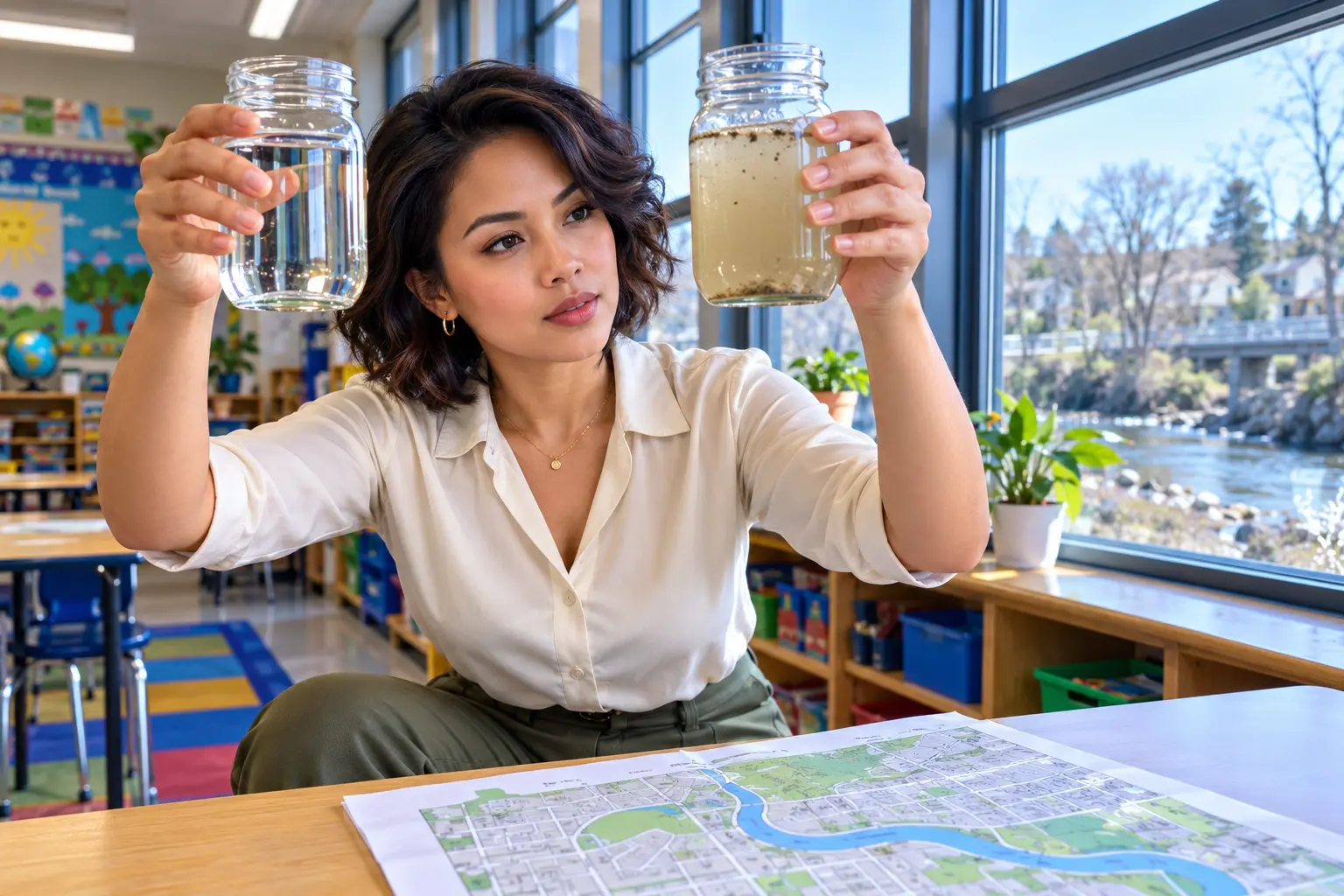
A definition is easier to trust after you run it on a place you know. Picture a creek, ditch, or storm drain near a school that runs brown after a hard rain. Neighbors notice the color, children are told to stay back, and a flyer asks families to pick up trash on Saturday. The flyer is a start. The five parts ask for more before anyone treats the problem as solved.
- Awareness and sensitivity: Walk the bank or the sidewalk after rain and on a dry day, and note the color, the smell, the trash, and who uses the spot.
- Knowledge and understanding: Find where the water arrives from, such as roofs, streets, a pipe, or bare soil, and ask what the city or the school already tests before you lock in a cause.
- Attitudes: List who is helped or hurt by each possible change, from students who play nearby to people downstream and the office that would pay for a fix.
- Skills: Compare at least two responses, such as a Saturday pickup of visible trash and a monitoring plan plus a meeting with public works, and weigh time, cost, and who must agree.
- Participation: Choose one action the group can carry out, do it, and check later whether the water, the trash, or the city’s response changed, including a result that shows the first action was too small.
The Saturday flyer covers a piece of awareness and one assigned action. Working the other parts is what makes the hour educational: you learn possible causes, you compare the pickup with a test of those causes, and you keep the result of the check. The Tbilisi principles ask learners to help plan that work and to accept the consequences, so the group should be able to explain why it chose the pickup, the monitoring plan, or both.
The same walk works in a kitchen if you have no creek nearby. Food scraps are the issue, the two options are a city compost bin and a home pail, and the check is what you throw away over the next two weeks and what the bin service will actually accept. You still need two sources that do not say the same thing, because a single cheerful graphic is information.
Who Is Environmental Education For?
The Tbilisi declaration names three audiences, and your situation is likely one of them. The first is the general public of young people and adults, whose daily habits affect the environment. The second is people whose jobs change environmental quality. The third is scientists and technicians, whose research becomes a base for education and for management. The declaration also says the work should use schools, programs outside school, and the mass media, so a classroom is only one door in.
The same five parts scale to different ages and rooms. Use the row that matches your role, then ask the question in the last column before you commit time.
| Your role | Where it happens | What to ask |
|---|---|---|
| A child in school | Class, the schoolyard, a nearby park | Will I investigate a real place and help choose an action? |
| A teenager | A class project, a club, a citizen science effort | Do I compare more than one option and see what happened after? |
| A parent | Home, a school partnership, a park day | Can our family weigh two choices and try one? |
| A teacher or youth leader | A lesson, an after-school group, a nature center | Do learners plan part of the work and accept the result? |
| An adult in a community group | A meeting, a workplace, a watershed group | Are we studying a local issue and deciding together? |
| A very young child | Preschool, a garden, a story built around a problem | Is there a question, a try, and time to talk about what worked? |
Very young children are included on purpose. The principles start with environmental sensitivity in the early years, with special attention to the child’s own community, and they still want a question and a firsthand try. Older adults showed up in fewer of the reviewed programs, so a community class or a watershed group is a fair place for people who never met this work in school.
The people who lead the work are not all classroom teachers. Some of them green a school through lessons, teacher training, and the schoolyard itself. Others run citizen science so neighbors learn how a study works and then use the data for a species, a habitat, or a local process. Health workers use the same approach when they teach the link between health and the environment, including more time in nature as one part of care.
Teachers and youth leaders can set a clearer bar with the K-12 environmental education guidelines. They describe what an environmentally literate student should know and be able to do, with expectations at fourth grade, eighth grade, and twelfth grade. The four strands are questioning and interpretation, environmental processes and systems, skills for understanding and addressing environmental issues, and personal and civic responsibility.
In the United States, the 1990 law that gave this work a federal home is written for students and for the people who teach them. Schools, colleges, clubs, and nature centers can all carry it. Technical job training aimed only at environmental managers, and work aimed mainly at noneducational research, sits outside that legal definition, so a professional certificate is a different program from the education described here.
Common Mistakes With Environmental Education
You can spot a thin program by the part it skips, even when the flyer uses the right name. The miss is usually a missing comparison or a missing check, not a lack of enthusiasm.
WHERE PROGRAMS GO THIN
- Awareness only: You can name a problem, and you still cannot explain a cause, an option, or a next step.
- One viewpoint: The lesson announces the correct action and skips the comparison.
- Nature only: The program ignores streets, buildings, and other built places the declaration counts as environment.
- One afternoon: There is an event, and there is no question to investigate before or after it.
- No check: Learners never choose the action, or they never look back to see what changed.
A planting day shows the same gap in a kinder light. Putting a tree in the ground builds awareness and a piece of participation. The education continues when students learn what the tree needs, who will water it, and what they will look for a season later to see whether the planting held. Without that follow-through, the day is a ceremony. If a schedule later squeezes the topic out to make room for another priority, what disappears is this decision practice, not only a stack of nature facts.
Frequently Asked Questions
Is Environmental Education the Same as Time Outdoors?
Time outdoors is one setting environmental education uses, alongside classrooms and city streets. The 1977 Tbilisi principles call for firsthand experience and also for learning in the built environment, including streets, buildings, and the systems that move water and waste. A walk becomes environmental education when you carry a question, check what you find against another source, and decide what you will do with the answer.
How Is Environmental Education Different From Environmental Science?
Environmental science studies how natural systems work and how people affect them, and environmental education uses that knowledge as one tool among others. You also sort out what you care about, compare options, and take part in a decision. That wider brief is why a program can include civics, health, and the design of streets and buildings, with a science lesson as one piece of the work.
Can You Practice Environmental Education at Home?
Yes, a household can practice it by choosing one issue, such as food scraps, a high energy bill, or a park shared with neighbors. Gather two sources that do not agree, list two actions you could keep up for a few weeks, pick one, and write down what you expected to see. A family can do that comparison and the follow-up without a formal class, which matches the call to reach the general public through daily life.
Does a Cleanup Day Count as Environmental Education?
A cleanup can be the participation part of environmental education when your group has already looked into the problem and chosen that action over others. On its own, one afternoon of picking up trash is a single activity. In the review of civic outcomes, 24 programs ran from a month to a year and 26 ran for more than a year, which is a fair benchmark when a program offers only one day.
What Does the National Environmental Education Act Require?
The National Environmental Education Act of 1990 directs the EPA to provide national leadership to increase environmental literacy, and the agency created the Office of Environmental Education to carry that out. The policy supports education on the environment for students and for people who work with students, in schools, colleges, and related programs, and it encourages environmental careers. Your school’s course list is still set by the school and by state or local rules, so read what your own district requires before you assume a topic is covered.
Pick one place you already pass, such as a storm drain, a lunch line, or a park path. Write one question you need answered, two options you could really try, and what you would look at a month later to judge the choice.


One UI 9.5 Beta Puts the Galaxy S26 on Last Year’s Clock

DBS Puts a 24/7 USDC Window Inside the Bank

European Startups Head for $81 Billion as First Checks Shrink

US Stocks Lost $1.3 Trillion Before Nvidia’s Beat

Home Depot Bets on Finance Chief Richard McPhail as CEO

Aramco Crash Kills 14 Two Days After Oil Restart

Salah Captained Egypt to Their First World Cup Win

Zelda’s 40th Switch 2 Ships Without a Zelda Game

Apple Labor Day Deals Hide June’s Memory Price Hike

El Niño Puts Israel’s Needed Winter Rain on a Flood Clock
-
 BUSINESS5 months ago
Aramco Crash Kills 14 Two Days After Oil Restart
-
 NEWS6 months ago
Salah Captained Egypt to Their First World Cup Win
-
 GAMING2 months ago
Zelda’s 40th Switch 2 Ships Without a Zelda Game
-
 NEWS3 months ago
Apple Labor Day Deals Hide June’s Memory Price Hike
-
 NEWS5 months ago
El Niño Puts Israel’s Needed Winter Rain on a Flood Clock
-

 GAMING2 months ago
Palworld 1.0.4 Adds Palpedia Search After the 1.0 Launch
-

 NEWS4 months ago
Saudi Visa Routes Split Nigerian Travelers Into Two Speeds
-

 BUSINESS9 months ago
BAE’s 60-Year Saudi Franchise Now Runs Through Taif