
BUSINESS
Foremost Farms Will End 40-Pound Blocks in Marshfield
Foremost Farms will close its Marshfield cheese plant in December and exit 40-pound blocks after new U.S. cheese capacity undercut the 1950s line.

Foremost Farms USA will shut its Marshfield, Wisconsin, cheese plant on or around Dec. 15 and stop making 40-pound block cheese. The farmer-owned co-op, which draws milk from hundreds of Midwest farms in seven states, told workers on Aug. 24 and made the decision public two days later.
The cut takes 68 jobs out of a 1950s plant that still turns out about 61 million pounds of cheese a year. Foremost itself tied the move to rising U.S. cheese capacity, the same buildout that trade groups have been selling as a boom.
Foremost Is Walking Away From 40-Pound Blocks
In a statement posted Aug. 26, the co-op said it would close its Marshfield cheese plant in December and “discontinue production of 40 lb. block cheese as part of a strategic realignment of its product portfolio to meet evolving market demands.” Production is supposed to run through the transition, then stop.
The review, Foremost said, covered “changing dairy market dynamics, including increased U.S. cheese production capacity and shifting consumer demand.” That sentence is the whole case. The plant did not fail a quality audit. The format it lives on, the 40-pound cheddar block that sets the Chicago cash market, is the product the co-op is leaving.
This is not a reflection on our employees in Marshfield. The Marshfield team has consistently demonstrated dedication, professionalism and excellence. This decision was incredibly difficult and is based solely on changing market conditions and long-term needs of our cooperative.
Brenda Dehart, president and CEO, Foremost Farms USA
Dehart, who became CEO in May 2025, said the co-op would offer training, human-resources help, and a chance to apply at other Foremost plants. Kari Paterson, vice president of human resources, told the state the layoffs are expected to be permanent and that wages and agreed benefits run through each worker’s last day.
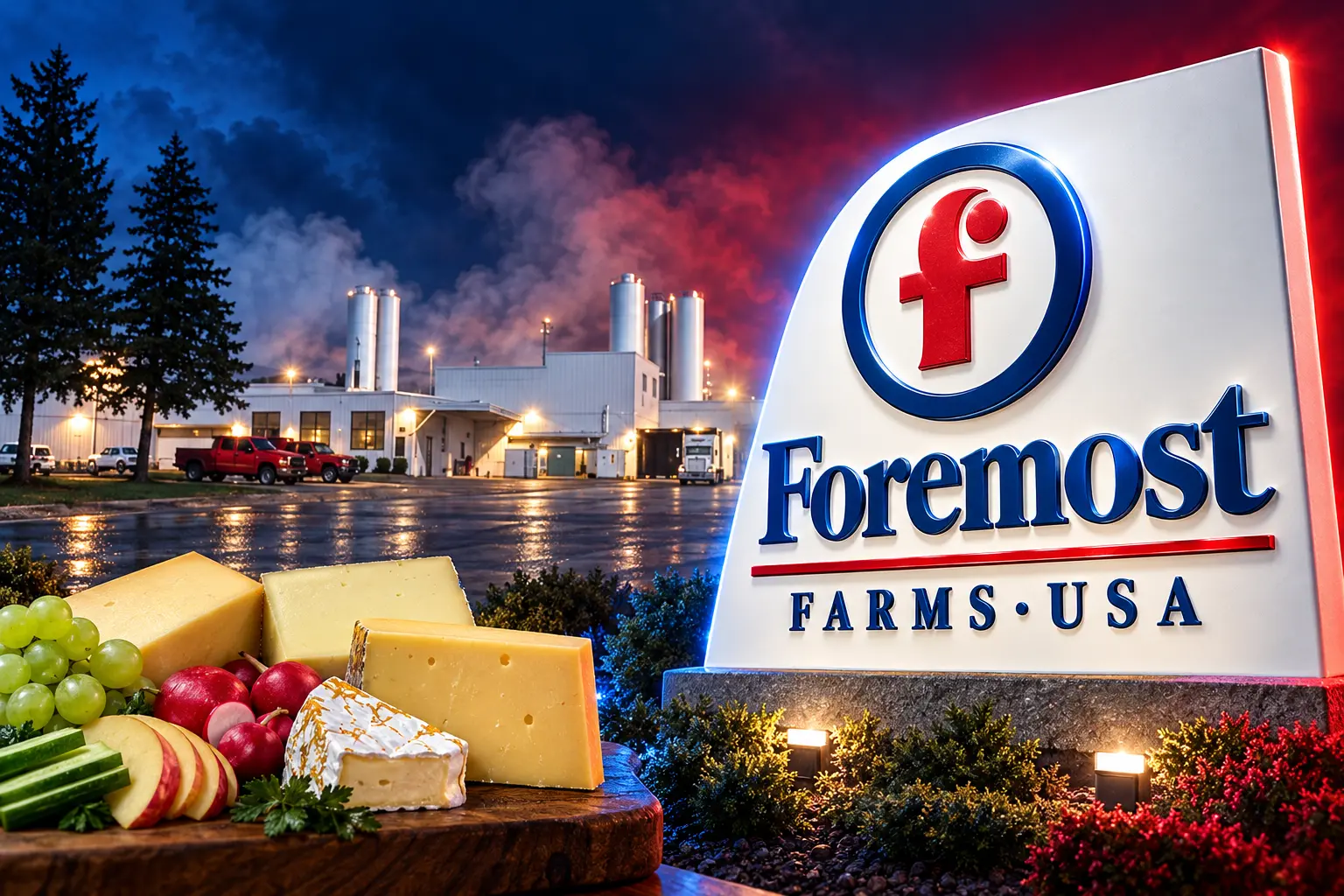
68 Jobs and a December 15 Date
The Wisconsin Department of Workforce Development received the notice on Aug. 24 for the plant at 1511 E. 4th Street. It records a permanent layoff of all 68 employees, with most separations on Dec. 15, 2026. Three people on the roster, the production manager, the maintenance manager, and a maintenance supervisor, stay on the books until Jan. 15, 2027.
The crew is represented by Teamsters Local 662. Separate notice went to business agent Dan Boley and to Marshfield Mayor Nick Poeschel. The filing lists the floor as it actually runs, not as a slogan.
THE MARSHFIELD ROSTER IN THE WARN NOTICE
| Job title | Workers | Separation date |
|---|---|---|
| General laborer | 14 | Dec. 15, 2026 |
| Cheesemaker | 5 | Dec. 15, 2026 |
| Maintenance | 7 | Dec. 15, 2026 |
| Production supervisor | 7 | Dec. 15, 2026 |
| Evaporator operator | 5 | Dec. 15, 2026 |
| Intake operator | 5 | Dec. 15, 2026 |
| Separator operator | 5 | Dec. 15, 2026 |
| Laboratory technician | 4 | Dec. 15, 2026 |
| Shipping and receiving | 4 | Dec. 15, 2026 |
| Clean-up | 3 | Dec. 15, 2026 |
| Plant ops associate | 2 | Dec. 15, 2026 |
| Other salaried and skilled roles | 7 | Dec. 15, 2026 or Jan. 15, 2027 |
Fourteen general laborers is the largest group. Five cheesemakers and seven maintenance workers sit right behind them, which is what a mid-century vat plant looks like on paper. A 2024 plant sheet still counted 66 people at the site; the WARN list is the current headcount.
The $3.20 Billion Cheese Buildout
On Oct. 2, 2025, the International Dairy Foods Association put U.S. processors on the clock for more than $11 billion in new plants and expansions across 19 states, with more than 50 projects due between 2025 and early 2028. Cheese was the largest slice, at $3.20 billion, about 29 percent of that total. Wisconsin itself was third among states, at $1.1 billion, or about 10 percent.
IDFA president and CEO Michael Dykes said the spend matched a forecast that U.S. milk output would rise 15 billion pounds by 2030, enough to fill more than 1.7 billion gallon jugs. The same release cited Circana for cottage-cheese sales up about 20 percent in the year to June 2025, and put 2023 per-person dairy use at 661 pounds. Protein drinks, yogurt, and whey are where that money wants to go. A 1950s 40-pound-block line is not.
WHERE THE $11 BILLION WAS AIMED
| Product category | IDFA tally |
|---|---|
| Cheese | $3.20 billion |
| Milk and cream | $2.97 billion |
| Yogurt and cultured dairy | $2.81 billion |
| Butter and powders | $1.60 billion |
| Ice cream | $530 million |
Cash prices show what extra cheese vats do when they all run at once. USDA Dairy Market News, drawing on CME Group trading, said 40-pound blocks settled at $1.4650 a pound on Friday, Sept. 4, 2026, down 1.25 cents on the day. Barrels finished at $1.5325. An early-August cheese note from research firm Ever.Ag had cheddar spending the rest of 2026 around the mid-$1.50s. Spot blocks are already under that band.
Land O’Lakes has put $34 million into dairy-ingredients work at Tulare, California, a small version of the same bet. The Marshfield decision sits on the other side of that ledger: old block capacity coming out after new capacity has already arrived.
The 1950-127 Stamp Leaves With the Brand
Marshfield’s identity was a number. Wisconsin assigned the plant 1950 and the grader 127, and the 1950-127 brand followed those stamps onto boxes of cheddar that food-service buyers ordered by the digits. The co-op’s own 2024 plant sheet said the site made about 61 million pounds of cheese a year for food-service and cut-and-wrap customers, and that it had taken 27 product awards in recent contests. In 2024 its medium cheddar won Best of Class at the World Championship Cheese Contest.
On Sept. 19, 2025, Foremost agreed to sell that food-service business. On Dec. 16 it said it had sold its foodservice cheese business, including the 1950-127 brand and related equipment, to Wisconsin Dairy Distributing of Waupun. Foremost kept a bulk-cheese supply deal with WDD. Several of its sales staff moved with the brand. The two firms donated 20,000 pounds of cheese to hunger-relief groups in Wisconsin and Michigan that month.
Dehart called the sale a way for both sides “to focus on what they do best,” and the release said the deal let Foremost concentrate on “core strengths in bulk cheese production.” Eight months later the co-op is shutting the plant that invented the brand and dropping the 40-pound block, the bulk format that sale was supposed to feed.
WHAT MARSHFIELD STILL MAKES UNTIL DECEMBER
- 40-lb block cheddar: Colored and white blocks for aging, the line Foremost is dropping co-op-wide.
- Mild cheddar: Colored and white, sold into food service and cut-and-wrap.
- Other American styles: Colby, Monterey Jack, brick, and gouda.
- Food-service melts: Pizza cheese and queso quesadilla, plus kosher cheese for Passover.
- Whey: Condensed whey, the leftover stream from those vats.
Once those vats go dark, Foremost is out of that mix. The awards stay on the wall. The milk has to go somewhere else in the network.
Butter and Protein Get the Capital Instead
The co-op did not wait for December to show where cash is going. On April 21, 2026, Foremost said it would expand its Reedsburg, Wisconsin, butter plant and its Greenville, Michigan, dairy campus. Dehart said the work would “strengthen Foremost Farms for the long term” by “expanding at Reedsburg and Greenville and optimizing our network.”
Reedsburg, a butter site that dates to 1914, is being built up as a milk-and-components balancing hub, so cream and solids can move across the system when cheese plants do not want them. Greenville, opened in 2018 on 96 acres, is getting more membrane equipment for ultrafiltered milk, including milk protein isolates and concentrates aimed at high-protein drinks and cultured foods. That is the IDFA map in miniature: butter, powders, and protein, not another 40-pound-block vat in central Wisconsin.
Four months after that announcement, Marshfield was told it would close. The sequence is the argument. Foremost is not leaving dairy. It is leaving a format that new, larger cheese plants can flood, and it is putting member capital into the rooms that still have a shortage.
The 640-Pound Blocks Stay at Lancaster
Foremost still lists seven manufacturing plants plus headquarters in Middleton. After Marshfield, six plants remain. The locations list keeps Appleton on cheese and ingredients, Clayton on specialty cheeses in a 1930s building, Lancaster on 640-pound cheddar blocks and dry ingredients, Richland Center on cheese and value-added whey, Reedsburg on butter, and Greenville on cream, reverse-osmosis skim, and custom blends. A Sparta site sends cream to Reedsburg.
Lancaster matters for the product exit. Foremost is not abandoning cheddar. It is abandoning the 40-pound block and keeping the 640-pound block that cut-and-wrap customers break down themselves. In 2000, Richland Center left barrel cheddar and retooled for mozzarella loaves. Appleton later doubled mozzarella, a history page says, from 65 million to 130 million pounds a year. The co-op has walked away from commodity formats before when the pizza and ingredients trade paid better.
It already closed a Plover, Wisconsin, plant at the end of 2022. Mullins Cheese later moved into that building. Marshfield is a larger loss, 61 million pounds and a union crew, but it sits on the same path: drop the line that no longer earns, keep the plants that still do.
Where Does Marshfield Milk Go After December?
Foremost has not said which plant will take Marshfield’s milk, or how much member volume will be rerouted to Appleton, Clayton, Lancaster, Richland Center, or Reedsburg. The Aug. 26 statement only said the co-op is “focusing resources on areas that best position the business for future growth and success.” Member farms still have a home in those six plants. The 68 people on the Marshfield roster have a posting window, not a promised seat.
Other co-ops have been pruning networks on the same calendar. Dairy Farmers of America said in June it would idle its St. Albans, Vermont, milk plant, with about 80 jobs ending when operations stopped on Aug. 17. That site was fluid milk, not cheese, and DFA said the milk would move to plants in New York, Massachusetts, and Maine. The pattern is the same even when the product is not: older rooms go quiet while the industry funds new ones.
THE RETREAT FROM BLOCK CHEESE
- September 19, 2025: Foremost agrees to sell the 1950-127 food-service brand and equipment to Wisconsin Dairy Distributing.
- December 16, 2025: The sale closes, with a bulk-cheese supply deal back to WDD.
- April 21, 2026: Foremost announces expansions at Reedsburg and Greenville for butter balancing and milk-protein products.
- August 24, 2026: Workers, Local 662, and the city get WARN notice that Marshfield will close.
- August 26, 2026: Foremost says it will exit 40-pound block cheese when the plant shuts.
- December 15, 2026: Operations are set to end; 65 of 68 jobs separate that day.
- January 15, 2027: The last three managers leave the payroll.
On Dec. 15 the vats at 1511 E. 4th Street are scheduled to go cold. The 40-pound block will still trade in Chicago. It will just not come from Marshfield, and it will not come from Foremost.

Christa Pike Survived the Execution Tennessee Would Not Pause

Musk’s Oligarch Charge Hits a Queue of Three

Circle Puts USDC and EURC Into SAP Pay Workflows

Ring’s First Smart Lock Skips Home Wi-Fi for Sidewalk

GTA 6 Puts Cash Back on the Story Path

Salah Captained Egypt to Their First World Cup Win

Aramco Crash Kills 14 Two Days After Oil Restart

Zelda’s 40th Switch 2 Ships Without a Zelda Game

Apple Labor Day Deals Hide June’s Memory Price Hike

Palworld 1.0.4 Adds Palpedia Search After the 1.0 Launch
-
 NEWS5 months ago
Salah Captained Egypt to Their First World Cup Win
-
 BUSINESS4 months ago
Aramco Crash Kills 14 Two Days After Oil Restart
-
 GAMING1 month ago
Zelda’s 40th Switch 2 Ships Without a Zelda Game
-
 NEWS2 months ago
Apple Labor Day Deals Hide June’s Memory Price Hike
-
 GAMING1 month ago
Palworld 1.0.4 Adds Palpedia Search After the 1.0 Launch
-

 NEWS4 months ago
El Niño Puts Israel’s Needed Winter Rain on a Flood Clock
-

 BUSINESS8 months ago
BAE’s 60-Year Saudi Franchise Now Runs Through Taif
-

 BUSINESS8 months ago
Egypt Bets EGP 638 Billion Can Open Sinai to Investors