
NEWS
Egypt’s World Cup Run Replays a Decade-Old Coptic File
Coptic Solidarity’s 2026 World Cup complaint restates its 2018 FIFA dossier: a Christian name still ends many Egyptian youth trials.

Coptic Solidarity told FIFA in July 2026 that Egypt’s World Cup squad still had no known Christian player, repeating a finding it first filed in 2016. Clips of the team in group Islamic prayer, including sujood after Egypt went 2-0 up on Argentina, carried the old complaint onto the pitch. Egypt lost that last-16 tie 3-2 on July 7 in Atlanta.
Copts are estimated at 10 to 15 percent of Egypt. The World Cup did not invent their absence from the side. It put a ten-year FIFA file under stadium lights.
The Kneeling Team Reached the Last 16 Without a Copt
Egypt beat Australia 1-1, then 4-2 on penalties, to reach the last 16 for the first time. After the Australia win, head coach Hossam Hassan walked the pitch with a Palestinian flag and dedicated the night to Egyptians and Palestinians. “My heart and soul are with them,” he said.
FIFA said flags representing all 211 member associations are permitted at its tournaments. No sanction against Hassan was announced. Players later knelt in sujood after Egypt led Argentina 2-0. The Egypt Football Association had already posted a prayer clip under the title “The Secret to Victory.”
Mina Thabet, an expert on religious minorities in Egypt and a former prisoner of conscience, said the roots sit in “the scouting, recruitment, and trial processes in local clubs.” Coptic Solidarity’s July 7 statement said there were still no known Coptic players on the senior squad, the reserve, or the youth national teams.
That is the same blank the group recorded for the 2018 World Cup in Russia, and for Egypt’s 2016 Rio Olympic mission, which it said was devoid of Copts. Hassan later used FIFA’s anti-racism gesture toward the referee in Atlanta. The Coptic file with FIFA is older than that gesture, and it is about religion, not a disallowed goal.
Magdi Khalil’s 2018 Dossier Is Still FIFA’s File
Magdi Khalil wrote Coptic Solidarity’s report “Discrimination Against Copts in Egyptian Sport Clubs” and the group sent it to FIFA officials, and through the online complaints mechanism, on June 17, 2018. The first formal complaints to FIFA and the International Olympic Committee had gone in August 2016.
The 2018 report counted no more than six Coptic footballers in top-flight clubs over the previous half-century. It also counted one Coptic footballer among 540 players then in those clubs, a snapshot the group still cited in July 2026. A sampling of 25 cases sat in the same file.
THE COPTS’ FIFA PAPER TRAIL
| Date | What was filed |
|---|---|
| August 2016 | Coptic Solidarity’s first complaints to FIFA and the IOC |
| June 17, 2018 | Khalil’s sports-clubs report submitted to FIFA |
| July 7, 2026 | World Cup statement: still no known Copts on senior, reserve, or youth sides |
| July 2026 | Egypt’s sports ministry finds misconduct in the Makari Younan youth case |
Lindsay Rodriguez, Coptic Solidarity’s director of development and advocacy, described the effect as children filtered out early so they never reach professional clubs or the national team. International pressure, she said, ended racial segregation in South African sport, and the same principle should apply if Egypt wants the prestige of FIFA competitions while Christian athletes are kept off the path that leads there.
The result is what many describe as a pipeline of exclusion: talented Coptic children are filtered out early, ensuring they never reach professional clubs or the national team.
Lindsay Rodriguez, Director of Development and Advocacy, Coptic Solidarity
Pope Tawadros II, asked on March 22, 2018, about the missing players, pointed away from his own flock. “Do not ask Copts about this, rather address the question to clubs and playgrounds, how likely it is that there is not a single Coptic footballer to be found in all Egyptian soccer teams?”
“You Are Christian, and Christians Do Not Play Soccer”
The 2018 dossier did not argue from population math alone. It listed named tryouts in which a Christian name, a wrist cross, or the religion box on a form ended the night. Sports commentator Khalid Al Ghandour said on television that Egypt’s 18 major teams then had not a single Coptic player, after a caller said Minya Sports Club’s technical director had demanded a conversion to Islam. The Sports Media Committee rebuked Al Ghandour for stirring sedition, the report said, instead of opening the club.
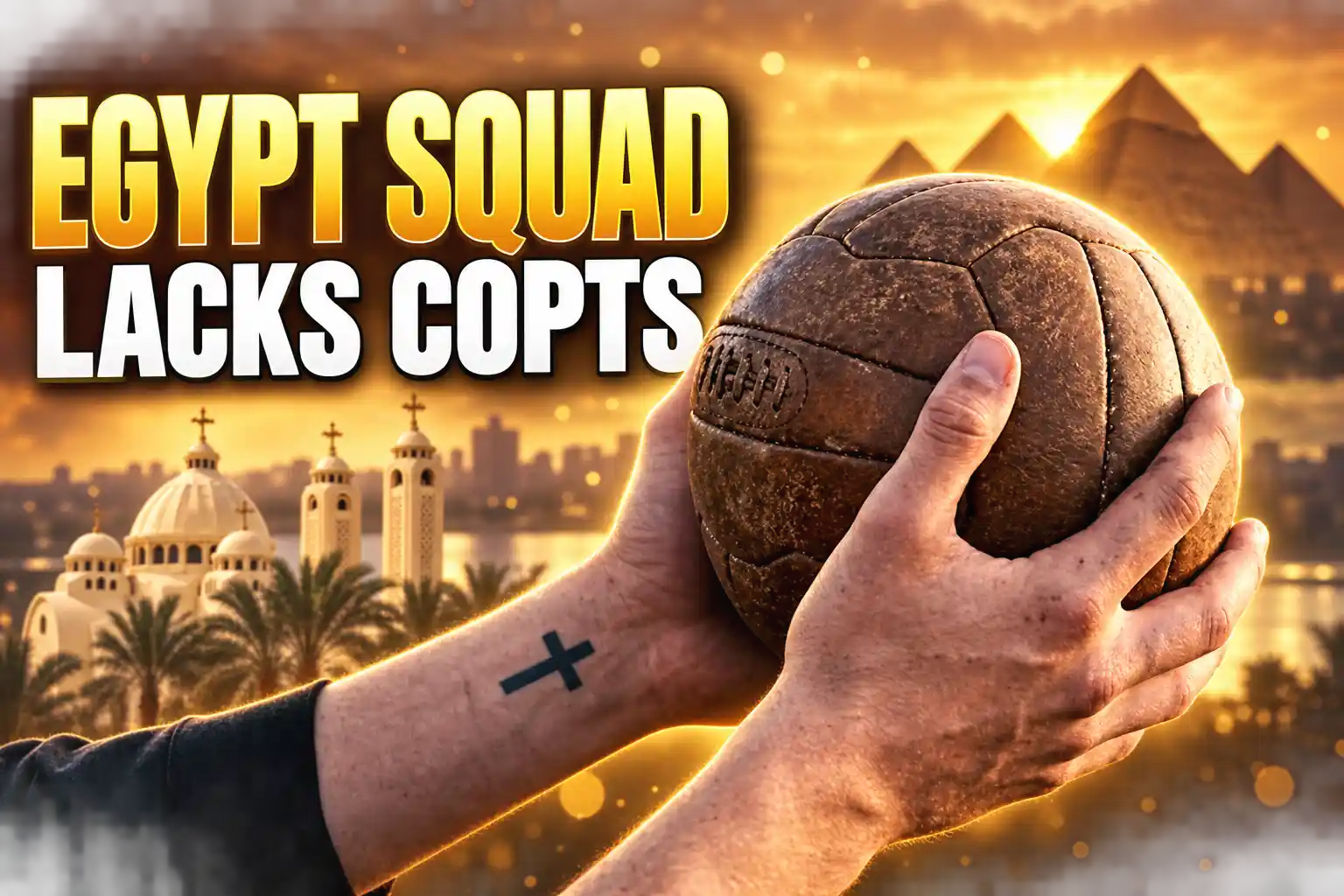
Al Ahly technical director Ikrami, caught on camera with a young Copt named Pierre Zouhair Shafiq, pointed the boy and a colleague to the door once he knew they were Christian, according to the same file. At Al Ahly, a child named Tony Atef was rejected over a cross tattooed on his wrist; coverage forced the club to reverse itself and take him. Former player Ashraf Youssef told a newspaper his teammates refused to eat with him because he was Christian.
NAMES THE 2018 FILE PUT ON THE RECORD
- Bassam Al Sayyid Hawash: In 2007 a Maghaghah District Club coach named Omar told him, “You are Christian, and Christians do not play soccer.”
- Fady Gouda Nakhla: In 2015 Al Nasr’s captain praised him as “the magician,” then dismissed him when he filled in the religion item as Christian.
- Mina Samir Tawfiq: Assiut, Petrojet, Ismaili, and Haras Al Hedoud turned him away as a Christian; Al Ittihad asked him to change his name to Mustafa, meaning a conversion he refused.
- Tony Atef: Al Ahly rejected him for a wrist cross, then accepted him after the refusal became public.
- Mina Bandari: Asked to change his name to be accepted, he refused and founded the Je Suis Academy to train Coptic youth on rented fields.
Hassan Shehata, the former national-team coach, used to take a Muslim cleric on international trips to recite the Quran, the 2018 report said. He also said a player’s relationship with God and his proper behavior were important factors when he selected those who would represent Egypt. The national side, the report noted, was already nicknamed “the kneeling team.”
Hany Ramzy’s Cross Before the Netherlands
Whenever the blank roster comes up, clubs and coaches reach for one defender. Hany Ramzy, born in Cairo to Coptic Orthodox parents, came through Al Ahly, went to Switzerland and then the Bundesliga, and captained Egypt. Record keepers list him with 122 caps between 1988 and 2002. Many Egyptians learned he was Christian when he made the sign of the cross before a 1990 World Cup match against the Netherlands. No Coptic player has worn the senior shirt since those last caps in 2002.
Ahmed Hossam, the former Egypt striker known as Mido, put a number on what that exception was covering. In a 2018 television interview he asked how five Christian footballers at the top level could be the entire history of the game in Egypt, and he proposed that Christians make up at least 10 percent of junior teams.
Does it make sense that throughout the entire history of soccer in Egypt, there have only been five Christian footballers at the top level? There are many Christian children who are not allowed to continue to play because of the racist attitude of certain coaches.
Ahmed Hossam (Mido), former Egypt international, television interview, 2018
Mido’s five and Khalil’s “no more than six” over half a century are counts from different mouths, and both describe a trickle. Coptic Solidarity has said some young players were told to hide a cross, change a name, or walk away into pharmacy and engineering. Ramzy himself has said talented Copts quit because they stop believing merit will decide who stays.
FIFA’s Article 4 Already Bans Religious Discrimination
FIFA’s 2024 statutes are not silent on the Coptic file. Article 4 says discrimination against a person or group on account of religion is strictly prohibited and punishable by suspension or expulsion. The same article says FIFA remains neutral in politics and religion, with a narrow exception tied to its own objectives.
The Palestinian flag Hassan carried is the flag of a FIFA member association, and the governing body treated it as permitted kit. The Coptic complaint is a religion case under the same article, filed in 2016, restated in 2018, and restated again during the 2026 tournament. FIFA has not announced an investigation, a suspension, or an expulsion tied to that file.
After the Argentina defeat, Egyptian political analyst Mohammad Nour said on his YouTube channel that “FIFA and Israel prevented Egypt from winning,” called Argentina “an Israeli team par excellence,” and claimed officials “did not allow the flag of Palestine.” Hassan had already carried that flag on the pitch. Nour’s clip does not answer why a Christian name still dies in a trial in Minya or Alexandria. It does show how fast a World Cup injustice story can travel when the injured party is the national team, and how slow the same audience is when the injured party is a Coptic child at the club door.
After Atlanta, Cairo Punished One Youth Coach
For years, Coptic Solidarity says, Egyptian authorities treated sports complaints as isolated gripes or as foreign agitation. In July 2026, after the World Cup run, the Ministry of Youth and Sports broke that pattern in one junior case. It said it found sufficient evidence of misconduct by a coach at Alexandria’s Al-Ittihad Club who had allegedly excluded a junior footballer, Makari Younan, because of his Christian name.
WHAT CAIRO ORDERED IN THE MAKARI CASE
- The finding: Enough evidence that a youth coach excluded Makari Younan over a Christian name.
- The penalty track: Disciplinary proceedings against the coach.
- The next cases: Future complaints of this kind to be sent to the public prosecutor.
- The line: Discrimination in youth sports would not be tolerated.
Coptic Solidarity called the decision the first official acknowledgment that such exclusion is not only a family’s allegation. It also said the file could not stop at one coach. Almost immediately, another complaint landed: Romany Emad Gad, a midfielder from Gharbia Governorate, had passed successive trials at Ghazl El-Mahalla in Tanta, then was rejected after club officials learned he was Christian, according to the group.
#RomanyEmad, another case of discrimination against Coptic players in sports; a pattern that will not end unless strict policy is legislated and enforced to prohibit discrimination based on religion. #Egypt, #football, #Soccer, #copticequality #coptic #christian pic.twitter.com/FTehalLnoj
— Coptic Solidarity (@CoptSolidarity) July 26, 2026
By late July the group was still posting that Romany’s case would not end without a rule that actually binds clubs. Through August it was still explaining the same youth-trial filter in interviews. FIFA had not, in those posts, announced that the 2016 complaint was now an open case.
Church Pitches Never Feed the National Squad
Coptic churches answered the closed academies by running their own tournaments on small fields inside church walls. Those games give boys a ball. They do not give a scout from Al Ahly or Zamalek a reason to sign one. Mina Bandari’s Je Suis Academy rented remote pitches for players the big clubs had already turned away. Limited money, and the same club doors, kept that circuit from becoming a second professional path.
Khalil’s report called the youth cutoff a design, not an accident: keep Copts off junior teams and the senior league will never have to reject them in public. Yasser Ayoub, among Egypt’s best-known sports writers, wrote that anyone who tries to prove the bias is treated as an agitator, so the subject lives in private while it is denied in public. Tariq al-Shennawi asked in Al-Masry Al-Youm whether Muslim families had simply stopped letting their children play with Coptic neighbors. Osama Ghareib’s answer in the same paper was blunter: Copts are pushed out as they are labelled infidels, and newly religious club officials will not take a Christian child “even if his talent exceeded that of famous international footballer Messi.”
Makari Younan’s file is the first time a ministry named a Christian name as evidence. Romany Emad Gad’s complaint arrived before that file could settle. The last-16 side that prayed together in Atlanta still had no known Copt to kneel beside, or to stand apart, and FIFA’s Article 4 still sits on the same desk it reached in 2016.

Cook Hands Democrats the House as Crypto’s Bill Stays Dead

Wicker’s Broken Bed Was the Short Story’s Punch Line

Nvidia’s $500 Billion Financing Plan Draws a $180 Sell

Maserati Bets the Grecale V6 Can Fill Porsche’s Gap

EV Cable Theft Follows the Old Railway Copper Playbook

Aramco Crash Kills 14 Two Days After Oil Restart

Salah Captained Egypt to Their First World Cup Win

Zelda’s 40th Switch 2 Ships Without a Zelda Game

Apple Labor Day Deals Hide June’s Memory Price Hike

Palworld 1.0.4 Adds Palpedia Search After the 1.0 Launch
-
 BUSINESS4 months ago
Aramco Crash Kills 14 Two Days After Oil Restart
-
 NEWS5 months ago
Salah Captained Egypt to Their First World Cup Win
-
 GAMING2 months ago
Zelda’s 40th Switch 2 Ships Without a Zelda Game
-
 NEWS2 months ago
Apple Labor Day Deals Hide June’s Memory Price Hike
-

 NEWS4 months ago
El Niño Puts Israel’s Needed Winter Rain on a Flood Clock
-
 GAMING2 months ago
Palworld 1.0.4 Adds Palpedia Search After the 1.0 Launch
-

 BUSINESS8 months ago
BAE’s 60-Year Saudi Franchise Now Runs Through Taif
-

 BUSINESS8 months ago
Egypt Bets EGP 638 Billion Can Open Sinai to Investors