
NEWS
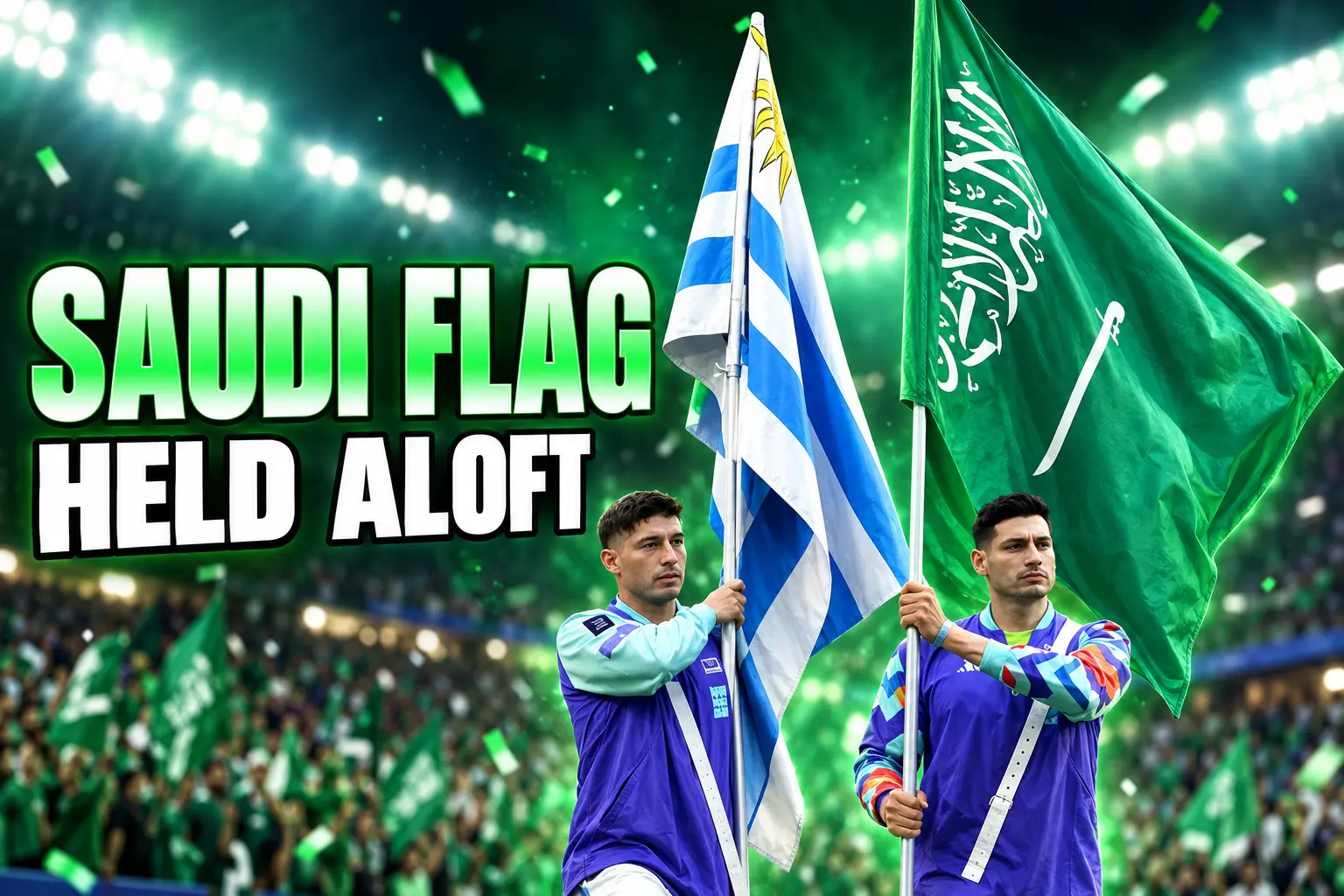
FIFA Held Saudi Flags Off the Grass at the World Cup
FIFA’s new grass-flag ceremony met a 1973 Saudi law and Iraq’s Takbir, so volunteers held both teams’ banners aloft at the 2026 World Cup.

FIFA kept the Saudi and Iraqi flags off the grass at the 2026 World Cup after its new pre-match ceremony put giant banners on the pitch. Volunteers held the cloth through the anthems instead of laying it down. Uruguay’s flag got the same lift so one side would not look marked out.
The tweak looked like a one-match courtesy in Miami. It was the new pageant meeting a 1973 law, then Iraq’s Takbir, then a habit of raising the other team’s flag too.
A New Ceremony Built Around Flags on Grass
On 4 June 2026, FIFA rolled out a redesigned pre-match show for the 48-team tournament in the United States, Mexico, and Canada. Squads would gather around a centre-circle banner for the anthems, with extra-large country flag banners and other on-pitch pieces set so every seat had a view.
FIFA President Gianni Infantino sold that gathering as unity, not a sideshow. The giant flags were the picture that made the unity read on television.
Having all players and referees face each other in the centre circle during the national anthems will create a moment of unity, pride and emotion that truly belongs to the teams and to everyone in the stadium. The FIFA World Cup is about every player and every fan, and this new pre-match ceremony reflects that.
Gianni Infantino, FIFA President, FIFA media release, 4 June 2026
In most fixtures those banners went onto the turf, were photographed, then rolled up. The format was new for this World Cup. It assumed every flag could lie on grass like a prop.
Saudi Law Has Barred the Flag From Land Since 1973
Saudi Arabia’s flag cannot be treated as a prop. The green field carries the Shahada, the Islamic declaration of faith, in white Thuluth script above an unsheathed white sword: “There is no God but Allah and Muhammad is the Messenger of Allah.”
The Law of the Flag of Saudi Arabia, issued by royal decree in 1973, treats that cloth as a religious object as well as a national one. The national flag and the king’s flag shall never touch the surfaces of land and water. They are never flown at half-mast. They cannot be used as a trademark or for advertising.
A later official guideline puts the same rule in plainer words. The flag must not touch anything lower than it, including ground, water, or a table. When it is lowered, it is folded so no edge dangles onto the ground.
THE 1973 FLAG BANS
- Land and water: The national flag and the king’s flag shall never touch those surfaces.
- Half-mast: Flags that bear the Shahada or a Quranic verse are never lowered that way.
- Trade marks: Commercial use and advertising are barred except as the law allows.
- Condition: A faded or poor flag is not raised; once unusable it is burned by whoever held it.
Laying a giant Saudi banner on a football pitch would have broken that code in front of a global audience. FIFA’s new ceremony had nowhere to put the cloth except in people’s hands.
Iraq’s Flag Carries a Different Sacred Line
Iraq’s flag is not Saudi’s green field, and it is not covered by the 1973 decree. It still carries sacred wording. Between the stripes sits the Takbir, the Arabic phrase “Allahu akbar,” which a FIFA spokesperson rendered as “God is Greatest.”
Muslims use that line in daily prayer, at celebration, and in the call to prayer. Treating the cloth like ordinary fabric, laying it where people walk, sitting on it, or balling it up, is read as an insult to the words, not only to the state.
A FIFA spokesperson later named both countries together. When Saudi Arabia or Iraq played, the flags of both teams in that fixture were held up over the ground so the pageant could continue without putting the inscriptions on the turf.
Praise for that handling spread among Saudi users as respect for the Shahada. A thinner strand treated the off-grass rule as special pleading. A circulating claim also bundled Egypt and Iran into the same carve-out. FIFA’s description did not. It named Saudi Arabia and Iraq.
Why Uruguay and Spain Held Their Flags Too
Uruguay’s flag has stripes, a sun, and no religious text. It still stayed off the grass on 15 June 2026 at Miami Stadium in Miami Gardens, Florida, the Hard Rock Stadium venue, because FIFA wanted the picture balanced.
If only the Saudi flag had been held up, one half of the pitch would have looked like a protest and the other like the standard show. Volunteers kept both banners in the air through the anthems. The same pairing was used when Saudi Arabia later met Spain, and it was used at Iraq’s matches, so the opposition was never the only side with cloth on the turf.
The symmetry was a production choice, not a Uruguayan request that has been put on the record. It also meant a secular republic’s flag was handled like a sacred object for the length of a song, then taken away.
1-1 in Miami, Then a Whistle in Added Time
The ceremony was the detail cameras caught first. The match under it was a scrap. Saudi Arabia led through Abdulelah Al-Amri in the 41st minute after Fernando Muslera could not hold a header, then Maxi Araujo equalised in the 80th. The FIFA full-time match report logged a 1-1 draw, attendance of 62,764, and Italian referee Maurizio Mariani.
MATCH STATS IN MIAMI
| Stat | Saudi Arabia | Uruguay |
|---|---|---|
| Result | 1 | 1 |
| Possession | 33% | 67% |
| Attempts (on target) | 7 (3) | 29 (11) |
| Corners | 4 | 14 |
| Fouls | 11 | 6 |
| Yellow cards | 1 | 0 |
Uruguay had the ball and the shots. Saudi Arabia, coached by Georgios Donis, held a point against Marcelo Bielsa’s side. Al-Amri was booked in the 44th minute. Mohammed Alowais played the full 102 minutes in goal, the 90 plus four minutes of first-half added time plus eight in the second.
THE NIGHT’S SEQUENCE
- 41st minute: Al-Amri scores for 1-0.
- Around the 60th minute: Alowais goes down for treatment; Donis is shown calling a player over with a notebook while Mariani is at the goalmouth.
- 80th minute: Araujo equalises.
- 90+2: Abdullah Al-Hamdan comes on.
- End of eight added minutes: after a Uruguay corner is cleared, Al-Hamdan runs through on Muslera and Mariani blows for full time.
Match accounts describe Al-Hamdan going clear on the last break, then stopping with his arms out when the whistle cut the counter. FIFA’s sheet lists eight minutes of second-half added time and does not narrate that break. The point stood at 1-1.
The notebook scene sat next to a rule Pierluigi Collina, FIFA’s chief refereeing officer, had already walked through with coaches from all 48 teams. Players were not to troop to the bench for a tactical talk while a goalkeeper lay injured. Referees would step in. They would not show cards for it.
The goalkeeper has the right to be injured, but the players do not have the right to leave the field of play to have a sort of timeout with their respective coaches.
Pierluigi Collina, FIFA Chief Refereeing Officer, coaches’ workshop briefing
Broadcast pictures of Donis with the notebook did not produce a sanction, which matches what Collina had said about discipline. The new law had a gap by design.
FIFA Calls It a Reasonable Presentation Request
Eight days after Miami, a FIFA spokesperson tied the raised flags to the same 4 June redesign rather than to a secret extra protocol. “As part of the FIFA World Cup 2026 opening ceremony enhancements, FIFA introduced a new fan-centric presentation,” the spokesperson said. “In delivering these ceremonies, FIFA worked closely with the participating teams to accommodate reasonable presentation requests.”
That sentence is the whole mechanism. The grass banners were FIFA’s idea. The off-grass handling was a team request FIFA judged reasonable. Iraq’s Takbir produced a second yes. Opponents’ flags went up so the yes would not look like a slight.
The same raised-flag handling appeared again when Saudi Arabia played in Houston against Cape Verde, which is what you would expect if the request ran for the group, not for one Miami camera shot. Volunteers kept doing a job the new ceremony had not budgeted for: holding cloth that the show had meant to leave on the dirt.
Infantino had wanted a 360-degree picture of two nations on the grass. In two nations’ fixtures, the picture was people holding those nations off the grass, because the text on the cloth is not decoration.
Frequently Asked Questions
What Happens to a Worn-Out Saudi Flag?
Once a Saudi flag is old or in such poor condition that it can no longer be used, it is burned by the party that used it, not patched, sold, or stored as surplus cloth, under the 1973 law’s disposal rule.
What Is the Penalty if the Saudi Flag Is Insulted?
Anyone who, in public, drops, destroys, or insults the national flag, the royal flag, or another emblem of the Kingdom out of hatred or contempt faces imprisonment for a term not exceeding one year, a fine not exceeding SAR 3,000, or both.
Why Is the Saudi Flag Never Flown at Half-Mast?
Flags that bear the Shahada or a Quranic verse are never flown at half-mast, including in mourning, because lowering the cloth would be read as lowering the declaration of faith itself rather than a secular emblem.
Which World Cup Flags Did FIFA Keep Off the Grass?
FIFA identified Saudi Arabia and Iraq, and it had both teams’ flags in those fixtures held above the turf; circulating lists that added Egypt and Iran did not match that description.

Ninja Theory Staff Face Redundancy After Two Xbox Sales Collapse

Amazon Sells the MacBook Air at Its Pre-Hike Price

U.S. Slows Jet Parts to Squeeze China’s Flying Fleets

PEGI Pulled the GTA 6 Age Rating After Cocaine Details

Northwestern’s Smaller Ryan Field Gave Penn State Nowhere to Hide

Aramco Crash Kills 14 Two Days After Oil Restart

Salah Captained Egypt to Their First World Cup Win

Apple Labor Day Deals Hide June’s Memory Price Hike

Palworld 1.0.4 Adds Palpedia Search After the 1.0 Launch

Zelda’s 40th Switch 2 Ships Without a Zelda Game
-
 BUSINESS3 months ago
Aramco Crash Kills 14 Two Days After Oil Restart
-
 NEWS4 months ago
Salah Captained Egypt to Their First World Cup Win
-
 NEWS1 month ago
Apple Labor Day Deals Hide June’s Memory Price Hike
-
 GAMING4 weeks ago
Palworld 1.0.4 Adds Palpedia Search After the 1.0 Launch
-
 GAMING4 weeks ago
Zelda’s 40th Switch 2 Ships Without a Zelda Game
-

 NEWS3 months ago
El Niño Puts Israel’s Needed Winter Rain on a Flood Clock
-
 BUSINESS2 months ago
Egypt Seeks Two Extra El-Dabaa Reactors Before First Power
-
 ENTERTAINMENT3 months ago
A Thousand and One Drops Off Riyadh’s October Calendar