
BUSINESS
Egypt Uses Belgium’s Settlement Ban to Press the EU
Egypt praised Belgium’s draft settlement-goods license rule and urged the EU to copy it, while Cairo’s gas and QIZ trade with Israel kept running.

Egypt’s foreign ministry praised Belgium’s clamp on settlement goods on 19 July 2026 and told every EU country to copy it. The Belgian cabinet had approved a draft royal decree only the day before, a licensing rule that still had to go to the Council of State and that gave traders a 120-day transition.
Cairo wanted a European legal template after the World Court’s 2024 opinion, because the EU as a bloc still would not vote. Its own gas contracts and QIZ factories with Israel were not part of that ask.
Belgium’s Cabinet Approved a License Rule
The Council of Ministers met on 18 July 2026, the last sitting before the summer break, and signed off on a draft royal decree on prior import licenses. The text amends a 30 December 1993 decree on the import, export and transit of goods. It carries out a coalition deal dated 12 September 2025, which had sat in intra-coalition bargaining for months.
The tool is not a shop-floor ban written as a criminal statute. It sits inside Belgium’s existing permit, control and sanctions system. If the papers show, or officials can reasonably presume, that goods come from an Israeli settlement in occupied Palestinian territory, the license is to be refused as a matter of course.
WHAT THE DRAFT ACTUALLY DOES
- The map: It names the West Bank, including East Jerusalem, and the Gaza Strip. It does not name the Golan Heights.
- The filter: Origin is checked against the EU postcode list already used to deny tariff preferences on settlement output.
- The carve-outs: Palestinian economic operators and humanitarian shipments get specific exemptions.
- The clock: Traders and administrators get a 120-day transition once the rule runs.
- The next legal step: The draft goes to the Council of State for advice before it can be a finished royal decree.
Foreign minister Maxime Prévot’s spokesperson, Laurens Soenen, said authorizations would be “systematically refused,” and that Brussels still saw the step as compatible with Belgium’s tie to Israel. “Takes nothing away from Belgium’s relationship with Israel or from our attachment to Israel’s security,” Soenen said.
Israeli lawmaker Sharren Haskel called the vote a “point of no return” and said Israel would keep selling “products from Judea and Samaria to countries that choose to import innovation, quality, and technology.” That line treats a customs license as a break with the state. The Belgian text is narrower than that fight.
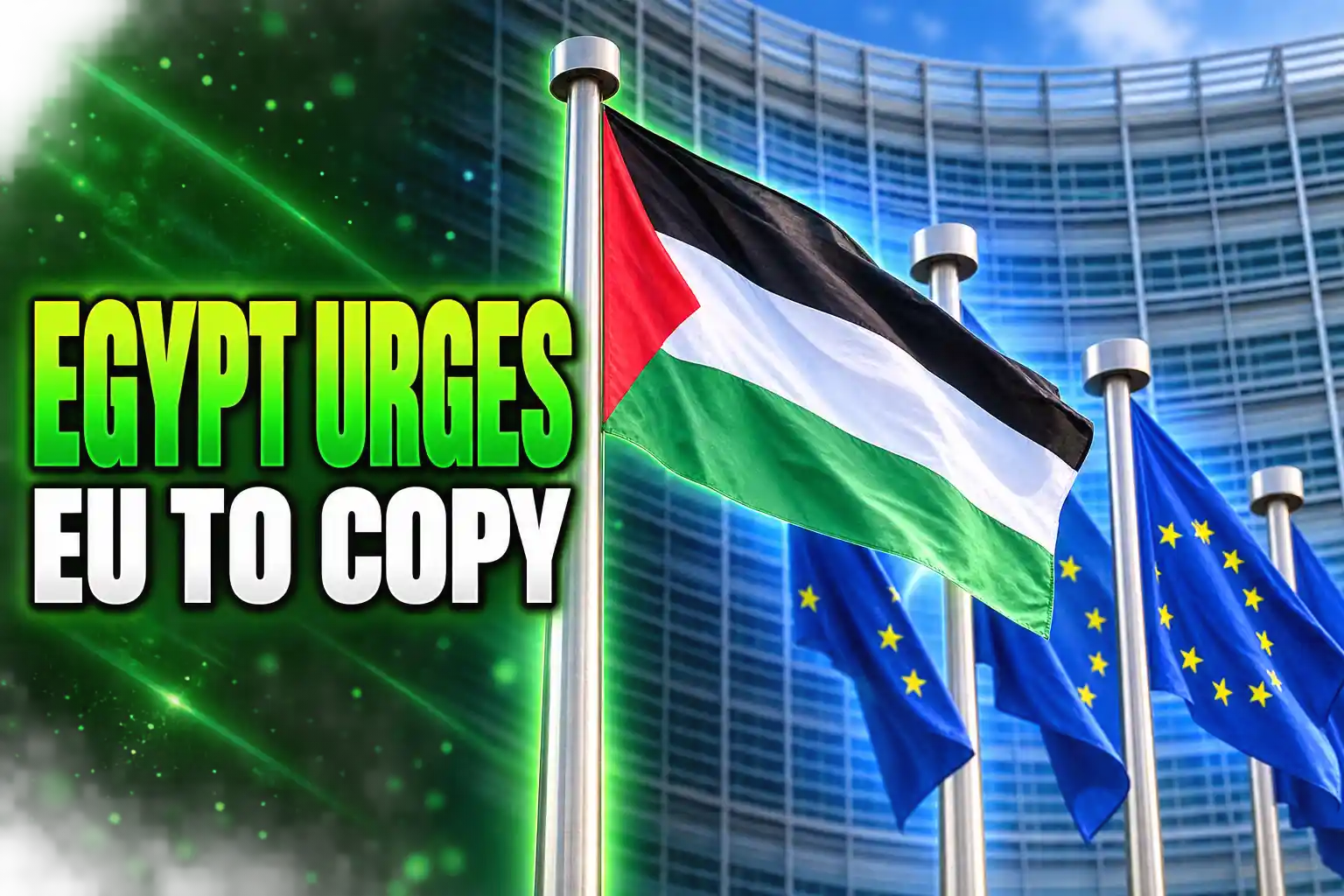
Cairo Called the Draft an Important Step
Egypt’s Ministry of Foreign Affairs, International Cooperation and Egyptian Expatriates answered on 19 July, with Foreign Minister Badr Abdelatty’s department framing a draft Belgian decree as a model for the whole Union. The statement did not linger on licenses, postcodes or the Council of State. It went straight to law and to the rest of Europe.
A practical and responsible application of international law and international legitimacy resolutions, particularly UN Security Council Resolution 2334.
Egyptian Ministry of Foreign Affairs, statement of 19 July 2026
The ministry called the Belgian decision “an important step,” said settlements have no legal validity, and asked “all EU member states and the international community to follow Belgium’s example” with similar legal measures. It restated Egypt’s line on an independent Palestinian state on the 4 June 1967 borders, with East Jerusalem as capital, and said regional security required an end to the occupation.
Three days later the same ministry welcomed a Dutch cabinet decision in almost the same words, this time naming Belgium and the Netherlands together. On 26 July it hailed Ireland’s new statute and again told EU countries not to help sustain settlements, even indirectly. The Belgian draft was the first of that sequence, and it is the one Cairo used to open the campaign.
Ireland and the Netherlands Put Bans on the Dock
By early October 2026 the map around Belgium had moved. Ireland and the Netherlands had gone from pledges to customs rules. Britain, France and Canada had joined a wider political pledge. The EU still had not adopted a Union-wide ban.
FROM THE WORLD COURT TO THE AUTUMN BANS
- 19 July 2024: The International Court of Justice issues its advisory opinion on Israel’s policies in occupied Palestinian territory, including East Jerusalem.
- 12 September 2025: Belgium’s coalition agrees to write a national import ban into a royal decree.
- 13 July 2026: EU foreign ministers tell ambassadors to keep working on a possible Union ban; High Representative Kaja Kallas says the Commission’s trade-ban option drew the broadest support.
- 18-19 July 2026: Belgium’s cabinet approves the draft decree; Egypt’s foreign ministry calls it an important step and asks the EU to follow.
- 23 July 2026: Ireland’s president signs the Israeli Settlements in the Occupied Palestinian Territory (Prohibition of Importation of Goods) Act 2026.
- 8 September 2026: Foreign ministers from twelve countries, including the United Kingdom, France and Canada, say they will restrict settlement-goods trade or back an EU equivalent.
- 15 September 2026: Ireland’s import ban takes effect.
- 21 September 2026: The Dutch temporary sanctions decree takes effect, with a sunset of 21 September 2029.
Spain had already written a settlement-goods ban into national law in September 2025 and was applying it by January 2026. Norway moved on a national goods measure as well. Slovenia had adopted a similar line and then shifted after a change of government, which is why country counts in July bounced between four and five.
Prévot had gone into the 13 July ministers’ meeting arguing for a Union-wide ban and accusing the Commission of handing capitals “a bone to chew on” rather than a plan. Egypt’s 19 July statement is the diplomatic echo of that complaint: if Brussels will not move as a bloc, take the next national text and ask everyone else to photocopy it.
Direct Imports Are the Only Easy Target
Belgium’s draft hits the license at the border. That is a strong tool against a crate that arrives from Haifa or Ashdod with a settlement postcode on the file. It is a weak tool against a crate that has already entered free circulation in another EU country, because the single market is built to let goods move once they are inside.
The postcode list Belgium is borrowing is not new. The European Commission’s technical arrangement on origin, in force since 2004, already denies preferential tariffs to settlement output. Member-state customs are supposed to read the Israeli certificate, match the postcode, and charge the full duty. A license refusal goes further than a tariff, but only on the import that Belgium itself is asked to clear.
That is why a Belgian supermarket can, in principle, still see dates or herbs that entered through a port in Germany or Rotterdam and then moved west. The Dutch decree tried to close some of that gap by banning purchase, sale, marketing and brokering, and by writing an anti-circumvention clause, and by covering the Golan as well as the West Bank and East Jerusalem. Belgium’s July text does not do that extra work.
WHERE EXPERTS DISAGREE
- Trade-law camp: Ministers from the Netherlands, Portugal, Ireland and Belgium argue a settlement-goods ban is a trade file and can pass by qualified majority.
- Foreign-policy camp: Italy’s Antonio Tajani said the choice is political and needs unanimity; Lithuania’s Kęstutis Budrys backed keeping unanimity on sensitive partnerships; Germany’s minister arrived at the July council talking about dialogue with Israel, not a vote.
Until that argument is settled, national drafts are what Egypt has to work with. Each one is a press statement Cairo can issue in 24 hours. None of them is the Union rule the foreign ministry keeps requesting.
Egypt Still Buys Israeli Gas and Sells Through QIZs
The same week Cairo praised Belgium, its commercial file with Israel did not pause. Egyptian officials have been trying to ease, not cut, the Israeli share in a US-facing factory scheme, and Israeli producers have been lining up more gas for Egyptian buyers.
The Qualifying Industrial Zones protocol, live since February 2005, lets jointly made Egyptian-Israeli goods enter the United States duty-free. Eligible output needs 35 percent value added in the zones. Egypt must supply at least 12 percent of that, and the Israeli content rule for US duty-free access is 11 percent. As of September 2025, 1,293 companies sat in the program, 80 percent of them in apparel. QIZ exports were $1.4 billion in 2025, half of Egypt’s sales to the United States, up 8 percent from the year before. Egyptian officials have again asked to cut the Israeli share toward 8 percent, which would make the US door easier for Egyptian plants, not close it.
CAIRO’S ISRAEL ACCOUNTS, SEPARATE FROM SETTLEMENT JARS
- Factory lane: QIZ goods are for the American market, not Belgian customs, and they still need Israeli inputs under the protocol.
- Gas lane: A Leviathan export deal worth about $35 billion, more than 130 billion cubic meters through 2040, got Israel’s export license in December 2025.
- New memo: On 24 July 2026, five days after the Belgium statement, Isramco Negev 2 disclosed a nonbinding plan with Mubadala Energy Tamar to send up to 80 billion cubic meters from Tamar toward Egypt, a package valued at about $20 billion for 2031 to 2038, with a possible run to 2043.
- Merchandise lane: Egypt’s statistics agency put exports to Israel at $174.1 million in the first half of 2026, up 24.3 percent from $140.1 million a year earlier. In 2025, mineral fuels, oils, waxes and bitumen were about $2.28 billion of $2.34 billion in Israeli goods bought by Egypt.
None of those figures are settlement dates on a Belgian dock. They are the peace-treaty economy: pipeline gas, US tariff treatment, cement and chemicals. Egypt’s foreign ministry can applaud a European license on occupied-territory output without putting those contracts on the table, and that is what it did.
The World Court Told States to Distinguish the Territory
Cairo’s legal hook is older than Belgium’s draft. The ministry cited Security Council Resolution 2334, adopted 23 December 2016 by 14 votes to none with the United States abstaining. Egypt voted yes. The resolution says Israeli settlements in Palestinian territory occupied since 1967, including East Jerusalem, have “no legal validity” and are a “flagrant violation under international law,” and it demands a halt to settlement activity.
The newer text, which European campaigners and several capitals now treat as the operating manual, is the Court’s advisory opinion of 19 July 2024. The judges held that Israel’s continued presence in occupied Palestinian territory is unlawful, that Israel must end that presence as rapidly as possible and stop new settlement work, and that all states must not recognize the situation as legal and must not render aid or assistance in maintaining it. States are also told to distinguish, in their dealings, between the territory of Israel and the occupied territory.
An advisory opinion is not a statute. It does not, by itself, close a Belgian warehouse. What it does is give a foreign ministry a sentence it can drop into a 19 July statement and a coalition lawyer a reason to amend a 1993 import decree instead of waiting for 27 governments to agree on qualified majority versus unanimity.
Egypt filed written comments in that ICJ proceeding in October 2023. The 2026 statements on Belgium, the Netherlands and Ireland are the political follow-through: take the Court’s duty to distinguish, turn it into a customs code, and dare the holdouts to explain why they will not.
Settlement Crates Sit Inside a €43.3 Billion Trade
The EU remains Israel’s largest trading partner. Commission figures for 2025 put €43.3 billion in two-way goods, 31.7 percent of Israel’s goods trade with the world. The Union bought €15.3 billion of Israeli goods and sold €28 billion. Machinery, transport equipment and chemicals dominate both directions. Settlement output is a much thinner slice. Israel’s government has put settlement exports to the EU at about €230 million a year. Global Echo Litigation Center, tracking shipments rather than invoice value, counted about 5,900 consignments from Israel toward Europe and said more than 17 percent contained settlement-origin goods, with the Netherlands handling about a third of those movements, mostly farm goods such as dates, herbs, peppers and other fruit and vegetables.
That is the scale Egypt is asking Europe to police, and it is also why German and Italian hesitation is not about jam jars. A Union ban would be small in GDP terms and loud in foreign policy terms, which is why the legal basis fight keeps coming back.
WHO HAS ACTUALLY CLOSED THE DOCK
| Country | Legal tool | Status in early October 2026 |
|---|---|---|
| Spain | National law, September 2025 | In force by January 2026 |
| Ireland | Act signed 23 July 2026 | In force 15 September 2026 |
| Netherlands | Temporary sanctions decree | In force 21 September 2026; ends 21 September 2029 unless renewed |
| Belgium | Draft royal decree, 18 July 2026 | Cabinet approved; Council of State advice; 120-day transition once it runs |
| UK, France, Canada | Ministerial pledge, 8 September 2026 | Announced, not yet in force |
Belgium is the odd row in that table, and it is the row Egypt chose first. Ireland’s ban is already a live offence at the border. The Dutch decree already reaches purchase and sale. The Belgian file, on the day Cairo spoke, was a permit rule headed for the Council of State.
Prime Minister Bart De Wever’s cabinet still got Egypt’s fastest thank-you, because a draft in Brussels is useful in Cairo in a way a finished Irish statute is not: it sits in the EU’s capital, it can be waved at the Commission, and it lets the foreign ministry say the Union now has another legal example in the building. The crates will follow later, if the license ever bites, and if goods that entered through another member state do not simply arrive by truck.

Christa Pike Survived the Execution Tennessee Would Not Pause

Musk’s Oligarch Charge Hits a Queue of Three

Circle Puts USDC and EURC Into SAP Pay Workflows

Ring’s First Smart Lock Skips Home Wi-Fi for Sidewalk

GTA 6 Puts Cash Back on the Story Path

Aramco Crash Kills 14 Two Days After Oil Restart

Salah Captained Egypt to Their First World Cup Win

Apple Labor Day Deals Hide June’s Memory Price Hike

Zelda’s 40th Switch 2 Ships Without a Zelda Game

Palworld 1.0.4 Adds Palpedia Search After the 1.0 Launch
-
 BUSINESS3 months ago
Aramco Crash Kills 14 Two Days After Oil Restart
-
 NEWS4 months ago
Salah Captained Egypt to Their First World Cup Win
-
 NEWS1 month ago
Apple Labor Day Deals Hide June’s Memory Price Hike
-
 GAMING4 weeks ago
Zelda’s 40th Switch 2 Ships Without a Zelda Game
-
 GAMING4 weeks ago
Palworld 1.0.4 Adds Palpedia Search After the 1.0 Launch
-

 NEWS3 months ago
El Niño Puts Israel’s Needed Winter Rain on a Flood Clock
-

 ENTERTAINMENT1 month ago
King Charles Letter Keeps Harry and Meghan as Private Citizens
-

 ENTERTAINMENT3 months ago
A Thousand and One Drops Off Riyadh’s October Calendar