
Saudia will fly nonstop between Riyadh and Tokyo starting November 17, three times a week, and no other airline currently sells that ticket. The route lands at Narita on a Boeing 787-9, and tickets are already on sale four months before the first departure. Saudia flew this same city pair years ago, then walked away from it.
Every early write-up leads with the same framing: a new bridge for Vision 2030’s tourism goals. Three flights a week is a modest number for an airline making that claim.
A Solo Nonstop Seat Between Two Capitals
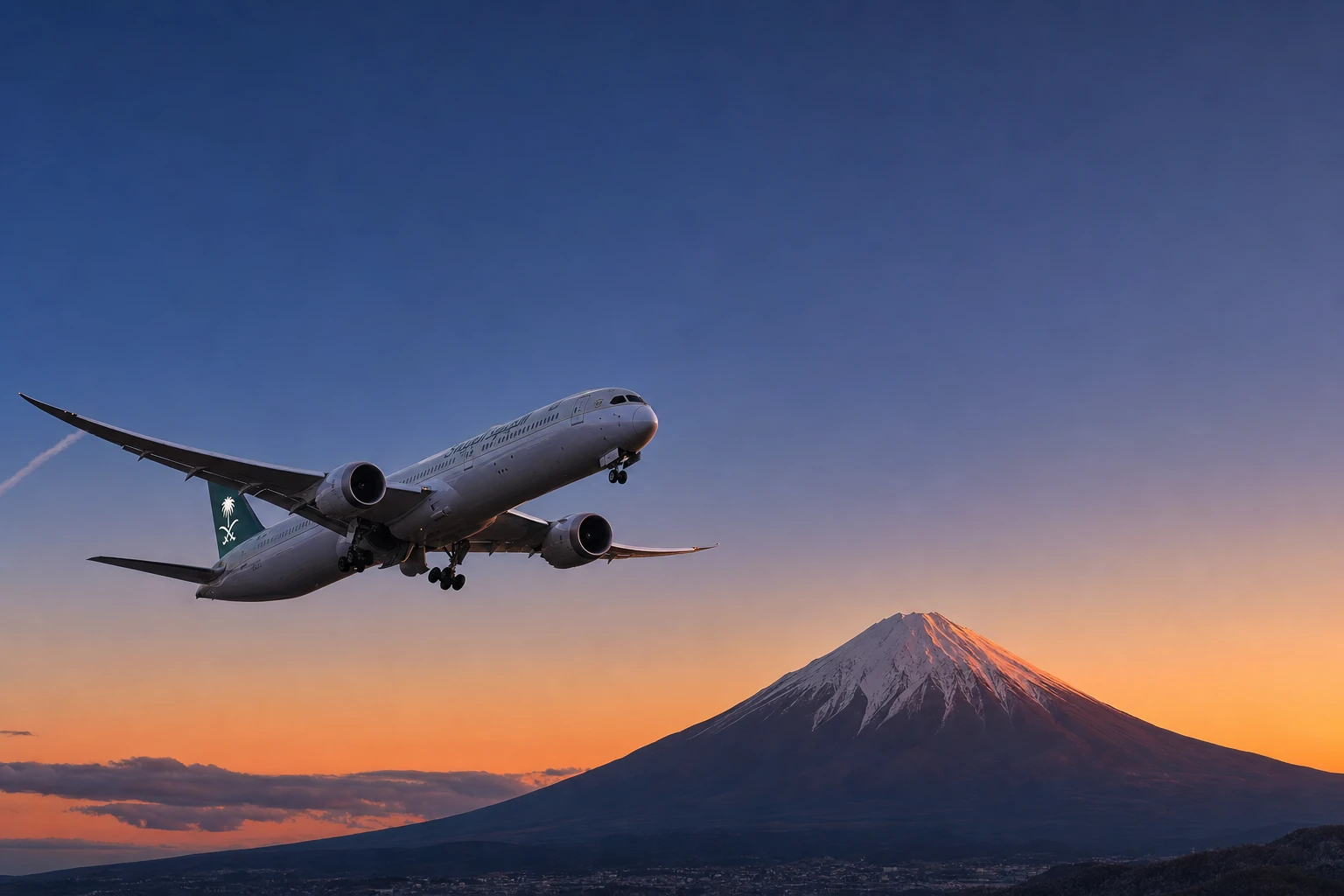
Flight SV824 leaves Riyadh at 01:00 and lands in Narita at 17:25 the same day, a trip of roughly 10 hours and 25 minutes. The return, SV825, leaves Narita at 21:30 and lands in Riyadh at 05:25 the next morning, about 13 hours and 55 minutes later. Both flights operate on Tuesdays, Thursdays and Saturdays aboard a Boeing 787-9, arriving and departing from Terminal 1 at Narita International Airport.
| Flight | Route | Departure | Arrival | Flight Time |
|---|---|---|---|---|
| SV824 | Riyadh to Tokyo Narita | 01:00 (Riyadh) | 17:25 (Narita, same day) | About 10h 25m |
| SV825 | Tokyo Narita to Riyadh | 21:30 (Narita) | 05:25 (Riyadh, next day) | About 13h 55m |
Saudia confirmed the launch on its verified account, posting that it had added Tokyo to its route map for the winter schedule. Aviation data providers tracking the corridor show no other carrier currently selling a nonstop seat between the two countries, so Saudia has the market to itself once flights begin.
The Timing Traces Back to Vision 2030
Saudia built the announcement around a partnership rather than a solo push. The airline worked with the Air Connectivity Programme (ACP), a government initiative that helps fund new international routes, alongside the Saudi Tourism Authority, which is lining up joint travel packages with partners in Japan.
The stated goals line up with three named documents: the National Aviation Strategy, the National Tourism Strategy, and Vision 2030, the kingdom’s plan to build tourism and logistics into a bigger share of its economy. Arab News also reported the route lands ahead of Saudi Arabia hosting the AFC Asian Cup 2027, a tournament expected to draw traveling fans from competing nations, Japan among them.
The addition of Tokyo carries strategic importance beyond traditional air connectivity. It creates a new bridge between Saudi Arabia and Japan, supporting the growing relationship between the two countries and their people.
Saudia said in a statement released Wednesday, as reported by Arab News.
It is a pattern the airline has repeated before. Saudia used similar language when it opened a Riyadh-Athens route in December 2024, treating each new long-haul city as both a commercial route and a diplomatic marker.
Saudia Already Tried This Route
This is not Saudia’s first attempt at the Tokyo market. The airline flew to both Narita and Osaka’s Kansai Airport in past years before dropping both routes around 2022, according to its own historical route records. Nothing in the public announcement explains why the earlier service ended, and Saudia has not framed the new launch as a correction of that decision.
What is different this time is the absence of rivals. Gulf carriers with far larger Japan networks, Emirates, Qatar Airways and Etihad Airways among them, still route passengers through a connecting hub to reach Tokyo. None has filed a competing nonstop.
Other regional airlines have made similar wagers on a single widebody rotation to open a market nobody else was serving. Arkia, an Israeli carrier, leaned on one aircraft when it deployed a Dreamliner on its new New York route during wartime, a bet that paid off well enough to expand.
Three Flights a Week Looks Like a Hedge
Three weekly flights is a light schedule for a flagship long-haul launch, and it fits a pattern. CAPA, an aviation analytics firm, confirmed the Tokyo schedule through a 15 July 2026 booking-system listing and found the corridor is currently unserved by any carrier, citing OAG’s schedule data.
Saudia has run this play before. It resumed three-weekly Riyadh-Nice service on 24 June 2026 as the only scheduled operator on that route, and it tested a short-lived, three-weekly Riyadh-Wedjh service with A320s between late May and the end of June. Both were low-frequency trials on routes with no direct competition.
Riyadh Air is the kingdom’s newer, separately branded state airline. It scheduled fresh Riyadh services using the same 787-9 type to Malaga, Kuala Lumpur and Dhaka starting in July and August, widening the internal competition for the same premium long-haul travelers out of the capital.
Saudia’s own network shows the same caution elsewhere. The airline is phasing in Airbus A321XLR service to Geneva at three weekly flights before adding a fourth, the same cautious ramp now showing up on Tokyo.
What we know:
- Launch date of November 17, 2026, three weekly flights, a Boeing 787-9 aircraft, and tickets already on sale.
- No competing nonstop service exists on the route, according to OAG’s schedule tracking.
What’s unconfirmed:
- Whether frequency rises beyond three weekly flights if early bookings hold up.
- Whether Osaka’s Kansai route returns alongside Tokyo, and what one-way fares will look like.
Who Else Could Fly This Route Nonstop?
Nobody currently does. Travelers moving between Riyadh and Tokyo today connect through hubs such as Abu Dhabi, Dubai, Doha or Cairo, adding hours and a second boarding pass. Nine airlines sell one-stop itineraries on the pair right now, and Saudia’s November flight would be the first single-leg option in years.
Flight-search data compiled by FlightRoutes.com shows roughly 61 weekly one-stop flights spread across those carriers, with connection times varying by hub.
| Airline | Connecting Hub | Current Frequency |
|---|---|---|
| Etihad Airways | Abu Dhabi | Multiple daily, about 13h 55m total |
| Emirates | Dubai | 1 flight per day |
| Qatar Airways | Doha | 4 to 6 flights per day |
| Saudia and EgyptAir | Cairo | 2 to 3 flights per day |
| Cathay Pacific | Hong Kong | 1 to 2 flights per day |
A similar monopoly existed on the Tel Aviv-Tokyo pair until earlier this year, when Arkia undercut El Al’s sole grip on the route with a rival nonstop and cheaper fares. Riyadh-Tokyo carries the same setup today: one airline, one schedule, and nobody yet racing to match it.
Booking Before the Autumn Foliage Rush
Tickets for SV824 and SV825 are already listed through Saudia’s own booking site and through authorized agents, Wego among them. The November 17 start date falls squarely in Tokyo’s autumn foliage season, typically one of the costliest stretches to find a hotel room in the city.
- Book lodging early, since autumn foliage season pushes Tokyo hotel rates higher the closer the date gets.
- Check entry requirements separately, since Saudi Arabia and Japan each set their own visa rules and this launch changes neither country’s process.
- Watch for schedule confirmation closer to departure, since aircraft type and timings on newly filed long-haul routes sometimes shift before the first flight.
- Compare against connecting fares, since a one-stop itinerary through Doha, Dubai or Abu Dhabi may still undercut the nonstop on price even if it costs more time.
None of that changes the basic fact on the ground. Saudia currently has the only flight number worth checking for a direct seat.
The Bigger Numbers Behind One Small Route
A single new route barely shows up in Saudia’s overall numbers, but those numbers explain why the airline keeps testing new corridors at low frequency first. The airline carried roughly 37 million guests in 2025 across more than 203,900 flights, a 6% rise from the year before, according to an aviation industry analysis report.
- 37 million guests flew Saudia in 2025 across more than 203,900 flights, up 6% from the prior year.
- 153 aircraft make up Saudia’s current fleet, serving over 100 destinations across four continents, with 112 more jets on order.
- $1.1 billion is Saudia’s brand value under Brand Finance’s latest ranking, up 34% and back to its highest level since 2021.
- Riyadh Air, the newer state-backed carrier chasing the same premium travelers, began flying to London Heathrow on October 26, 2025.
Saudia is a fully state-owned enterprise, and its route decisions run through the same Vision 2030 machinery as the Tokyo announcement. A single Riyadh-Narita rotation three times a week is a rounding error against that scale, which is exactly why it can afford to start small and watch what the bookings say.
Frequently Asked Questions
How long is the flight between Riyadh and Tokyo?
The outbound flight, SV824, takes about 10 hours and 25 minutes from Riyadh to Narita. The return, SV825, takes roughly 13 hours and 55 minutes, with the extra time coming mostly from stronger headwinds the 787-9 meets flying west back toward the Arabian Peninsula.
Which airport in Tokyo does Saudia use?
Saudia flies into Narita International Airport, landing at Terminal 1, rather than the closer Haneda Airport. Narita sits roughly 60 to 90 minutes from central Tokyo by train, a detail worth building into any tight connection.
Is this really the only nonstop option between Saudi Arabia and Japan?
Yes, for now. OAG’s schedule tracking shows no other airline has filed a competing nonstop, and current flight-search data shows the nine carriers selling the route today all require at least one connection. That could change if a rival airline decides the market is worth matching.
Can I book a ticket now even though the route does not start until November?
Yes. Saudia opened sales for SV824 and SV825 through its own site and through agents including Wego more than four months before the first scheduled departure, well ahead of the typical booking window for a brand-new long-haul route.
Will Saudia bring back its old Osaka route too?
There is no confirmation of that yet. AeroRoutes, a flight-schedule tracking publication, noted Saudia briefly offered passenger service to Osaka in September 2026, separate from the November Tokyo launch, but the airline’s current published schedule lists only Riyadh-Narita restarting this winter.
