
An Egyptian woman dining with friends at Sizzler’s Mall of Arabia branch said the manager interrupted her companion’s noon prayer, compared the act to using a toilet, and ordered the group to leave. Within hours the chain issued a public apology, suspended the probationary employee, and insisted the episode was an individual failure.
That response failed to end the argument. Instead it opened a second front of anger from customers who say designated prayer rooms already exist in the mall and that firing a new hire amounts to surrender.
What Unfolded in the Secluded Corner
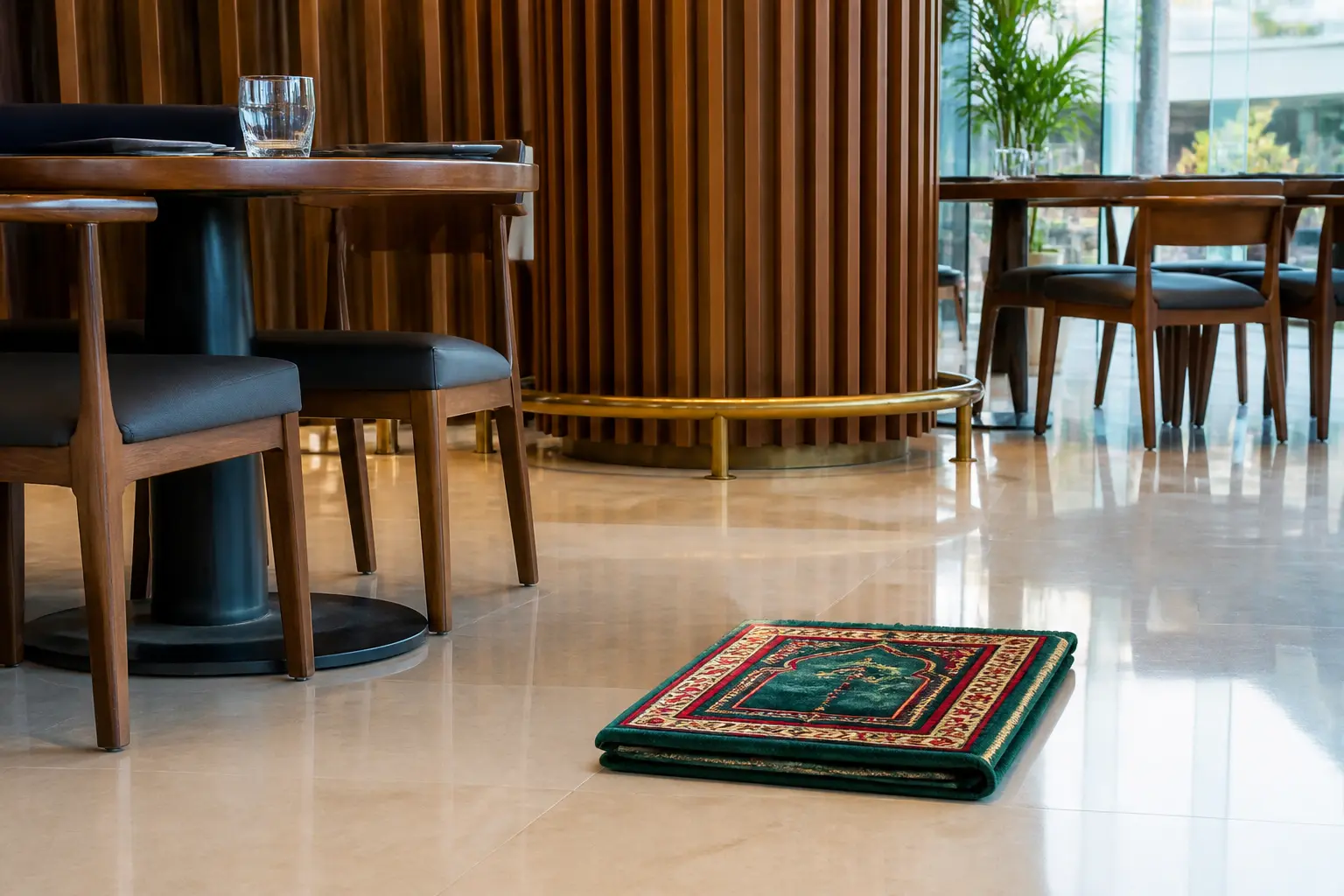
Nada Metwally described the scene in a detailed Facebook post that spread rapidly. She was eating with friends, some of them mothers with children, when one companion realized the time for noon prayer was about to close. The friend performed ablution in the mall restroom, asked staff for a place to pray, and after learning one suggested spot led to the kitchen chose a quiet corner away from tables.
The sequence mattered to those who later took sides. Ablution was already complete. Staff had been asked. The kitchen path was rejected. Only then did the quiet corner become the fallback. Each step narrowed the options left on the dining floor.
Metwally said the branch manager approached and tried to stop the prayer mid-way. When she intervened and asked him to speak respectfully, he directed her friend to “go pray near the bathrooms” and added a line that became the flashpoint.
Why don’t you take two extra steps to God, just like you go to the toilet?
Metwally objected to the comparison. She said the manager raised his voice, gestured angrily, and eventually told the group they were not welcome. Several diners backed the women and told security no disturbance had occurred. Some customers walked out. One child present began crying from the raised voices. Mall of Arabia management later reviewed cameras, according to Metwally, and told her the right lay with the diners.
The group paid their bill in full and waited hours for a Sizzler manager to appear. None did that day. That long wait, after the bill was already settled, became part of the grievance itself. It signaled to the women that the branch had no ready path for de-escalation once voices rose.
The Chain Moves Fast on a Two-Week Hire
Sizzler Steak House, which opened its first Egyptian outlet in 2014 and now runs eight branches across Cairo since 2014, posted a full apology statement on Instagram the next day. Management said it had contacted Metwally and her family directly. The employee, still on probation and employed less than two weeks, was suspended immediately and referred for investigation with a view to ending his service.
- Eight branches operating since 2014 with no prior similar incident claimed
- Less than two weeks on the job for the suspended manager
- Immediate suspension plus internal and legal procedures
- Direct contact and apology to the customer and family
The company stressed it does not ban prayer. It said it simply follows Mall of Arabia regulations that require worship inside mosques or designated prayer areas rather than inside retail stores.
Speed was the point of the statement. A probationary hire of under two weeks gave management a clean lever: suspend first, investigate next, and frame the episode as one person’s failure rather than a brand pattern. Eight branches and no claimed prior incident supplied the backdrop for that claim. The same speed, however, also fed the countercharge that the chain had simply cut loose the easiest person on the roster.
Direct contact with Metwally and her family was meant to close the personal wound. Public suspension was meant to show consequences. Neither step settled the larger quarrel over where a diner may finish an obligatory prayer once ablution is done and a corner is free.
Mall Rules Meet Customer Expectations
Those mall rules sit at the center of the dispute. Sizzler’s statement framed the manager’s action as enforcement of venue policy, not personal hostility to religion. Commenters on the Instagram post and on X repeatedly noted that prayer rooms exist a short walk away inside Mall of Arabia. Some argued any customer who needs to pray can use them without turning a dining floor into an ad-hoc musalla.
Others rejected that framing. They said a Muslim country should not force a woman who has already done ablution and found a quiet corner to interrupt her prayer or walk farther. Metwally herself asked whether the same manager would have ejected her from a standalone Sizzler branch outside a mall. The company has not publicly answered that specific point.
The unanswered question keeps the policy debate alive. Inside a mall, landlord rules bind every tenant. Outside a mall, the same brand might face only its own floor plan. Customers heard the company’s mall-regulation defense as incomplete until that contrast is addressed in public.
Egypt’s official religious bodies have long addressed prayer timing in workplaces. Dar Al-Ifta guidance on prayer breaks affirms that employees may take time for obligatory prayers and related ablution without penalty, provided it does not undermine contracted duties. The guidance is aimed at workers, not diners, yet it underscores a broader cultural expectation that obligatory prayer finds space.
That distinction between worker and diner is easy to miss in the heat of a comment thread. The fatwa does not order restaurants to clear floor space. It does show that Egyptian religious authorities treat the prayer window as something that ordinary schedules must accommodate. Diners who sided with Metwally borrowed that cultural baseline even though the text itself speaks to employees.
Two Camps Form Overnight
Social media did not unite behind either the women or the manager. One camp shared Metwally’s full account, highlighted the toilet comparison, and called for boycotts of every Sizzler branch. The other camp mocked “prayer in restaurants and cafes,” accused the women of seeking trends, and demanded the employee’s reinstatement. Several posts insisted the firing punished a man who was only doing his job.
| Viewpoint | Core claim | Typical demand |
|---|---|---|
| Support for diners | Rude interruption of prayer and ejection were unacceptable | Keep the suspension, add prayer corners in stores |
| Support for manager | Mall has designated rooms; dining floor is not a mosque | Reinstate the employee, stop “pandering” |
| Mall-policy focus | Rules exist for a reason; enforcement style was the problem | Clarify rules, train staff on tone |
A widely shared X post from Ismail Hosny called the company “weak” for yielding to what he termed invented cafe prayer. Other users posted the opposite: “We are in a Muslim country and she has the right as long as she bothers no one.” The same apology post that was meant to close the matter became a magnet for both boycott threats and rehire petitions.
The three-way split in the table still leaves little middle ground. Boycott calls treat the toilet line as proof of contempt. Rehire calls treat the suspension as proof of corporate panic. The narrower camp that blames tone rather than the rule itself has the least volume online, yet it is the only position that matches the company’s own claim that it does not ban prayer and only enforces mall policy.
Who Carries the Cost
The probationary manager is the most immediate loser. A job of under two weeks ended in public suspension and likely termination after a single confrontation. Sizzler loses goodwill on two flanks at once: customers who feel the original offense was minimized and customers who feel the company abandoned its own staff. Diners who simply want a quiet steak now walk into a politicized space.
Mall of Arabia itself escaped the worst heat. Metwally praised its rapid response and camera review. The mall’s policy, however, is now under informal public scrutiny. If every retail tenant must redirect worshippers to shared facilities, staff need clearer scripts than a toilet comparison.
Egyptian restaurants abroad sometimes market themselves as cultural bridges. The recent Egyptian restaurant opening in New Jersey is one example of cuisine carrying identity across borders. At home the same cuisine now sits inside a sharper debate about identity inside commercial walls.
Costs stack unevenly. The newest hire absorbs the personal blow. The brand absorbs split reputation damage. Ordinary customers absorb a dining room that now carries political charge. The mall, praised for its camera review, still owns the rule set that every tenant must translate into daily speech. Praise for process does not remove the need for better wording on the floor.
Tone Turns a Mall Rule Into a Flashpoint
Policy and delivery are not the same skill. Sizzler’s public line is that Mall of Arabia requires worship in mosques or designated prayer areas, not inside retail stores. Commenters who defend the manager lean on that same map of the building. The flashpoint line about toilets did not come from the written rule. It came from how the rule was spoken in a raised voice, mid-prayer, in front of children.
Several diners told security no disturbance had occurred. That detail undercuts any claim that the corner prayer had already disrupted service. The later camera review, which Metwally said backed the diners, points in the same direction. What remained contested was not whether a rule existed, but whether the manager’s words and gestures matched the calm redirection the rule required.
- Designated prayer rooms already exist a short walk away inside the mall
- The dining-floor corner was chosen only after staff pointed toward the kitchen
- The comparison to toilets, not the redirect itself, drove the viral anger
- Mall footage review, per Metwally, sided with the diners on the right to stay
Training that stops at “send them to the prayer room” leaves staff unprepared for the next minute, when a customer has already begun and objects to the wording. The third camp in the online table, the one that wants clearer rules and better tone, is describing exactly that gap. Suspension removes one employee. It does not write the script the next employee will need.
What the Suspension Leaves Unresolved
Immediate suspension of a probationary worker answered the demand for visible consequences. It did not answer Metwally’s question about a standalone branch, nor did it tell other tenants how to speak when a diner has already finished ablution. Investigation with a view to ending service may close the personnel file. The Instagram comment threads show the public file is still open.
Boycott calls and rehire petitions now share the same apology post. One side reads the suspension as the minimum decent step. The other reads it as proof the company folded. Both sides treat the mall’s designated rooms as settled fact. They disagree on whether that fact ends the customer’s claim once a quiet corner is in use and no tables are blocked.
Sizzler’s promise of “necessary measures” still has no public detail. Staff training, clearer signage, or small designated corners inside some branches would each please one camp and irritate the other. Until the chain names which measure it will take, the suspension stands alone as the only concrete act, and alone it cannot carry the full weight of the dispute.
A Quiet Corner Became a National Proxy
The incident lasted minutes. The argument it ignited is older. Where exactly does obligatory prayer belong when people spend hours inside climate-controlled malls that already contain prayer rooms? How much deference does a private business owe a customer’s religious schedule versus its own floor plan and landlord rules? How should a manager speak when enforcing those rules?
- August 6 or 7, 2026, Group dines at Sizzler Mall of Arabia; noon prayer time running out
- Same afternoon, Friend begins prayer in corner; manager intervenes; confrontation escalates; group told to leave
- Later that day, Customers leave in protest; mall management reviews footage and contacts the women
- Following day, Sizzler posts apology, announces suspension of the probationary employee
- Ongoing, Investigation continues; social media remains split between boycott and rehire calls
Sizzler promised “necessary measures” to prevent a repeat. That phrase covers staff training, clearer signage, or even small designated corners inside some branches. Any of those steps will please one camp and irritate the other. The chain that wanted the story to end with a single suspension now owns a running referendum on the place of prayer in Egyptian retail life.
The women paid their bill and went home. The manager is suspended. The apology sits on Instagram with hundreds of comments that refuse to agree. The corner where a prayer started is empty again, but the argument it started is not.
