
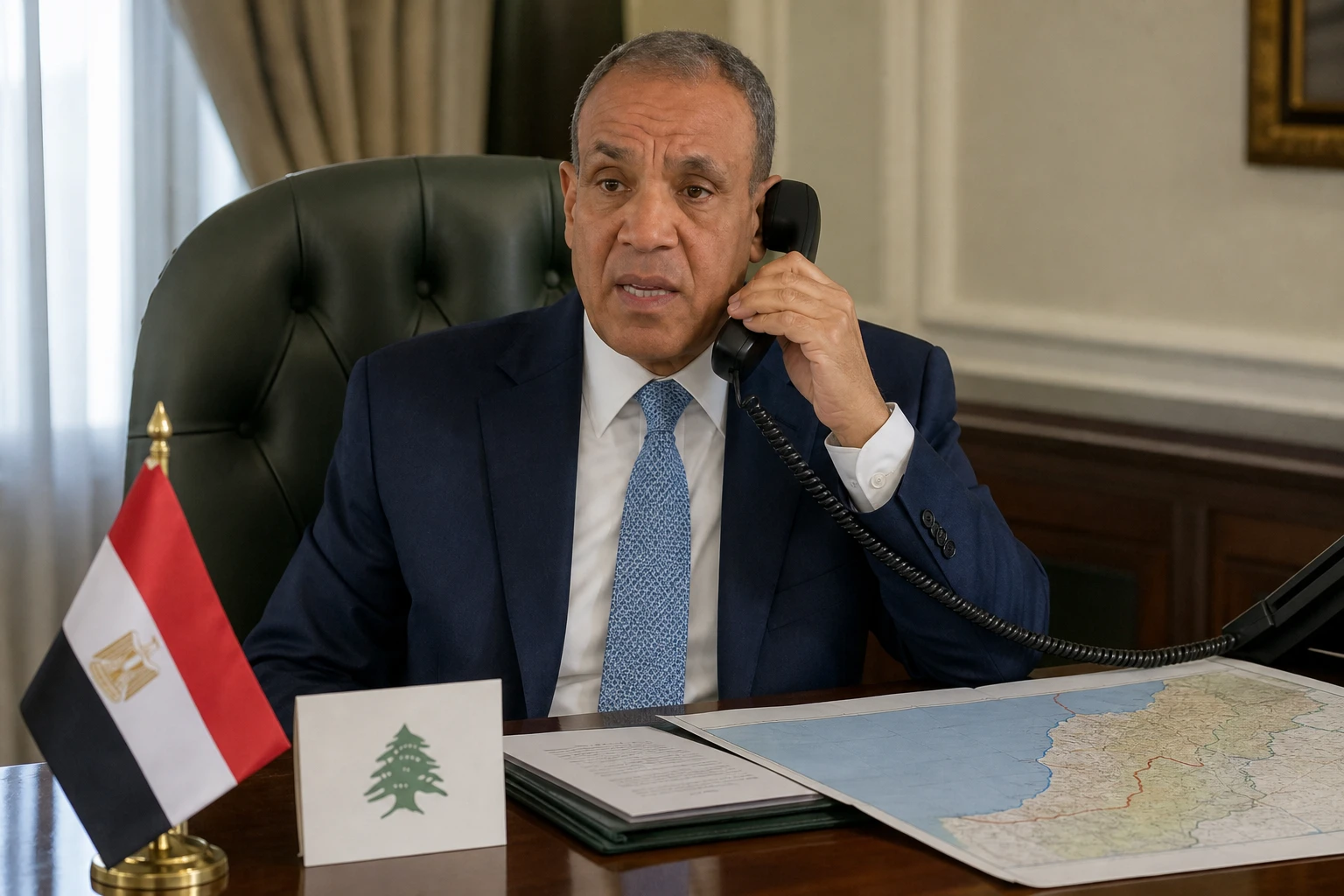
Egyptian Foreign Minister Badr Abdelatty told Lebanese Prime Minister Nawaf Salam on Tuesday that Cairo stands fully with Lebanon’s state institutions, demanding a complete Israeli withdrawal from Lebanese territory and insisting that weapons stay under government authority.
The phone call landed on the same day the seventh round of U.S.-brokered Lebanon-Israel talks wrapped in Rome, and just as Salam traded public barbs with Hezbollah over the negotiations themselves.
What the Ministers Said
According to the Egyptian Foreign Ministry readout carried by Ahram Online, Abdelatty expressed full solidarity with Lebanon amid its political and security pressures. He called any violation of Lebanese sovereignty, unity or territorial integrity a clear breach of international law and UN Security Council Resolution 1701.
He stressed the need to support Lebanese state institutions, especially the Lebanese Armed Forces, so they can exercise authority across the whole country. Weapons must remain under the authority of the Lebanese state, he said, to protect national institutions and the interests of the Lebanese people.
That pairing matters. Solidarity alone would have been a routine regional courtesy. Pairing it with an explicit weapons monopoly and a full withdrawal demand turns the call into a policy signal rather than a gesture.
Salam thanked Egypt for its consistent assistance and praised Cairo’s longstanding support for the Lebanese state. He underlined the value of ongoing consultation with Egypt on regional issues.
Daily News Egypt reported the same core points and noted the call coincided with the close of the Rome round. The timing was not accidental. Cairo chose the day the latest negotiating session ended to put its conditions on the record while the talks were still fresh in public view.
Rome Framework Still Moves in Pilot Steps
The June 26, 2026, trilateral framework agreement, brokered by the United States, sets a sequenced path: Israeli forces withdraw from southern Lebanon in stages while Lebanese Armed Forces units take over after verifying the disarmament and dismantling of non-state armed groups’ infrastructure. Pilot zones come first.
Earlier Rome sessions in mid-July produced agreement on advancing those initial pilot security zones. Lebanese media said the latest August round covered border issues, military arrangements and efforts to firm up a ceasefire. Lebanon tabled a land-border demarcation proposal. Israeli negotiators, for the first time according to LBCI presidential sources, accepted work on “re-establishing internationally drawn borders.” Beirut still sought a political guarantee that Israel would halt fire and bombings; no answer had arrived from Israeli political leadership by the time reports emerged.
| Round | Date / Location | Key outcome reported |
|---|---|---|
| Framework signing | 26 June 2026, Washington | Sequenced withdrawal for LAF takeover and Hezbollah disarmament oversight |
| Rome session | 14-15 July 2026 | Pilot zones advanced; positive U.S. assessment |
| Seventh Rome round | 4 August 2026 | Border discussion opened; ceasefire guarantee still pending |
Expectations for rapid full withdrawal remain low. Israel has tied its pullback to verified removal of the Hezbollah threat. Lebanon wants the occupation ended and displaced residents returned.
The sequence itself is the mechanism. Each pilot zone must clear verification before the next stage opens. That design slows the process by intent. It also gives both capitals repeated political off-ramps if domestic pressure rises.
Cairo’s Pattern of Quiet State Backing
Egypt has spent months inserting itself into the Lebanon file. In March and April Abdelatty visited Beirut, delivered aid, and met President Joseph Aoun, Salam and Speaker Nabih Berri. Cairo conveyed red lines on maritime and land borders and warned against excessive concessions. Sources told The National that Egypt was surprised Lebanon opened direct talks without prior consultation yet still offered negotiating expertise drawn from decades of dealing with Israel.
- March and April 2026: Abdelatty visits Beirut, delivers aid, and meets Aoun, Salam and Berri
- Spring contacts: Cairo conveys red lines on maritime and land borders and warns against excessive concessions
- Talks open: Egypt registers surprise at direct negotiations launched without prior consultation, then still offers expertise
- August call: Abdelatty restates full solidarity, full withdrawal and exclusive state control of weapons
The same preference for strong Arab state institutions appears in Egypt’s recent reaffirmation of support for Qatar and in Cairo’s backing for Yemen’s government. When Houthi actions threaten shipping, Egypt’s stakes when Houthi actions hit the Suez become immediate. A stable Lebanese state that controls its own weapons reduces one more vector of spillover risk along Egypt’s eastern approaches.
Across these files the method is consistent. Cairo backs the formal government, not parallel armed structures, and treats institutional control of force as the condition for lasting calm. Lebanon now sits inside that same template.
The Army Monopoly Line Lands Hard
Abdelatty’s emphasis on the Lebanese Armed Forces and exclusive state control of weapons is not new language, but its timing amplifies it. The framework itself assigns the LAF the job of overseeing disarmament inside the pilot zones. Hezbollah Secretary-General Naim Qassem has rejected the deal as surrender and null. On the anniversary of the Beirut port explosion he accused the talks of bringing only “shame, humiliation, disappointment, and successive concessions” and urged the government to stop free giveaways.
Salam answered on X without naming the group. He said the greatest assistance to Israel came from those who “monopolised dragging Lebanon into absurd support wars,” giving Israel pretexts to violate sovereignty, destroy cities and displace citizens.
Whoever monopolised the decision of war and tries to continue confiscating the state’s decision, tying Lebanon to foreign calculations and axes while ignoring the interests of his environment and the Lebanese in general, cannot distribute certificates in patriotism, let alone in sovereignty.
Salam insisted true sovereignty rests on one independent decision and one army that alone extends authority over all territory. The Egyptian call, stressing exactly that monopoly, therefore reads in Beirut as external reinforcement of the prime minister’s position at a moment of open rupture.
The overlap is precise. Abdelatty’s language and Salam’s reply both place the army, not any other formation, at the center of legitimate force. That alignment leaves little room for a dual-authority reading of the framework’s pilot phase.
Resolution 1701 Still Sets the Legal Floor
Both sides of the call invoked the 2006 text. Its key provisions of resolution 1701 demand a full cessation of hostilities, the disarmament of all armed groups so that no weapons or authority exist in Lebanon other than the Lebanese state, no foreign forces without government consent, and an area free of armed personnel, assets and weapons other than those of the Lebanese authorities and UNIFIL between the Blue Line and the Litani River.
- Full respect for the Blue Line as the temporary line of withdrawal
- Israeli withdrawal parallel to LAF and reinforced UNIFIL deployment
- End to unauthorized arms transfers into Lebanon
- Support for the Lebanese government’s exclusive authority nationwide
Implementation has been incomplete for nearly two decades. The current framework tries to operationalize the same principles through sequenced pilots rather than a single leap. Egypt’s repeated citation of 1701 keeps the legal benchmark public while the practical mechanics are bargained in Rome.
By citing the resolution on the same day a negotiating round closed, Cairo linked the private bargaining track to a public legal standard that neither side can easily rewrite. The pilots may move slowly. The floor they rest on does not move with them.
How the Pilot Zones Carry the Whole Deal
The framework’s design makes the first zones do more than local security work. They are the proof of concept for every later stage. If verification holds and the LAF can hold ground after Israeli units leave, the political case for the next tranche grows. If verification stalls or residual infrastructure remains, the sequence itself freezes.
That is why the army monopoly line and the withdrawal demand arrive together. Without exclusive LAF control inside each pilot, the handover step has no credible recipient. Without a credible recipient, Israel’s condition of verified threat removal never clears. Without that clearance, Lebanon’s demand for full withdrawal and the return of displaced residents stays unmet.
Rome’s mid-July advance on pilot zones and the August opening of border discussion therefore matter as tests of method, not only as agenda items. Each small agreement either validates the sequence or exposes its weak joint. Egypt’s call inserts an outside capital into that test at the moment when domestic Lebanese argument over the same sequence was loudest.
Lebanon and Israel Still Define Success Differently
The public record already shows two end-states that only partly overlap. Arranging those positions side by side clarifies why the ceasefire guarantee remains outstanding and why rapid full withdrawal is not expected.
| Actor | Stated priority from the record |
|---|---|
| Lebanon | End the occupation; return displaced residents; obtain a political guarantee that fire and bombings stop |
| Israel | Tie any pullback to verified removal of the Hezbollah threat |
| Egypt | Complete Israeli withdrawal; weapons solely under Lebanese state authority; LAF authority nationwide |
| Framework text | Staged Israeli withdrawal; LAF takeover after verified disarmament and dismantling in pilot zones first |
Lebanon tabled a land-border demarcation proposal. Israeli negotiators accepted work on re-establishing internationally drawn borders, a first according to LBCI presidential sources. That narrow convergence on borders does not yet resolve the larger gap on timing, verification and the political guarantee Beirut still seeks.
Egypt’s intervention does not invent a third map. It weights the Lebanese reading: withdrawal is the destination, not a lever that can stay deferred without cost, and the army is the only legitimate holder of arms once stages complete. How far that weighting moves the Rome table remains open. It does raise the diplomatic cost of treating the state path as optional.
What the Call Changes on the Ground
Diplomatically the conversation adds an Arab capital’s weight behind the state-centric reading of the framework. It raises the political price for any actor, internal or external, that treats Lebanese sovereignty as optional. For Salam’s government it supplies cover against accusations of isolation or excessive concession. For Hezbollah it underlines that even traditional supporters of the “resistance” narrative now prioritize the army’s monopoly. For Israeli negotiators it signals that full withdrawal remains the non-negotiable Lebanese and Egyptian demand, not a bargaining chip that can be indefinitely deferred.
Practically nothing on the southern map shifts overnight. Pilot zones still require verification mechanisms, funding for the LAF, and political will inside Lebanon to confront residual armed infrastructure. Ceasefire guarantees remain outstanding. Yet the second-order effect is already visible: Cairo has made itself a reference point for the legitimacy of the state path at the precise week when that path faced its sharpest domestic challenge.
The call also narrows the space for ambiguity about what “support for Lebanon” means in Egyptian usage. It means support for institutions that hold a monopoly on force, not for arrangements that leave parallel arsenals intact after pilots close. That definition will travel with Cairo into any later consultation Salam seeks on regional issues.
Longstanding Ties, Immediate Stakes
Egypt and Lebanon share decades of fraternal language and practical cooperation, including training and equipment for the Lebanese army. Abdelatty framed the latest support as continuity. In the current regional climate, continuity itself is a choice. By pairing solidarity with explicit conditions on withdrawal and weapons, Egypt is protecting a preferred end-state: a Lebanon whose borders and arsenals are controlled by its own government, not by non-state actors or foreign armies.
Whether the Rome process can convert that preference into verified pilot handovers will decide if the phone call becomes a footnote or an early marker of a durable shift. For now the message from Cairo is unambiguous. The Lebanese state, its army and its exclusive claim to arms hold Egypt’s backing.
