
The US State Department said Thursday that Israel and Lebanon are “a lot closer on what needs to be done to advance and expand the pilot zone process” after their seventh round of direct talks in Rome. The claim landed one day after an IED killed two IDF reservists in southern Lebanon and triggered the heaviest Israeli fire in weeks.
A Lebanese presidential source told AFP the same day that the talks “had not yielded definitive results regarding the pilot zones” and that Israel refused further withdrawals until the Lebanese army held full control of the first two zones.
Rome Claim Meets Lebanese Pushback
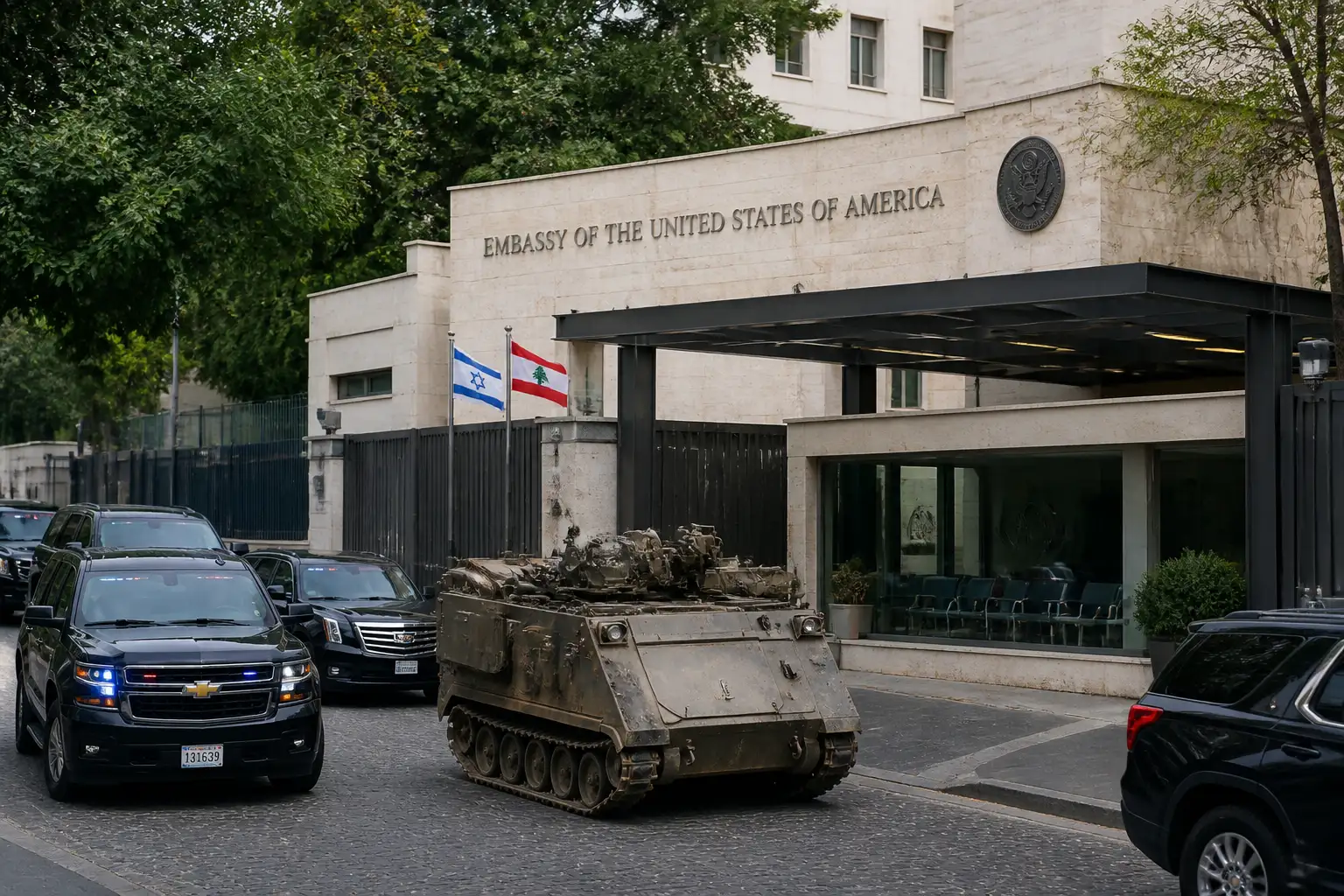
State Department language framed the three-day session at the US Embassy as productive. Both sides remained at the table even after Wednesday’s escalation forced an early pause.
Lebanese accounts painted a narrower picture. Israel insisted on verifying implementation inside the initial pilot zones before any expansion. Haaretz reported the sides still disagreed on the inspection mechanism for Hezbollah operatives and infrastructure, and that no consensus existed on countries for a verification committee.
Al Akhbar said American mediators told the Lebanese side they would not pressure Israel to speed its pullback. The Lebanese Armed Forces, the Americans said, must show clear steps disarming Hezbollah across the country first. Lebanon had proposed Khiam or Bint Jbeil as the next zone; both saw heavy fighting and remain under Israeli control.
- US public line: sides closer on advancing and expanding pilot zones
- Lebanese source: no definitive results, Israel demands verification of first two zones
- Israeli position per reports: no further withdrawals without agreed inspection mechanism
- Next formal round already set for early September
The gap between the American summary and the Lebanese readout is the story’s core tension. Technical work continued. Concrete expansion did not.
Wednesday’s Deadly Explosion and Strikes
Around noon on August 5, troops from a reserve brigade entered a structure in Majdal Zoun while demolishing Hezbollah infrastructure. An explosion killed Maj. (res.) Harel Birenstock, 34, and Sgt. Maj. (res.) Tamir Vaknin, 33. Four others were seriously wounded.
Their deaths were the first IDF fatalities in Lebanon since Capt. David Hazutt on June 28. Israel answered with heavy strikes Wednesday afternoon and Thursday morning. UNIFIL recorded 113 projectiles launched by the IDF on Wednesday, the highest daily total since June 21. No Hezbollah launches were detected in the same window, according to the force.
Stats from the flare-up
- 2 IDF reservists killed, 4 seriously wounded
- 113 IDF projectiles on Wednesday (UNIFIL)
- Talks paused early Wednesday, resumed Thursday on schedule
- One Lebanese civilian reported killed in a separate strike on Tibnin
Rambam Health Care Campus in Haifa said Thursday that the four wounded had stabilized. One was off a ventilator and talking with family; three remained unconscious.
How the Pilot Zones Were Meant to Work
The entire process rests on the June 26 Trilateral Framework signed in Washington by Israel, Lebanon and the United States. That text sets a sequenced process of LAF control then verified disarmament before any IDF redeployment.
Two initial zones were already agreed. Future zones require mutual consent. Only after confirmation that non-state armed groups and their infrastructure are gone does the Lebanese army assume full responsibility, reconstruction begin, and civilians return under exclusive state control.
| Step | Actor | Requirement |
|---|---|---|
| 1. Entry | LAF | Full security responsibility inside agreed zone |
| 2. Clearance | LAF | Fighters, weapons and infrastructure removed |
| 3. Confirmation | Third-party verifier | Ground check accepted by both sides |
| 4. Redeployment | IDF | Forces pull back once confirmation delivered |
| 5. Return | Civilians | Reconstruction under exclusive Lebanese control |
In July the United States announced first pilot zone operations in Froun, Srifa and Zawtar al-Gharbiya. Early ground tests showed how slow and contested each hand-over remains. Residents found most homes uninhabitable. Israeli units stayed nearby and fired warning shots when LAF troops approached too close.
Verification Shortlist Emerges Without a New Zone
The Rome round did produce one tangible technical step. A Lebanese official told Reuters on August 7 that the sides agreed a shortlist of countries that could send troops to verify Hezbollah’s disarmament. Washington will narrow the list and may choose more than one country. Lebanon rejected any role for private security firms.
France had been vetoed earlier by Israel and the United States. Discussion of housing the verifiers under a renewed UNIFIL mandate or a separate arrangement continues. UNIFIL’s current mandate ends December 31, 2026. Separate reporting has pointed to Italy as a leading candidate to verify clearance, given its long UNIFIL footprint and bilateral contacts with the LAF.
No agreement was reached on the next withdrawal area. The next talks are set for early September. The shortlist advances the verification box on the Framework checklist. It does not move a single additional village from Israeli to Lebanese control.
Three Parallel Tracks in the Italian Capital
Saudi outlet Asharq News described the Rome meetings as running three tracks at once.
- Political track: proposed pilot zones and expansion criteria
- Military track: common definitions of military operations
- Legal track: Lebanese prisoners held by Israel, with a “positive” atmosphere reported and civilians to be handled separately from Hezbollah operatives
The multi-track format kept the parties talking even while the border burned. It also diluted any single deliverable. Progress on prisoners or definitions can be real without unlocking the next geographic step. That structure explains how Washington can claim the sides are closer while Beirut reports no definitive results on the zones themselves.
Regional diplomacy continues in parallel. Egypt’s public backing for the Lebanese state and an earlier French proposal on Hezbollah withdrawal show other capitals still trying to shape the end-state. None of those efforts forced a new pilot zone onto the map this week.
The Families Who Buried Two Reservists
Birenstock, a married father of four from the Efrat area and company commander in the 55th Reserve Paratroopers Brigade, was laid to rest Thursday at Mount Herzl. Vaknin, 33, a tech worker from Eilat who stayed in Israel to remain near family, was buried in his hometown military cemetery.
My firstborn son. My beautiful boy. I can’t believe this is what happened to us. I never will. You made me a mother, and then a grandmother. You built the sweetest family imaginable. Now we’re learning what pain really is… God in Heaven, hold our hand and teach us how to live with this pain that tears the soul apart.
His mother, Yonat, spoke those words at the Jerusalem funeral. Birenstock’s wife Elia said she had tried to be strong for the children after October 7 but this time had “no strength left.” Vaknin’s father Shimon said after kaddish that he did not want to recite the prayer for his son and asked how he was burying him instead of walking beside him at a wedding.
Hundreds attended both funerals. The personal cost arrived while diplomats in Rome still debated the next technical clause.
What the Pause Leaves Unsettled
Hezbollah is not a party to the Framework and continues to refuse disarmament. Israeli officials have said troops will stay as long as the threat remains. Lebanese officials want larger zones and faster hand-overs to reclaim sovereignty and start reconstruction. The US insists the process is performance-based: verified results first, movement second.
The shortlist of potential verifiers is a real bureaucratic step. So is the decision to keep talking in September. Neither changes the fact that two more Israeli families are mourning, that 113 projectiles flew in a single day, and that the next pilot zone is still a proposal rather than a map change. The Framework’s sequence is intact on paper. On the ground the sequence waits for the next confirmation that may never arrive quickly enough for either capital’s politics.
