
Deputy Prime Minister and Foreign Minister Ishaq Dar departed for a one-day visit to Amman on Tuesday for an emergency ministerial meeting on occupied Jerusalem. Jordan convened the gathering of Arab League and Islamic foreign ministers to forge a unified response to what it calls an imminent threat at Al-Aqsa Mosque.
The talks open Wednesday under King Abdullah II’s host role. Pakistan frames its presence as steadfast backing for Palestinian statehood. The deeper driver sits in Amman: the Hashemite kingdom’s own custodianship, water supply, and demographic balance hang on the outcome.
The Amman Call Brings Arab and Islamic Ministers Together
Jordanian Deputy Prime Minister and Foreign Minister Ayman Al Safadi issued the invitation. Foreign ministers from Arab League states plus Pakistan, Turkey, Indonesia, Malaysia and others are expected. They will call on King Abdullah II and hold bilateral sessions on the sidelines covering Gaza’s humanitarian crisis and wider regional files.
The Foreign Office in Islamabad described Dar’s trip as a clear show of Pakistan’s principled support for an independent, sovereign and contiguous State of Palestine on pre-1967 borders with Al-Quds Al-Sharif as capital. Dar is to reaffirm unwavering backing for the Palestinian people.
- Formulate a joint diplomatic position on East Jerusalem’s status
- Press international actors to halt changes at holy sites
- Coordinate responses to settler violence and access restrictions
- Exchange views on Gaza ceasefire prospects and West Bank displacement risks
Turkish Foreign Minister Hakan Fidan confirmed attendance, signaling the meeting’s reach beyond the Arab core. No final communique has emerged yet as the day unfolds.
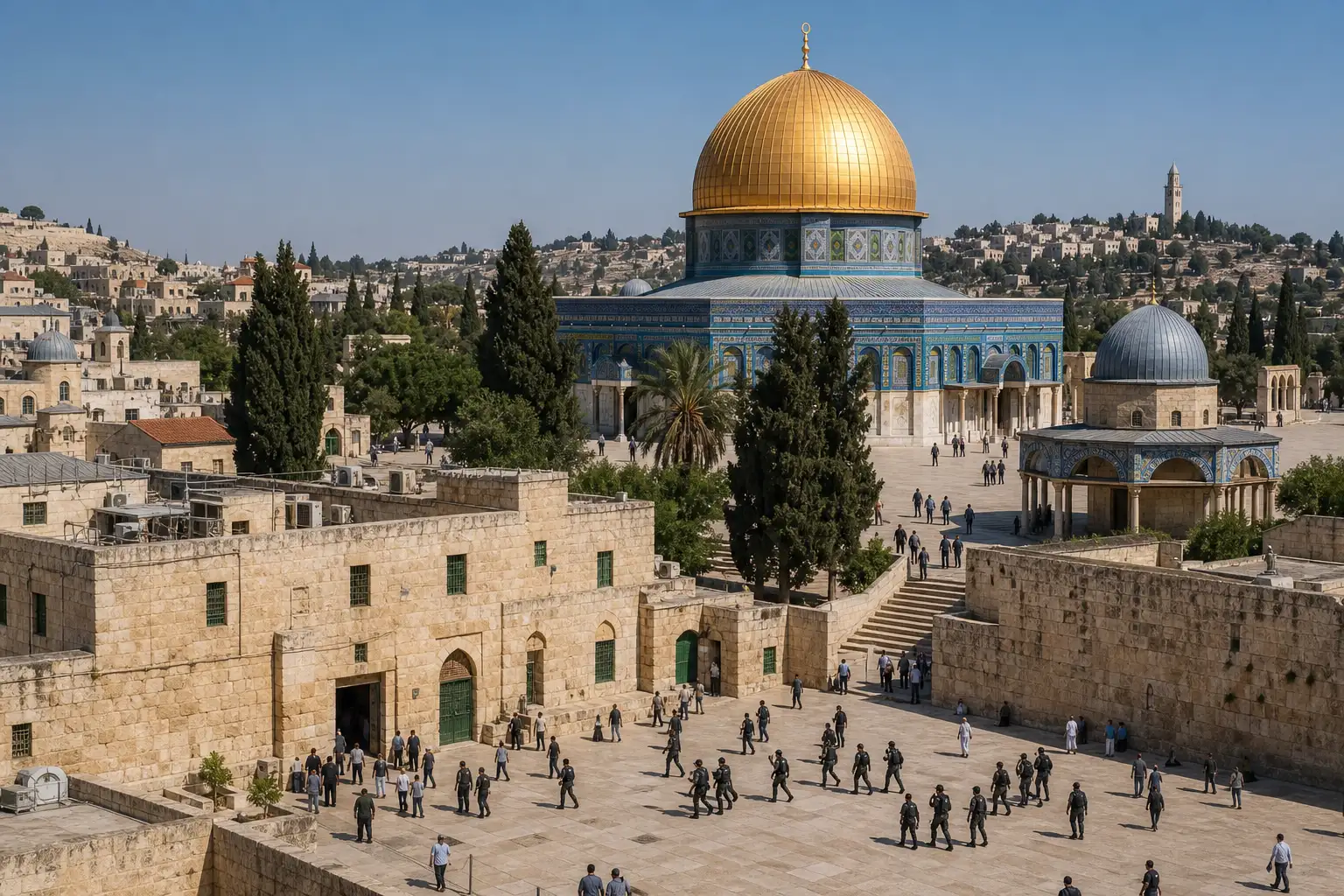
Why Al-Aqsa Became the Summer Flashpoint
On 23 July more than 4,200 Israeli settlers and far-right activists entered the Al-Aqsa compound during Tisha B’Av. National Security Minister Itamar Ben-Gvir joined them under heavy police escort. Palestinian officials recorded Talmudic rituals, prostrations, singing and prayer inside the site. Worshippers faced barriers and assaults at the gates.
Israeli media said police allowed over 1,000 to pray. The long-standing arrangement permits Jewish visits but bars non-Muslim prayer. Palestinian authorities called the day one of the largest incursions of the year and a step toward temporal and spatial division of the compound.
Stats snapshot of the pressure:
- 4,288 Israelis entered the compound on 23 July per Jerusalem governorate tallies
- 27 settler stormings of Al-Aqsa recorded in July alone by Palestinian endowments officials
- Over 950 settler attacks with casualties or damage across the West Bank and East Jerusalem in the first half of 2026, averaging six per day
- 18 Palestinians killed in settler-linked violence by mid-July 2026, already past the full-year 2025 total
UN experts in June warned of surging Israeli settler terror in the Occupied Palestinian Territory, including East Jerusalem, describing it as daily terror backed by state acquiescence that forces displacement.
Jordan Carries the Hidden Stake
Amman does not treat the compound as a distant Palestinian file. The Hashemite monarchy holds custodianship of Muslim and Christian holy sites in Jerusalem, a role dating more than a century and reaffirmed after 1967 and in the 1994 Israel-Jordan peace treaty. That role underpins royal legitimacy at home and regional standing.
This is a constant threat, a dangerous threat that we’re trying to counter in every tool that we have possible. We warn that tampering with the status quo could trigger a religious conflict that will reverberate beyond Palestine and Jordan into the whole Muslim world. Jerusalem is a tinderbox.
Ayman Safadi told The Guardian those words while explaining why he called the emergency session. He pointed to a recruitment drive for a special Temple Mount police unit and braced for further challenges during major Jewish holidays in September, which this year coincide with an intense Israeli election campaign.
Jordan also faces direct pressure on water. Israel declined to renew a 2021 deal that supplied 100 million cubic metres a year and reverted to the lower 1994 volume of 50 million. Officials linked the cut to Jordanian criticism of Gaza operations. For one of the world’s most water-scarce countries, the shortfall is immediate.
Demographics add another layer. Jordanians of Palestinian descent already form more than half of the kingdom’s 11.5 million people. East Bankers fear further dilution of national identity. Safadi has drawn a red line against any mass displacement of West Bank Palestinians into Jordan, calling it a violation that Amman will do whatever it takes to prevent.
Domestic politics tighten the bind. The Islamist Umma party (formerly the Islamic Action Front) gained ground on the back of Gaza anger and now holds significant seats. The monarchy has slowed political reform while facing open letters demanding withdrawal of the expanded US military presence on Jordanian bases after repeated strikes on a US base in Jordan.
The Status Quo Frays Under Daily Pressure
Under the arrangement that followed the 1967 war, the Islamic Waqf (under Jordanian custodianship) administers the interior of the Al-Haram al-Sharif compound while Israel controls external security. Non-Muslims may visit; prayer remains reserved for Muslims. Israel says it upholds the status quo. Palestinians and Jordan see systematic erosion through higher visitor numbers, public rituals, ministerial visits and access denials for Muslim worshippers.
Key Dates That Built the Arrangement
- 1920s-1930s British Mandate status quo rules for holy sites take shape after earlier riots
- June 1967 Israel captures East Jerusalem; Jordan retains de facto Waqf role under new security reality
- 1994 Israel-Jordan peace treaty formally recognizes Jordan’s special role in the Islamic holy sites
- 2000 Ariel Sharon’s visit to the compound helps ignite the second intifada
- 2023-2026 Accelerated settler and ministerial entries, prayer displays and police facilitation under the current Israeli coalition
Parallel disputes over land and archaeology feed the same anxiety. Contested excavations and property claims in Silwan and the Old City, including disputed digs in Jerusalem’s City of David, keep the question of control alive on the ground.
| Period | Documented Pressure Point | Scale or Impact |
|---|---|---|
| July 2026 | Tisha B’Av mass entry with Ben-Gvir | 4,288+ Israelis; public prayer and rituals |
| First half 2026 | Settler attacks West Bank/E. Jerusalem | 950+ incidents; 18 Palestinian fatalities by mid-July |
| May 2026 | Jerusalem Day Flag March | Assaults, property damage, movement barriers in Old City and Silwan |
| Ongoing 2026 | Access restrictions and Waqf limits | Worshipper bans, student denials, police facilitation of larger groups |
Jerusalem experts note that the collapse of the delicate balance risks violence whose shockwaves would travel far beyond the compound. International silence has left the warning largely unheeded so far.
Pakistan Keeps Its Long-Standing Position Intact
Islamabad’s line has not shifted. Dar’s participation restates support for a contiguous Palestinian state on the 4 June 1967 lines with East Jerusalem as capital. In June, Pakistan joined eight other Muslim countries in categorical rejection of any attempt to alter the historical and legal status of Jerusalem’s Islamic and Christian holy sites.
The Foreign Office links the Amman trip directly to that record. Bilateral meetings on the margins will cover the humanitarian file in Palestine and other mutual concerns. For Pakistan the meeting is continuity rather than a new departure: consistent diplomatic alignment with the Arab-Islamic consensus on Al-Quds.
September Holidays and Israeli Elections Raise the Stakes
Safadi has flagged the major Jewish holidays next month as a probable window for further direct challenges. Those dates fall inside a hard-fought Israeli election cycle in which the far-right coalition is fighting for survival. Radical elements may seek irreversible geographic or administrative changes in the three months before polling.
West Bank annexation talk and settlement expansion already raise the political cost inside Jordan of maintaining the 1994 peace framework. Anti-normalisation sentiment has grown. The kingdom’s air force has repeatedly intercepted Iranian drones and missiles headed toward Israel, a role that protects the western neighbour while fueling domestic resentment.
What we know
- Meeting convened by Jordan for 5 August with Arab League and selected Islamic foreign ministers
- King Abdullah II to receive the group; bilaterals planned
- Safadi publicly warned of imminent takeover risk and religious-conflict spillover
- July 23 entry exceeded prior Tisha B’Av records and included ministerial participation
What remains unconfirmed
- Exact text of any joint statement or concrete enforcement steps
- Whether additional countries will join after the opening session
- Israeli government response beyond existing status-quo statements
- Immediate impact on water deliveries or West Bank displacement planning
The ministers meeting in Amman today are writing the next chapter of a dispute that has already outlasted multiple wars and peace treaties. For Jordan the chapter is existential. For Pakistan it is another chance to stand with the position it has held for decades. The compound itself remains the tinderbox Safadi named, and the dry season of elections and holidays is only beginning.
