
Egypt’s fight with Ethiopia over the Nile has quietly become the smaller problem. Fifteen years after Addis Ababa broke ground on the Grand Ethiopian Renaissance Dam, the dispute Cairo still calls an existential threat has been pulled into a messier, wider contest for the Horn of Africa, according to experts cited by The National. Egypt, a nation of 110 million people that depends on the Nile for nearly all its fresh water, has not eased its pressure on Ethiopia. It has widened the fight instead, adding ports, weapons and new alliances stretching from Somalia to Eritrea.
The dam has not cut Egypt’s share of the water yet. Now the bigger danger is a scramble for military footholds along the Red Sea, one that could pull in countries with no stake in the river at all.
A Dispute That Outgrew the Dam
Cairo’s public position has not budged. Egypt still calls the dam an existential threat and still wants a binding deal governing how much water Ethiopia releases downstream during a drought.
Egyptian President Abdel Fattah el-Sisi has publicly ruled out military action to resolve the standoff, even as his government expands its military footprint elsewhere in the region. The fifteen-year dispute, dating to construction that began in 2011, has moved into unfamiliar territory, according to Mohammed Hegazi, a retired Egyptian career diplomat who now studies Nile politics.
“The current situation in the Horn of Africa has created new conditions in which the issue of the dam, while still a central one, is linked to a broader and more important geostrategic situation,” Hegazi said.
That picture, he explained, includes risks to freedom of navigation and security in the Red Sea, Ethiopia’s ambition for a military and trading foothold there, and its overtures to the breakaway region of Somaliland for a permanent coastal outlet.
Old tension between Eritrea and Ethiopia adds another layer. So does Sudan’s civil war, grinding into its third year and drawing in outside patrons on both sides. Egypt’s own expanding footprint, meanwhile, has fed warnings that Egypt could spark a regional conflict over the dam.
Egypt draws roughly 90% of its household and agricultural water from the Nile, which explains why Cairo treats any reduction as a matter of national survival rather than routine diplomacy.
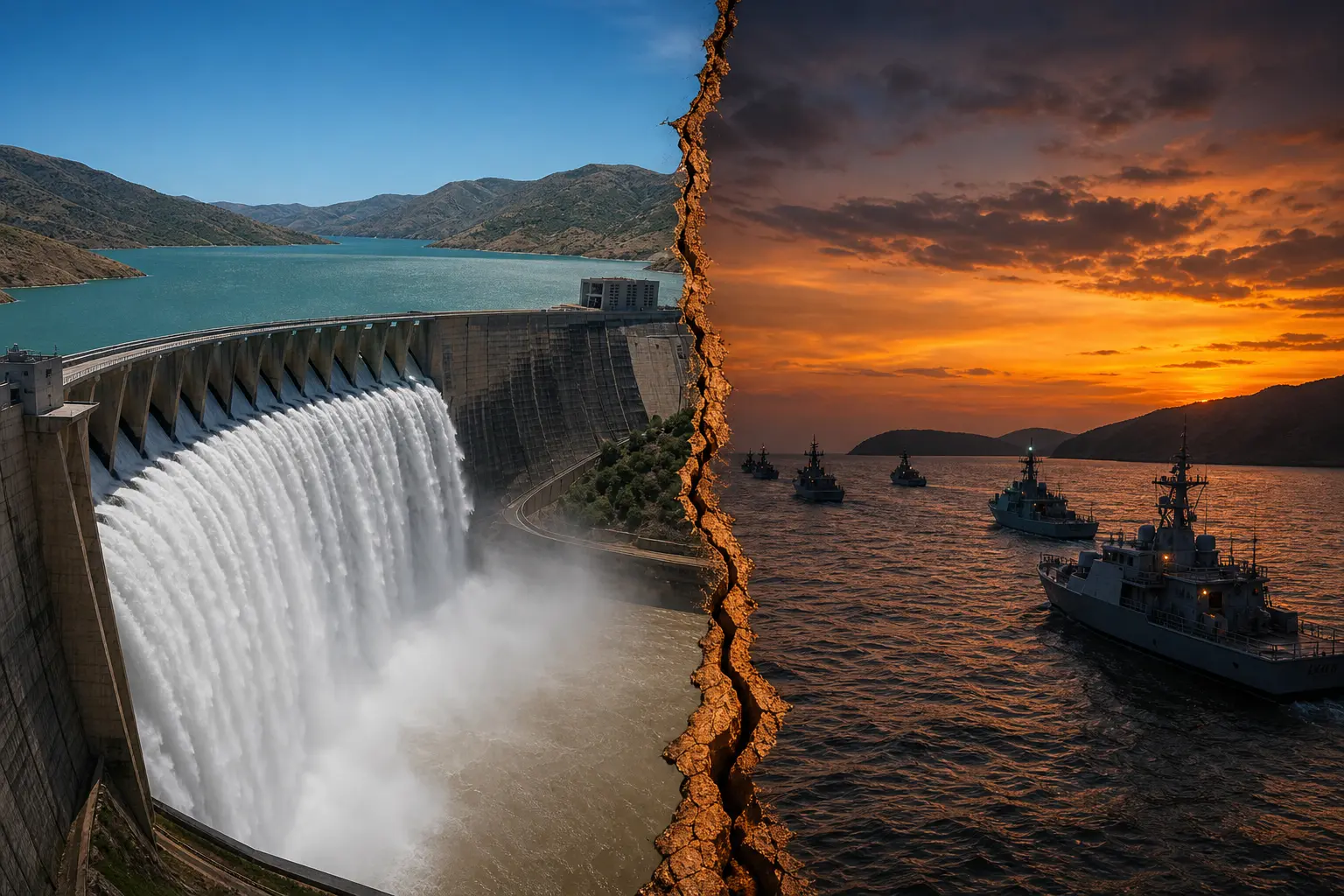
Cairo Rings Ethiopia With Ports and Troops
Egypt’s response has shown up as ports, weapons and troops on the ground. In February 2026, Egypt sent roughly 1,100 soldiers into Somalia under the African Union’s stabilization mission there, Foreign Policy reported, a deployment that has reignited old rivalries across Somalia and the Horn. Cairo has committed to providing up to 10,000 troops to that mission over time, according to the Africa Center for Strategic Studies.
| Country | Egypt’s Engagement | Why It Matters to Ethiopia |
|---|---|---|
| Somalia | Defense pact with Mogadishu covering weapons shipments and joint counterterrorism operations | Somalia is furious over Ethiopia’s 2024 Somaliland deal, giving Egypt a ready ally on Ethiopia’s eastern flank |
| Djibouti | Agreement reached in late 2025 to upgrade the port of Doraleh | Ethiopia has leaned on Doraleh for most of its seaborne trade since losing its own coastline in 1993 |
| Eritrea | Agreement reached in late 2025 to upgrade the port of Assab | Eritrea and Ethiopia fought a border war from 1998 to 2000, and relations have soured again |
| Sudan | Satellite imagery reportedly shows Egyptian drone strikes on Rapid Support Forces positions backing Sudan’s army | Sudan is Egypt’s fellow downstream Nile state and has at times tried to mediate the wider dispute |
Not everyone in Egypt is cheering the buildup. A Foreign Policy correspondent reporting from Cairo this year found residents increasingly linking the spending on ports, weapons and troop deployments abroad to a domestic economy that is not improving.
“The new administrative capital does nothing to grow our economy,” one trader said, declining to give his name. “It’s a smokescreen for corruption. We are all struggling.”
The Rains That Are Buying Egypt Time
The dam Cairo fears has been finished for less than a year. Ethiopia completed the fifth and final filling of the reservoir in October 2024 and formally inaugurated the plant on September 9, 2025, fourteen years after construction began.
The gravity dam stretches about 1,800 meters across the Blue Nile and rises roughly 170 meters, backing a reservoir holding 74 billion cubic meters of water, according to Webuild Group, the Italian contractor that built it. At full output, its 13 turbines can generate 5,150 megawatts, making it Africa’s largest power plant.
Filling that reservoir flooded roughly 1,680 square kilometers of forest in northwest Ethiopia, an area about four times the size of Cairo, and displaced close to 20,000 people, according to a fact sheet from the advocacy group International Rivers.
None of that has yet meant less water for Egypt. Heavy rains over the Ethiopian highlands, the Blue Nile’s source, kept the river running high through the filling years, masking whatever downstream effect the dam might have. The open question is what happens in a dry year, when Cairo worries Ethiopia would protect its own reservoir before letting water reach Sudan and Egypt.
Why Does Ethiopia Want a Foothold on Somaliland’s Coast?
Ethiopia has been landlocked since Eritrea’s independence in 1993 and depends on Djibouti for the great majority of its trade. In January 2024, it signed a memorandum of understanding with the breakaway region of Somaliland for access to roughly 20 kilometers of coastline for a naval base, a deal that enraged Somalia and reshaped alliances across the region.
Somalia considers Somaliland its own territory and viewed the memorandum as a breach of its sovereignty. Egypt, Somalia and Turkey have opposed the arrangement together. Turkey brokered months of talks between Addis Ababa and Mogadishu in Ankara meant to defuse the standoff. They eased the immediate friction but never produced a signed breakthrough, and a third round of negotiations was later postponed.
The dispute has since pulled in players with no direct stake in the Nile at all.
- Israel moved to recognize Somaliland as a sovereign state in late December 2025, handing Ethiopia’s preferred coastal partner a diplomatic win Cairo did not want.
- Eritrea, once Ethiopia’s wartime enemy turned uneasy neighbor, has drifted back toward hostility and is deepening ties with Egypt and Somalia instead.
- Tigray’s TPLF, the Tigray People’s Liberation Front, has formed a breakaway regional government and aligned with Eritrea, testing the Pretoria agreement that ended Ethiopia’s 2021 to 2022 civil war in its north.
- Sudan’s army accuses Ethiopia, Kenya and factions in Libya of arming the Rapid Support Forces militia it has fought since 2023.
Egypt, Turkey and Somalia all denounced Israel’s move within hours of it becoming public, and intelligence reports have since warned of a looming Egypt-Israel confrontation over the Horn of Africa’s future.
Washington’s Promised Mediation Keeps Sliding
Egypt has been waiting on President Donald Trump to make good on a pledge. In January 2026, Trump wrote to Sisi promising to “restart U.S. mediation between Egypt and Ethiopia to responsibly resolve the question of ‘The Nile Water Sharing’ once and for all.” Sisi thanked him, calling the Nile “the lifeline of the Egyptian people.”
Six months later, that mediation has barely moved. Washington’s attention has been consumed by its confrontation with Iran and by this year’s midterm elections, according to Michael Hanna, director of the US program at the International Crisis Group.
Egypt now wants an Ethiopia that either enters an agreement on the dam, collapses internally or suffers a meltdown.
Hanna said that, adding it is “very difficult to see how the United States can force Ethiopia’s hand over the issue of the dam at present.” He pointed to Washington’s distraction, Trump’s focus on the midterms, and the likelihood that Ethiopia’s own regional backers would push back hard against US pressure.
Massad Boulos, Trump’s senior adviser on Arab and African affairs, met Sisi in Cairo in April 2026 and later signaled a shift in tone. “The GERD issue must be resolved through technical means, not political pressure,” Boulos said in an interview with Al Arabiya Arabic. During that April meeting, Sisi told Boulos that “Egypt will not be lenient when it comes to its existential water interests,” according to a presidential statement.
Egypt Wants a Signature Ethiopia Won’t Give
Cairo’s core demand has not changed in fifteen years: a legally binding agreement letting Egyptian and Sudanese experts take part in managing the dam’s operation, especially during droughts.
The demand traces back to colonial-era deals Ethiopia never signed. A 1929 agreement between Egypt and Britain, followed by a 1959 treaty between Egypt and Sudan, split the Nile’s flow, giving Egypt 66% and Sudan 22%, with Ethiopia left out of both.
A 2015 Declaration of Principles, signed by all three countries, was meant to bridge that gap. It gave downstream countries priority on future electricity purchases and set up a dispute mechanism. For the first time, though, it did not reaffirm Egypt’s historical share of the water, something Ethiopia has since treated as tacit approval of the dam.
Ethiopia has refused outside involvement in running the dam, insisting the project is an internal matter. “We believe in shared progress, shared energy, and shared water,” Ethiopian Prime Minister Abiy Ahmed said at the dam’s inauguration in September 2025. “Prosperity for one should mean prosperity for all.”
Egypt has also pushed the other ten Nile Basin countries for a charter requiring unanimous approval before any new dam is built. That effort has found little support upstream, where members of the Nile Basin Initiative signed their own water-sharing accord without Cairo or Khartoum on board.
The War Risk Has Shifted to Eritrea
Analysts increasingly point to Eritrea and Ethiopia as the likelier flashpoint for a new war in the Horn.
“Many are concerned that the general state of the Horn of Africa and the reorganization of alliances there could result in war breaking out again, possibly between Ethiopia and Eritrea,” Hanna said. “Those new alliances in the Horn of Africa, of which Egypt is now a part, have left their mark on every part of that region.”
The dam dispute itself may be more solvable than the rhetoric suggests. Peer-reviewed modeling published in Communications Earth & Environment found the dam could still generate 87% of its optimal hydropower during a prolonged drought without adding to Egypt’s water deficit, if Ethiopia adopts cooperative operating rules.
The alliances forming around the dispute look harder to walk back. A recent American Enterprise Institute assessment describes Egypt and Saudi Arabia deepening ties with Djibouti and Eritrea specifically to contain Ethiopia and the UAE-Israel duo across the region.
Fifteen years of talks over the dam produced no signed deal. It is the alliances forming around it that may decide what happens next in the Horn of Africa.
Frequently Asked Questions
What Is the Grand Ethiopian Renaissance Dam?
The dam started out as “the Millennium Dam” before Ethiopia’s Council of Ministers renamed it in April 2011, months after construction began. Built at a cost of roughly $5 billion, it sits on the Blue Nile in Ethiopia’s Benishangul-Gumuz region, near the Sudanese border, and its installed capacity of 5,150 megawatts makes it Africa’s largest power plant.
How Much of the Nile’s Water Is Egypt Entitled To?
A 1959 treaty between Egypt and Sudan allocated Egypt about 55.5 billion cubic meters of Nile water a year, a figure Cairo still treats as its historical right even though Ethiopia was never a party to that agreement.
Could the Dam Fail or Flood Sudan and Egypt?
Scientists caution that dam failure or mismanagement could trigger catastrophic flooding in Sudan and Egypt, according to researchers cited by the conservation outlet Mongabay. Egypt’s irrigation ministry made a related accusation last year, blaming Ethiopia for “reckless dam management” after sudden water releases worsened flooding in northern Egypt, while Ethiopia said its operations followed technical protocols and actually reduced flooding in Sudan.
Why Does Ethiopia Want Access to the Red Sea?
Ethiopia is the world’s largest landlocked country by population, and it has leaned almost entirely on Djibouti’s ports for trade since losing its own coastline when Eritrea became independent in 1993.
What Did Trump Say About the Dam During His First Term?
In 2020, Trump predicted Egypt would act on its own, saying “they’ll blow up that dam. And they have to do something.” Ethiopian Prime Minister Abiy Ahmed responded that his country would “not cave in to aggression of any kind.”
Is a War Between Egypt and Ethiopia Likely?
Research from the Foreign Policy Research Institute concludes Ethiopia could only seriously damage Egypt’s water access after a prolonged drought combined with a deliberately hostile posture toward Cairo, a scenario that has not occurred so far.
