
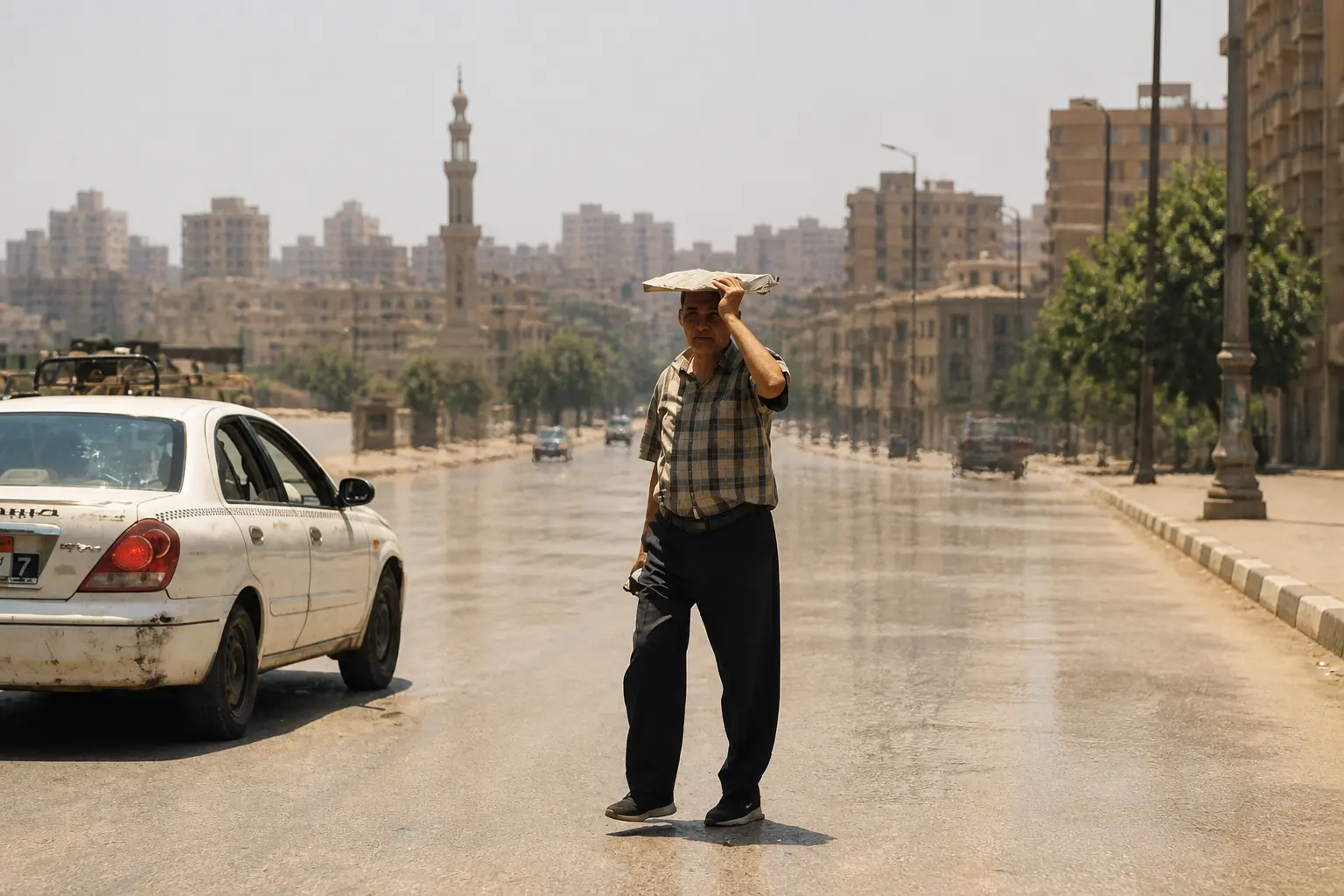
The Egyptian Meteorological Authority predicts extremely hot and humid weather across most of Egypt on Friday, with Cairo reaching 36°C, Aswan 43°C and morning mist turning to fog on northern roads.
Winds of 30-40 km/h will give Cairo slight outdoor relief while stirring sand across the Red Sea governorate and Upper Egypt. Rough seas will disrupt navigation on both coasts.
Extremely Hot Humid Friday Holds Across Egypt
Daytime conditions stay extremely hot and humid inland and hot and humid along the North Coast. Night and early morning ease only to moderate and humid across most of the country.
The forecast follows a multi-week heatwave that earlier pushed Upper Egypt to 46°C and Greater Cairo into the low 40s. Satellite data showed a break earlier in the week, yet Friday remains firmly in summer mode.
Mist and fog will form on agricultural roads and highways from the northern governorates through Cairo, the Canal cities, Central Sinai and North Upper Egypt. Drivers face reduced visibility at the start of the day.
City Highs From Coast to Aswan
Predicted highs under the EMA outlook are straightforward and regional.
| City / Region | High (°C) |
|---|---|
| Cairo | 36 |
| Alexandria | 31 |
| Marsa Matruh | 31 |
| Sohag | 40 |
| Qena | 42 |
| Aswan | 43 |
These figures sit close to the long-term Cairo August average high near 36°C. The south remains well above that mark, as usual in peak summer.
Perceived temperatures will run several degrees higher because of humidity, a pattern EMA has flagged throughout the recent hot spell.
Humidity Keeps the Feels-Like High
Even with the slight drop from earlier peaks, moisture in the air prevents real relief. Earlier EMA briefings noted feels-like values 2-4°C above shade readings during the heatwave.
That gap matters for anyone outdoors between late morning and late afternoon. Health guidance from the authority has stayed consistent: limit direct sun exposure in peak hours, drink water steadily, wear loose cotton and watch children, older adults and outdoor labourers.
The same humidity that raises discomfort also supports the morning fog banks now expected on the main northern corridors.
Outdoor Work and Open Sites Still Pay
The second-order costs of these days show up first among people who cannot stay inside.
- Construction crews have already shifted to shorter shifts, more water breaks and evening-only starts in some firms.
- Open-air archaeological sites in Luxor, Aswan and around Cairo saw sharp booking drops at the height of the heat.
- Farmers face weaker harvest windows for wheat, rice, fruit and vegetables, with knock-on pressure on food prices.
- Electricity demand spikes force higher oil and gas imports to keep plants running and air-conditioners on.
A construction worker in Alexandria described the grind earlier in the heatwave: eight-hour days remain, but breaks multiply and the work still has to finish. Company owners added shade, water and later start times. Those adjustments do not disappear when the thermometer falls a couple of degrees.
Tourism operators feel the same lag. Beach destinations gain visitors fleeing the interior heat, while temple and pyramid visits thin out until the sun drops.
We work eight hours a day. It’s exhausting. Now we take more breaks than usual to have a drink, tea, water, but we can’t take long breaks as we have to finish tasks every day.
Aly Gamal, a construction worker in Alexandria, told Africanews during the July peak of the same heat spell.
Fog Dust and the Drive to Work
Road conditions add another layer. Morning fog on the northern network into Cairo slows traffic and raises crash risk on agricultural and highway stretches. Later in the day the same wind field that cools Cairo a little lifts sand and dust across Upper Egypt and the Red Sea governorates.
Commuters and freight haulers absorb the delay. The pattern is familiar from previous hot spells this season, including the Thursday forecast that put Cairo at 35°C and the earlier Thursday outlook with Cairo 33°C.
Dust also settles on solar panels and outdoor equipment, trimming generation efficiency on the days demand is highest.
Seas That Keep Ships Waiting
Maritime warnings are explicit. The Mediterranean will run moderate waves of 1.5-2 metres under northwest winds. Navigation faces disruption along the shores of Marsa Matruh, El-Alamein, Alexandria, Baltim, Gamasa, Damietta, Port Said and El Arish, where winds average 40-50 km/h and waves reach 2-3 metres.
On the Red Sea and Gulf of Suez the same wind speeds and 2-3 metre seas will interrupt traffic. Fishing boats, ferries and commercial vessels all lose windows.
For coastal towns the rough water is both hazard and temporary economic brake. For Red Sea tourism operators it is one more reason guests stay poolside rather than dive or cruise.
How This Summer Fits a Longer Pattern
Friday’s numbers look ordinary against the August climatology, yet they arrive after weeks of elevated heat. EMA data earlier in the month recorded 46°C in Upper Egypt and 43°C in Cairo. Post-peak readings from Dr Mahmoud Shaheen of the Weather Hazard Forecasting and Early Warning Department showed the first clear step-down earlier this week.
Longer records show the background is shifting. A Lancet Countdown policy brief for Egypt documented that populations aged 65 and over experienced almost 44 million more heatwave exposure days in 2016-2020 than in the 1986-2005 baseline. In 2020 alone the country lost 1.4 billion potential labour hours lost to high temperatures, nearly half in agriculture and a quarter in construction.
Studies of Egyptian heatwaves from 1990 to 2023 find rising frequency, duration and nighttime persistence, especially after 2010. The WHO has projected heat-related deaths among the elderly could reach roughly 47 per 100,000 by 2080 under high-emission paths, falling below 9 per 100,000 with strong mitigation.
Urban green cover remains low in Egyptian cities, limiting natural cooling. Power systems still lean on imported fuels for summer peaks. Those structural facts turn every “normal” hot humid Friday into another day of accumulated strain.
Residents already adapt in visible ways: later evening outings, heavier beach traffic, more indoor time at midday. The fog, dust and sea warnings simply add friction to the same routine. Friday will feel like high summer because it is, and because the weeks before it raised the baseline that people and systems must now meet.
