
Three months after commercial service began, Africa’s first monorail carries 30 to 50 passengers per four-car train on a typical afternoon run from New Cairo toward the New Administrative Capital. The driverless Innovia 300 sets glide every six to eight minutes on elevated beams, air-conditioned and polished, exactly as French manufacturer Alstom promised.
President Abdel Fattah El Sisi inaugurated the East Nile line on 20 March. The first 16 stations opened to the public on 6 May; six more to Cairo Stadium followed in late June. The system already links the eastern suburbs straight into Metro Line 3. Yet the quiet carriages point past simple ridership tallies toward a sharper outcome: the line is the first fixed rail tether that makes daily life in Egypt’s desert capital practical.
Driverless Beams Over New Cairo
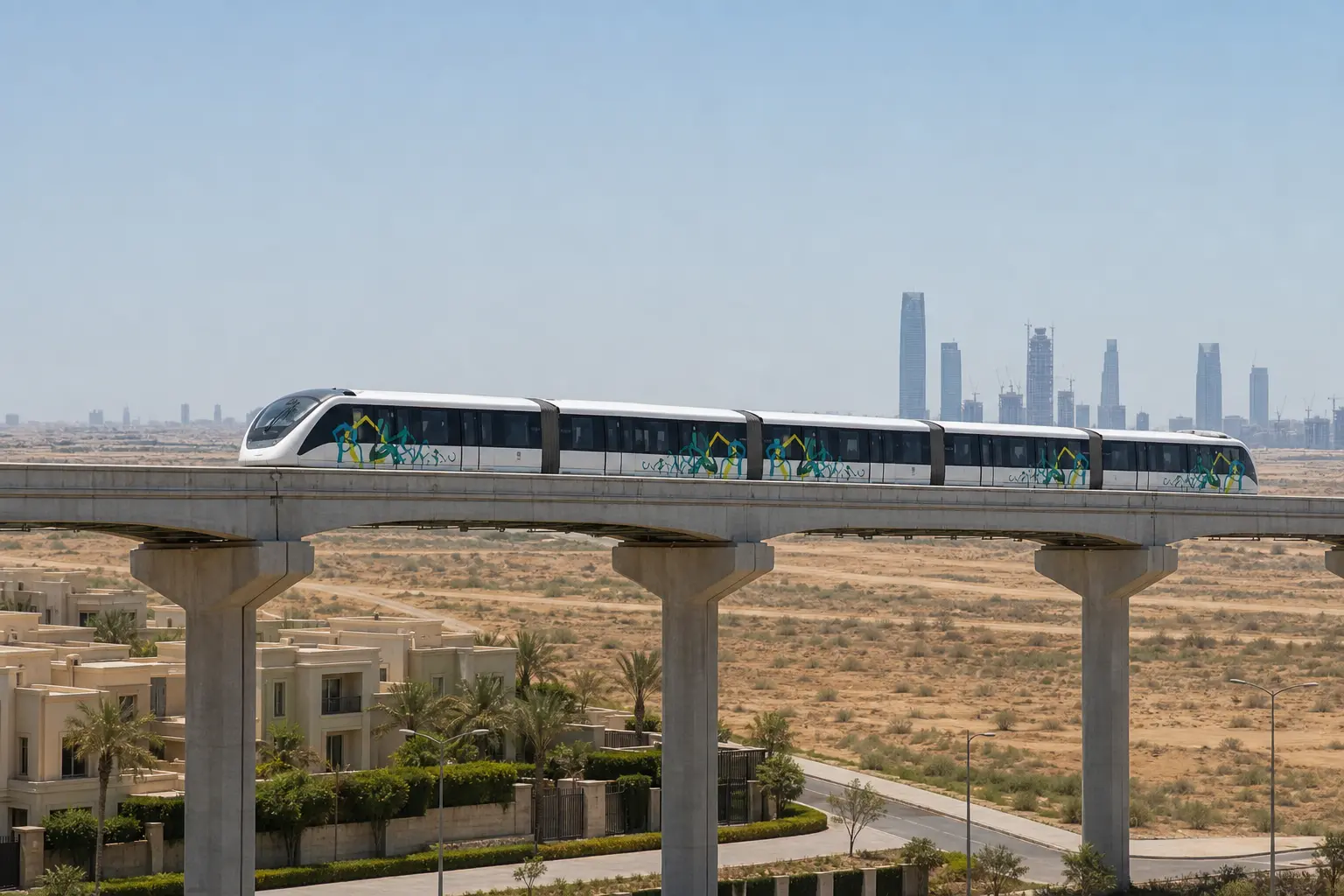
The East Nile Monorail stretches 56.5 kilometres with 22 stations once complete. Trains built at Alstom’s Derby plant in England run at up to 80 km/h on precast concrete guideways. Ultimate capacity sits at 45,000 passengers per hour per direction when headways drop to 90 seconds. Officials project 500,000 to 600,000 daily riders once the West Nile line to 6 October City joins next year.
- Phases live now: 16 stations May, full eastern spine June
- Travel time cut: El Moshir Tantawi to Justice City falls from roughly 80 minutes by road to 40 minutes
- Tech firsts for Africa: GoA4 driverless CBTC signalling plus platform screen doors
- Fleet: 68 to 70 four-car Innovia 300 sets, 280 cars total for both lines
Alstom’s press materials stress the line halving road travel time to 40 minutes between key eastern points while integrating with existing metro and light rail. Local engineering handled testing; more than 98 percent of the workforce on the project has been Egyptian.
| Metric | East Nile Monorail | Cairo Metro Line 3 (longest) |
|---|---|---|
| Length | 56.5 km | 41 km |
| Full single fare | EGP 80 | EGP 20 (over 23 stops) |
| Cost per km (full run) | ~EGP 1.42 | ~EGP 0.49 |
| Peak capacity target | 45,000 pphpd | Higher volume, denser cars |
The cars themselves are smaller than metro stock. Scenic views of villas and gated compounds dominate the eastern run. That geography is not accidental.
Fares Hit Harder Than the Metro
Tickets use four zones. A one-zone hop of up to five stations costs EGP 20 (about $0.40). Two zones reach EGP 40, three EGP 55, the full 22-station trip EGP 80. Monthly passes top out near EGP 2,400 for 60 full-line trips, with 50 percent off for seniors and people with disabilities. Single tickets are one-way only.
Egypt’s minimum wage stands at EGP 8,000 a month. A full-line daily commuter with subscription still faces roughly EGP 1,760 monthly, about 22 percent of that floor and above the UN’s 15 percent household transport guideline. Average private-sector pay sits lower still. By comparison the metro’s flat EGP 20 covers far more distance for most riders.
| Journey type | Monorail fare (EGP) | Share of min. wage (monthly full use) |
|---|---|---|
| 1 zone (≤5 stops) | 20 | Lower |
| Full line | 80 | ~22% with pass |
| Metro long haul | 20 flat | Far smaller share |
Passengers interviewed in early months often cite comfort and safety after dark. Maha, 34, rides four times a week from Point 90 for errands and yoga: “I have come to find it quite relaxing actually. And if I am coming home late, it feels a lot safer than taking an Uber.” Others simply note the price barrier.
The Capital Finally Has a Spine
The New Administrative Capital sits roughly 45 kilometres east of central Cairo. Officials put permanent residents near 25,000 and daily government commuters near 50,000. Ministries, the Iconic Tower, Al-Fattah Al-Aleem mosque and wide boulevards already stand. Without fixed high-capacity transit the site remained a long, unpredictable drive or multi-leg microbus ordeal.
The monorail changes that equation. It drops riders at Justice City and Masa Hotel stations with straightforward transfers to the Light Rail Transit and onward options. Civil servants and private-sector staff who already work in the new zone now have a timed, air-conditioned option instead of two crowded microbuses. That reliability is the second-order effect: it turns a prestige project into a place people can treat as a regular workplace.
Urban planners have long warned that infrastructure should follow existing density. Osama Okeil, transport engineering professor at Ain Shams University, told AFP the monorail risks serving “empty desert” and that money would have done more for overstretched railways and buses. Yet the government’s decade-long push to shift administration out of clogged central Cairo made a dedicated eastern spine inevitable once the capital’s buildings rose. The monorail is the physical commitment that makes the shift stick.
Who Rides It Daily?
Early loads skew toward New Cairo and eastern compound residents running errands, job interviews or short hops. Gomaa, 52, in a traditional galabeya, rode toward Masa Hotel to switch for Badr City and a prospective New Cairo job. He fits the intended profile. The National’s Thursday afternoon count of 30-50 people across four cars matches other reporters’ sparse peak-hour observations in May and June.
The monorail is made for a different social class.
Mohamed El-Shawadfi, a management and investment professor, told Al Jazeera that framing directly. Fare levels reflect early low volume; he expects balance once numbers rise. Transport expert Osama Aqeel argues Bus Rapid Transit offers cheaper reach for more people right now. Informal microbuses and the existing metro’s 4.5 million daily riders still move the bulk of Greater Cairo’s 26 million.
The line already feeds growing Cairo business process hubs and eastern offices that draw middle-class and professional traffic. It does little for dense older districts where most journeys begin and end on cheaper modes.
UK Export Cash Built the Trains
An Alstom-led consortium with Orascom Construction and Arab Contractors signed the core contract in August 2019. The package covers design, build and 30 years of operations and maintenance for both the East and West Nile lines. Alstom materials put the figure at a €2.7bn design build and 30-year O&M deal. Separate reporting cites a £2.3 billion UKEF-backed element focused on the Derby-built rolling stock, one of the largest overseas infrastructure financings in the agency’s history.
UK Export Finance categorised the project Category A and provided roughly £1.7 billion UK Export Finance support (around 1.9 billion euros principal) to the National Authority for Tunnels. The last of the 68 trains left Derby in January 2024. The programme sustained about 150 direct UK jobs at peak. Egyptian partners handle civil works; Alstom supplies the automated trains and core systems.
- August 2019: Consortium contract signed
- 2020-22: Pandemic and currency shocks slow imports and payments
- November 2024: Trial runs begin
- 20 March 2026: Presidential inauguration
- 6 May 2026: Commercial service, first 16 stations
- Late June 2026: Extension to Cairo Stadium / Metro 3 link
Delays before opening added at least 45 billion Egyptian pounds (around $882 million) according to National Authority for Tunnels board sources speaking to Al Manassa, roughly 18 percent of earlier 4.5-billion-euro project estimates. Devaluations and dollar shortages drove much of the overrun.
Debt Service Crowds the Books
Ministerial statements have put the monorail near $2.8 billion; other tallies run higher, toward the $4.5 billion figure common in international coverage. An Egyptian Initiative for Personal Rights budget analysis found the outlay equal to roughly half the health allocation and 40 percent of the education budget for 2026-27. Debt service already absorbs about two-thirds of government expenditure. Interest alone is projected near 9.8 percent of GDP, outstripping combined education, health, subsidies and wages in some tallies.
Critics including EIPR researcher Maye Kabil note the line primarily serves higher-income new urban zones. The same capital push that produced the monorail has also drawn Egypt’s recent record FDI inflows, yet Africa’s overall share of global investment has shrunk. Localization is now the cost-control lever: the Egyptian Company for Metro Management and Operation partnered with Alstom to cut the O&M bill by up to 25 percent and raise Egyptian staffing toward 90 percent at launch, targeting 95 percent within two years.
Whether that offsets the capital burden depends on ridership growth the eastern line has not yet shown.
West Nile Line Changes the Math
The second, 42-kilometre West Nile monorail from Giza toward 6 October City is due next year. Together the pair will total roughly 96-100 kilometres and 33 stations. Officials still speak of half a million-plus daily riders system-wide once both run and frequencies tighten. Full 45,000 pphpd capacity remains a future operating target, not today’s reality.
If the western line fills with 6 October City commuters the way planners hope, average loads will rise and the per-passenger cost case improves. If it repeats the eastern line’s quiet start, the debt service and fare structure will face sharper questions. Either way the monorail has already altered the map: the New Administrative Capital is no longer an isolated construction zone. It has a high-capacity, timed rail link into the eastern urban fabric.
The trains run on schedule. The stations stay clean. The larger experiment is whether that reliability pulls enough of Cairo’s next economic layer eastward to justify the bill that ordinary taxpayers and metro riders continue to share.
