
Saudi Arabia, Pakistan and Türkiye signed the Mecca Joint Defense Agreement on Friday, pledging that an armed attack on any one of them will be treated as an attack on all three. Iranian lawmaker Ebrahim Rezaei immediately dismissed the deal as worthless paper that will not deliver security.
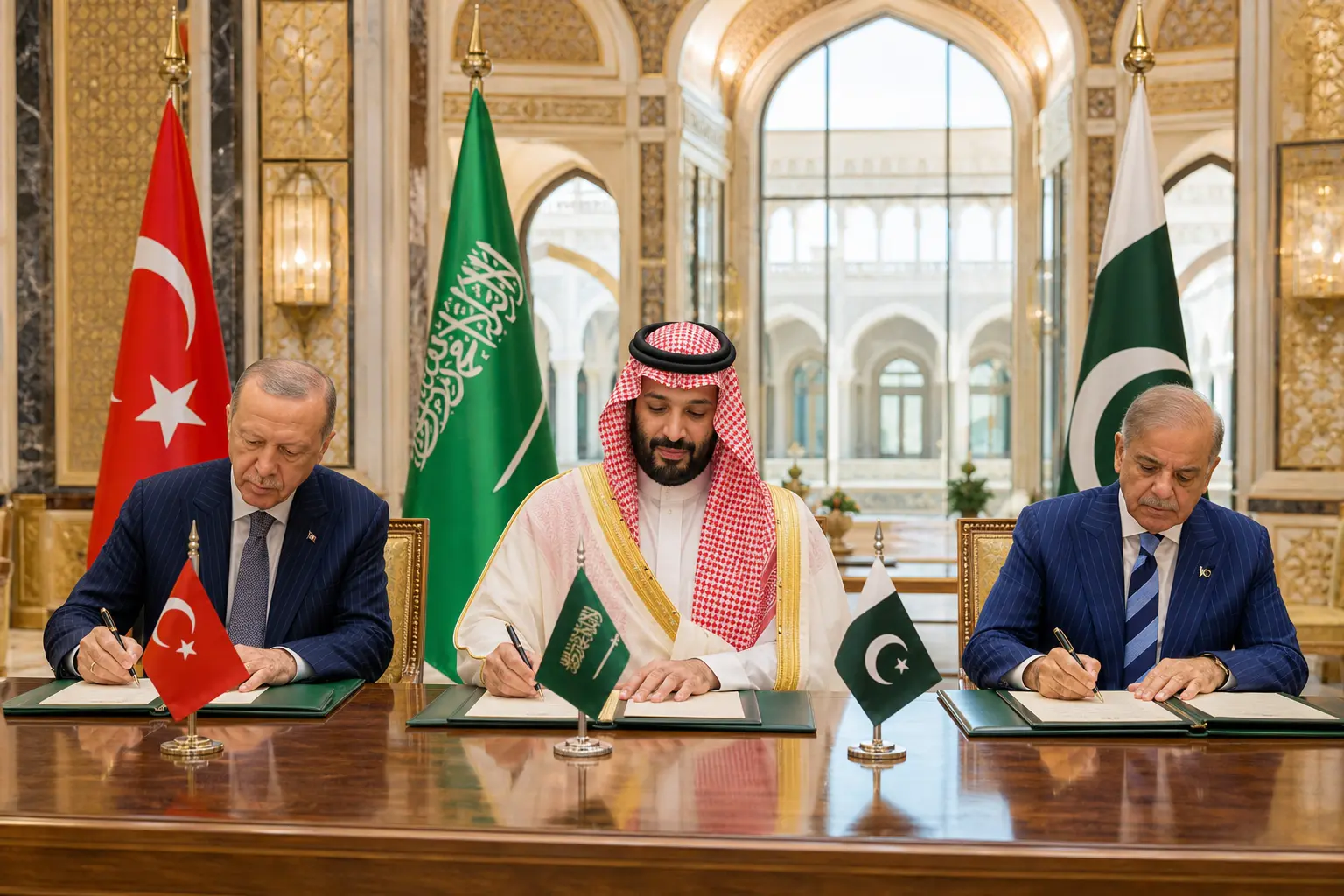
The ceremony in Mecca brought Crown Prince Mohammed bin Salman, President Recep Tayyip Erdoğan and Prime Minister Shehbaz Sharif together at a moment when Gulf states face renewed strikes from Iran-backed groups and questions about the US security umbrella after months of direct conflict with Tehran.
Three Leaders Put Pens to Paper in Mecca
The joint statement released by Saudi and Pakistani foreign ministries said the pact aims “to strengthen collective deterrence against any act of aggression” and expands military coordination plus defense-industry cooperation. It builds on nearly a year of talks and a bilateral Saudi-Pakistan mutual defense deal signed in September 2025.
Saudi Foreign Ministry posted the signing photos showing the three leaders at the table. Pakistan’s Foreign Ministry emphasized shared commitment to regional stability. Turkish and Saudi officials stressed the agreement is purely defensive and not aimed at any specific country.
Saudi deputy minister Rayed Krimly clarified that the deal “does not represent any intention to build a military axis or a sectarian/religious bloc” and is “not linked to nuclear ambitions or an arms race, but rather to building sustainable, self-reliant capabilities.” It does not replace existing bilateral or multilateral arrangements, he said.
Iran Calls It Paper Security
Ebrahim Rezaei, a member of the Iranian parliament’s National Security and Foreign Policy Committee, struck back on X within hours.
Saudis must know that a paper agreement with Türkiye and Pakistan will not bring them security, just as years of one-sided nursing to the Americans did not bring them security. Reform your policies so that you do not need to beg for security from others.
Rezaei’s post, widely quoted by regional outlets, framed the pact as another failed attempt by Riyadh to buy protection instead of changing course. The criticism lands against a backdrop of Houthi projectile attacks on southern Saudi Arabia that wounded civilians and Iranian threats of coordinated militia strikes from Iraq and Yemen.
Tehran has long accused Gulf states of enabling US and Israeli operations. The new trilateral language raises the theoretical cost of any further proxy attack on Saudi soil.
What Each Capital Brings
The three partners arrive with complementary assets that make the paper more than symbolism on paper alone.
| Country | Core assets | Immediate interest |
|---|---|---|
| Saudi Arabia | Oil wealth, finance, Gulf basing, Vision 2030 stakes | Diversified deterrence after Iranian and Houthi strikes |
| Pakistan | Nuclear arsenal, large battle-tested army, prior troop deployments | Prestige, funding, technology access, Middle East influence |
| Türkiye | NATO’s second-largest army, drone and munitions industry, training fleets | Defense exports, economic ties, wider Muslim security network |
Pakistan has trained Saudi forces for decades and already deployed jets and troops during the current Iran conflict. Türkiye sealed a large drone sale to Riyadh in 2023 and regularly exchanges ships and aircraft with Pakistan. Saudi money can underwrite joint production and readiness.
Atlantic Council experts break down each side: Riyadh gains leverage without abandoning the United States; Islamabad embeds itself deeper in Gulf architecture and can cite the pact in Washington; Ankara adds economic and nuclear weight to its existing security partnerships.
The Escalation Ladder Nobody Wanted Fully Open
Here is the second-order effect. An Iranian-backed militia rocket that kills Saudis can now, under the letter of the text, pull nuclear-armed Pakistan and a NATO member into the response matrix. Both countries have so far avoided major direct involvement in the US-Israeli campaign against Iran that began on 28 February 2026.
The joint statement never spells out the form of assistance required. No automatic troop numbers, no nuclear umbrella language, no command structure. Pakistani officials previously insisted their 2025 bilateral deal with Riyadh carried no nuclear guarantee. That silence remains.
India, which has tense relations with both Pakistan and Türkiye yet close economic ties with Saudi Arabia, said it is closely monitoring the agreement. Any future Indo-Pakistani crisis now carries a theoretical Saudi and Turkish consultation layer. Crowd reaction on X from Indian accounts framed the pact as Delhi needing to watch every Pakistani move; Saudi and Pakistani voices celebrated technology transfer and investment synergies.
Gulf states already navigate a fragile path between Iran and the United States. Gulf states pressing for Hormuz implementation after intermittent ceasefires know that wider alliances can both deter and entangle. Jordan’s experience shows the cost of proximity: Jordan’s costly US missile shield choice turned the kingdom into an unwanted target when Iranian missiles flew. The Mecca pact risks a similar dynamic for Islamabad and Ankara.
Earlier Islamic Pacts That Never Grew Teeth
Middle East expert Mohammad Muddassir Quamar told RT it is too early to claim the deal will reshape the regional balance. Many similar pacts among Islamic nations produced little beyond statements.
- 1960s-70s: Pakistan deployed troops to Saudi Arabia under informal understandings that never became a standing alliance.
- 2015: Saudi Arabia launched the Islamic Military Counter Terrorism Coalition, often labeled an “Islamic NATO.” It stayed mostly on paper with conferences and limited coordination.
- September 2025: Riyadh and Islamabad signed their bilateral Strategic Mutual Defense Agreement. Support stayed context-specific.
- 7 August 2026: Türkiye joins, creating the trilateral Mecca framework.
CENTO and the Regional Cooperation for Development faded decades earlier for the same reasons: rivalries over leadership, no integrated command, and unequal willingness to fight. The new pact’s symbolic weight comes from the holy city venue and the three leaders’ presence. Its operational weight will be measured only when the next major strike hits Saudi territory or shipping.
What Officials Insist the Pact Is Not
Krimly, Erdoğan and Sharif all used defensive language. Erdoğan said the deal rests on collective deterrence and that Türkiye keeps its preference for dialogue under international law. Sharif called it a historic endeavor for homeland and regional security. No party claimed a religious bloc or anti-Iran axis in public.
Yet the timing is unmistakable. Saudi officials told CNN they were preparing for multiple coordinated attacks by Iran-backed militias. Houthis renewed fire on Saudi territory and routes. Earlier episodes already saw earlier Saudi strikes linked to Iranian missiles and US intercepts. The pact arrives as Riyadh hedges against both Iranian pressure and doubts about sole reliance on Washington.
- Confirmed: Mutual defense clause treating attack on one as attack on all; focus on deterrence, coordination and industry cooperation; signed by the three leaders in Mecca on 7 August 2026.
- Unconfirmed or undefined: Exact military response obligations; any nuclear dimension; automatic versus political decision trigger; expansion to other members.
Experts from the Atlantic Council note that diplomatic signaling and selective support may matter more than any automatic Article 5-style response. Past practice with the GCC and the 2025 bilateral deal shows that mobilization stays highly context-specific.
Frequently Asked Questions
What exactly does the Mecca Joint Defense Agreement say?
The core clause states that any armed attack against any one of the three states shall be regarded as an attack against them all, with the stated purpose of strengthening collective deterrence and expanding defense cooperation and industry links. No detailed force commitments appear in the public joint statement.
Who signed the pact and when?
Saudi Crown Prince Mohammed bin Salman, Turkish President Recep Tayyip Erdoğan and Pakistani Prime Minister Shehbaz Sharif signed it on Friday 7 August 2026 in Mecca after nearly a year of negotiations that built on a 2025 Saudi-Pakistan bilateral deal.
Does the agreement give Saudi Arabia a Pakistani nuclear umbrella?
No public language creates a nuclear guarantee. Pakistani officials previously maintained that the 2025 bilateral pact with Riyadh did not include one, and the trilateral text stays silent on the point.
Is this an Islamic NATO or a sectarian bloc?
Saudi officials explicitly rejected that label. Deputy Minister Rayed Krimly said it is not a military axis, not a sectarian or religious bloc, and not linked to nuclear ambitions or an arms race.
How have past Muslim defense pacts performed?
Earlier efforts, including the 2015 Islamic Military Counter Terrorism Coalition and older bilateral arrangements, produced limited standing forces or automatic responses and often stalled over leadership rivalries and burden-sharing disputes.
The three capitals now own a shared piece of paper and a larger share of each other’s risks. Whether that paper hardens into usable deterrence will be decided by the next rocket that lands on Saudi soil, not by the ceremony in Mecca.
