
Deputy Prime Minister and Foreign Minister Ishaq Dar arrived in Amman on August 4 for a one-day visit to the August 5 Ministerial Meeting on Jerusalem, hosted by Jordan at the invitation of Foreign Minister Ayman Al Safadi. The gathering of Arab League and Islamic-country foreign ministers aims to forge a unified stand on the deteriorating situation in occupied East Jerusalem.
The ministers will also call on King Abdullah II. Dar’s office and the Foreign Office framed the trip as a reaffirmation of Pakistan’s support for the Palestinian people and an independent state on pre-1967 borders with Al-Quds Al-Sharif as capital.
The Coalition That Filled the Room
Turkish Foreign Ministry sources listed the expected participants: Türkiye, Jordan, Palestine, Egypt, Pakistan, Saudi Arabia, Qatar, Indonesia, Bahrain, Iraq, Morocco, Tunisia, Algeria, Somalia, Malaysia and the Arab League secretary-general. The host is Jordan’s Deputy Prime Minister and Foreign Minister Ayman Al Safadi (also rendered Eymen al-Safadi).
Agenda items run beyond symbolism. Officials planned to cover the historical and legal status of holy sites, developments in East Jerusalem and the West Bank, Israeli practices called contrary to international law, the Gaza ceasefire process and steps toward a two-state solution. Common positions and regional stability cooperation sit on the table as well.
| Country / Body | Role noted |
|---|---|
| Jordan | Host, Hashemite custodian |
| Pakistan | DPM/FM Ishaq Dar attending |
| Türkiye | FM Hakan Fidan attending |
| Palestine, Egypt, Saudi Arabia, Qatar | Core Arab participants |
| Indonesia, Malaysia, others | Wider Islamic group |
| Arab League | Secretary-general present |
Bilateral meetings on the sidelines let Dar exchange views on regional and international issues, including the humanitarian situation in Palestine.
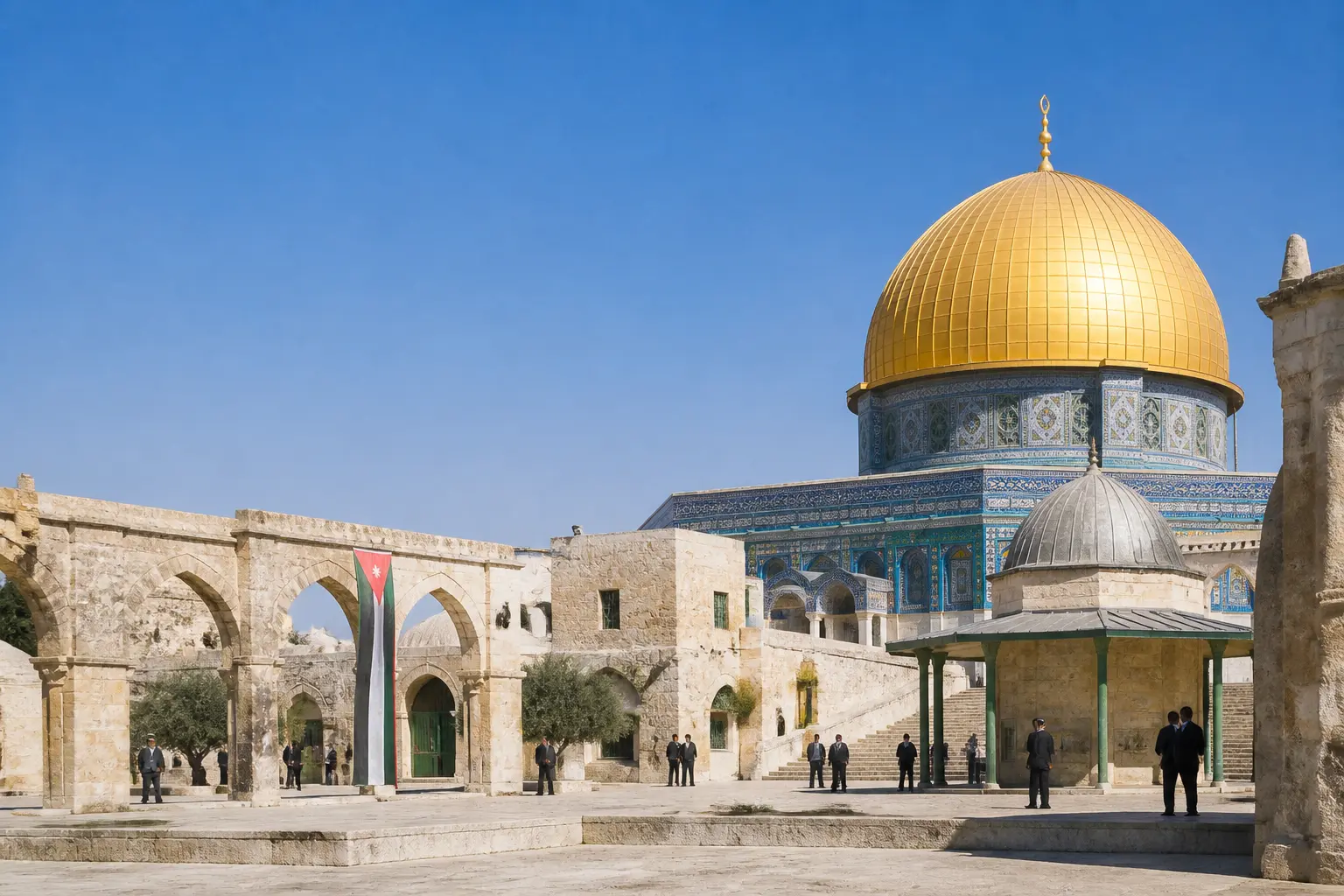
What Triggered the Call to Amman
The immediate backdrop is a string of large settler entries into the Al-Aqsa Mosque / Al-Haram Al-Sharif compound. On July 23, 2026, Palestinian officials recorded more than 4,200 Israelis, including far-right National Security Minister Itamar Ben-Gvir, entering under heavy police protection during Tisha B’Av. The Jerusalem governorate put the figure at 4,288 and expected it could approach 5,000. Settlers performed rituals, prayed and sang. Israeli media said police allowed more than 1,000 to pray, despite the long-standing ban on non-Muslim prayer.
- 4,288 Israelis entered the compound that day per Palestinian counts
- Ben-Gvir joined and later said visitors “feel like the owners”
- Jordan’s Foreign Ministry called the visit a desecration and unacceptable provocation
- Palestinian officials warned of temporal and spatial division of the site
Jordan convened the meeting after accusing Israeli authorities and far-right politicians of undermining the status quo. Jerusalem has sharpened as a flashpoint during the long Gaza war and rising West Bank violence and settlement activity.
These provocative and unacceptable actions constitute a flagrant violation of international law, the relevant United Nations resolutions, and the historical and legal status quo at the holy sites in occupied East Jerusalem.
That language comes from the June 2, 2026 joint statement condemning settler incursions issued by the foreign ministers of Türkiye, Egypt, Indonesia, Jordan, Pakistan, Qatar, Saudi Arabia and the UAE. The same group has issued further joint texts, including a later joint condemnation of West Bank mosque attacks.
Jordan Holds the Custodianship Stake
The choice of Amman is not accidental. Jordan’s Hashemite kings have held custodianship of Jerusalem’s Muslim and Christian holy sites for a century, a role tracing to 1924 and reaffirmed in the 1994 Israel-Jordan peace treaty. The Jerusalem Endowments and Al-Aqsa Mosque Affairs Department under Jordan’s Ministry of Awqaf administers the compound. The June statement underlined that the entire 144-dunam area is exclusively for Muslim worship and that the Jordanian-linked department holds exclusive jurisdiction.
King Abdullah II will receive the visiting ministers. That audience places the monarchical custodian at the political center of the response. Street-level pressure exists too: sit-ins in Amman have condemned the settler storms. Analysts on the ground and online have framed Ben-Gvir’s July visit less as holiday observance and more as a sovereignty signal, a reading that matches Jordan’s language of escalation and barbaric provocation.
Pakistan’s coverage often centers its own principled support. The hidden weight sits with the host that must manage the site day to day while absorbing regional fallout from any change in arrangements.
Pakistan’s Consistent Line and Side Talks
The Foreign Office departure announcement stated that Dar would reaffirm “Pakistan’s unwavering support for the Palestinian people and their just cause.” Spokesperson Tahir Andrabi called the participation a manifestation of commitment to an independent, sovereign and contiguous Palestine based on pre-1967 borders with Al-Quds Al-Sharif as capital. Pakistan does not recognize Israel and has joined the repeated multilateral condemnations of settler entries, flag-raisings inside the courtyards and attempts to alter the demographic and legal character of East Jerusalem.
Dar is scheduled for bilaterals with counterparts. Those conversations cover Gaza’s humanitarian file, wider regional developments and international efforts. The pattern is steady: Islamabad aligns with the core group of Arab and Islamic states that issues joint texts after each major incident.
From Statements to an In-Person Huddle
- 2 June 2026, Eight foreign ministers issue joint condemnation of settler incursions and flag-raising at Al-Aqsa, reaffirm Jordanian administration and 144-dunam exclusive Muslim worship.
- 18 June 2026, Same core group condemns escalating settler violence against West Bank mosques and Palestinians.
- 23 July 2026, Over 4,200 enter Al-Aqsa with Ben-Gvir; another joint statement follows within days condemning mass incursions, tents erected by police and inflammatory acts.
- 4-5 August 2026, Ministers gather in person in Amman, expand the circle and add the King audience plus Gaza and two-state tracks.
The move from paper statements to a physical ministerial meeting signals that the group judges the status-quo erosion serious enough for higher coordination. Turkish sources indicated Fidan would stress protection of holy sites as shared international responsibility, raise Christian sites and embassy moves to Jerusalem, and press for action against de-facto annexation and forced displacement in East Jerusalem and the West Bank.
What the Ministers Want on the Table
Beyond Al-Aqsa, the room is set to review Gaza ceasefire implementation and any roadmap that extends positive effects to the West Bank and East Jerusalem. Turkish briefings flagged continued Israeli attacks despite agreements as unacceptable. Participants are expected to consult on concrete international pressure and accountability. The two-state solution language remains the shared horizon: independent Palestine on 1967 lines with East Jerusalem as capital, consistent with UN resolutions and the Arab Peace Initiative.
Jerusalem’s contested archaeology and land disputes form part of the wider pressure on the city’s character. Recent coverage of disputed digs near the holy sites and an art festival spotlighting Jerusalem land fights shows how heritage claims and property battles keep the city in the headlines even when the main stage is Al-Aqsa.
No final communique had emerged by the time of writing on August 5. The practical test is whether the unified position produces coordinated diplomatic steps or remains another round of parallel statements. Jordan’s custodianship gives the host both authority and vulnerability: any further erosion at the compound lands first on Amman’s doorstep and on the King’s public role.
Dar’s presence keeps Pakistan inside the core consultative circle that has spoken with one voice since at least June. The larger stake belongs to the kingdom that administers the site and receives the ministers under its roof.
