
Israeli reservations have blocked a scheduled four-way mediators meeting in Cairo on implementing the second phase of the Gaza ceasefire, a well-informed Palestinian source told Asharq Al-Awsat on Friday. No new date has been set.
The freeze comes more than a week after Egypt, Qatar and Türkiye reached fresh understandings with Hamas and other Palestinian factions. Those understandings cover arrangements for the phase that US President Donald Trump called “historic.” Prime Minister Benjamin Netanyahu has offered no clear public endorsement.
The result is a pause at the threshold of the harder stage of the October agreement. Mediators hold a text they regard as settled. Israel has raised fresh objections. Washington has yet to show how far it will push.
The Meeting That Never Opened
Preparations for the Cairo session bringing together Egypt, the United States, Qatar and Türkiye were under way in early August, according to Egyptian sources cited by Al Qahera News and later confirmed to Asharq Al-Awsat. The aim was to reaffirm commitment and start the agreed mechanisms linked to the Board of Peace.
The Palestinian source said the gathering failed to take place last week because Israel objected to the proposal on the table. “As of this moment,” the source said around midday Friday, “no new date has been set for the meeting.” A Hamas delegation remains in Egypt, yet meetings with the four-party committee have also been held up.
Negotiations slowed particularly over withdrawal arrangements. “Everyone is waiting for the American move and to see whether they have anything to offer in this regard, especially in terms of putting pressure on Israel,” the source said. Asked about a possible meeting this week, the source replied that efforts continue to overcome obstacles posed by Netanyahu and that “anything is possible, and it depends on Trump’s position and pressure from Washington.”
The holdup leaves several tracks idle at once. The four-way committee cannot open. Board-linked mechanisms stay on paper. The Hamas team in Egypt has no formal counterpart across the table.
- Four-way Cairo session: prepared, then blocked; no new date.
- Board of Peace mechanisms: ready to start once commitment is reaffirmed.
- Hamas contacts in Egypt: delegation present, four-party meetings held up.
This stall follows earlier four-party ceasefire talks that helped shape the October agreement now entering its harder stage.
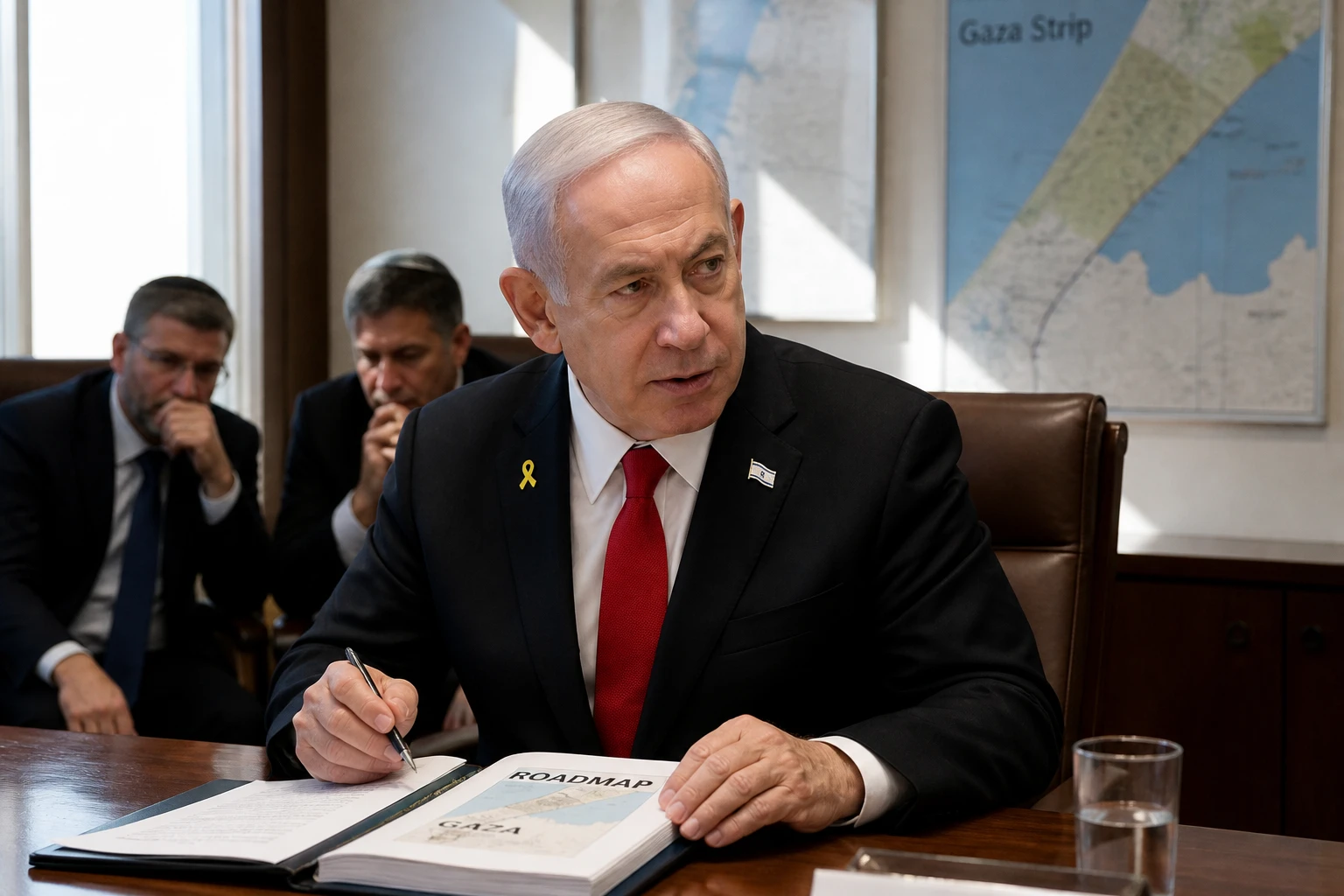
Three Red Lines on the Table
According to Haaretz reporting carried by Asharq Al-Awsat, Israel’s late objections center on three points after the mediators and Board of Peace finalized terms with Hamas. The dispute erupted even though Israeli officials had been aware of the proposal for months through US-Israeli consultations.
| Objection | Roadmap wording | Israeli demand |
|---|---|---|
| Collected weapons | Stored inside Gaza | Destroyed or removed |
| Monitoring mechanism | Includes Türkiye and Qatar | Exclude both from verification |
| Military operations | Barred in areas under National Committee and Stabilization Force | Retain authority to strike |
Each point cuts to control after any pullback. Storage inside Gaza would leave hardware in the enclave under some form of local custody. Destruction or removal would not. Including Türkiye and Qatar in verification would give two mediator states a direct role in certifying compliance. Israel wants that role denied. Barring strikes in areas under the National Committee and Stabilization Force would limit residual military freedom; retaining strike authority would preserve it.
Netanyahu stated in a Facebook video on Wednesday that Israel had not agreed to a plan to disarm Hamas despite the group’s acceptance, and that forces would not withdraw from current positions until full disarmament. An Israeli cabinet decision after Nickolay Mladenov’s August 3 meeting scaled back offensive activity so that any strike now needs chief-of-staff approval, yet that change stopped short of a full halt.
The gap between scaled-back rules of engagement and a full halt is itself part of the quarrel. Mediators treat the roadmap as a package. Netanyahu’s public line treats disarmament as a precondition that has not been met on Israeli terms.
Smotrich’s Cabinet and the October Vote
Political sources say the reversal is driven by partisan and electoral calculations. Israel’s general election is set for October 27. Far-right ministers have mounted a media campaign arguing the version now under discussion differs from what the security cabinet earlier approved.
- Bezalel Smotrich (Finance) and Orit Strook (Settlements) led public opposition and called for an immediate cabinet session to block the international stabilization force.
- Ze’ev Elkin and Avi Dichter pressed during a security cabinet meeting for rejection of the second-phase roadmap and resumption of large-scale attacks.
- Opposition voices and Hebrew media portrayed Netanyahu as unable to rein in partners or project independent strength ahead of voters.
One reading circulating among Israeli political sources is that Dermer’s mission includes seeking a two-month postponement until after the vote. Accepting the full package risks electoral damage inside the coalition that keeps Netanyahu in office. That domestic calculation sits behind the formal security language.
The campaign against the stabilization force and the push to resume large-scale attacks serve the same calendar. Ministers who reject the current text are also defining the ground on which Netanyahu must run. A two-month delay would move any binding choice past election day and ease immediate coalition strain.
Hamas and the Mediators Hold Position
About a week ago Hamas and other factions said they had dealt “responsibly and positively” with the mediators’ proposals. They called Israel’s commitment to stop killing and end attacks the essential first step, and insisted phase two depends on Israel completing all first-phase provisions.
A Washington Institute analysis detailed Hamas acceptance of the full roadmap, including eventual full disarmament within three years and transfer of governing authority to a technocratic National Committee for the Administration of Gaza with no Hamas seats. Hamas control has shrunk to roughly 36 percent of the territory under sustained pressure.
The mediators stress the need for Israel to comply with all of its obligations under international law and to fully uphold its commitments under the ceasefire agreement… and call on the international community to assume its responsibilities and exert the necessary pressure on Israel… in a manner that ensures the completion of President Trump’s peace plan.
That language comes from the mediators’ joint condemnation of violations issued by Türkiye, Egypt and Qatar on 3 August. They noted Trump’s description of the roadmap consensus as historic and warned that continued strikes undermine the second phase.
The mediators’ joint line ties completion of Trump’s plan to external pressure on Israel. Hamas, for its part, has already accepted disarmament on a multi-year clock and a governing handoff that leaves it without seats on the National Committee. The remaining fight is less about whether a text exists than about whether Israel will treat that text as binding before the October vote.
Dermer’s Quiet Errand in Washington
As US officials concluded Netanyahu intended to retreat from the second-phase launch and introduce fresh demands, the premier dispatched former Strategic Affairs Minister Ron Dermer to Washington. Haaretz sources said Dermer’s brief was to “resolve the crisis” and persuade the administration to accept Israel’s new positions or at least delay.
- Late July: Security cabinet approved limited trial deployment of the International Stabilization Force in Rafah, yet legal status with the Board of Peace remained unclear.
- 3 August: Mladenov met Netanyahu in Jerusalem; Board later clarified withdrawal occurs only after verified disarmament.
- First week August: Dermer holds talks with US officials amid reports of administration anger that objections arrived only after the deal was announced.
- 7 August: Palestinian source confirms Cairo four-way still has no date; Hamas team waits in Egypt.
US officials rejected claims that Israel had not seen the final amendments, noting an Israeli delegation visited El Alamein during the closing stage. The atmosphere is described as charged; Trump wants the initiative to succeed and has grown impatient with delays.
Dermer’s task is therefore double. He must narrow the gap on weapons, monitoring and residual strike authority, or buy time until after 27 October. Administration impatience over late objections limits how quietly that errand can run.
The Board Already Moved the Goalposts
After the Mladenov-Netanyahu meeting the Board of Peace shifted toward Israel’s preferred sequencing. The initial roadmap had implied parallel Israeli withdrawal and Hamas disarmament. The updated stance makes withdrawal from the Yellow Line (the 2025 ceasefire boundary) conditional on verified disarmament and drops language of a “full withdrawal,” leaving open a security perimeter near the border.
Disarmament itself remains contested. The document uses “decommissioning,” which Hamas reads as controlled storage inside Gaza while Israel insists on physical removal. Definitions of prohibited weapons, personal firearms, tunnels and production sites are still ambiguous. No functioning civilian police or full International Stabilization Force yet exists on the ground, leaving implementation capacity thin. These technical gaps give both sides room to fight over wording for months.
The underlying structure of Trump plan’s second-phase goals still aims at a stabilization force, technocratic administration and longer-term demilitarization, yet the political path to start that work now runs through Netanyahu’s coalition arithmetic.
The Yellow Line Still Blocks Any Pullback
Withdrawal talk now turns on the Yellow Line, the 2025 ceasefire boundary. The Board’s updated stance ties any move off that line to verified disarmament first. Parallel pullback and disarmament, once implied, no longer frame the sequence.
What “verified” means is unsettled. Hamas reads decommissioning as storage inside Gaza. Israel demands destruction or removal. Monitoring that includes Türkiye and Qatar is written into the mediators’ version and rejected in Israel’s. Without an agreed verifier, no certificate of disarmament can be issued that both sides accept.
Capacity on the ground is thin in any case. No full International Stabilization Force is deployed. No functioning civilian police force is in place to inherit security tasks. Even a clean text would meet a weak implementation shell. The limited trial deployment approved for Rafah in late July still lacked clear legal status with the Board of Peace, underscoring how early the process remains.
The open security perimeter near the border, left by the drop of “full withdrawal” language, gives Israel a residual claim even after any partial pullback. That claim collides with the roadmap bar on military operations in areas under the National Committee and Stabilization Force. Until the Yellow Line sequence and the perimeter question are closed, forces stay where they are.
Washington Holds Both Clocks in Play
Two calendars now govern the second phase. One is diplomatic: the mediators’ push to open Cairo, seat the Board mechanisms, and treat Trump’s “historic” label as a commitment to act. The other is Israeli and electoral: 27 October, the far-right campaign against the package, and the reported bid for a two-month postponement.
Trump wants the initiative to succeed and has grown impatient with delays. US officials already reject the claim that Israel never saw the final amendments, pointing to the El Alamein visit. That record weakens any argument for reopening substance from scratch. It leaves pressure or delay as the real options on the American side.
A decisive American move could force the Cairo four-way onto the calendar and test whether Netanyahu can carry his cabinet. Acceptance of a post-election timetable would freeze the harder stage until the coalition arithmetic is reset at the polls. The Palestinian source’s Friday assessment still stands: anything is possible, and it depends on Trump’s position and pressure from Washington.
Egypt has already shown limits on patience with Netanyahu on Rafah and related files. Qatar and Türkiye, named in the monitoring dispute, have no incentive to dilute their own role. The mediators’ 3 August joint statement called on the international community to exert the necessary pressure. That call now lands chiefly on the White House.
What Still Hangs Over Gaza
Implementation of the first phase had already stalled after the Iran war and repeated Israeli strikes. The new understandings were meant to restart momentum. Instead the enclave remains under partial Israeli military presence, with aid and reconstruction constrained and civilian suffering continuing.
What we know
- Hamas and factions accepted the mediators’ roadmap text more than a week ago.
- Cairo four-way and Board-linked meetings are frozen by Israeli objections; no date set as of Friday midday.
- Netanyahu has publicly refused withdrawal before full Hamas disarmament.
- Far-right ministers are actively campaigning against the current package ahead of the 27 October election.
What remains unconfirmed
- Whether Trump will apply decisive pressure or accept a post-election timetable.
- Exact legal status of any Stabilization Force deployment.
- Whether a revised text can bridge the storage-versus-destruction and monitoring gaps.
Egypt has already signaled Egypt’s earlier limits on patience with Netanyahu on Rafah and related files. The mediators continue contacts. A Hamas team waits in Cairo. The next move belongs to Washington and to the political calendar inside Israel. Until those two clocks align, the second phase stays on paper.
