
Ireland’s new €53 million Dassault Falcon 6X government jet was delivered without the FalconEye enhanced vision system after procurement officials rejected a written deal with Israel’s Elbit Systems. The aircraft, which arrived just before Christmas 2025, now faces tighter options for landing in fog according to multiple sources and a former Irish Air Corps pilot, even as the Department of Defence insists there are no current operational limits.
The multi-purpose Strategic Reach Aircraft carries up to 14 passengers and is meant for senior ministers, the Taoiseach and long-distance air ambulance work. It replaced an ageing Learjet that had suffered technical problems and shorter range. Operated by the Irish Air Corps from Casement Aerodrome in Baldonnell, the jet normally ships with FalconEye as standard equipment.
The Jet Arrives Without Its Eyes
Multiple sources told The Journal that the nose-mounted FalconEye package of cameras and sensors was deliberately left off. Installing it would have required a direct procurement agreement with Elbit. Officials judged that step too far under the government’s post-2024 policy.
The Department of Defence answered questions in April with a fixed line: “there are no current limits on the operational capability of the aircraft.” The same wording appeared in a Dáil reply to Labour TD Ged Nash. Sources who know the jet say the missing kit still narrows the weather windows pilots can use.
What We Know
- Aircraft: Dassault Falcon 6X, €53m, delivered late 2025
- Missing kit: FalconEye combined vision system (Elbit partnership)
- Reason given by sources: avoided written contract with Israeli firm
- Official stance: no current operational limits
What’s Unconfirmed
- Any formal retrofit plan or alternative non-Israeli system
- Exact number of fog-related diversions since delivery
- Further projects quietly dropped under the same rule
A Freedom of Information request for documents on other restricted projects returned no relevant records from the Defence Forces or Gardaí. The Department sought more time because its procurement staff were on leave.
The gap between the official formula and the sources’ description is therefore not about airworthiness. It is about how often the crew can press an approach when the weather turns. That distinction shapes every later claim in the story.
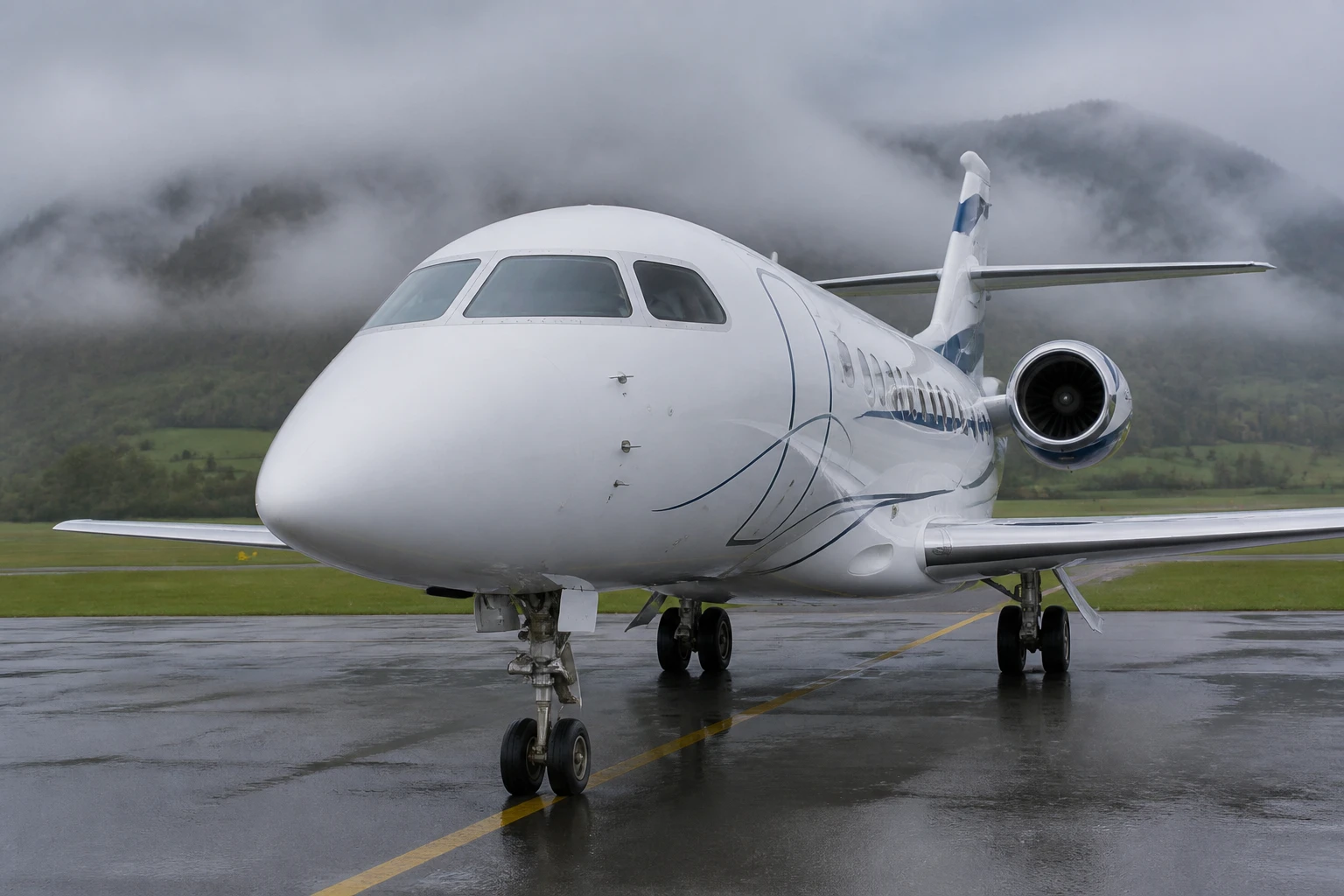
FalconEye Lets Crews Keep Flying When Fog Rolls In
FalconEye is a combined vision system that fuses real-time enhanced imagery from multi-spectral cameras with synthetic terrain data drawn from an onboard database. The result appears on a wide-field head-up display so pilots can “see through” fog, darkness or heavy precipitation and identify runways, lights and obstacles.
- Four day sensors for lights and terrain imaging
- One night sensor for low-light detection
- One thermal sensor for heat-based terrain views
- HUD field of view roughly 40° by 30°
Dassault markets the package as giving unprecedented all-weather situational awareness. Regulators have certified the combined vision system certified to 100 feet for Enhanced Flight Vision System operations. That credit lets crews continue approaches when reported visibility sits below published minima, cutting diversions, holds and go-arounds. The system also detects modern LED runway lights, a capability few competitors match.
An earlier Elbit Systems combined vision certification for Falcon aircraft established the technology’s baseline. On the 6X it is listed as standard, with a dual-HUD option available. Without it, Irish crews revert to conventional minima and divert more readily when visibility collapses.
The certification to 100 feet is the operational hinge. With the system, a crew can treat that lower figure as the decision height on an Enhanced Flight Vision System approach. Without it, the published minima for the runway and the aircraft category remain the hard stop. Holds lengthen. Fuel burns rise. Alternate airports enter the plan earlier.
A 2024 Directive Drew the Line at Written Deals
In late August 2024, Micheál Martin, then Tánaiste and Minister for Defence and Foreign Affairs, ordered a halt to new purchases of Israeli military equipment. He cited the International Court of Justice advisory opinion that Israel’s occupation of Palestinian territory amounted to illegal annexation. Martin directed officials to review existing packages and ensure “no such further procurement takes place.”
- July 2024, ICJ advisory opinion on occupation and annexation published
- 30 August 2024, Martin announces cease of Israeli military equipment buys; first EU state to do so after the war began
- Late 2025, Falcon 6X delivered without optional FalconEye
- April 2026, DoD and Dáil replies affirm “no current limits”
- 4 August 2026, The Journal reports the omission and pilot concerns
Ireland had spent well over €20 million with Israeli firms across two decades on drones, ammunition and radar. An ongoing maintenance contract with Aeronautics Defence Industries for existing drones was placed under review. The new policy left integral systems on other platforms untouched while optional extras on the government jet became avoidable.
That same policy climate later produced Ireland’s ban on settlement goods and sharper diplomatic steps, including embassy closure moves and entry bans on certain Israeli ministers. The FalconEye decision sits inside that broader posture.
The directive’s practical test was simple. Would a purchase need a fresh written deal with an Israeli supplier? If yes, and if the item could be left off, officials had a path to compliance that did not require redesigning an airframe. FalconEye met both conditions. The review of the Aeronautics maintenance contract shows the same logic applied to legacy work still in force.
Helicopters Kept Their Israeli Avionics
The line between optional and essential proved decisive. Four new Airbus helicopters on order for the Air Corps carry Helionix avionics that incorporate Elbit technology. Those systems are integral to the cockpit architecture; the airframes cannot be built without them. The new CASA 295 maritime patrol aircraft likewise arrived with Israeli-made radar.
| Platform | Israeli-linked system | Status | Reason kept or dropped |
|---|---|---|---|
| Falcon 6X government jet | FalconEye CVS (Elbit/Dassault) | Omitted | Optional; required separate written deal |
| Airbus helicopters (x4) | Helionix (Airbus/Elbit) | Retained | Integral to avionics; cannot build without |
| CASA 295 maritime patrol | Israeli radar | Retained | Fitted as essential sensor suite |
| Existing drones | Aeronautics maintenance | Under review | Legacy contract; cancellation unclear |
Procurement officials could request the Falcon 6X without FalconEye because the system sits outside the core airframe. They could not make the same request for the helicopters. The result is a fleet that still flies with Israeli components where they cannot be stripped out, while the flagship VIP jet flies without the one optional safety aid that would have been most useful on Irish winters.
That split was not an accident of paperwork. It followed directly from how each platform is built and sold. Where the Israeli-linked kit was baked into the architecture, the 2024 line left it alone. Where it could be declined at order, the line removed it.
Foggy Islands Raise the Diversion Risk
Ireland’s climate makes low-visibility landings a routine operational fact rather than a rare edge case. Freezing fog warnings and widespread mist regularly affect Dublin, Cork and regional fields. The Falcon 6X is also tasked with air ambulance missions that may need to reach smaller or less-equipped airports under time pressure.
Kevin Phipps, a former Irish Air Corps pilot who now flies airlines, spelled out the practical difference for The Journal.
Enhanced vision systems use a number of infra-red and other light spectrum cameras whose imagery is projected onto heads up display screens in the cockpit to provide unparalleled situational awareness allowing pilots to see at night and through the most inclement weather conditions. The operational benefit of this system is the ability to land in fog when other aircraft would have to divert to another airport.
Phipps’s point lands hardest for a government jet that must keep ministers moving and patients moving. Diversions cost time, fuel and schedule certainty. On medevac legs they can cost more than that. Officials can correctly say the aircraft remains safe and airworthy under conventional rules. Pilots still lose the margin that the type’s standard fit was designed to deliver.
- Ministerial and Taoiseach transport on fixed European and longer itineraries
- Long-distance air ambulance taskings into smaller or less-equipped fields
- Training and currency flying from Baldonnell in the same weather patterns
Each of those roles meets the same island climate. Freezing fog and mist do not wait for a clear slot in the diary. When reported visibility falls below conventional minima, the missing credit is what separates a continued approach from an early turn toward the alternate.
Pilots See Fewer Options Than Officials Admit
The gap between the Department’s formula and the aviation sources’ assessment is the heart of the story. No one claims the jet is grounded or illegal to operate. Everyone agrees the missing system removes a certified operational credit that other Falcon 6X operators enjoy. Crowds watching the story on X immediately framed the choice as self-imposed limitation: one widely shared post noted Ireland’s sovereign right not to see where it is going. Another called the episode a symptom of broader fixation. Those reactions track the optics. The aircraft itself simply flies with a thinner weather envelope than the brochure promised.
The Falcon 6X with standard FalconEye fit was sold on exactly that envelope: 5,500 nm range, high-speed cruise and the ability to use more airports more often. Ireland bought the airframe and the range. It declined the eyes.
What the two sides share, and where they part, can be set out plainly:
- Shared ground: the jet is safe, airworthy and legal under conventional rules
- Shared ground: FalconEye’s certified credit is absent from the Irish fit
- Official line: no current limits on operational capability
- Aviation sources: narrower weather windows and earlier diversion decisions
That is the whole dispute. It needs no exaggeration. The brochure promised a weather envelope other operators still hold. Ireland’s airframe flies without that piece of the envelope.
Optional Kits Became the Policy Pressure Point
The 2024 directive did not order fleets to be stripped of every Israeli-linked component already flying. It stopped new purchases and put existing packages under review. That wording created a clear pressure point at the moment of order: anything optional that required a fresh written deal could be declined without rewriting a type certificate or delaying an airframe already on the line.
FalconEye sat precisely on that pressure point. It is standard on the type in Dassault’s marketing, yet it still needed a separate procurement step with Elbit. Helionix on the Airbus helicopters and the radar on the CASA 295 did not offer the same off-ramp. Those systems travel with the build. Declining them would have meant declining the platforms.
The result is a fleet whose Israeli-linked equipment now sorts into three practical buckets drawn from the record already public:
- Omitted at order: FalconEye on the Falcon 6X
- Retained as integral: Helionix on the four Airbus helicopters; Israeli radar on the CASA 295
- Under review: the Aeronautics maintenance contract on existing drones
Officials followed the line they were given. The VIP jet was the platform on which following that line changed the weather tools in the cockpit. Other platforms kept what they could not lose. The policy’s clean boundary on paper therefore produced an uneven boundary in the hangar.
The Next Mission Still Takes Off
For now the jet continues its dual role. Ministers board it for European and longer trips. Air Corps crews train and fly the medical evacuation profile when called. The Department can keep repeating that nothing is currently limited. Each time fog thickens over Baldonnell or a destination field, the crew will decide whether the published minima allow the approach or whether another airport becomes the safer choice.
That calculation is the quiet daily cost of the 2024 line. Ireland drew a clean boundary around new written contracts with Israeli defense firms. The boundary left the government’s own aircraft without a system that is standard on the type and purpose-built for the weather the island actually has. Other platforms kept their embedded Israeli sensors because removing them was impossible. The VIP jet lost its optional sensor package because removing it was possible. The aircraft remains pristine, capable and expensive. It simply sees less when the weather closes in.
The same political current that produced the procurement rule also shaped later rhetoric, including the Irish president’s neutrality and genocide remarks. Capability questions now sit alongside those statements every time the Falcon 6X files a flight plan into uncertain visibility.
