
BUSINESS
Jood Eskan Puts 8,000 Homes on a Six-Month Clock
Jood Eskan’s 2026 Ramadan drive passed SAR 1.4 billion and 8,000 homes, then faced the six-month handover test Majid Al-Hogail set in Diriyah.

Jood Eskan closed its 2026 Ramadan drive above SAR 1.4 billion (about $373 million), a total the platform said helped secure more than 8,000 homes for qualifying Saudi families. The annual Aljood Minna Wafeena campaign, a name that translates as generosity is from us and within us, ran from February 18 to March 19, 2026, and beat a stated fundraising goal of SAR 1.2 billion.
King Salman and Crown Prince Mohammed bin Salman opened the month with combined gifts of SAR 150 million through the platform. Municipalities and Housing Minister Majid bin Abdullah Al-Hogail, who chairs the Developmental Housing Foundation (Sakan) that runs Jood, then put a clock on the result. At a Diriyah event with property firms on March 11, he said 8,000 families would be living in new homes within six months.
More Than 8,000 Homes From One Ramadan Drive
The campaign close issued on March 19 said the drive had gone past its Ramadan target and supplied more than 8,000 housing units across the Kingdom. A day later, Jood Eskan published its own outcomes note with the SAR 1.4 billion figure and a warning about how that number should be read.
Success should not be measured only through headline figures such as donations collected or applications processed, but through whether families achieve lasting housing stability over time.
Jood Eskan, campaign outcomes statement, March 20, 2026
Al-Hogail had already told the Diriyah hall that gifts on the platform were running at SAR 1 million a day. He also split the large checks: the National Housing Company and real-estate developers had given SAR 160 million, and nonprofit groups plus the wider third sector had given SAR 300 million. Those slices sit inside the SAR 1.4 billion, they do not sit on top of it.
The royal-court account posted the opening gifts on February 17, 2026, the night before 1 Ramadan 1447.
#خادم_الحرمين_الشريفين وسمو #ولي_العهد يدشّنان حملة (الجود منّا وفينا) بتبرعين سخيّين بمبلغ 150 مليون ريال عبر منصة جود الإسكان لدعم الأسر المستحقة.https://t.co/kEo3qwnqWG#واس pic.twitter.com/XbavVprshq
— واس الأخبار الملكية (@spagov) February 17, 2026
Replies under that post clustered around thanks and prayer. The harder question was the one Jood wrote into its own close: whether a family that is “secured” on a campaign dashboard is still housed a year later.
How Jood Eskan Matches a Donor to a Family
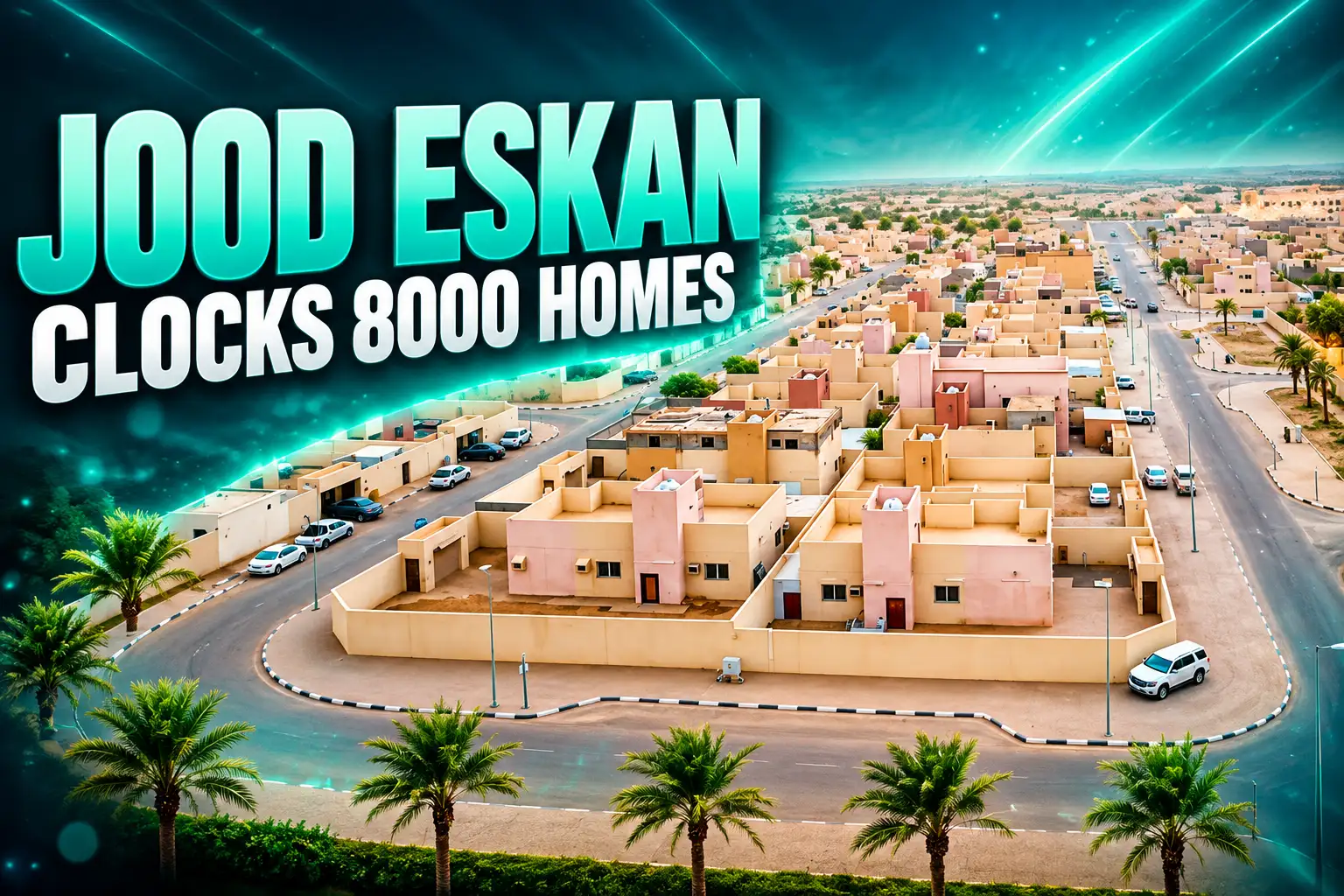
Jood Eskan is not a general pot. Sakan launched the site in 2019 as a digital match between a donor and a verified housing case, and the live board still works that way. A visitor can browse open cases on Jood Eskan, see the city, the number of dependents, the remaining riyals, and the partner charity, then pay toward that file.
One purchase-support file in Makkah, listed as case 23514, showed a 42-year-old father of four. The target was SAR 160,500. Gifts had reached SAR 128,930, leaving SAR 31,570. That remaining balance is the product. People do not buy a slogan. They retire a number next to a family.
THE GIVING TRACKS ON THE LIVE BOARD
- Purchase support: Donors close a gap so a qualifying family can buy a home.
- Rent support: A separate track pays rent for households that cannot keep a roof this month.
- Repair support: Listed as restoration, it funds work on a house a family already occupies.
- Waqf share: An endowment pool, including a first waqf share with its own target, is meant to keep money moving after Ramadan.
The public board, when read in early October 2026, counted 5.3 million donation operations, 54,200 completed cases, and 77.4 million visits. Al-Hogail said in February 2026 that the platform had begun with 100 families, that more than 4.5 million donors had given more than SAR 5 billion since 2021, and that more than 50,000 families had been served. The 54,200 completed cases are a later, different count from the site itself, not a restatement of his 50,000-family figure.
Jood’s April 8, 2026 policy note drew a line between zakat and other gifts. Up to 7% of non-zakat gifts may be taken, when needed and after committee approval, to cover platform and partner costs. Beneficiary records, the same note said, are stored inside Saudi jurisdiction. After the assessment path was put online, case resolution fell from about one month to 19 days. In 2025 the ministry said more than 150,000 digital operations ran through the system and that the needs of more than 400,000 beneficiary families were studied against national databases.
NHC and Builders Added 160 Million Riyals
The Ramadan calendar is also a deal calendar. On March 6, with Al-Hogail in the room, the campaign’s nonprofit-sector night signed housing agreements worth SAR 311,229,500, a package the organizers said would reach more than 2,500 families. The named contracts below are a subset of that night. Other unsigned “initiatives” were counted toward the 2,500 and are not in the rows.
NAMED DEALS FROM THE MARCH 6 NIGHT
| Partner | Amount (SAR) | Families |
|---|---|---|
| Human Resources and Social Development (two deals) | 123,060,000 | 448 |
| Al-Bir Society, Eastern Province | 85,050,000 | 380 |
| Civil society groups | 14,125,000 | 100 |
| Additional listed agreement | 9,900,000 | 120 |
Those four lines cover 1,048 families. The rest of the night’s more than 2,500 sat in other partnerships that were announced as a group. Five days later came the Diriyah builder event and the SAR 160 million from NHC and developers. Banks, endowments, and media groups have been listed as standing partners in earlier Ramadan drives, and they show up again as the people who can move units, not only as names on a thank-you slide.
Al-Hogail’s six-month pledge makes that distinction practical. A riyal given in Ramadan still has to become keys, a contract, or a rent receipt. Builders and a state housing company are the parties that can do that at the scale of 8,000 families.
A Seven-Year Crowdfunding Machine
Aljood Minna Wafeena is one season of a machine that now runs all year. Each Ramadan still resets the public target, and the last three seasons did not use the same slogan or the same scoreboard.
RAMADAN HOUSING DRIVES, 2024 TO 2026
| Year | Campaign | Amount | Families or homes |
|---|---|---|---|
| 2024 | Evergreen Stock, an IPO-style sale of charity shares | SAR 1 billion | 3,500 families |
| 2025 | Jood Regions | SAR 1.8 billion | More than 11,479 families |
| 2026 | Aljood Minna Wafeena | More than SAR 1.4 billion | More than 8,000 homes |
The 2024 close is the official national-portal account of 3,500 families in the 2024 drive, reached 13 days after launch. Abdulaziz Al-Kuraidis, secretary-general of Sakan, put the 2025 Jood Regions total at SAR 1.8 billion and more than 11,479 families, counting cash, financing, construction gifts, and in-kind support. The 2026 line is the campaign close plus Jood’s March 20 note, and it is a homes tally, not the same unit as the 2025 family count.
Before this year’s close, the public scoreboard was still the campaign’s 8,000-home target. Al-Hogail said on February 18 that the 2026 drive aimed to serve 8,000 families. Regional courts of governors treated it as a work file, not a poster. In late January the Qassim governor’s executive team was told that the prior Jood Regions round had housed more than 3,500 beneficiaries in that region alone.
Saudi Homeownership Is Still Short of 70 Percent
Jood is the residual track. The main ownership machine is Sakani, the ministry’s support program of subsidized loans, ready units, off-plan sales, self-build, and land. The 70 percent homeownership by 2030 goal is the Housing Program’s line. Official figures put Saudi household ownership at 47 percent in 2016 and at 66.24% by the end of 2025, a gap of 3.76 percentage points.
In the first half of 2026, the ministry said 63,076 Saudi families moved into their first homes, including 12,004 in June, and that 48,631 families used Sakani in that half, including 10,160 in June. Supported Sakani contracts since 2017 stood at about 1.05 million by the end of June 2026. Against that flow, more than 8,000 Jood homes is a narrow band. It is aimed at households that still need a grant, a rent rescue, or a repair, not at the typical Sakani buyer.
Al-Hogail has described that band in other rooms. In February 2026 he said nonprofit housing work had reached 106,000 social-security families, that more than 200,000 households had been kept from losing a home, and that a rent-support program was helping about 6,600 families that year. Electronic signatures, he said, had cut property-ownership paperwork from 14 days to two. Jood sits on the grant side of that stack. Sakani sits on the loan-and-product side. Mixing the two brands is the usual error, and it hides who still needs a donor.
Makkah Reviewed the File in September
Six months from March 11, 2026 is September 11, 2026. That is the date implied by Al-Hogail’s Diriyah pledge that 8,000 families would be in new homes. The campaign close never published a public, region-by-region move-in ledger against that date. What did appear were delivery scenes on either side of it.
FROM THE RAMADAN OPENING TO THE HANDOVER FILE
- February 18, 2026: King Salman and the crown prince open Aljood Minna Wafeena with SAR 150 million, and Al-Hogail sets a target of 8,000 families.
- March 6, 2026: Nonprofit-sector night signs deals of SAR 311,229,500 for more than 2,500 families.
- March 11, 2026: Al-Hogail, in Diriyah, says the total has reached SAR 1.4 billion and that 8,000 families will move within six months.
- March 19, 2026: The campaign close records more than 8,000 housing units and a result above the SAR 1.2 billion target.
- September 16, 2026: Prince Saud bin Mishal bin Abdulaziz, deputy governor of Makkah, reviews the campaign’s regional outcomes and its remaining housing targets.
- October 1, 2026: Al-Hogail attends a Saudi National Bank handover on Jood’s platform, marking 10 years of a bank partnership that supplied 2,269 units worth SAR 244 million to more than 11,000 beneficiaries.
The Makkah briefing is the first official regional audit in the public file after the six-month mark, and it was framed as a progress reading, not as a final count of keys in doors. The October 1 bank ceremony is a longer partnership coming due, not a census of the 8,000 Ramadan homes. Al-Hogail thanked SNB chairman Saeed bin Mohammed Al-Ghamdi and chief executive Tareq bin Abdulrahman Al-Sadhan and tied the handovers to Vision 2030.
A separate Sakan delivery plan, funded in part by a personal SAR 1 billion gift from the crown prince in April 2025, had already started nationwide handovers in December 2025 on a six-phase map, two regions a month, with a 12-month finish line. That plan and the Ramadan crowdfund share a minister, a foundation, and a platform. They do not share a ledger. Until Jood publishes move-in numbers against the March 11 pledge, the SAR 1.4 billion remains a raised total, and the more than 8,000 homes remain a secured total, which is the distinction the platform asked the country to keep.
Frequently Asked Questions
Is Jood Eskan the Same Program as Sakani?
No. Sakani is the ministry’s housing-support marketplace, run with the Real Estate Development Fund, for loans, ready homes, off-plan units, self-build, and land. Jood Eskan is Sakan’s charitable crowdfunding site, where donors retire a remaining balance on a verified case. A family can meet a Sakani product and still be a Jood case if the gap is a grant, rent, or repair rather than a mortgage.
What Was the Evergreen Stock Housing Campaign?
It was Jood’s 2024 Ramadan format, built as a mock share sale: 100 million charity “stocks” at SAR 10 each, aimed at SAR 1 billion. The national portal said the goal was hit in 13 days and that the money was meant to house 3,500 families. The 2026 drive dropped the share story and went back to a straight family-and-home target.
Where Does Jood Eskan Keep Beneficiary Data?
Jood’s April 8, 2026 governance note said beneficiary data is stored inside Saudi Arabia, with confidentiality rules and disclosure controls around it. That is a location promise, not a public audit of every file, and it sits beside the 7% cap on non-zakat operating deductions.
Does Jood Eskan Take Gifts Only in Ramadan?
No. The live site keeps year-round asks, including a standing prompt to make giving permanent, staff-group drives, and the waqf share. Ramadan is when governors, banks, and builders concentrate large pledges. The case board does not switch off in Shawwal.
On the public board, case 23514 still had SAR 31,570 to go. That is a smaller number than SAR 1.4 billion, and it is the unit the platform actually sells.

Ninja Theory Staff Face Redundancy After Two Xbox Sales Collapse

Amazon Sells the MacBook Air at Its Pre-Hike Price

U.S. Slows Jet Parts to Squeeze China’s Flying Fleets

PEGI Pulled the GTA 6 Age Rating After Cocaine Details

Northwestern’s Smaller Ryan Field Gave Penn State Nowhere to Hide

Aramco Crash Kills 14 Two Days After Oil Restart

Salah Captained Egypt to Their First World Cup Win

Apple Labor Day Deals Hide June’s Memory Price Hike

Palworld 1.0.4 Adds Palpedia Search After the 1.0 Launch

Zelda’s 40th Switch 2 Ships Without a Zelda Game
-
 BUSINESS3 months ago
Aramco Crash Kills 14 Two Days After Oil Restart
-
 NEWS4 months ago
Salah Captained Egypt to Their First World Cup Win
-
 NEWS1 month ago
Apple Labor Day Deals Hide June’s Memory Price Hike
-
 GAMING4 weeks ago
Palworld 1.0.4 Adds Palpedia Search After the 1.0 Launch
-
 GAMING4 weeks ago
Zelda’s 40th Switch 2 Ships Without a Zelda Game
-

 NEWS3 months ago
El Niño Puts Israel’s Needed Winter Rain on a Flood Clock
-

 ENTERTAINMENT4 weeks ago
King Charles Letter Keeps Harry and Meghan as Private Citizens
-

 NEWS3 months ago
Saudi Visa Routes Split Nigerian Travelers Into Two Speeds