
Israeli settlers raised the Israeli flag inside the courtyards of Al-Aqsa Mosque in occupied East Jerusalem on Sunday, May 31, singing the national anthem on the steps that lead to the Dome of the Rock. The United Arab Emirates and Jordan both condemned the incursion within hours, calling it a provocation and an act of extremism, and reaffirming Jordan’s custodial role over Islam’s third-holiest site.
The words were strong. They were also familiar. Almost the same sentences have followed almost the same scenes for years, while the arrangement that is supposed to keep the compound calm, the so-called status quo set after the 1967 war, has been worn down one visit, one flag and one ministerial endorsement at a time.
The Flag on the Steps, and the Ritual That Follows
The settlers entered the 35-acre compound through Al-Maghrabah Gate, the one access point fully controlled by Israeli authorities, under police protection. Palestinian worshippers and the Jerusalem Waqf describe these entries as raids; the Israeli participants describe them as visits to what they call the Temple Mount, the holiest site in Judaism, where the two ancient temples once stood.
In its statement, the UAE foreign ministry said it “strongly condemned and denounced” the storming, including the raising of the flag within the courtyards, and held “the Israeli authorities responsible for halting these escalatory actions.” Jordan’s foreign ministry, through the official Petra news agency, called the storming “provocative and reckless” and restated its “absolute rejection” of the continued incursions. Itamar Ben-Gvir, Israel’s far-right national security minister, is among several officials who have publicly backed expanded Jewish access and prayer at the site.
What makes the moment worth more than a diplomatic shrug is the flag itself. Raising a national flag inside a space the arrangement designates as a Muslim place of worship is a symbolic claim of sovereignty, not a private act of faith, and that is exactly the line the status quo was meant to hold.
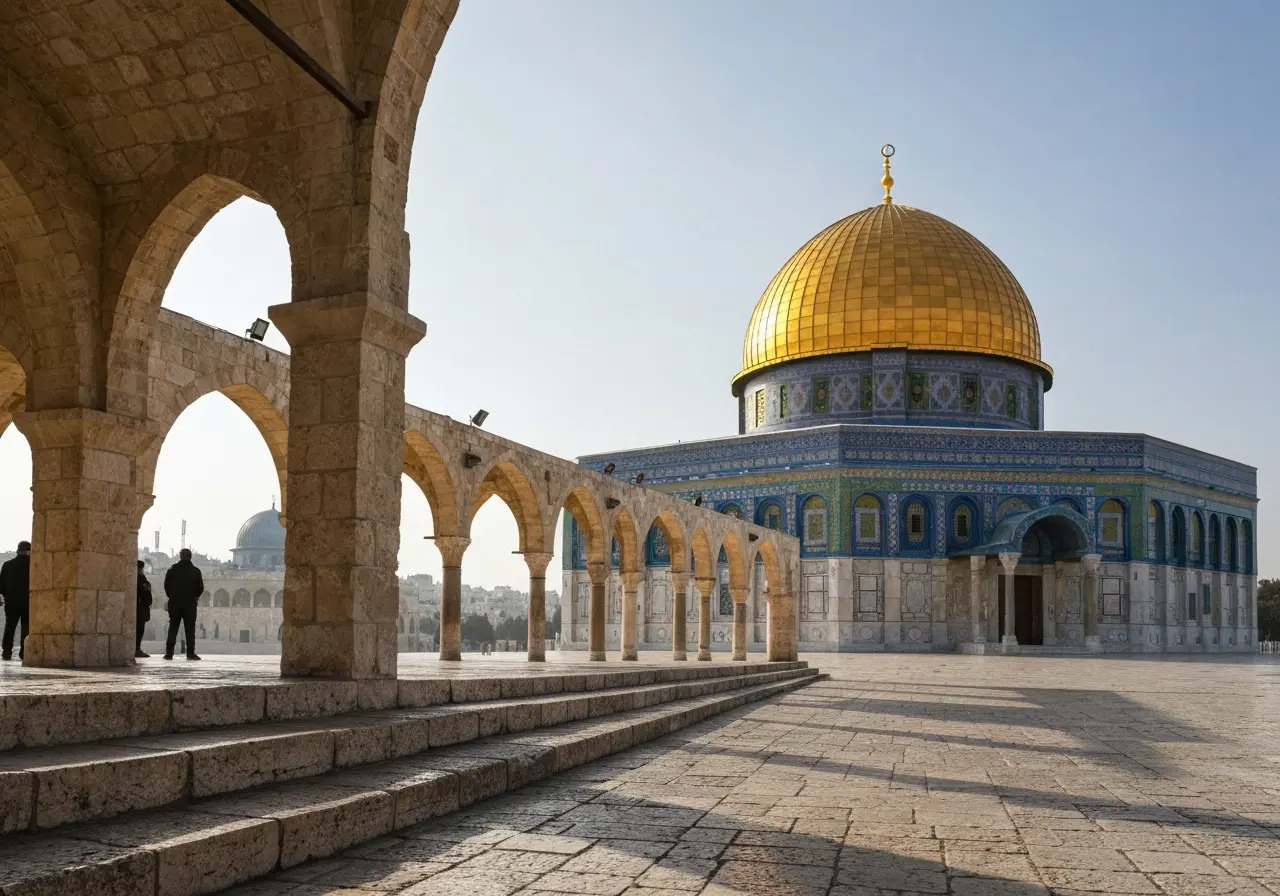
What the 1967 Status Quo Governs
The status quo is not a single signed document. It is a set of understandings, partly verbal, that froze the management of the compound roughly as it stood when Israel captured East Jerusalem in June 1967. Understanding who controls what explains why a flag and a song carry so much weight.
Who Runs the Inside
After the 1967 war, Israel’s then defense minister Moshe Dayan reached an oral understanding with the Islamic authorities: the holy esplanade would belong to Islam and be administered by the Waqf, the Islamic endowment body, while Israel kept overall security control. The Jerusalem Islamic Waqf, part of Jordan’s Ministry of Awqaf and Islamic Affairs, manages the buildings, the staff and day-to-day religious life inside the walls.
Who Holds the Gates
Israeli police control the perimeter and the gates, deciding who enters and when. That split, internal religious administration under the Waqf and external security under Israel, is the load-bearing compromise of the whole arrangement, and the friction point in nearly every crisis.
The Prayer Line
Under the long-standing reading of the arrangement, non-Muslims may visit the compound during set hours but may not pray there in any organized way. That single rule is the one settlers and sympathetic ministers most want to break, and the one Jordan most fiercely defends.
| Domain | Islamic Waqf / Jordan | Israeli authorities |
|---|---|---|
| Internal religious administration | Full control | None by arrangement |
| Perimeter and gate access | None | Full control |
| Non-Muslim entry | Opposes expansion | Permits during set hours |
| Organized non-Muslim prayer | Barred under arrangement | Increasingly tolerated in practice |
A Pattern Older Than the Outrage
Sunday’s scene reads less like a single event and more like the latest entry in a long ledger. The flashpoints stretch back more than half a century, and each one shifted the baseline a little further from where it started.
- 1969: An arson attack by an Australian visitor gutted part of the prayer hall and destroyed the 12th-century pulpit of Saladin, closing the compound and igniting region-wide fury.
- 2000: Ariel Sharon’s walk into the compound with about 1,000 police helped trigger the Second Intifada, in which thousands of Palestinians and Israelis were killed.
- 2017: Israel installed metal detectors and cameras after a deadly shootout, then removed them after eleven days of protest and clashes.
- 2021: Repeated raids during Ramadan left scores of Palestinians wounded and arrested and fed into a wider escalation.
- 2025: A record day of Jewish visits on Tisha B’Av, with Ben-Gvir openly praying at the site, drew formal protests from Jordan and the Palestinian Authority.
Read in sequence, the incidents trace a direction of travel. Each crisis ends with a return to a slightly altered normal, and the altered normal becomes the next starting point. The condemnation is the constant; the line being defended keeps moving.
The Custodian With a Billion-Dollar Stake
Jordan is not a bystander offering moral support. The Hashemite monarchy has been the recognized custodian of Jerusalem’s Muslim holy sites since 1924, a role carried over through decades and reaffirmed in writing when it counted most. For Amman, the compound is both a religious trust and a pillar of the dynasty’s legitimacy across the Muslim world.
- $1 billion-plus spent by Jordan and the Hashemites since 1924 on administering and restoring the holy sites, by one independent estimate.
- Article 9 of the 1994 Israel-Jordan peace treaty commits Israel to respect Jordan’s “special role” over the Muslim shrines in Jerusalem.
- 3,527 Jewish visitors recorded in a single day during Tisha B’Av in August 2025, a high-water mark cited by an Israeli visitors’ group.
- 1,251 settlers said to have entered the compound that same morning, according to the Jerusalem Waqf’s separate count.
The 1994 treaty matters because it turned a custom into a commitment Israel signed. A 2013 agreement between King Abdullah II and Palestinian Authority President Mahmoud Abbas formalized the arrangement further, putting the custodianship on firmer paper. Academic accounts of the role, including an analysis of Jordan’s custodianship of the Jerusalem shrines, trace how central the site is to the kingdom’s standing.
That is why the UAE statement went out of its way to name “the custodial role of the Hashemite Kingdom of Jordan.” Backing the custodian is a way of defending the arrangement without having to police it, since Abu Dhabi has no presence inside the walls and no control over the gates.
The Plan Hanging Over the Custodianship
The flag-raising lands at a delicate moment for that custodianship. In late May, Middle East Eye reported that the United States and Israel were working on a proposal to end Jordan’s role and recast the compound as a shared “multi-faith” center, with rotational oversight offered to several Arab states. A US official rejected the report as “totally false,” and no such change has been adopted, so the plan remains a contested account rather than a confirmed policy.
Still, the reporting clarifies the stakes behind every flag and chant. The fight is not only over who prays on a given afternoon. It is over who administers the site at all, and under whose name.
| Feature | Current status quo | Reported “multi-faith” proposal |
|---|---|---|
| Administering body | Jordanian Islamic Waqf | New Israeli-created body |
| Religious identity | Muslim holy site | Shared Abrahamic center |
| Oversight | Hashemite custodianship | Rotational Arab oversight |
| Non-Muslim prayer | Barred under arrangement | Permitted |
The reported list of states briefed on the idea, including the UAE, Egypt, Bahrain and Morocco, is itself revealing. Saudi Arabia is said to have opposed it as a threat to regional stability. Such a split would put the same governments that issue these condemnations in an awkward position, defending an arrangement some of their partners have quietly been asked to help replace.
For now the proposal sits in the realm of reports and denials. What is concrete is the steady on-the-ground change, documented by analysts who track how the Temple Mount arrangement works in practice, that makes a future redrawing easier to imagine.
Why the Condemnations Keep Coming and the Line Keeps Moving
The gap between rhetoric and outcome is the real story of Sunday. Arab governments hold no security control inside the compound, so their tools are statements, summit declarations and quiet diplomacy, none of which can stop a group of settlers at a gate Israel controls. Researchers who warn that the Al-Aqsa arrangement is being changed argue the shift is happening precisely because the cost of changing it has stayed low.
Raising the Israeli flag inside the courtyards of Al-Aqsa Mosque, along with performing provocative rituals, is part of a systematic and deliberate official Israeli policy led by the extremist occupation government.
That assessment came from Omar Rajoub, director of the media department at the Jerusalem Governorate, after Sunday’s incursion. Whether or not every condemnation changes the next morning at the gate, the official record now holds the UAE statement and Jordan’s, posted on the UAE foreign ministry’s account of the Al-Aqsa storming and through Petra. The next time a flag goes up on the steps, the dispute will start from wherever this one leaves the line.
Frequently Asked Questions
What is the status quo at Al-Aqsa Mosque?
It is a set of mostly verbal understandings dating to 1967 under which the Islamic Waqf administers religious life inside the compound while Israel controls security and the gates. Non-Muslims may visit during set hours but, under the traditional reading, may not pray there in any organized way.
Who controls Al-Aqsa Mosque?
Day-to-day administration is run by the Jerusalem Islamic Waqf, which is part of Jordan’s Ministry of Awqaf and Islamic Affairs, giving Jordan custodial authority over the site. Israeli police control the perimeter, the gates and overall security, including the Al-Maghrabah Gate used by visiting settlers.
Why did the UAE and Jordan condemn the storming?
Both governments viewed the entry of settlers under police protection, and the raising of the Israeli flag, as a provocation that breaches the historical and legal status quo. The UAE held Israeli authorities responsible for halting the escalation and backed Jordan’s custodial role.
What is Jordan’s custodianship of Jerusalem’s holy sites?
The Hashemite monarchy has been recognized as custodian of the Muslim holy sites in Jerusalem since 1924. The role is referenced in Article 9 of the 1994 Israel-Jordan peace treaty and was reaffirmed in a 2013 agreement between King Abdullah II and Palestinian President Mahmoud Abbas.
Why is Al-Aqsa Mosque so contested?
The compound is Islam’s third-holiest site and also the holiest site in Judaism, where the ancient temples stood. Competing religious and national claims over the same 35-acre space, combined with the divided security-and-administration arrangement, make it one of the most sensitive flashpoints in the region.
