
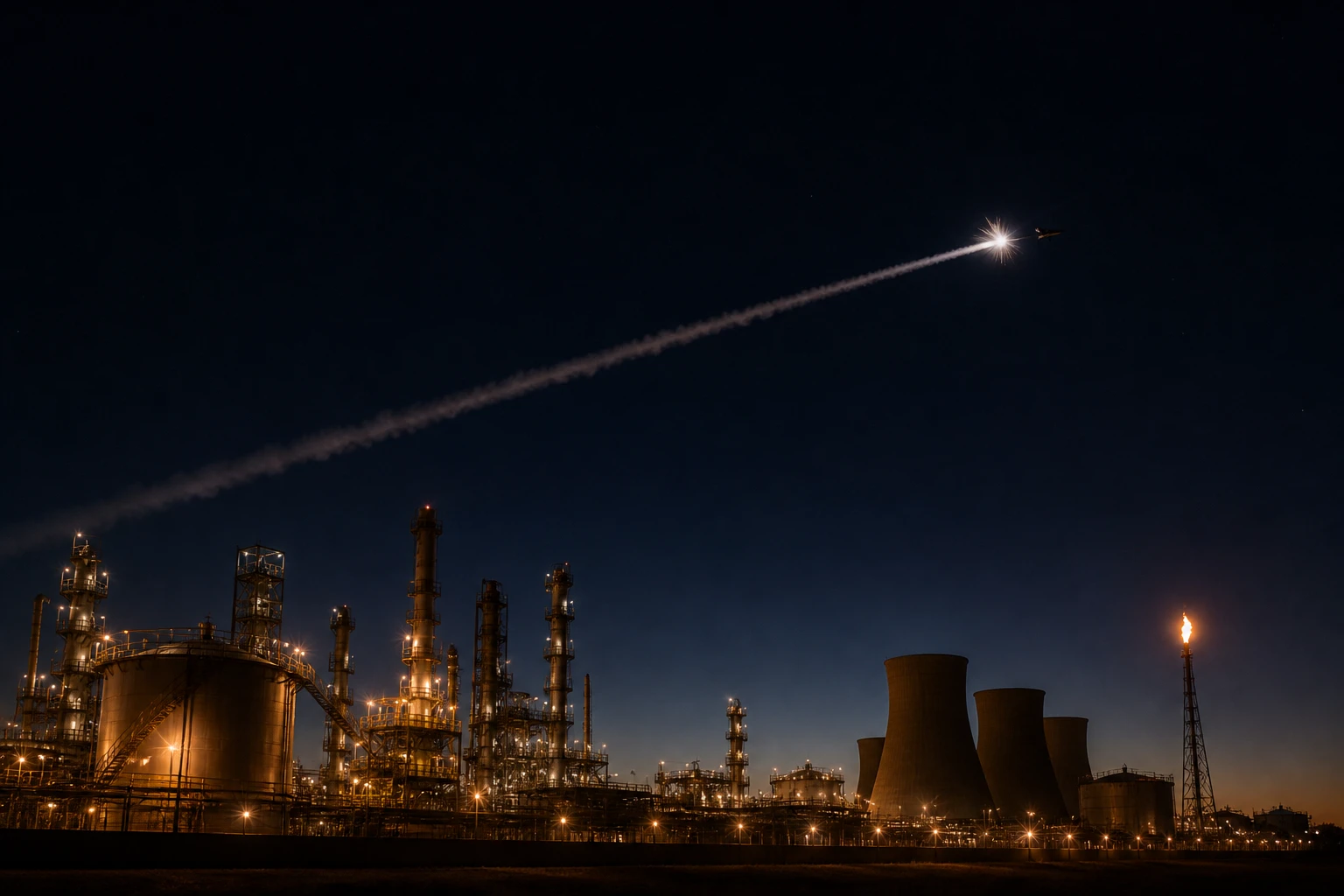
The United States and Saudi Arabia bombed Iranian-backed militia sites across eastern Iraq late Tuesday, hitting back after more than 30 drone and missile attempts struck American forces and Saudi oil facilities over three days. Iraq did not thank either ally. Its government accused both militaries of violating its sovereignty and threatened to strike back at the forces that struck on its soil.
Prime Minister Mohammed Shia al-Sudani summoned the American charge d’affaires and Iran’s ambassador on the same day, treating Washington and Tehran as jointly responsible for turning his country into a battlefield neither Iraqi voters nor Iraqi soldiers chose to fight on.
Why Saudi Arabia Is Striking Targets Inside Iraq
Saudi Arabia joined U.S. Central Command (CENTCOM, the military headquarters overseeing American operations across the Middle East) in striking what the two militaries called terrorist logistics and weapons sites across eastern Iraq, a target description CENTCOM posted directly to terrorist logistics and weapons sites across eastern Iraq. The Saudi Ministry of Defense confirmed it too had carried out precise and targeted strikes, citing its right to self-defense.
CENTCOM said the joint operation answered more than 30 attempted drone attacks on U.S. forces and Saudi energy infrastructure over the prior three days, all of which it described as unsuccessful. Saudi Arabia separately said it intercepted drones launched from Iraqi territory aimed at petroleum facilities in Riyadh and in the kingdom’s eastern province.
Earlier the same day, CENTCOM said Iran’s Revolutionary Guards had mounted an attempted surprise attack, firing ballistic missiles at American forces in the region before U.S. defenses intercepted them. Neither military named the specific factions hit in Tuesday’s strikes, though Iran backs several Shiite militias in Iraq, including groups the U.S. has already labeled foreign terrorist organizations. CENTCOM blamed Iran’s Islamic Revolutionary Guard Corps (IRGC, the branch of Iran’s military that funds and arms regional proxy forces) for directing the attacks and warned that its proxies must cease or face further American response. The pattern was not new; drone strikes have hit targets across four countries during the declared lull in direct fighting with Iran.
Baghdad Turns on the Forces Bombing Its Own Militias
Iraq’s reaction was immediate and unusually sharp for a government that depends on both Washington and Tehran. The Popular Mobilization Forces (PMF), the Iraqi paramilitary umbrella that includes Iran-aligned factions and answers to Baghdad’s own chain of command, said the strikes hit its headquarters and formations directly.
The group called it a highly dangerous escalation, a violation of Iraq’s sovereignty, and an attack on its official security institutions. Iraq’s Council of Ministers met the same night and issued its own statement.
To confront and respond to military attacks carried out by military aircraft and drones targeting the headquarters and formations of the Popular Mobilization Forces Commission and other formations of our armed forces, using available means, in accordance with the right to respond and self-defense.
Al-Sudani’s office said the foreign ministry would summon the U.S. charge d’affaires and Iran’s ambassador separately on Wednesday, a diplomatic move that puts Iraq’s two most powerful foreign patrons on equal footing as violators of its territory. It is a position few Iraqi governments have stated so plainly since American forces left in force after 2011.
What’s Confirmed, What Isn’t Yet
The story is still moving. Here is what both militaries and Baghdad have verified, and what remains open.
- Confirmed: CENTCOM and the Saudi Ministry of Defense jointly struck weapons and logistics sites in eastern Iraq late Tuesday.
- Confirmed: CENTCOM says more than 30 drone attempts hit U.S. forces and Saudi energy sites over three days, all unsuccessful.
- Confirmed: Iraq’s Council of Ministers ordered a response and moved to summon both the U.S. charge d’affaires and Iran’s ambassador.
- Unconfirmed: Which specific militia factions were hit; neither CENTCOM nor Saudi Arabia has named them publicly.
- Unconfirmed: Any casualty count from Tuesday’s strikes on Iraqi soil.
- Unconfirmed: Whether Washington resumes direct strikes on Iran, or what form Baghdad’s threatened response actually takes.
The Détente Riyadh Built With Tehran Is Unraveling
Three years ago, Saudi Arabia and Iran were the ones shaking hands. Brokered by China, the two governments agreed in March 2023 to restore diplomatic relations within two months, ending a seven-year rupture that began when protesters stormed the Saudi embassy in Tehran. The deal, reported at the time by the United States Institute of Peace, revived a 2001 security cooperation pact and was widely read as Riyadh hedging against a region where American commitment felt uncertain.
Tuesday’s joint strikes are the clearest sign yet that the hedge has failed. A kingdom that spent three years courting Tehran as a way to keep militia-launched drones off its refineries is now flying combat missions alongside the United States against forces Iran arms and directs. Saudi Arabia framed its own strikes purely as self-defense, not as a break with Tehran, but the operational reality is that Riyadh chose sides on a night when Iranian-linked drones were still hitting its energy infrastructure.
Squeezed From Two Coastlines
The kingdom’s exposure is not just political. Saudi Arabia now faces pressure on both coasts at once, with Iran’s proxies threatening the Strait of Hormuz to its east and Yemen’s Houthis threatening the Red Sea to its west.
| Chokepoint | Normal Flow | Current Status | Primary Threat |
|---|---|---|---|
| Strait of Hormuz | Roughly 20 million barrels a day, per the U.S. Energy Information Administration | Fell to 14.6 million barrels a day in the first quarter of 2026, down nearly 30% year over year | Iran and the IRGC |
| Red Sea / Bab el Mandeb | A key artery for Gulf crude and refined-fuel shipments to Europe | Houthis declared a naval blockade and struck the tankers Encelia and Layla around July 22 | Iran-backed Houthis in Yemen |
The nearly 30% drop in Hormuz oil flows already shows how much the Iran conflict has cut into the region’s main export route even before the Houthis opened a second front. President Trump said the U.S. would hold Iran responsible for future Houthi attacks after the group claimed its tanker strikes last week, a warning that has not stopped the Red Sea campaign from continuing.
The Militias Washington Has Been Naming for Years
The groups CENTCOM blamed for Tuesday’s drone barrage were not named, but Iran’s roster of armed proxies inside Iraq is well documented by the U.S. government.
- Kata’ib Hezbollah – formed in 2006 out of the old Mahdi Army network and designated a Foreign Terrorist Organization by Washington in 2009
- Kataib Imam Ali – added to the U.S. terrorism list in June 2025
- Four additional factions – designated Foreign Terrorist Organizations together in September 2025
- Seven militia commanders – named Specially Designated Global Terrorists in sanctions on Iran-backed militia commanders issued by the Treasury Department in April 2026
Every one of those factions operates from Iraqi territory, often with offices, salaries, and equipment tied to the same Popular Mobilization Forces structure that Baghdad says was hit Tuesday. That overlap is exactly why Iraq calls the strikes an attack on its own official institutions rather than a clean counterterrorism operation against outside fighters.
Iraq’s Pipeline Bet Sits in the Blast Radius
Beyond the politics, Iraq has real economic exposure sitting inside the same conflict zone. Baghdad and Amman have been working to revive the Basra-Aqaba pipeline project with Jordan, a route meant to give Iraqi crude an export path that skips the Strait of Hormuz entirely. It is precisely the kind of alternative infrastructure the region needs more of while Hormuz volumes are down.
But that plan already looked shakier before Tuesday’s strikes. Drone activity tied to the wider Iran conflict had put Iraq’s pipeline gamble at risk even under the five-day lull. Now the same eastern Iraq desert that hosts militia depots also sits near proposed pipeline corridors, and a Baghdad government publicly vowing to confront U.S. and Saudi aircraft has little room to also guarantee foreign investors a stable route.
Trump’s Diplomatic Window Keeps Shrinking
All of this unfolds while Washington tries to hold a fragile pause with Iran itself. The U.S. carried out nearly two weeks of nightly strikes on Iranian targets that ended Thursday night, and Tuesday’s Iraq operation tested whether that five-day lull could survive contact with new attacks.
Trump said Tuesday morning that the U.S. and Iran have had very good talks and voiced optimism a deal was possible, but he warned that the U.S. will finish the job if the Iranian regime does not strike an agreement. Iran has said it is not currently seeking direct talks with Washington. The two sides remain apart on Iran’s push to keep control over the Strait of Hormuz and America’s demand that Tehran give up uranium enrichment entirely.
Neither side has said whether Tuesday’s strikes on Iraqi soil count as a resumption of the broader campaign or a one-off response contained to Iraq. For now, the nightly strikes on Iran itself have not restarted, the Houthi blockade in the Red Sea has not lifted, and Baghdad’s foreign ministry is set to summon two ambassadors over a fight it did not start.
