
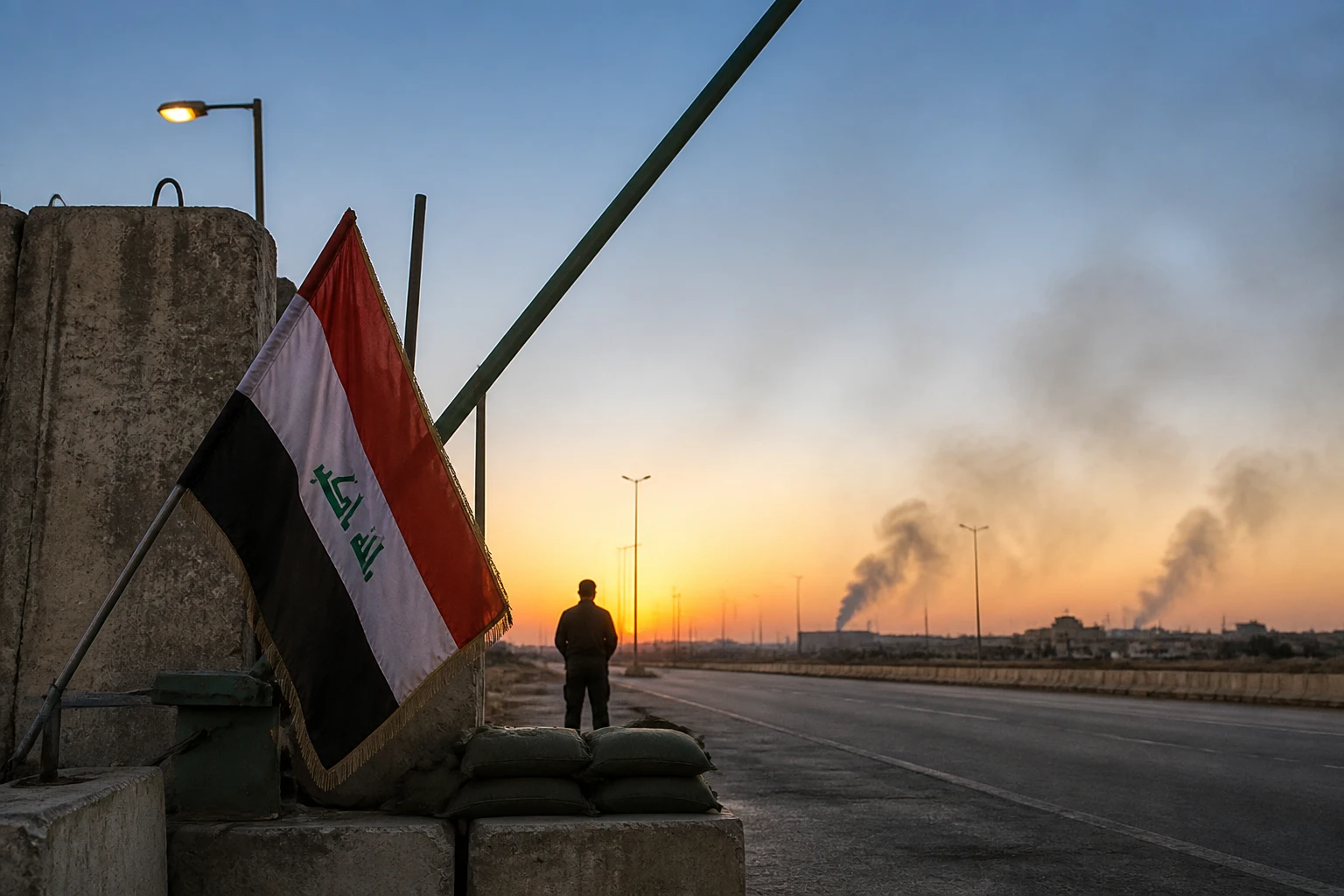
US and Saudi fighter jets struck Iran-aligned militia sites across eastern Iraq before dawn on Wednesday. The network they hit is one Iraqi law still classifies as part of Baghdad’s own armed forces.
The Popular Mobilization Forces (PMF), an umbrella of mostly Shiite militias, said the raid hit its headquarters in Basra and left an unspecified number dead or wounded. It called the strike a “highly dangerous escalation” that violated Iraq’s sovereignty.
The strikes followed a brutal 72 hours of attacks: more than 30 drone strikes on US forces, a hit on Saudi Arabia’s largest oil processing plant, and an intercepted Iranian missile barrage. Iraq launched none of it. It just keeps absorbing the fallout.
US and Saudi Jets Hit PMF Sites across Eastern Iraq
US Central Command (CENTCOM) said Wednesday’s mission flew jointly with Saudi Arabia, calling it retaliation for a campaign it blames on Iran’s Islamic Revolutionary Guard Corps (IRGC). “US and Saudi fighter aircraft struck multiple terrorist logistics and weapons sites across eastern Iraq in a strong response to over 30 IRGC-directed aerial drone attacks in the last 72 hours,” CENTCOM said.
CENTCOM added a warning aimed squarely at Tehran: “The IRGC and its terrorist proxies must cease these attacks to avoid further US military response.”
Saudi Arabia confirmed its own role hours later. The kingdom’s Defense Ministry said in a statement on X that the strikes answered drone attacks aimed at oil facilities in the Eastern Province and at Riyadh. “The kingdom stresses it does not seek escalation but it will respond to any aggression it faces,” the ministry said, invoking its right to self defense.
The PMF’s account carried a different weight, given its own legal status inside the Iraqi state. It said the strikes hit its Basra headquarters directly and accused Washington and Riyadh of violating Iraqi sovereignty outright.
| Party | Target or Role | Stated Justification |
|---|---|---|
| US CENTCOM | Militia logistics and weapons sites across eastern Iraq | Response to over 30 IRGC-directed drone attacks in 72 hours |
| Saudi Arabia | Joint strikes flown alongside US aircraft | Retaliation for drone attacks on Eastern Province and Riyadh facilities |
| Popular Mobilization Forces | Its own headquarters in Basra, reportedly struck | Calls the raid a sovereignty violation and dangerous escalation |
None of the three statements names a death toll. The PMF said only that the strike “killed and injured” people at its Basra facility without specifying how many, leaving the human cost of Wednesday’s raid unverified for now.
The Attacks That Broke the Lull
Wednesday’s strikes did not come out of nowhere. CENTCOM’s 72-hour count includes a drone strike on July 27 that hit Saudi Arabia’s Abqaiq processing complex, described in regional reporting as the world’s largest crude stabilization plant. Saudi officials say the drones launched from Iraqi airspace, flown by Iran-aligned militants.
Responsibility for that strike is not fully settled.
- Saudi Arabia and CENTCOM say the drones that hit Abqaiq on July 27 launched from Iraqi territory, aimed at the kingdom’s Eastern Province and its capital.
- Yemen’s Houthi movement claimed the same attack through military spokesperson Yahya Saree, who said it answered “violations of Yemeni airspace by Saudi drones.”
Iraq sits underneath that dispute either way. Whatever launched at Abqaiq, Baghdad absorbed the retaliation aimed at the accusation, part of drone strikes hitting Saudi oil facilities despite the truce that has run since June.
Tuesday added a second front. CENTCOM said IRGC forces “launched multiple ballistic missiles from Iran in an attempted surprise attack on US forces based in the Middle East,” intercepting every one. “All Iranian missiles were successfully intercepted,” the command said. “US forces remain vigilant and at a high state of readiness.” The attack ended a lull that had held for days.
The Militia That Iraq’s Own Law Calls Its Army
Iraq’s parliament passed a law in 2016, with 208 lawmakers in favor, folding the Popular Mobilization Forces into the country’s official armed forces. It placed PMF fighters under the commander in chief, the Iraqi prime minister, and gave them salaries and pensions matching the regular army and police, according to the 2016 law folding militias into the army tracked by the Library of Congress.
That status has not changed since. The PMF operates as an independent organization with its own corporate personality, but it remains legally part of the Iraqi armed forces, reporting to the same chain of command that answers for the country’s conventional military.
In practice, PMF brigades answer more reliably to factional and Iranian influence than to Baghdad. That gap between paper command and actual loyalty is exactly what the United States has spent 2026 pressing Iraq to close.
Can Baghdad Disarm a Force It Doesn’t Control?
Not easily. Iraqi law folded the PMF into the armed forces in 2016, but a bill meant to tighten that command structure collapsed in parliament this year under US pressure and internal political division. Prime Minister Ali al-Zaidi keeps pledging disarmament while his own defense partner in Washington tells him, publicly, to finish the job.
Al-Zaidi traveled to Washington in mid-July and met US Defense Secretary Pete Hegseth, who told him Iraq needed to “assert its sovereignty and disarm the Iran-aligned militias.” The two governments followed up with their joint statement on security cooperation alongside US special presidential envoy Tom Barrack.
Weeks earlier, Al-Zaidi had said there was “no evidence” that attacks on Gulf states originated from Iraqi territory, while pledging Baghdad would not let its land be used to target neighboring countries. The strikes on Abqaiq, and now on PMF sites inside Iraq, test that pledge directly.
Iraq’s exposure is not only military. The country’s own energy corridors sit inside the blast radius of this fight too, a risk laid out in Saudi Arabia’s warnings over Iraq’s pipeline gamble. Baghdad’s parliament had already pulled its own PMF regulation bill once this year, citing internal division and an unfinished overhaul of the militia’s legal status.
Five Months, Two Broken Truces
Wednesday’s strikes land inside a war that has already broken one framework meant to end it. The United States and Israel opened the fighting with strikes on Iran’s nuclear, military and civilian sites on February 28. Iran responded in kind and, by March, had begun targeting shipping in the Strait of Hormuz as a pressure tactic in ceasefire talks.
Washington and Tehran signed a memorandum of understanding (MoU) on June 17, opening a 60-day negotiating window. It did not hold. Fighting resumed in earnest by July 7, and the pattern since has been bursts of strikes followed by uneasy lulls, one of which ended Tuesday with the intercepted missile attack.
- February 28: The US and Israel open the war with strikes on Iran’s nuclear, military and civilian sites.
- March: Iran begins targeting shipping in the Strait of Hormuz as a pressure tactic tied to ceasefire talks.
- June 17: The two sides sign a memorandum of understanding opening a 60-day negotiating window.
- July 7: Hostilities resume despite the still-running MoU window.
- July 28 to 29: A days-long lull ends with an intercepted missile attack, followed by the US-Saudi strikes on PMF sites in Iraq.
The lull-and-flare rhythm has repeated for weeks. Even the most recent quiet stretch saw drone strikes reaching Israel, Jordan and Iraq despite the lull, undercutting any sense that the fighting had genuinely paused.
By the time Washington and Tehran signed the MoU in June, the US military had confirmed 13 combat deaths across the region, a toll the Pentagon has continued updating in its running tally of the war’s American toll. Iraq shows up in that accounting only as terrain, not as a combatant.
Netanyahu Left Washington Smiling While Baghdad Braced
Tuesday’s other headline out of Washington had nothing to do with Iraq. Israeli Prime Minister Benjamin Netanyahu met President Donald Trump in the Oval Office for 90 minutes, the first sit-down since the US-Israeli war on Iran began. The White House called the talks “positive and productive.”
The meeting looked shaky beforehand. Trump had been publicly complaining about Netanyahu, most notably on Fox News, before the Israeli leader arrived in Washington for Senator Lindsey Graham’s funeral. It ended warmly anyway.
One of the best conversations I’ve ever had with the president of the United States.
Netanyahu said that in a video posted after the meeting, adding that the talks touched on “our common goal: ensuring that Iran does not obtain nuclear weapons.” Trump, writing on Truth Social, called it a “very good meeting” and said “many important subjects were discussed” without elaborating.
Reuters reported that Netanyahu wanted Trump’s public support ahead of Israel’s October 27 election, and Tuesday’s Oval Office optics delivered exactly that.
Iraq’s prime minister got a defense secretary’s public demand to disarm his own military. Israel’s prime minister got ninety minutes in the Oval Office and a warm video message on the way out.
Frequently Asked Questions
Is the Strait of Hormuz Still Open to Shipping?
Yes, though traffic has thinned. Despite conflicting US and Iranian statements about whether the waterway is open, tracking of public shipping data shows transits never fully stopped even as the strait became one of the world’s most dangerous waterways after Iran began targeting vessels there in March.
When Does the US-Iran Truce Window Run Out?
The memorandum of understanding signed on June 17 opened a 60-day negotiating window, putting its formal expiration around mid-August. Fighting resumed well before that deadline, on July 7, and neither side has said whether the window will be extended or treated as void.
Why Is Saudi Arabia Striking Targets Inside Iraq?
Saudi Arabia says Iran-aligned militants launched drones from Iraqi territory at its Eastern Province oil facilities and at Riyadh, and its Defense Ministry has invoked the kingdom’s right to self-defense. Riyadh has stressed it is not seeking a wider war but will respond to attacks it can trace back to Iraqi soil.
What Is Iraq Doing to Rein In the Militias?
Prime Minister Ali al-Zaidi has pledged full disarmament of groups operating outside state control, but a bill meant to formalize that process was withdrawn from parliament this year amid internal division and US pressure. No replacement legislation has passed as of this week.
