
Iran fired a barrage of ballistic missiles at American forces in Jordan on Tuesday, and every one of them missed. U.S. Central Command said its air defenses intercepted the entire salvo, the first direct missile attack on U.S. troops since President Donald Trump paused a bombing campaign against Tehran less than a week earlier.
The clean record does not tell the whole story. Hours later, U.S. and Saudi fighter jets struck Iran-backed militia sites deep inside Iraq, pulling a third country openly into a war that is now five months old and still spreading.
IRGC’s Missiles Miss Their Mark
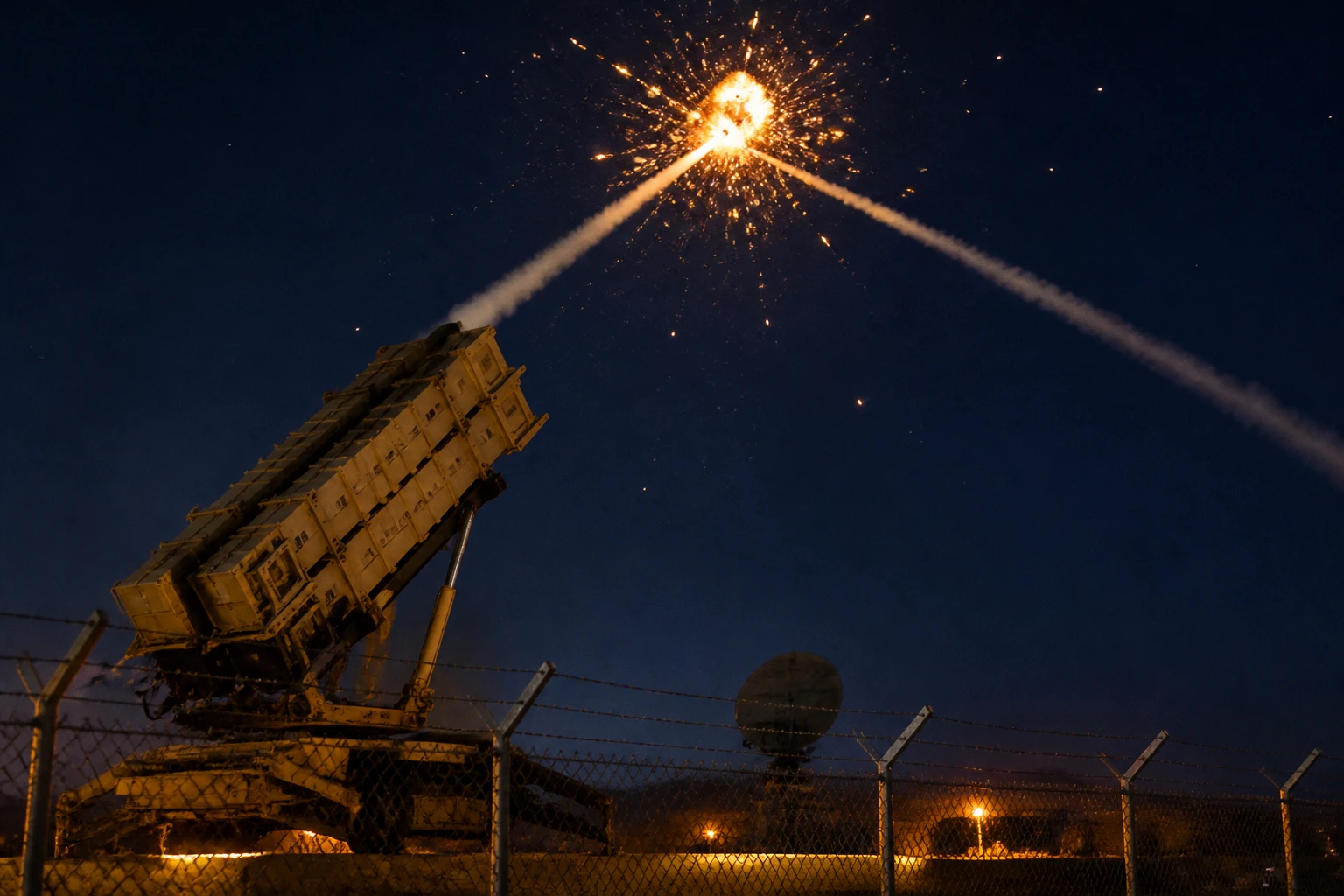
The missiles launched around 5:45 p.m. ET Tuesday toward U.S. forces near Muwaffaq Salti Air Base in Jordan, according to open-source intelligence trackers who posted footage of Patriot air defense batteries engaging incoming threats over the base. Axios first reported the launch, citing a U.S. official who said the missiles were headed for the American base in Jordan.
U.S. Central Command (CENTCOM), the Pentagon’s command overseeing military operations across the Middle East, posted its own account on X shortly after:
Islamic Revolutionary Guard Corps forces launched multiple ballistic missiles from Iran in an attempted surprise attack on U.S. forces based in the Middle East. All Iranian missiles were successfully intercepted.
The statement did not say where in the Middle East Iran had aimed. Iran’s own account filled in what Washington left out. The Islamic Revolutionary Guard Corps (IRGC), the ideological wing of Iran’s military, said its forces had targeted a U.S. air base and a U.S. Central Command hub in Jordan directly, calling the launch retaliation for “U.S. actions against Iranian interests.”
What we know:
- CENTCOM says IRGC forces fired multiple ballistic missiles at U.S. forces in the Middle East and that every one was intercepted, with no reported American casualties.
- U.S. and Saudi fighter aircraft struck militia logistics and weapons sites in eastern Iraq in the hours that followed.
What’s unconfirmed:
- The exact location CENTCOM said Iran tried to hit; its statement named no target.
- How many missiles Iran launched, and whether Iran’s own claim of striking a base and a CENTCOM hub in Jordan holds up against Washington’s account.
The two accounts have not been reconciled.
A Pause That Barely Lasted a Week
Tuesday’s launch was Iran’s first ballistic missile strike on American forces since Trump abruptly called off a roughly two-week bombing campaign against Iranian targets over the weekend. Trump said “good talks” were underway with Tehran and warned he would resume strikes if the negotiations did not deliver.
The paused campaign began after Iran killed two American service members in a missile and drone barrage on the same Jordanian base on July 17, an escalation that pushed Washington toward weeks of retaliatory strikes on Iranian targets. That spiral traces back to the conflict’s roots in February’s opening strikes, according to a UK Parliament research briefing tracking the war’s spread.
Saudi Arabia Enters the Fight
The Iraq strikes were not a solo U.S. operation. Saudi Arabia’s air force flew alongside American jets, and Riyadh’s Defense Ministry said its own air defenses had separately intercepted and destroyed several drones aimed at petroleum facilities in the kingdom’s eastern region in the days before.
Saudi officials said more than 30 drone attacks launched from Iraqi territory had hit or targeted the kingdom’s energy infrastructure over the prior 72 hours. Riyadh described its response as “limited, targeted strikes,” insisting it did not seek escalation but would answer any “aggression.”
| Actor | Action | Target | Stated Justification |
|---|---|---|---|
| IRGC | Fired multiple ballistic missiles | U.S. forces near a Jordan air base | Retaliation for “U.S. actions against Iranian interests” |
| U.S. Central Command | Intercepted missiles; struck militia sites | Militia logistics and weapons sites, eastern Iraq | Sites “directed by Tehran” to hit U.S. and Saudi targets |
| Saudi Arabia | Joint fighter strikes; air defense intercepts | Militia sites in Iraq; drones over eastern oil facilities | Response to 30-plus drone attacks on petroleum facilities |
| Iran-backed militias | Launched drone barrages from Iraqi soil | Saudi energy infrastructure, U.S. forces | Acting on alleged direction from Tehran |
The U.S. urged Iran and its regional proxies to “cease these attacks to avoid further U.S. military response.”
The Interceptor Math Behind a Clean Record
A perfect interception record still has a cost that Central Command’s statement does not mention. The Center for Strategic and International Studies estimates more than 1,500 Patriot interceptors expended since February, leaving an available inventory under 1,000, a stockpile the Pentagon cannot rebuild quickly because production runs at a fraction of wartime consumption.
Kelly Grieco, a senior fellow at the Stimson Center, a Washington think tank, has said the U.S. is using munitions “faster than we can replace them.” The strain has already changed how commanders fight. In prior barrages, U.S. commanders let some incoming missiles pass unintercepted rather than expend interceptors on every threat, weighing which launches actually endangered troops and letting the rest fall.
Saudi Arabia’s entry adds a new claim on the same finite pool of hardware. Every interceptor Riyadh fires at a drone over its oil fields is one the alliance cannot fire at the next Iranian missile aimed at Jordan.
A War Now Five Months Old
Tuesday’s exchange is the latest chapter in a war that has run since February 28, when U.S. and Israeli strikes hit Iran and, in the opening barrage, killed Iran’s Supreme Leader Ali Khamenei. Iran answered with hundreds of missiles and thousands of drones fired across the region at Israel and at Gulf states hosting American troops.
A conditional ceasefire and a U.S. Iran memorandum of understanding quieted the fighting on April 8. It never fully held. The Council on Foreign Relations’ running tracker of the war’s toll counts thousands of deaths across Iran and Lebanon, dozens more across Israel and the Gulf Arab states, and millions displaced, including more than one-sixth of Lebanon’s population after the fighting pulled Israel and Hezbollah back into open conflict.
- Feb. 28, 2026: U.S. and Israeli strikes hit Iran, killing Supreme Leader Ali Khamenei in the opening barrage and starting the war.
- April 8, 2026: A conditional ceasefire and a U.S. Iran memorandum of understanding pause large-scale fighting.
- July 17, 2026: An Iranian missile and drone barrage on the Jordan base kills two American service members.
- Weekend of July 24 to 26, 2026: Trump halts a two-week bombing campaign, citing progress in talks with Tehran.
- July 28 to 29, 2026: Iran fires missiles at U.S. forces again; CENTCOM reports a full intercept, and U.S. Saudi jets strike militia sites in Iraq.
Officials on both sides say the April ceasefire is still technically in force.
Iraq Absorbs the Fallout
The strikes this week did not touch Iranian soil. Iraq absorbed them instead. The militia sites U.S. and Saudi jets hit sit inside Iraqi territory, not Iran’s, and Baghdad had no direct role in the drone launches that used its own territory as a staging ground.
Iraq’s government has pushed back before over strikes on its soil. Following the CENTCOM and Saudi operation, Baghdad signaled it would not simply absorb repeated foreign strikes on its territory, part of a threat to retaliate against the strikes that Iraqi officials called a violation of sovereignty.
The human cost keeps landing there too. A third American soldier died separately when falling wreckage from a downed Iranian drone struck troops on the ground in Iraq.
Can Trump’s Threat Survive a Thinning Arsenal?
Trump has threatened to resume bombing Iran if the negotiations he calls productive fail to deliver results. That threat draws on the same shrinking pool of interceptors and munitions that Israel and Saudi Arabia are also pulling from after five months of war. Central Command has not said whether Tuesday’s failed barrage changes its posture in Iraq beyond this week’s strikes.
Saudi Arabia has signaled it will keep responding to attacks on its energy infrastructure regardless of what Washington and Tehran decide. Riyadh’s message this week was aimed at the militias on its border rather than at Iran directly, but that distinction may not hold if the drone attacks on its oil fields continue.
Iran, for its part, says there is no negotiation to speak of. It has denied seeking any resumption of talks with Washington at all.
