
Egypt’s top diplomat spent part of his Monday in Cairo pressing a single, urgent point on a visiting counterpart: get the sailors home. Meeting Somali Foreign Minister Abdisalam Abdi Ali on the sidelines of the Korea-Africa Ministerial Meeting, Badr Abdelatty, Egypt’s Minister of Foreign Affairs, International Cooperation and Egyptians Abroad, underscored the importance of expediting the release of abducted Egyptian sailors, ensuring their safety and securing their freedom.
Those sailors are eight Egyptian nationals among the crew of the MT Eureka, a product tanker seized by armed men off Yemen on May 2 and steered into Somali waters. They are now the most visible casualties of something maritime-security analysts feared was coming back: organized piracy off the Horn of Africa, returning at a scale not seen since the early 2010s.
The Cairo Meeting and the Crew Caught in It
The headline from Monday’s talks was diplomatic warmth. Abdelatty praised the historical ties between Cairo and Mogadishu and reaffirmed Egypt’s support for Somalia’s unity, sovereignty and territorial integrity. The two ministers discussed trade, security cooperation and the broader situation in the Horn.
But the line that mattered to twelve families was shorter. Abdelatty told the Somali minister that releasing the captured Egyptian crew, unharmed and quickly, had to be a priority of the bilateral relationship. Abdisalam, for his part, reviewed his government’s efforts on security and state-building and thanked Egypt for its support.
That request lands on a Somali federal government with limited reach over the stretch of coast where the tanker now sits. The waters near Puntland, at the tip of the Horn, have historically been beyond Mogadishu’s direct control, which is exactly why a quiet appeal between foreign ministers carries real weight and real limits at the same time.
How the MT Eureka Was Taken
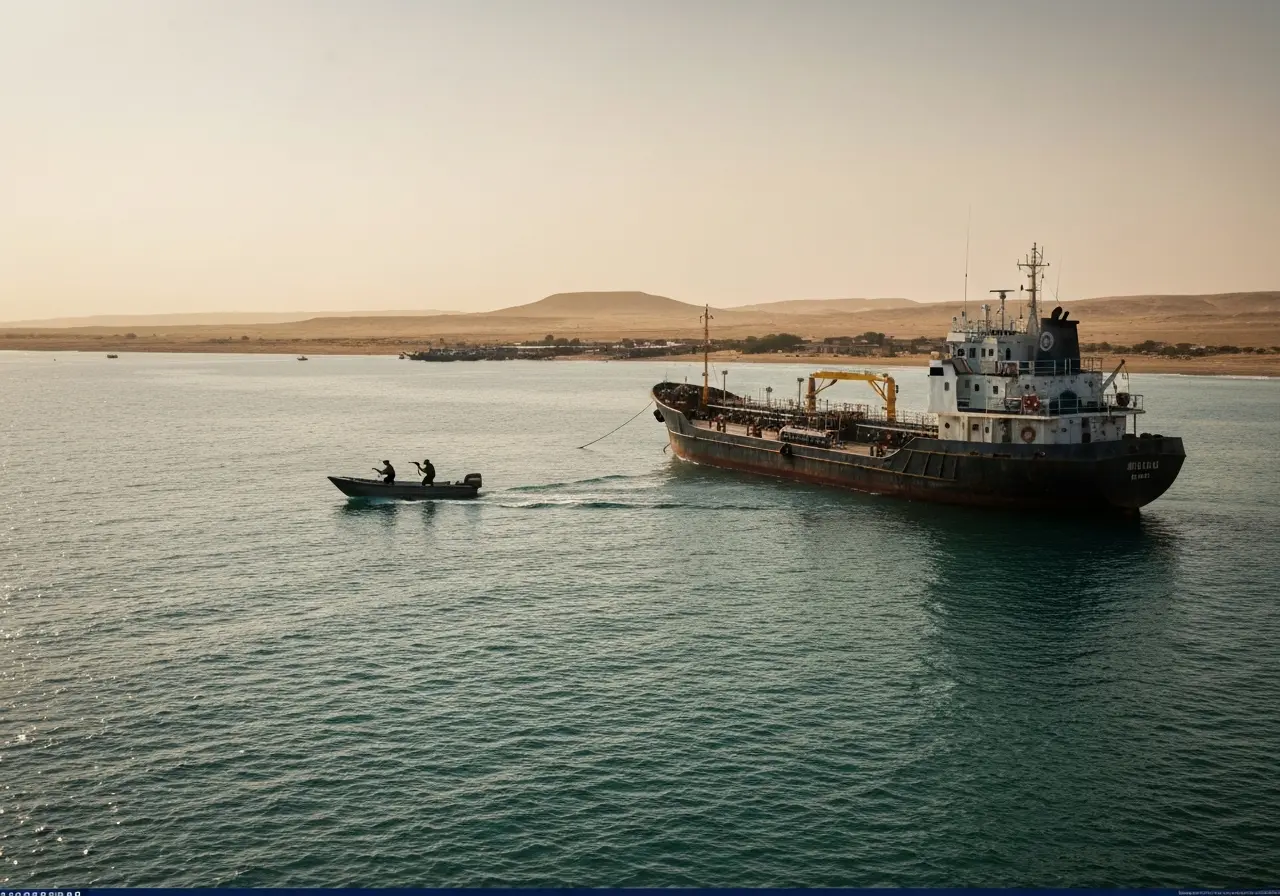
The seizure followed a familiar script. The Togo-flagged, UAE-managed tanker, carrying roughly 2,800 tonnes of diesel, was boarded in the early hours of May 2 near Yemen’s southern coast, in the Gulf of Aden corridor that feeds the Red Sea and the Suez Canal. A small armed party took control, then forced the vessel south toward the Somali shore.
Once the ship anchored near the fishing town of Murcanyo, more gunmen came aboard, swelling the guard force around the captives. Egypt’s Foreign Ministry has said the Egyptian sailors are in good health and being treated reasonably, with their safety the state’s top concern. Reports on the rest of the crew have varied between Indian and Pakistani nationals, a reminder of how thinly sourced the early days of any hijacking are.
- May 2, 2026 – the date the MT Eureka was boarded off Yemen’s southern coast
- 8 Egyptians – the nationals at the center of Cairo’s diplomatic push, part of a 12-member crew
- 2,800 tonnes – the volume of diesel aboard the small product tanker
- Puntland coast – where the vessel was anchored after being diverted from the Gulf of Aden
Egypt has instructed its embassy in Mogadishu to coordinate with Somali authorities and follow the crew’s condition. Families, meanwhile, have publicly criticized the ship’s managers over the pace of negotiations, the same friction that defined dozens of earlier hostage cases.
A Ransom Clock That Runs Only One Way
Money is the engine of this kind of piracy, and the numbers attached to the Eureka have moved in one direction. According to reporting on the standoff, the captors opened around the low millions before pushing their demand sharply higher.
- Early talks reportedly began near $3.5 million for the vessel and crew.
- The figure later sat around $7 million as negotiations stalled.
- The captors then raised it to roughly $10 million, with reports citing frustration over the slow pace of talks.
The escalation is not random. Restricting food and water, adding armed guards and inflating the price are pressure tactics drawn straight from the playbook of the 2008 to 2012 era, when ransom revenue financed entire coastal networks and the average payout climbed year after year. Time, in these cases, tends to favor the captors, because every delay is framed as the shipowner’s choice rather than the pirates’.
That dynamic is what makes Abdelatty’s word “expedite” so loaded. A fast, clean release is the humane outcome everyone wants. The structure of a ransom negotiation rarely delivers fast and clean.
Why 2026 Echoes the 2010-2012 Piracy Peak
For most of the past decade, Somali piracy looked beaten. Heavy naval patrols, armed guards on merchant ships and improved onboard security pushed successful hijackings toward zero. The Eureka case is part of the evidence that the lull is over.
The Numbers Behind the Revival
The International Maritime Bureau (IMB, the shipping industry’s piracy-reporting body) has logged several Somalia-linked incidents in 2026, concentrated in the Somali Basin and the southern Gulf of Aden. The cluster in late April was the sharpest signal.
- Three merchant vessels reported hijacked and still under pirate control since April 20, the first time multiple commercial ships have been held at once since the early-2010s peak.
- Six incidents tied to Somali groups recorded across 2026, after years near zero.
- $10 million demanded for the Eureka, in the same range pirates sought at the height of the original crisis.
Analysts at the Institute for Security Studies have described the pattern as a warning from the Western Indian Ocean rather than a one-off, pointing to dormant networks switching back on as opportunities open up.
What Is Different This Time
The revival is not a carbon copy. One detailed assessment of the 2026 maritime risk calls the current phase an intermediate reactivation, neither the hundreds of attacks a year seen at the peak nor the quiet of the past decade. Two things have changed the math: naval enforcement is thinner now, with assets like the EU’s Operation Atalanta counter-piracy mission stretched across more theatres, and Red Sea instability has scrambled shipping routes and patrol coverage across the wider region.
| Vessel | Type | Reported status |
|---|---|---|
| MT Eureka | Product tanker | Held off Puntland, crew including 8 Egyptians |
| M/T Honour 25 | Tanker | Hijacked late April, reported under pirate control |
| M/V Sward | Cargo vessel | Boarded late April in the same cluster |
The table tells the story Cairo is reacting to: the Eureka is not an isolated crime but one node in a small wave, and a wave is far harder for any single government to negotiate its way out of.
Cairo’s Wider Stakes in Mogadishu
Egypt’s interest in Somalia runs well past the eight men on the Eureka. The Gulf of Aden is the approach to the Suez Canal, a vital source of foreign-currency revenue for Cairo, and a resurgence of piracy threatens the traffic that keeps the canal busy. Protecting that corridor is a national-economic priority, not just a humanitarian one.
The diplomacy has a sharper edge, too. At the same meeting, Egypt restated its rejection of any unilateral moves against Somali sovereignty, and it has separately condemned the opening of a self-declared Somaliland mission in occupied Jerusalem, a move it called a violation of international law. Cairo also pressed for sustainable funding for the African Union Mission in Somalia (AMISOM, the AU-led security force backing the federal government against insurgents).
So the sailors sit inside a much larger relationship. Egypt wants a stable, unified Somalia partly because instability ashore feeds the very piracy now holding its citizens at sea. The hostage file and the sovereignty file are, in practice, two ends of the same rope.
What History Says About Getting the Crew Home
The hard lesson from the last piracy era is that hostages rarely come home on a diplomat’s timeline. Releases were measured in months, occasionally years, and almost always followed a payment rather than a rescue. Military intervention against a guarded, anchored tanker carries obvious risk to the crew, which is why states tend to default to slow, deniable negotiation.
Abdelatty has put Egypt’s weight behind a fast resolution and leaned on Mogadishu to use what leverage it has on the Puntland coast. The competing force is a captor group that has already shown it will raise the price and squeeze the conditions to grind the other side down.
If the Eureka is freed quickly and quietly, it will break the historical pattern and hand Cairo a clean win. If it follows the older script, the eight Egyptians become a long-running test of whether the diplomacy that worked on a meeting-room handshake can move a standoff anchored off a coastline no government fully controls.
