
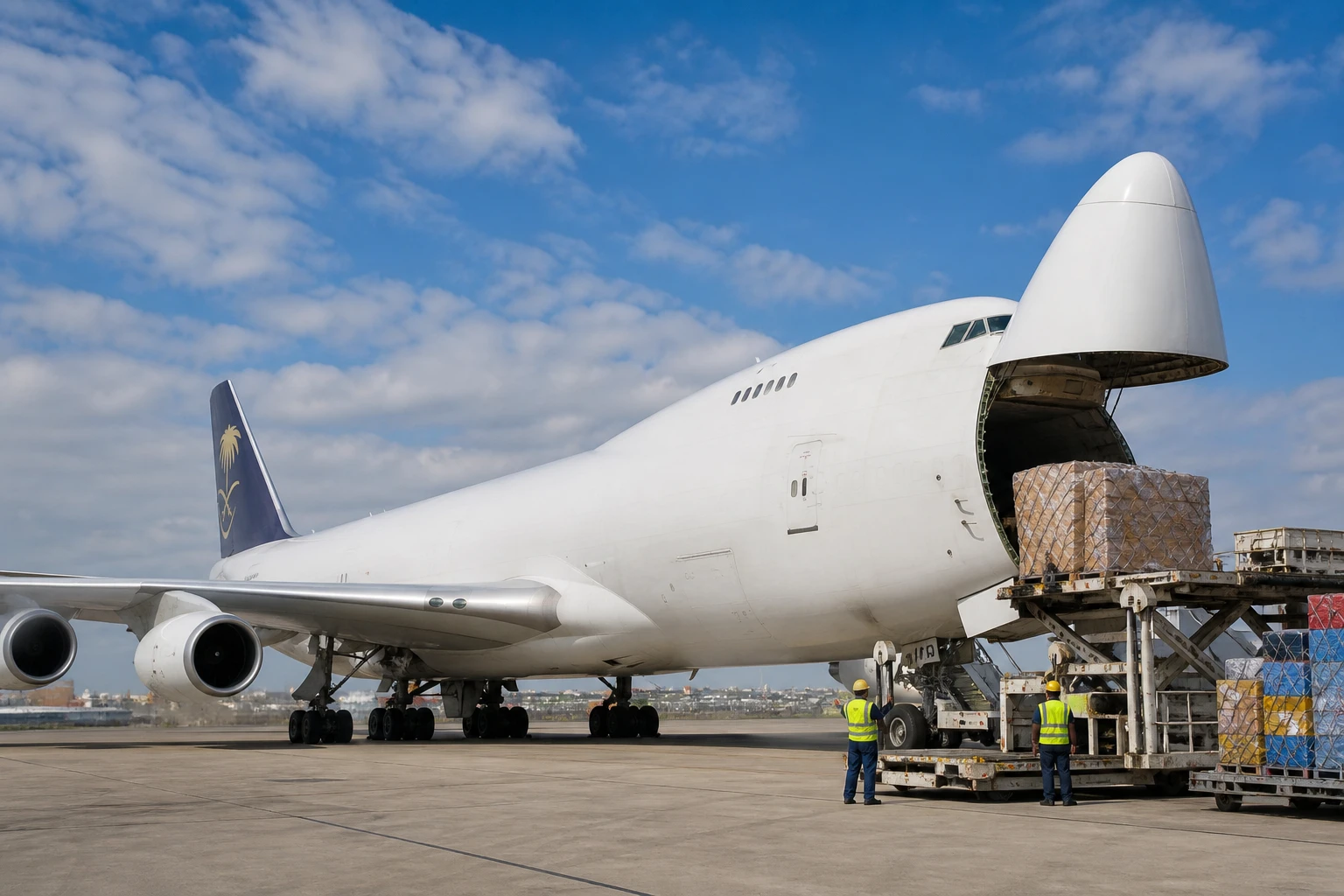
Saudia Cargo landed its first scheduled freighter in Melbourne on July 25, opening the only direct air-cargo link between Saudi Arabia and Australia. The weekly service runs on a Boeing 747-400F, a freighter with a hinged nose door and room for more than 100 tonnes of cargo on each rotation.
Logistics News Middle East first reported the launch. It also drops Saudi Arabia’s cargo carrier into a market two Gulf rivals have flown for years. Qatar Airways Cargo has sent freighters into Melbourne since 2020. Emirates SkyCargo already reaches four Australian cities. Saudia’s single weekly flight enters a sky its competitors know well.
The Freighter Behind the New Route
The aircraft flying the route is one of the last widebody jets built with a nose that swings open on hinges. That nose door lets ground crews drive pallets and outsized freight straight into the main deck nose first, instead of squeezing them through a narrower side hatch. It is the detail Saudia Cargo is counting on most for the heavy, awkward cargo ordinary freighters turn away.
Saudia Cargo’s own account of the enhanced logistics capacity from the new freighter frames Melbourne as a direct response to rising demand for air freight between the two countries. The route runs once a week in each direction for now.
- Perishables – fresh produce, seafood and other time-sensitive goods that need the fastest possible transit between the two markets
- Pharmaceuticals – temperature-sensitive medical shipments that depend on consistent, direct routing rather than transfers
- Industrial equipment – heavy machinery and oversized parts suited to a nose-loading deck
- E-commerce – retail parcels moving in both directions as online shopping between the two markets grows
Those four categories match almost exactly what Saudia Cargo and its government partners describe as the route’s target freight, a sign the service was built around specific demand rather than launched as a flag-planting exercise.
Vision 2030 Puts a Price on the Ambition
Saudia Cargo did not build this route alone. The General Authority of Foreign Trade (GAFT, the kingdom’s trade promotion regulator) and the Saudi Export Development Authority worked with the carrier to launch it, part of a national push to widen the market for Saudi exporters beyond the Gulf and Europe.
- Top 10 is the global ranking Saudi Arabia’s National Transport and Logistics Strategy has set as its target on the World Bank’s Logistics Performance Index
- More than $266 billion, over SAR 1 trillion, has gone into transport and logistics infrastructure under the kingdom’s broader Vision 2030 program
- 9 hours is the average customs clearance time now, down from 288 hours before the overhaul, according to Saudi logistics officials
The transport ministry’s own strategy states the goal plainly: rank among the world’s top ten logistics performers and become the leading maritime and aviation center in the Middle East. Every new freighter route, including the one to Melbourne, feeds that target on paper.
Melbourne Fits a Pattern Bigger Than One Route
Melbourne is not an isolated bet. Saudia Cargo carried more than 570,000 tonnes of freight in 2025, and 2026 has been a year of adding capacity to move even more. In Jeddah on July 6, the carrier signed an agreement for four Boeing 777-200 freighters, with the first due for delivery in the fourth quarter of 2026.
The pattern shows up beyond cargo, too. Saudia’s passenger network staged its own comeback earlier this year with the revival of nonstop flights between Riyadh and Tokyo, another long-haul market the carrier had walked away from years earlier and is now rebuilding almost from scratch.
Read together, the moves describe a carrier trying to turn Riyadh into a connecting point across three continents, which is exactly the role Vision 2030’s logistics strategy assigns it. Melbourne is one more line on that growing map, not a one-off.
Two Rivals Already Own This Sky
Saudia is not the first Gulf carrier to chase Australian freight. Qatar Airways Cargo began flying freighters into Melbourne and Perth in 2020, routing through a technical stop in Singapore. Emirates SkyCargo’s footprint is wider still, touching Brisbane, Melbourne, Perth and Sydney with a mix of dedicated 777 freighters and belly space on passenger widebodies.
| Carrier | Australian Freighter Route | Aircraft | Weekly Freighter Frequency | Serving Australia Since |
|---|---|---|---|---|
| Saudia Cargo | Riyadh to Melbourne | Boeing 747-400F, 100+ tonnes | 1 flight each way | 2026 |
| Qatar Airways Cargo | Melbourne and Perth, via Singapore | Freighter, about 200 tonnes main-deck space weekly each way | 2 flights each way | 2020 |
| Emirates SkyCargo | Brisbane, Melbourne, Perth, Sydney | Boeing 777F, up to 103 tonnes, plus passenger belly hold | Multiple flights, part of a wider daily network | Long-established, multi-city |
The comparison is not close yet on frequency. Qatar flies twice a week to the two cities it serves. Emirates’ courier network reaching four Australian cities sits on top of a much larger passenger schedule. Saudia’s one rotation a week is an opening bid, not a rival volume, at least until the new 777-200Fs arrive.
What Does Saudi Arabia Trade with Australia?
Australia shipped $882 million worth of goods to Saudi Arabia in 2025, led by meat, cereals and iron and steel. Saudi Arabia’s exports back to Australia totaled $638 million in 2024, dominated by fertilizer. Together the two flows add up to roughly $1.5 billion a year, the base the new freighter is meant to help grow.
Meat and edible offal alone accounted for $391.74 million of Australia’s exports, with pharmaceutical products adding another $44.62 million, categories that line up closely with the perishables and pharmaceuticals the route is built to carry. Saudi Arabia’s fertilizer shipments to Australia, which the Observatory of Economic Complexity puts at $486.88 million in the latest full year, made up the bulk of the flow moving the other way.
Neither figure is large next to Saudi Arabia’s trade with China or the United States. That is precisely the gap GAFT and Saudi Exports say they want the Melbourne route to close, by giving exporters on both sides a direct schedule to plan shipments around instead of routing through a third country.
One Flight a Week, a Much Bigger Bet
For now, the Riyadh-Melbourne route holds at one flight a week in each direction, the cautious cadence carriers typically use to open a long-haul freight lane before demand proves itself.
The next test of the bet arrives in the fourth quarter of 2026, when the first of Saudia Cargo’s four new Boeing 777-200 freighters joins the fleet. That is the capacity the carrier will need if Melbourne is going to grow from a toehold into something closer to what Qatar Airways Cargo and Emirates SkyCargo already run.
Frequently Asked Questions
Is the Riyadh-Melbourne freighter Saudi Arabia’s only direct air link to Australia?
Yes. Saudia has not announced passenger flights between Saudi Arabia and Australia, so the weekly freighter is currently the sole scheduled direct connection between the two countries. Travelers and shippers needing passenger routing still rely on one-stop itineraries through other Gulf or Asian hubs.
What does a nose-loading freighter actually allow that other cargo planes can’t manage?
A hinged nose door lets ground crews drive cargo straight onto the main deck without maneuvering it through a narrower side door. That matters most for machinery, vehicle parts and other oversized industrial loads too big or awkward for a standard side-loading freighter.
What is the Logistics Performance Index that Saudi Arabia is chasing?
It is a World Bank benchmark that scores countries on customs efficiency, infrastructure quality, shipment tracking and delivery timeliness. Saudi Arabia’s National Transport and Logistics Strategy has set a top ten global finish on that index as an official, published target.
