
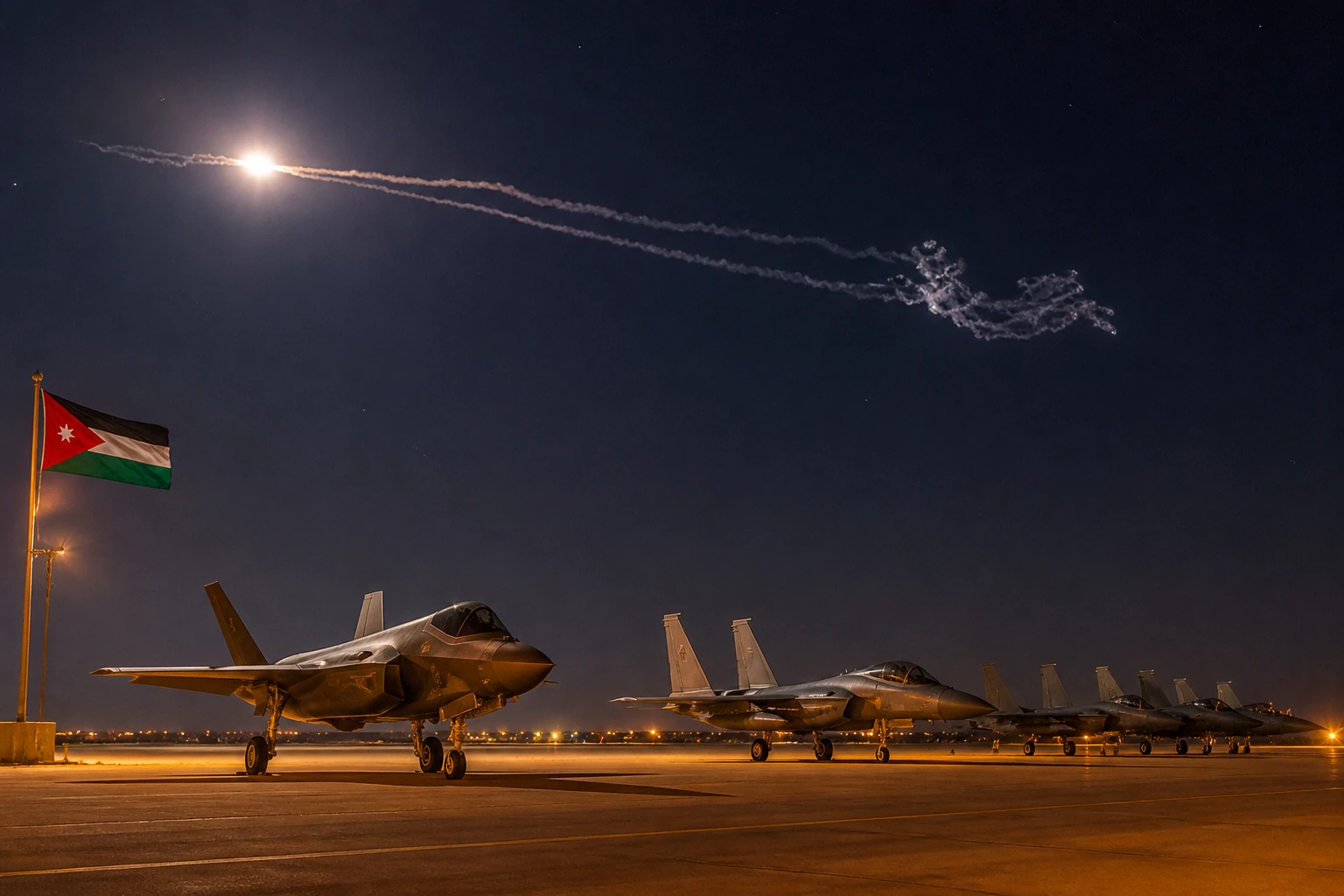
Iran fired ballistic missiles at Muwaffaq Salti Air Base in eastern Jordan late Tuesday, and US Central Command confirmed every missile was intercepted, calling the barrage an “attempted surprise attack.” The strike landed hours after President Donald Trump met Israeli Prime Minister Benjamin Netanyahu at the White House for talks dominated by Iran.
It was at least the fourth Iranian missile attack on the base in ten days. Jordan’s government, meanwhile, is still telling its own public that no American forces are stationed there at all.
CENTCOM Confirms an Intercepted Barrage
The first word out of the region came from Turkish state agency Anadolu and Iranian outlets, which reported dozens of missiles fired at US positions with no official word from Washington, Amman or Tehran. That gap closed within hours. US Central Command (CENTCOM), the military headquarters that oversees American forces across the Middle East, said Iran had launched ballistic missiles at the Jordan base and that air defenses shot down all of them before impact.
Jordanian air defense crews engaged the incoming projectiles alongside American systems, a detail that puts the kingdom’s own forces in the middle of a fight over its own airspace. No casualties or damage were reported.
- Confirmed: CENTCOM says Iran fired ballistic missiles at Muwaffaq Salti Air Base and that all were intercepted.
- Confirmed: The attack came hours after Trump hosted Netanyahu for Iran-focused talks at the White House.
- Unconfirmed: The exact number of missiles fired, and whether Jordanian batteries, US Patriot systems or both made the intercepts.
- Unconfirmed: Any statement from Iran’s own government specifically addressing Tuesday’s launch.
That confirmation gap matters. Four hours of uncertainty is routine in a fast-moving strike, but it is also the exact window in which Iranian state media, Jordanian denials and unverified social posts compete to define what happened before the Pentagon says a word.
A Fourth Missile Attack in Ten Days
Tuesday’s launch did not arrive out of nowhere. It capped a stretch of direct Iranian strikes on the same Jordanian base that started ten days earlier and pushed Washington into its longest bombing campaign of the war.
- Feb. 28, 2026: The United States and Israel begin a sustained campaign of strikes against Iran, opening the war that now frames every subsequent attack.
- March 4, 2026: Iran declares the Strait of Hormuz closed and starts using drones, missiles and small boats to threaten vessels transiting the waterway.
- July 12, 2026: Trump announces the blockade will be reinstated with a 20 percent fee on cargo passing through Hormuz; Brent crude jumps more than 9 percent in a single session, its sharpest daily gain since 2020.
- July 18, 2026: Iranian missiles and drones hit Muwaffaq Salti Air Base directly, killing two US service members and prompting a 13-night US bombing campaign against Iranian targets.
- July 24, 2026: Trump pauses further strikes on Iran to give negotiations another chance.
- July 28, 2026: Iran fires ballistic missiles at the same base again; CENTCOM says the barrage was fully intercepted.
The pattern is hard to miss. A pause meant to open room for diplomacy lasted four days before Iran tested it with another launch.
Why Does Jordan Deny Hosting the Troops Iran Just Targeted?
Jordan’s government has categorically denied that American forces are deployed on its soil, even as Iran fires missiles at a Jordanian base that hosts thousands of them, because acknowledging the deployment would hand Tehran’s messaging campaign a win at home and expose a decision much of the Jordanian public never endorsed.
Roughly 3,800 US troops operate in the kingdom under a 2021 agreement granting US forces broad access to Jordanian territory, a deal backed by over a billion dollars in annual security aid. Iran’s Revolutionary Guard has appealed directly to “the Jordanian people,” urging them to demand the bases’ removal. Amman’s response has been to frame each strike as a violation of its sovereignty and airspace while sidestepping the question of what, exactly, is being violated.
It is a workable position only because it never has to be tested in public. Jordan gets to protest an attack on its territory without confirming what the attack was actually aimed at.
Sixty Aircraft, Zero Acknowledgment
Muwaffaq Salti, also known as Azraq Air Base, sits in Jordan’s Zarqa Governorate roughly 100 kilometers northeast of Amman, a Royal Jordanian Air Force field that has become one of the most heavily used American forward positions in the region. Satellite tracking and flight data have put more than 60 US fighter jets there, including 30 F-35s and 36 F-15s, with at least 68 transport aircraft landing since the prior weekend and new air defense batteries installed on the ground.
The base’s value is geographic. From Azraq, tactical jets can reach western Iran, the Levant and the Eastern Mediterranean without depending on carrier strike groups at sea, cutting reaction time for the kind of rapid sorties the war has demanded since February. That same geography is what makes it a repeat target.
Bahrain and Kuwait Absorb the Same Pressure
Jordan is not the only US partner absorbing this kind of exposure. Amman has pointed to Bahrain and Kuwait as fellow targets of the same Iranian pressure campaign, both hosts of significant American military infrastructure now facing the same calculus Jordan is facing, including Kuwait’s own exposure to Iranian retaliation as neighboring governments weigh how far to go in backing it.
Jordan has separately pressed Iraq to restrain the Iran-aligned militias blamed for cross-border strikes launched from Iraqi territory into Jordanian airspace. The request underscores how little control Amman has over the threat landscape it is being asked to defend against; the militias answer to Tehran’s network, not to Jordan’s foreign ministry.
Hormuz Becomes a Second Battlefield
While missiles fall on Jordan, Iran is running a parallel pressure campaign at sea. Deputy Foreign Minister Kazem Gharibabadi warned this week that any European naval vessel entering the Strait of Hormuz would be treated as a “legitimate target,” even as he insisted Tehran remains open to negotiations to end the fighting.
The world must know that Iran is increasing its defensive tools, and we cannot under any circumstances give up these tools.
Gharibabadi made the remark describing the strait as a core piece of Iran’s national security strategy. The economic numbers back up why it matters: Brent crude touched $118 a barrel before easing to roughly $83, then spiked more than 9 percent in a single session after Trump’s mid-July announcement that Washington would reinstate its own blockade and impose a 20 percent fee on cargo shipped through the waterway, a policy detailed in a congressional analysis of Hormuz supply risks. Roughly a fifth of the world’s oil moves through the strait, which is how the chokepoint shapes global oil markets far beyond the region.
Trump has claimed the fee scheme still leaves him in charge of who moves through the waterway. “Only ships that we want to get through get through,” he told Fox News. The same pattern shows up onshore: Iran’s wider campaign has also included drone strikes on Saudi oil facilities despite an earlier truce, a sign that energy infrastructure across the region, not just military bases, is inside the target set now.
Tower 22’s Ghost
Jordan has been here before, though the shape of the threat has changed. On Jan. 28, 2024, a drone strike on Tower 22, a remote logistics outpost near Jordan’s border with Syria and Iraq, killed three US soldiers and wounded dozens more. Washington blamed the Islamic Resistance in Iraq, an umbrella of Iran-backed militias, while Iran denied direct involvement in the drone that its own manufacturing was later tied to.
| Date | Attacker | Weapon | US Casualties | Outcome |
|---|---|---|---|---|
| Jan. 28, 2024 (Tower 22) | Iran-backed Iraqi militia | Iranian-made drone | 3 killed, dozens wounded | US struck 85 sites in Iraq and Syria; Iran denied direct role |
| July 18, 2026 (Muwaffaq Salti) | Iran, directly | Missiles and drones | 2 killed | Trump launched a 13-night bombing campaign against Iran |
| July 28, 2026 (Muwaffaq Salti) | Iran, directly | Ballistic missiles | None reported | CENTCOM confirms full interception |
The difference between 2024 and now is the deniability. Tower 22 let Iran hide behind a militia proxy. The last ten days have not offered that cover, and yet Jordan’s public posture has barely moved, still built around denying the presence being fired at rather than naming the country doing the firing.
Fifteen Days of Diplomatic Silence
Gharibabadi says Tehran wants to “break the cycle of war” through renewed talks with Washington, but claims the US has made no contact in 15 days. Trump has offered his own version of an off ramp, framed as a threat rather than an invitation. “If they don’t make a deal, then I go back and I finish the job,” he told Fox News, warning that a renewed campaign would target Iranian power plants and bridges and take the country “many years” to rebuild.
Neither government has set a date for talks to resume. The next test sits at Muwaffaq Salti, where the interceptors have worked four times in ten days and only need to fail once.
Frequently Asked Questions
Why Are US Troops Based in Jordan?
American forces operate in Jordan under a layered set of agreements: a 1996 status of forces agreement, a 2006 acquisition and cross-servicing agreement, and the 2021 Defense Cooperation Agreement that now governs day-to-day access. The arrangement also underpins joint exercises such as Eager Lion and pre-deployment training rotations that predate the current war by years.
What Is Muwaffaq Salti Air Base Used For?
Also called Azraq Air Base, the installation sits in Jordan’s Zarqa Governorate, about 100 kilometers northeast of Amman. Its location lets tactical jets reach western Iran, the Levant and the Eastern Mediterranean without relying on carriers at sea, which is why the Pentagon has used it as a forward staging point since the war began in February.
What Is CENTCOM?
US Central Command is the military headquarters responsible for American operations across the Middle East, Central Asia and parts of North Africa. It is the command that issues official assessments for strikes in the region, which is why its statement on Tuesday’s interception carried more weight than the earlier, unconfirmed media reports out of Iran.
Is the US Formally at War With Iran?
Neither Washington nor Tehran has issued a formal declaration of war. But the two countries have traded strikes since Feb. 28, 2026, including a 13-night US bombing campaign in July and now four Iranian missile attacks on a single Jordanian base in ten days, a pattern that looks far closer to sustained open conflict than the proxy warfare that defined the relationship in earlier years.
