
Egyptian President Abdel Fattah Al-Sisi called Iran’s strikes on Kuwait a “flagrant violation of international law” on Tuesday. He made the case in a phone call with Kuwait’s Emir, Sheikh Mishal Al-Ahmad Al-Jaber Al-Sabah, five months into a war that keeps hitting Kuwaiti soil.
That is standard Arab solidarity language for a war that keeps widening. Egypt also has roughly half a million citizens working inside Kuwait and four billion dollars sitting in Kuwaiti central bank deposits. That exposure makes this war Cairo’s business whether it ever sends a soldier or not.
What Al-Sisi Told Kuwait’s Emir
The Egyptian presidency said Al-Sisi described Iran’s strikes as a dangerous escalation that threatens regional security and stability, not an isolated incident. He rejected, in categorical terms, any attempt to undermine Kuwait’s sovereignty or its security.
Al-Sisi praised Sheikh Mishal’s handling of the crisis and Kuwait’s efforts to prevent further escalation, according to the presidency’s statement. He repeated a line Egyptian officials have used through months of regional strikes: that the security of Kuwait and other Arab states forms part of Egypt’s own national security.
Sheikh Mishal thanked Egypt for its steadfast support and pressed for something more concrete than sympathy. He raised continued consultation and coordination between Cairo and Kuwait City to contain the crisis and de-escalate tensions across the Middle East, the presidency said.
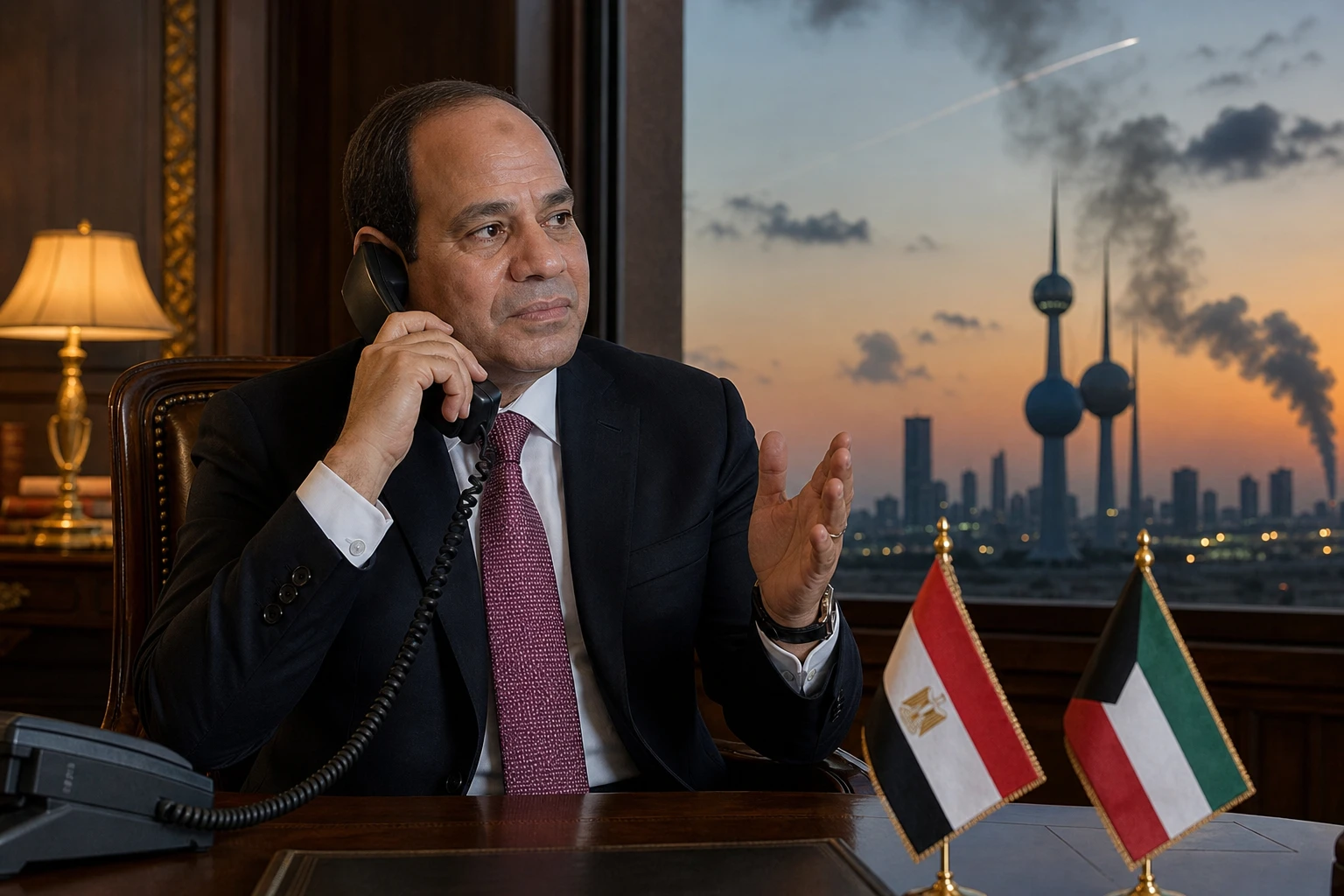
Five Months of Missiles Test a Reluctant Host
Kuwait did not choose this fight. The United States and Israel opened a war on Iran on February 28, 2026, striking Iranian military and government sites. Iran answered by firing on the Gulf states that host American forces. A congressional research brief on the conflict found it has exposed fundamental risks to Gulf security and economic vitality that Arab states had spent decades insuring against. Kuwait has absorbed some of the heaviest return fire alongside the United Arab Emirates (UAE) and Bahrain.
A drone strike set fuel tanks ablaze at Kuwait International Airport on April 1. A second strike on the same airport in June killed one person. By mid-July, Bloomberg described a fresh wave of strikes as the worst Kuwait had suffered since that June attack. Kuwaiti officials reported a fire at a power and water desalination plant, severe damage, and instructions for civilians to ration electricity. Kuwait Petroleum Corporation said one of its sites took significant material losses.
Iran’s Islamic Revolutionary Guard Corps (IRGC), the country’s elite paramilitary force, claimed its units had hit a U.S. base in Kuwait, destroying a missile defense radar, weapons depots and two HIMARS rocket launchers, a U.S.-made mobile artillery system. Four Kuwaiti navy personnel were hurt in one overnight barrage. An Indian utility worker was killed in the strike on the power and desalination facility, with dozens more injured.
What Iran has undertaken is an extremely dangerous escalation and a grave violation of international law and the United Nations Charter, and war crimes that necessitate international accountability and prosecution.
Jassim Al-Budaiwi, secretary-general of the Gulf Cooperation Council (GCC), said that after a round of strikes on Bahrain, Kuwait and Jordan. The six-nation bloc, grouping Kuwait, Saudi Arabia, the UAE, Qatar, Bahrain and Oman, said any attack on one member counts as an attack on all of them, a position laid out in a joint statement condemning attacks on GCC territories and Hormuz shipping.
How Kuwait Became a Front Line It Never Chose
The strikes on Kuwait did not arrive all at once. They built in stages over five months.
- February 28, 2026: The United States and Israel strike Iranian military and government targets, opening the war that would eventually reach Kuwait’s shores.
- April 1, 2026: An Iranian drone strike sets fuel tanks ablaze at Kuwait International Airport; officials report no casualties.
- June 3, 2026: A second drone strike hits the same airport, killing one person, as a fragile ceasefire effort falters.
- July 19, 2026: Iran strikes Bahrain, Kuwait and Jordan hours after a U.S. attack on an Iranian nuclear site; a Kuwaiti power plant catches fire.
- July 28, 2026: Al-Sisi calls Sheikh Mishal to condemn the strikes and pledge Egypt’s support for Kuwait’s sovereignty.
Why Are So Many Egyptians Working in Kuwait?
Kuwaiti labor figures have long counted Egyptians as the largest single nationality in the country’s foreign workforce, drawn by white-collar jobs the Kuwaiti economy has relied on for decades. Cairo’s interest in Kuwait’s security is inseparable from that community and the money it sends home.
The Egyptian community in Kuwait skews toward skilled and semi-skilled roles rather than the construction labor that dominates Egypt’s presence in Saudi Arabia. Workforce data point to a community built around:
- Teachers staffing Kuwaiti public and private schools
- Engineers at construction and industrial firms
- Accountants and finance staff inside Kuwaiti companies
- Healthcare workers, including doctors and nurses
- Oil-sector specialists tied to Kuwait’s energy industry
That occupational mix means higher average wages than Egyptian labor earns elsewhere in the Gulf, and it shows up in remittance data. Kuwait ranks as a top source country for Egyptian remittances per capita, the Middle East Institute has found, even though its Egyptian community is smaller than the one in Saudi Arabia. Egypt’s total remittances reached $31.5 billion in 2021, a figure that made it one of the five largest remittance recipients on earth.
Cairo’s Four Billion Dollar Stake in Kuwait
Money moves alongside the missiles. Kuwait has kept billions of dollars parked at Egypt’s central bank for years, support that has helped Cairo defend its currency and satisfy International Monetary Fund (IMF) reviewers during its own economic crisis.
| Kuwaiti Support to Egypt | Amount | Status |
|---|---|---|
| Central bank deposit, spring tranche | $2 billion | Renewed annually each April |
| Central bank deposit, autumn tranche | $2 billion | Renewed annually each September |
| Proposed conversion to direct investment | Up to $4 billion | Under discussion; slowed by regional conflict |
Cairo has spent more than a year negotiating to turn that deposit stock into direct investment across Egyptian sectors and assets, a shift that would deepen Kuwaiti stakes in Egyptian companies rather than simply propping up reserves. Egyptian financial media reported in April that the talks had stalled in part because the regional war was complicating how foreign investment gets converted and settled. Egypt’s headline growth numbers mask that dependence: output has expanded 5 percent even as private business activity keeps contracting, leaving Gulf deposits and remittances to fill a gap domestic industry has not.
A Familiar Cairo Script
Kuwait is not the first Gulf capital to get a solidarity call from Cairo since Iran’s war with the United States and Israel began. Egypt has condemned Houthi drone strikes on Saudi Arabia’s Yanbu pipeline and separately backed Riyadh against a Houthi Red Sea blockade that has already dented Suez Canal revenue. Each call leans on nearly identical language about sovereignty, regional stability and Arab solidarity.
The repetition carries weight. A region where Kuwait, Saudi Arabia and the UAE all face Iranian fire at once is a region where Egypt’s financial backers are distracted, drained or under attack themselves, at the same moment Cairo needs their deposits and their tourists most.
What Kuwait’s Emir Asked for in Return
Sheikh Mishal’s message back to Cairo, per the presidency’s readout, was not only gratitude. He stressed continued consultation and coordination between the two governments to preserve regional peace, address shared challenges and support de-escalation efforts across the Middle East.
He also credited Egypt’s own role in promoting regional stability, a nod to Cairo’s parallel efforts to keep the war from spreading further. Neither government signaled any change beyond diplomacy. Egypt has sent no troops or equipment to Kuwait in this war, and nothing in Tuesday’s call suggested that was under discussion.
What Cairo can offer for now is consistency: another call, another condemnation, another public reminder that Kuwait does not stand alone. Half a million Egyptian livelihoods and four billion dollars in Kuwaiti deposits are riding on that solidarity holding.
Frequently Asked Questions
Is Egypt Sending Troops or Weapons to Kuwait?
No. Egypt’s involvement in this war has stayed diplomatic, limited to statements and calls like the one between Al-Sisi and Sheikh Mishal on Tuesday. That marks a shift from the 1990-91 Gulf War, when Cairo sent ground troops as part of the U.S.-led coalition that expelled Iraqi forces occupying Kuwait.
Has Iran Struck Egyptian Territory in This War?
No. Iran’s retaliatory strikes have hit Kuwait, Bahrain, the UAE, Qatar and Jordan, the Gulf and Levant states hosting American forces, but not Egypt directly. Cairo’s exposure runs through its citizens, remittances and Gulf deposits rather than through any attack on Egyptian soil.
Why Is Iran Targeting Kuwait Specifically?
Kuwait is one of at least seven countries, along with Bahrain, Iraq, Oman, Qatar, Jordan and Syria, that have reported Iranian missile or drone fire since the war began, largely over the American military presence each one hosts. Kuwait and Bahrain have taken some of the heaviest hits of that group, alongside the UAE.
Is the Strait of Hormuz Still Closed?
Iran declared the Strait of Hormuz closed on March 4, 2026, and threatened to strike vessels attempting passage. That declaration alone has weighed on global oil and gas shipping through one of the world’s most important chokepoints for the length of the war.
Are Egyptians Elsewhere in the Gulf Affected Too?
Yes. Egyptian communities across Bahrain, the UAE and Qatar, all struck by Iran during this war, sent home a record volume of remittances even as the fighting escalated in 2026, according to Gulf business press coverage, underlining how much of Egypt’s economy now depends on Gulf states that are themselves under fire.
