
On July 22, 2026, U.S. Secretary of Energy Chris Wright and Saudi Minister of Energy Prince Abdulaziz bin Salman signed a 30-year peaceful nuclear cooperation agreement that lets Saudi Arabia enrich uranium on its own soil, a right Washington has refused every other Arab state that has asked for it. The deal, known formally as a Section 123 agreement after the law that authorizes it, now heads to Congress for review.
The fight breaking out in Washington over those enrichment terms treats centrifuges as if they were the Kingdom’s only route to a weapon. They are not the fastest one. Ten months before the ink dried on this deal, Saudi Arabia signed a mutual defense pact with nuclear-armed Pakistan, a country Riyadh has quietly financed for decades. That pact rarely comes up in the enrichment debate, and it changes the shape of the whole argument.
A Deal That Breaks From the Nuclear Gold Standard
Every U.S. civilian nuclear agreement since 2009 has been measured against one template: the deal Washington struck with the United Arab Emirates. The UAE agreed to permanently forgo uranium enrichment and plutonium reprocessing, buy its reactor fuel on the international market, and accept the International Atomic Energy Agency’s Additional Protocol, which lets IAEA inspectors show up unannounced at any site they consider suspicious. Nonproliferation researchers came to call that trio of commitments the gold standard, and Washington expected every future Gulf deal to match it.
Saudi Arabia’s agreement does not. It permits in-country enrichment pending a two-year joint U.S.-Saudi review of whether a domestic facility is commercially viable, and it does not require the Kingdom to adopt the Additional Protocol at all. The agreement announced by the Department of Energy frames this as a foundation for a decades-long energy partnership; critics call it a hole in the fence.
| Provision | UAE Agreement (2009) | Saudi Arabia Agreement (2026) |
|---|---|---|
| In-country uranium enrichment | Permanently forsworn | Allowed pending a two-year review |
| IAEA Additional Protocol | Required and signed | Not required |
| Reactor fuel sourcing | Imported, spent fuel returned | Domestic enrichment possible via a U.S.-built, U.S.-controlled facility |
| If enrichment is later denied | Not applicable | Barred from pursuing it independently for 10 years |
| Status as of writing | In force since 2009 | Pending statutory congressional review |
If Washington later decides Saudi enrichment is not warranted, the Kingdom is legally barred from building it alone, or with another foreign partner, for a decade. If it proceeds, American firms would build and operate the facility under what amounts to a black box: Saudi-driven enrichment happening under U.S. oversight, without the underlying technology ever transferring to Riyadh.
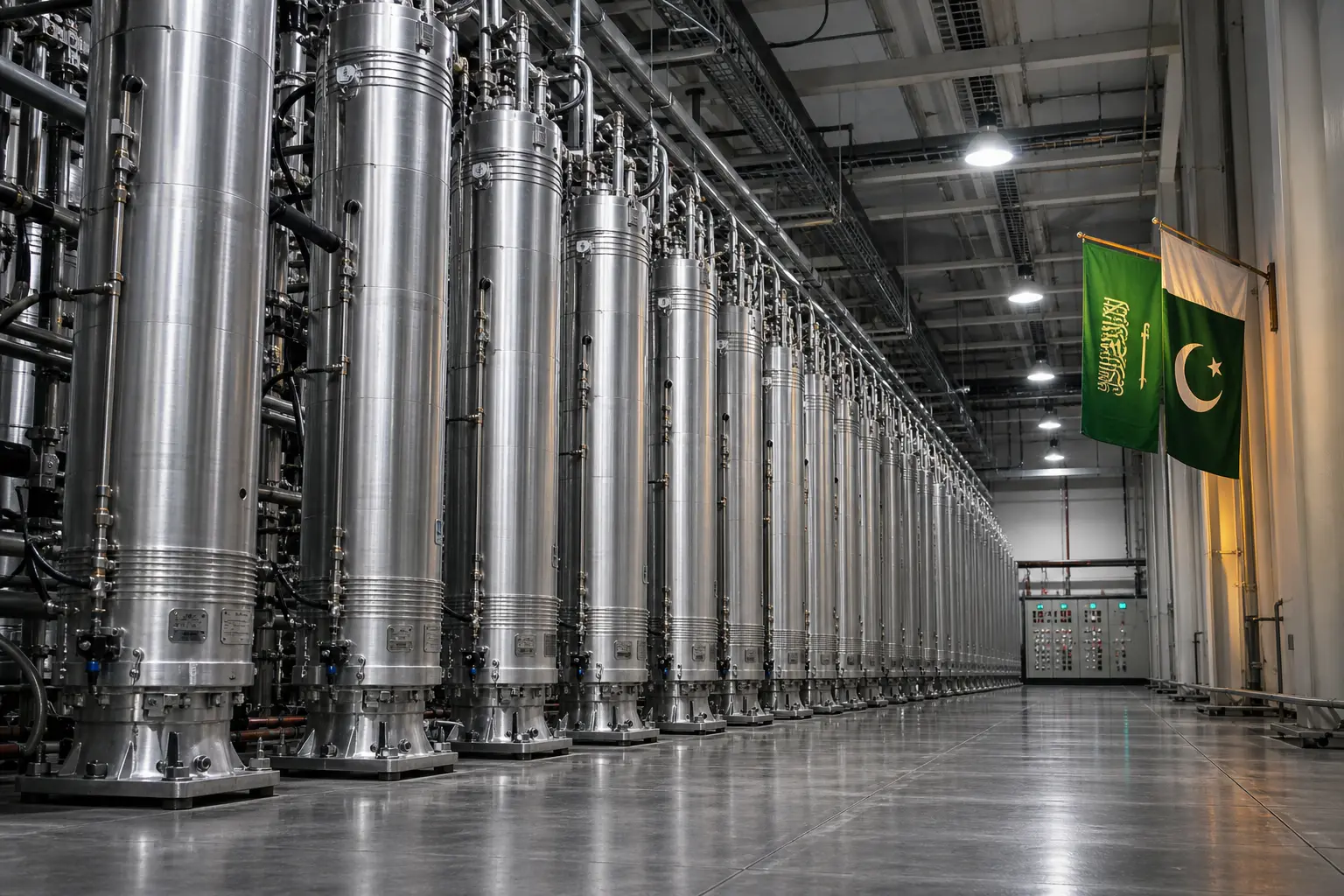
The Rung on the Ladder Saudi Arabia Just Skipped
Israel has long tracked Saudi nuclear ambitions as a step ladder, according to a Washington-based source who has spoken to OilPrice.com for years, including on this deal. A civilian program comes first. Enrichment capability comes next. Weapons-grade enrichment follows, then the missiles to deliver a warhead over distance.
“The Israelis see this as the key first stage in a development ladder,” the source said. “But in this deal, Saudi Arabia leapfrogs the second rung of the ladder.”
Crown Prince Mohammed bin Salman has never hidden the conditions under which he would want a bomb. In 2018, he said his country did not want nuclear weapons, then added: “Without a doubt, if Iran developed a nuclear bomb, we would follow suit as soon as possible.” Saudi Arabia ratified the Nuclear Nonproliferation Treaty in 1988, and officials insist the new deal is about electricity, not warheads.
Amos Yadlin, a former head of Israeli military intelligence, offered a blunter timeline back in 2013: “If Iran gets the bomb, the Saudis will not wait one month. They already paid for the bomb, they will go to Pakistan and bring what they need to bring.”
Riyadh’s Faster Route Runs Through Islamabad
Yadlin’s comment was not idle speculation about a hypothetical ally. Saudi Arabia has funded Pakistan’s nuclear weapons program since the 1970s, when Saudi oil money is widely believed to have helped bankroll the uranium enrichment plant at Kahuta. In 1999, a year after Pakistan’s first nuclear tests, Riyadh sent its own defense minister to tour that facility in person.
On September 17, 2025, at Al Yamamah Palace in Riyadh, Crown Prince Mohammed bin Salman and Pakistani Prime Minister Shehbaz Sharif signed a Strategic Mutual Defense Agreement built around one clause: any aggression against either country counts as aggression against both. Pakistan’s defense minister, Khawaja Mohammad Asif, said at the time that Pakistan’s nuclear capabilities “will be made available” to Saudi Arabia under the pact, a statement Islamabad later walked back. The text of the comprehensive mutual defense pact never mentions nuclear weapons by name.
Layer that pact on top of the 123 agreement’s mechanics, and the picture shifts. A senior source who works closely with the European Union’s energy security establishment told OilPrice.com that once Saudi Arabia has highly enriched uranium, the only missing piece for an actual weapon is what nuclear engineers call the physics package: the high-explosive detonator system, the neutron initiator, and the tamper and reflector that surround the core. Source that turnkey hardware from Pakistan, or another willing state, and the Kingdom would not need to build the metallurgical infrastructure to convert enriched gas into weapon-grade metal on its own.
Is Pakistan Extending a Nuclear Umbrella to Saudi Arabia?
No single document says so, and researchers are split. The defense pact’s legal text commits both countries to mutual defense in general terms, not nuclear-specific ones, and some analysts argue the umbrella framing is overstated. Others point to Pakistan’s own defense minister raising the idea publicly, plus decades of Saudi financing, as evidence the ambiguity is doing real strategic work.
- Belfer Center for Science and International Affairs (Harvard): argues the pact reflects conventional and diplomatic solidarity rather than a formal extension of Pakistan’s nuclear deterrent, calling umbrella talk overstated.
- Arms Control Association: treats the agreement as a meaningful expansion of Pakistan’s deterrence posture into the Gulf, regardless of the missing legal text.
- Pakistan’s own government: gave conflicting signals, with the defense minister first suggesting nuclear capabilities were on the table, then the government stepping back from that framing entirely.
The Belfer Center’s assessment that this falls short of a nuclear umbrella sits opposite an Arms Control Association brief describing extended nuclear deterrence reaching Saudi soil. Both groups agree on the facts. They disagree on what the facts mean, which is precisely the kind of ambiguity a state seeking leverage without a formal weapons program would want.
What Trump Gets Out of the Bargain
Set against that backdrop, President Trump’s decision to approve looser terms than the UAE ever received starts to look less like carelessness and more like a calculated trade. Four benefits stand out.
- Money. Potentially hundreds of billions of dollars in infrastructure and reactor contracts flow to American engineering and construction firms over the life of the deal.
- Blocking rivals. The agreement effectively locks Saudi Arabia out of comparable nuclear deals with China or Russia, neither of which would insist on the same non-proliferation conditions.
- Leverage on Iran. A U.S.-controlled nuclear infrastructure on Iran’s doorstep functions as pressure on Tehran, dangling the prospect of future capability without formally arming Riyadh today.
- Regional alignment. The deal pulls Saudi Arabia further into Washington’s orbit, laying groundwork some officials hope leads to a fresh round of Abraham Accords expansion, an outcome examined in Trump Bets a Landmark Saudi Nuclear Deal on Abraham Accords.
Each benefit is real on its own terms. None of them requires Pakistan to be part of the calculation, which is exactly why the Pakistan pact has drawn so little scrutiny inside the enrichment debate.
Congress Still Holds the Next Move
The agreement now sits with lawmakers for a statutorily required review, described in a Congressional Research Service brief on U.S.-Saudi nuclear cooperation. Congress can block it only if both the House and Senate pass disapproval resolutions, and overriding a presidential veto of that rejection would take two-thirds majorities in both chambers, a high bar that has rarely been cleared on foreign policy votes of this kind.
Opposition is already loud. Kelsey Davenport of the Arms Control Association wrote that the agreement “sets a terrible precedent” by abandoning the bipartisan enrichment and reprocessing restrictions that shaped every prior Gulf deal. Andrea Stricker of the Foundation for Defense of Democracies has separately criticized the deal’s terms. Senator Ed Markey, a Massachusetts Democrat, said it risks enabling nuclear proliferation in Saudi Arabia and igniting an arms race across the region. Those objections landed before an Israeli ultimatum that already threw the deal into doubt once this year, detailed in Trump’s Israel Ultimatum Throws US-Saudi Nuclear Deal Into Doubt.
None of that congressional fight touches Islamabad. Lawmakers can vote down enrichment facilities, attach inspection conditions, or demand the Additional Protocol. They cannot vote on a defense pact Saudi Arabia already signed with a nuclear-armed state a year earlier, in a different capital, under a different government’s authority entirely.
Frequently Asked Questions
What is a Section 123 agreement?
It is a bilateral pact authorized under Section 123 of the U.S. Atomic Energy Act of 1954, required before American companies can export nuclear technology, fuel, or reactor components to a foreign government. Every U.S. civilian nuclear partnership, including the deals with the UAE and now Saudi Arabia, operates under one.
Does Saudi Arabia already have nuclear weapons?
No. Saudi Arabia has no known weapons program and ratified the Nuclear Nonproliferation Treaty in 1988, which requires IAEA safeguards on its declared nuclear material. The new agreement grants a pathway toward domestic uranium enrichment for civilian energy use, not weapons, though critics argue the safeguards attached are weaker than on any comparable U.S. deal.
Has Pakistan officially confirmed a nuclear umbrella for Saudi Arabia?
Not in writing. Pakistan’s government has previously dismissed related reports as “speculative, mischievous and baseless,” even after its own defense minister said nuclear capabilities would be made available to Riyadh under the 2025 defense pact before that comment was walked back.
What is the IAEA’s Additional Protocol?
It is a voluntary agreement that expands IAEA inspectors’ authority beyond declared nuclear sites, allowing short-notice access to locations the agency suspects may host undeclared activity. The UAE adopted it as part of its 2009 deal; Saudi Arabia’s new agreement does not require it.
Could this trigger a wider nuclear arms race in the Middle East?
Nonproliferation researchers, including analysts at the Council on Foreign Relations, warn that a looser precedent for Saudi Arabia makes it harder for Washington to hold other regional states, including Turkey and Egypt, to the UAE’s stricter standard in future negotiations.
The centrifuges Congress is debating may never spin. The defense pact Riyadh signed with Islamabad in September 2025 already has.
