
Saudi Prince Alwaleed bin Talal disclosed a 5% stake in Lucid Motors on Tuesday, a $153 million position that sent the electric vehicle maker’s shares up 20.5% to around $7.80, after briefly touching $8.48. Two weeks earlier, the stock had traded as low as $2.37.
The purchase lands three weeks after Lucid beat back reports that it was weighing bankruptcy, and it follows a script Alwaleed has run before: buying into a crisis battered stock while other investors are still fleeing it.
A Filing Timed to a $2 Billion Market Cap
Prince Alwaleed disclosed ownership of 19.5 million shares of Lucid’s Class A stock in a filing with the Securities and Exchange Commission, Forbes reported, giving him sole voting and dispositive power over roughly 5% of the company. He confirmed the position in a post on X, writing that his investment office bought the shares while Lucid’s market capitalization sat below $2 billion, a threshold the stock first crossed as early as June 25.
Outlets including TechCrunch and Electrek, which reviewed the disclosure, reported the position was fully assembled by July 23, five days before it became public. That timing put the purchases squarely inside the stock’s worst stretch in years.
Lucid’s chief communications officer, Nick Twork, called the bankruptcy report “completely false” in a statement to Forbes, adding the company had “sufficient liquidity” for the next year and had not explored bankruptcy.
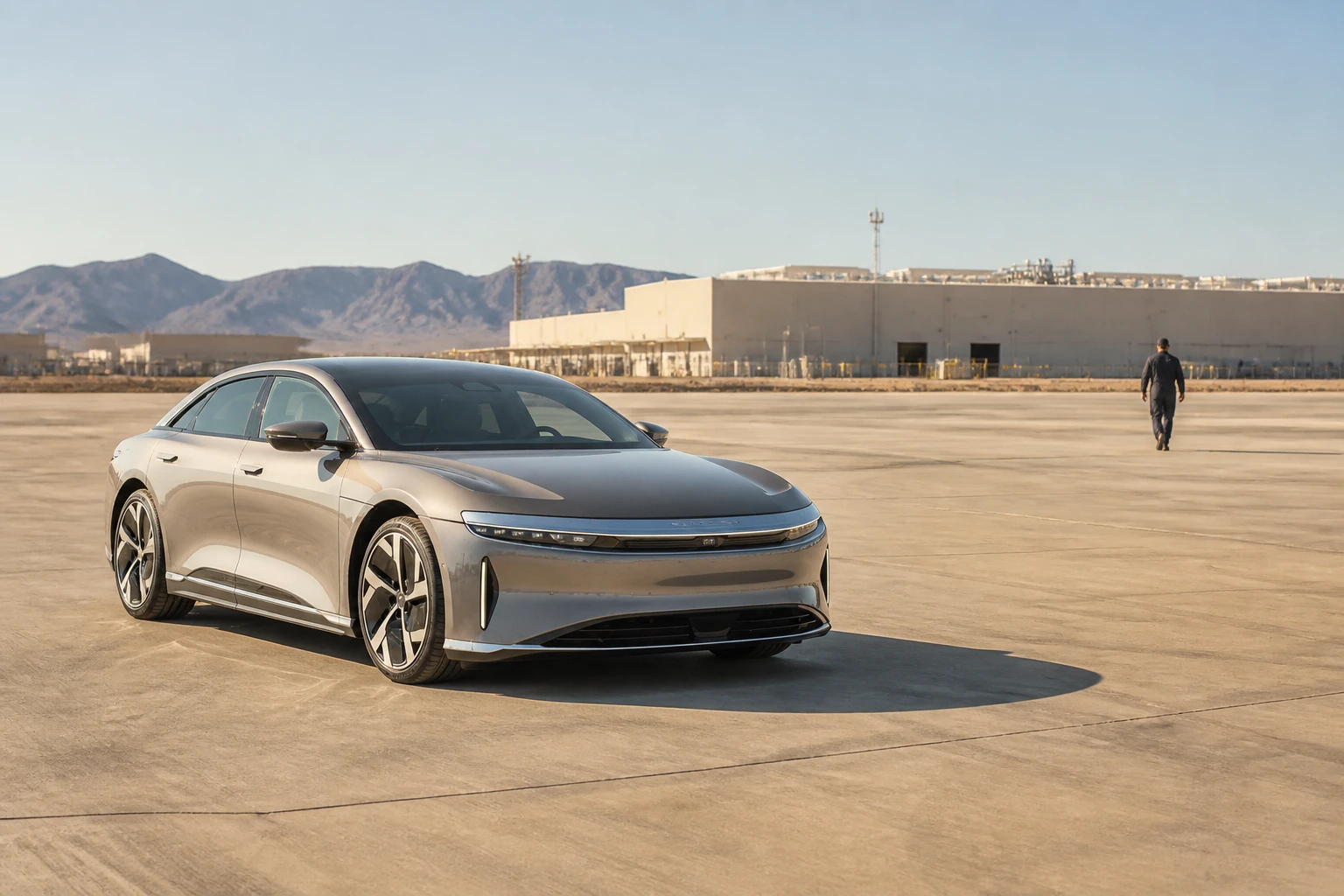
Does the Rally Put New Cash Into Lucid?
Not directly, and that is the detail most coverage of Tuesday’s pop skipped. Alwaleed’s shares came from existing stockholders trading on the open market, so the $153 million tied to his stake never touched Lucid’s treasury. The company’s actual cash cushion came from separate transactions, including preferred stock sold straight to Saudi Arabia’s sovereign wealth fund.
Lucid ended the first quarter with about $3.2 billion in total liquidity, including roughly $700 million in cash, even as free cash flow ran negative $1.44 billion for the quarter, more than double the prior year period’s burn. After the quarter closed, the company layered on $200 million from Uber, $300 million from a common stock offering, a $500 million term loan draw, and $550 million in convertible preferred stock from the Public Investment Fund, pushing pro forma liquidity to about $4.7 billion and extending its runway into the second half of 2027, according to the company’s own results.
Alwaleed’s purchase moved Lucid’s stock price. Its cash balance stayed exactly where it was Tuesday morning.
PIF’s Majority Stake Dwarfs the Prince’s Bet
Alwaleed’s investment is personal, made through his own office, and separate from Saudi Arabia’s sovereign wealth fund, the Public Investment Fund (PIF), which already controls Lucid. PIF and its affiliate Ayar reported beneficial ownership of about 281 million shares, or roughly 56.8% of Lucid’s common stock on an as converted basis, in a Schedule 13D/A amendment dated April 28, 2026.
That stake grew after Ayar Third, a PIF subsidiary, closed a purchase of 55,000 Series C convertible preferred shares at $10,000 apiece, a $550 million infusion carrying a 9% payment in kind dividend. PIF’s voting power stays capped at 19.99% unless shareholders vote to lift it, even with an economic stake covering more than half the company.
| Investor | Approximate Stake | Shares or Structure | Where the Money Went |
|---|---|---|---|
| Prince Alwaleed bin Talal | About 5% | 19.5 million Class A shares, bought through his personal investment office | Paid to existing shareholders on the open market |
| Public Investment Fund and Ayar | About 56.8% | 281 million shares plus Series C convertible preferred stock | Paid directly into Lucid’s own treasury |
The kingdom’s build-up in Lucid did not start this week. PIF has spent years layering preferred stock and credit into the automaker, work that amounted to a vote of confidence in the automaker long before Tuesday’s filing showed up.
The Citigroup Playbook, Thirty Five Years Later
Alwaleed built his reputation buying into wrecked companies. In 1991, he put $590 million into convertible preferred stock in Citicorp, then reeling from Latin American loan losses and a collapsing U.S. real estate market. The bet helped save the bank and made him, after Citicorp’s merger with Travelers Group, its largest individual shareholder.
He did not stop there. In November 2008, at the height of the global financial crisis, Alwaleed increased his Citigroup position to 5%, the same size stake he now holds in Lucid. Citigroup shares kept falling for months afterward. Alwaleed held on anyway, and the position eventually became one of the signature bets of his career.
A Fortune Built on Concentrated Bets
Forbes estimates Alwaleed’s net worth at $22.9 billion. His holding company, Kingdom Holding, and his personal investments span several sectors well beyond banking and cars:
- Four Seasons Hotels and Resorts, held through Kingdom Holding Company
- X, the social platform formerly known as Twitter
- SpaceXAI, Elon Musk’s artificial intelligence venture formerly known as xAI
- Snap Inc., parent company of Snapchat
- Rotana, the Arabic language movie and music company
The portfolio has not always been stable. Saudi authorities detained Alwaleed for several months in 2017 as part of a corruption crackdown, and Forbes dropped him from its billionaire rankings the following year. He and other Saudi billionaires returned to the list in 2025.
Lucid Still Has to Sell Cars
Lucid’s first quarter results, reported in May, showed revenue rising 20% to $282.5 million on a special purpose acquisition company (SPAC) legacy balance sheet that has never turned a profit. Net losses topped $1 billion for the quarter alone.
Some of that capital build-up helped ready its SUV lineup for volume production, part of an earlier Saudi financing push ahead of the SUV’s launch. The company has also been rebuilding its European leadership team as it tries to widen sales beyond North America.
The stock’s round trip from record highs to a near wipeout and partway back happened over less than five years:
- November 2021: Lucid’s market capitalization peaks near $90.9 billion as shares trade as high as $648.60, months after a SPAC merger had valued the company at $24 billion.
- February 2026: Lucid announces layoffs as losses continue to mount.
- June 2026: The company cuts jobs a second time.
- July 14, 2026: Shares crash to an all time low of $2.37 and trading is halted after the trade publication EV reports the automaker considered filing for bankruptcy, a claim Lucid later calls false.
- July 23, 2026: Regulatory filings show Prince Alwaleed’s position is fully assembled.
- July 28, 2026: Alwaleed discloses the stake publicly; shares jump 20.5%.
Even after Tuesday’s jump, Lucid shares remain down 71% over the past year and down nearly 28% since January. The stock moved. The cash burn did not.
Disclaimer: This article is for informational purposes only and is not investment advice. Lucid Motors shares are highly volatile, and readers should consult a qualified financial professional before making investment decisions. Figures are accurate as of publication on July 29, 2026.
