
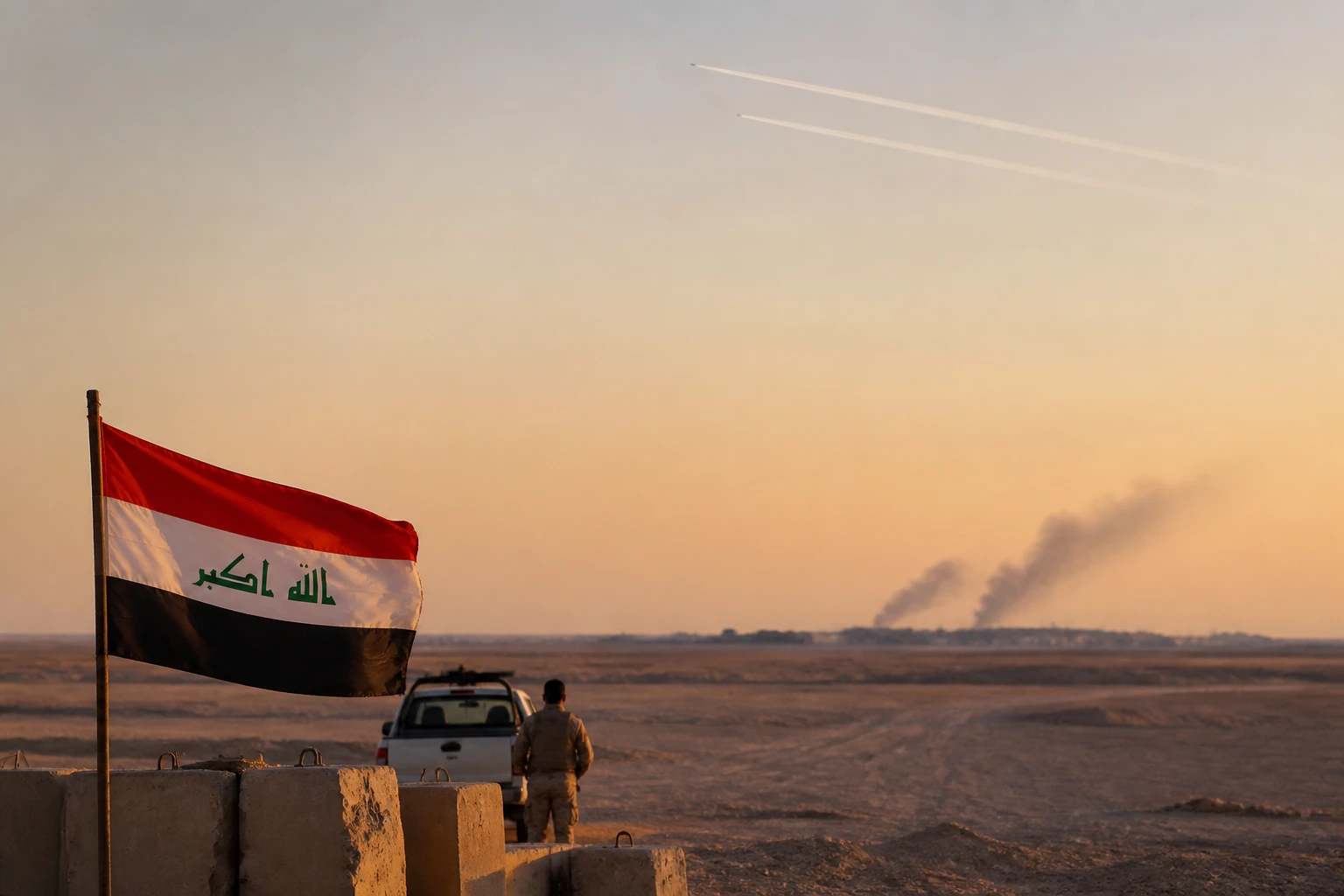
US and Saudi jets struck Iran-backed militias across eastern Iraq on Wednesday, retaliating for a barrage of drone and missile attacks that included a strike on a US base in Jordan. US Central Command (CENTCOM) said Iran’s Islamic Revolutionary Guard Corps (IRGC) directed the attacks. Saudi Arabia joined the retaliation, in what regional accounts describe as its first strikes inside Iraq since the war with Iran began.
The targets were formations that, on paper, belong to Iraq’s own state security forces. Baghdad did not order the strikes, and it has little power over the Iran-aligned militias that provoked them.
Eastern Iraq Takes the First Strikes
CENTCOM said in a post on X that US and Saudi aircraft “struck multiple terrorist logistics and weapons sites across eastern Iraq in a strong response to over 30 IRGC-directed aerial drone attacks in the last 72 hours.” The operation targeted Iran-aligned terrorists directed by the Revolutionary Guard, the command said, blaming the IRGC for orchestrating attacks on both US forces and Saudi energy infrastructure.
Arabic media reported unexplained explosions at a base belonging to the Popular Mobilization Forces (PMF) shortly before CENTCOM’s announcement went out. The PMF is Iraq’s official paramilitary umbrella, an institution that answers to the prime minister. It groups roughly 67 armed factions, including Iran-backed units such as Kataib Hezbollah, a US-designated terrorist organization that alone commands three PMF brigades.
The Saudi Defense Ministry said the strikes “reaffirm the Kingdom’s legitimate right to defend itself,” adding in its own post on X that Riyadh “does not seek escalation but will respond to any aggression it faces.”
Four Fronts, One Barrage
Iran and its regional allies hit US and Saudi interests on four separate fronts within a matter of hours, according to CENTCOM, Saudi officials and Iran’s own state media.
- Jordan: IRGC forces fired at least four ballistic missiles at a US base Washington has never formally declared, a US official told The Jerusalem Post, calling it “a major attack.”
- Saudi Arabia: Saudi air defenses intercepted and destroyed several drones aimed at oil facilities in the kingdom’s Eastern Province late Tuesday, Saudi Defense Ministry spokesperson Turki al-Maliki said.
- The Red Sea: Yemen’s Houthi movement fired ballistic missiles at a Saudi oil tanker Wednesday morning, claiming the vessel had violated its newly declared blockade of Saudi Arabia. The UK Maritime Trade Operations center separately reported that a tanker in the area had heard an explosion.
- The Strait of Hormuz: The IRGC told Iranian state media that three oil tankers were “struck and stopped” Wednesday morning after they “ignored warnings.”
Shortly before CENTCOM confirmed the missile strikes on Jordan, Iranian negotiator Seyed Mohammad Marandi wrote on X that Iran was “fully prepared for all out war.”
The Militias Wear an Iraqi Uniform
Kataib Hezbollah and the other factions hit this week hold formal rank inside Iraq’s own military structure. They are also Iran’s proxies. That overlap boxes in Baghdad every time Washington or Riyadh answers an attack launched from Iraqi territory.
Iraqi Prime Minister Mohammed Shia al-Sudani has already called earlier rounds of strikes on PMF headquarters this year a breach of Iraqi sovereignty. After the country’s security council convened over one such strike, it issued a statement on the response Iraq’s forces would take:
Confront and respond to military attacks carried out by military aircraft and drones targeting the headquarters and formations of the Popular Mobilization Forces Commission and other formations of our armed forces, using available means, in accordance with the right to respond and self-defense.
Al-Sudani said, in comments after the council meeting. Iraq’s foreign ministry has since summoned the US chargé d’affaires over the strikes and, separately, Iran’s ambassador over the militia attacks that provoked them.
A Playbook Seven Years Old
Wednesday’s strikes fit a pattern years old. Washington has hit Iran-backed fighters on Iraqi soil before, in bigger waves than this one.
| Date | Trigger | US-Led Response |
|---|---|---|
| December 2019 | Rocket attack kills a US contractor near Kirkuk | Precision strikes on five Kataib Hezbollah sites |
| January-February 2024 | Kataib Hezbollah attacks al-Asad Airbase | 125 US airstrikes on IRGC and allied militia targets; over 80 of 85 sites hit |
| February 2026 | Renewed militia attacks on US forces | Strikes open on a Kataib Hezbollah base at Jurf al-Sakhar |
| July 2026 | 30-plus drone attacks in 72 hours; missiles hit Jordan base | Joint US-Saudi strikes across eastern Iraq; Riyadh’s first inside Iraq |
The February 2024 round, when CENTCOM forces hit Kataib Hezbollah’s weapons and command capabilities, was the largest single US operation against the network before this year. Between February and April alone, Iran-aligned militias attempted more than 600 attacks on American citizens and facilities in Iraq, according to US officials. Wednesday’s strikes marked Saudi Arabia’s first direct role in the campaign.
The campaign has not stayed confined to Iraq and Jordan. Iran has separately claimed strikes on US bases in Bahrain and Kuwait as an earlier truce unraveled, spreading the same dynamic to two more Gulf hosts.
Washington Talks to Tehran While Tankers Stop in Hormuz
The US military struck Iran directly every night from July 8 through July 24, then paused. The halt was meant to give American and Iranian negotiators room to discuss reopening the Strait of Hormuz.
“We are in very deep talks with Iran, if they don’t work out, we will go back to very strong military action,” President Donald Trump told Axios on Monday. He said the talks would “either go fast or not at all,” and that other countries involved in the process had urged him to hold off on further escalation.
A senior Iranian source offered a narrower read to Reuters on Sunday: “If the US attacks stop, Iran will also halt its operations.” The same source added that “there is more skepticism than optimism about the halt in attacks. The prevailing view is that the pause is tactical rather than genuine.”
Wednesday tested that skepticism directly. The talks are meant to reopen a strait that Iran’s own naval forces stopped three tankers inside, hours before the joint strikes on Iraq began. The most recent data on oil flow through the strait put the total at 14.6 million barrels a day in the first quarter of this year. That is down nearly 30% from 20.4 million barrels a day twelve months earlier, according to the US Energy Information Administration (EIA). The strait ordinarily carries close to a fifth of the world’s petroleum liquids.
What Happens If the Pause Breaks?
If the Hormuz talks fail, Trump has promised a return to nightly strikes on Iran itself, the same campaign that ran from July 8 to July 24. That threat does not reach the militia, Houthi and tanker attacks already running outside the paused campaign, in Iraq, the Red Sea and now Saudi waters.
Saudi Arabia has kept its own options open. Al-Maliki said the kingdom retains the right to respond “at the appropriate time and place” to the drone and missile attacks on its territory. That language leaves room for further Saudi strikes inside Iraq beyond Wednesday’s.
For Baghdad, the fighting continues regardless of how the Hormuz talks end. Its own security forces remain the ground on which Washington, Riyadh and Tehran are settling scores that trace back to missiles fired from Iranian soil.
