
An Egyptian tour guide who sketched a stick figure on a 4,000-year-old pyramid this February is facing up to a year in prison. Do the same thing to a statue in Roman Egypt, and two thousand years later a classicist writes a book about you.
Hundreds of inscriptions carved by Greek-speaking travelers survive on Egypt’s most famous monuments, from the Great Pyramid of Giza to the temples of Abu Simbel. Archaeologists say they are proof that wealthy Greeks and Romans toured Egypt as sightseers, not soldiers or traders, more than two thousand years before the first travel agency existed. The habit of leaving a name behind never really left. Only the punishment for it changed.
The Statues That Sang for Roman Tourists
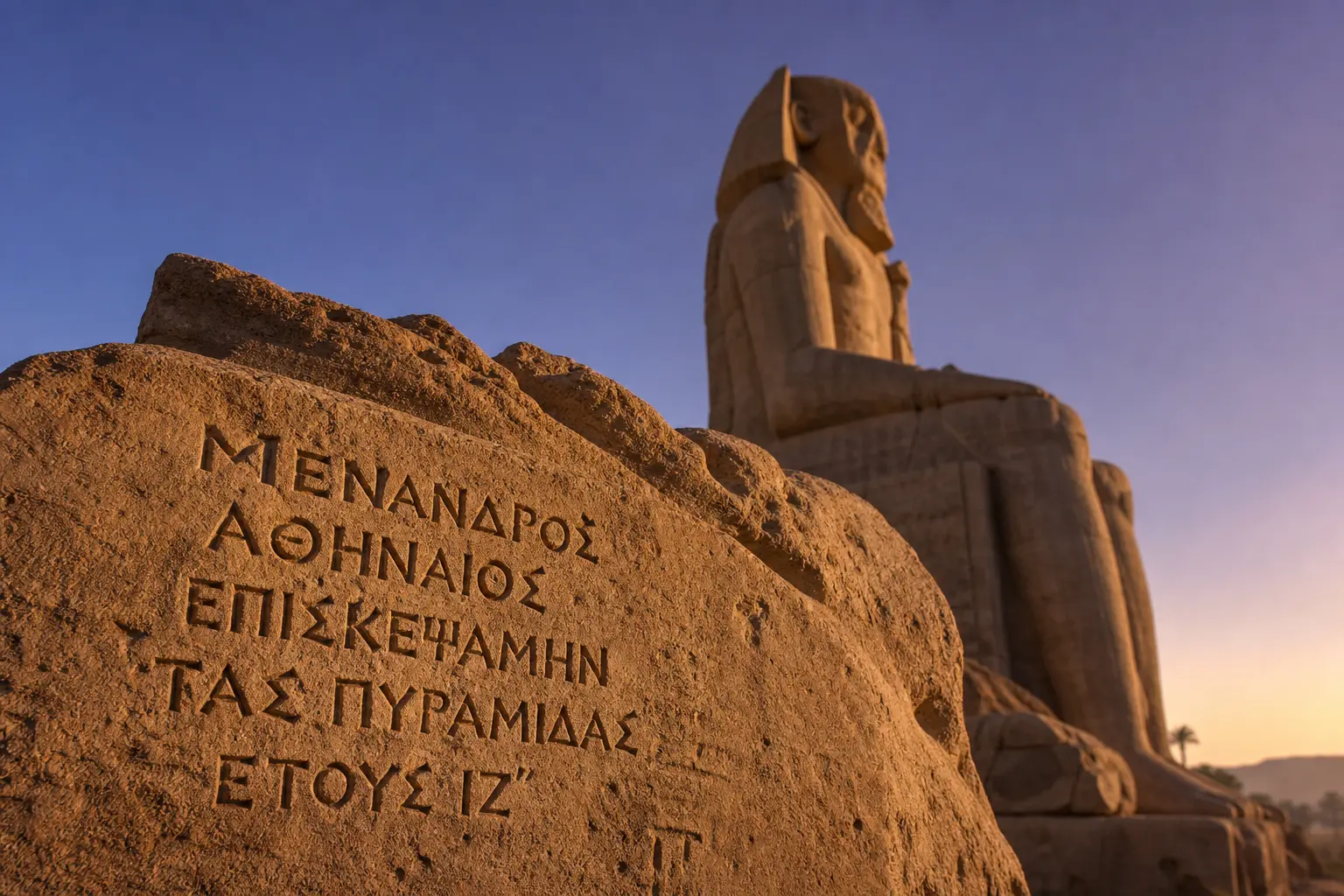
The clearest evidence sits at the Colossi of Memnon, two seated stone giants on Luxor’s west bank. An earthquake cracked the northern statue in antiquity, and afterward, as the desert air warmed at sunrise, the fractured stone let out a strange whistling sound. Ancient visitors decided it was the voice of Memnon, a mythical hero, greeting the dawn.
That reputation turned the statue into a destination. In a study titled catalogued 107 separate inscriptions carved into the statue’s legs and feet, classicist Rosenmeyer documented 61 in Greek, 45 in Latin and one written in both, dated across roughly two centuries, from about 20 to 250 A.D. Eleven were signed by women. Eight were left by prefects, the Roman officials who governed Egypt.
One of the more striking signatures belongs to Julia Balbilla, a Roman noblewoman and poet who traveled with Emperor Hadrian and his wife Sabina. In November of 130 A.D., she carved four elegiac poems into the stone describing the statue’s song. Most visitors wrote less. A name, a hometown, sometimes a rank, and a note on whether they heard the sound and at what hour.
Alexandria Made Egypt the Empire’s Bucket List
Egypt’s pull on Greek travelers began well before the Colossi acquired their reputation. Contact between the two civilizations stretched back centuries, part of a long relationship that predated Alexander’s arrival. Everything accelerated after 332 B.C., when Alexander the Great conquered Egypt and folded it into the Greek-speaking Mediterranean.
His successors, the Ptolemaic kings, built Alexandria into a magnet for scholars, merchants and pilgrims. Its library and cosmopolitan population, part of the Greek community that gave the city its character, drew visitors from across the Greek world. Herodotus, later dubbed the Father of History, had already described Egypt’s temples and customs in detail when he wrote his Histories around 424 B.C., decades before Alexander was born.
Strabo, a Greek geographer, went further. He spent roughly five years, from 25 to 20 B.C., based in Alexandria. In 25 or 24 B.C., he joined the Roman prefect Aelius Gallus and sailed the Nile as far south as Philae, recording temples, tombs and engineering feats that still fascinated visitors a century later.
Graffiti Turns Up From Giza to Abu Simbel
The Colossi are the best-documented case, but not the only one. Names show up across Egypt, in Greek, Latin and Demotic Egyptian, wherever a monument was famous enough to draw a crowd.
- Great Pyramid of Giza, where visitor names turn up among the inscriptions researchers have catalogued on its stones
- The Sphinx, where graffiti survives carved into one of its paws
- Abu Simbel, one of the temple complexes with dense clusters of Greek-language visitor inscriptions from the Hellenistic and Roman eras
- Colossi of Memnon, the single most documented case, with more than a hundred inscriptions on one statue alone
Historians reading these marks find soldiers, philosophers, merchants and pilgrims, sometimes traveling in groups. The motives look familiar: curiosity, religious devotion, education, prestige. Archaeologists believe local guides walked visitors through the myths and history attached to each site, and some ancient itineraries appear to have recommended specific stops, an early cousin of the guidebook. It is not the only recent find pointing to Egypt’s deep, tangled foreign ties; researchers have also traced donkey burials linking Canaanite and Egyptian households 4,700 years ago, evidence that outsiders were tied to the Nile Valley long before any Greek picked up a chisel.
A Timeline From Herodotus to a Pyramid Arrest
Laid end to end, the record runs from a historian’s manuscript to a police report filed this year.
- Around 424 B.C., Herodotus writes his Histories, describing Egypt’s monuments for a Greek readership.
- 332 B.C., Alexander the Great conquers Egypt and folds it into the Greek-speaking world.
- 25 to 24 B.C., Strabo sails the Nile with the prefect Aelius Gallus as far as Philae.
- 20 to 250 A.D., Greek and Latin speaking travelers carve more than a hundred inscriptions into the Colossi of Memnon.
- November 130 A.D., Julia Balbilla visits with Hadrian and leaves four poems carved into the stone.
- 1983, Egypt enacts the Antiquities Law, making it a crime to write on an ancient monument.
- February 2026, a tour guide is arrested for drawing on the Pyramid of Unas at Saqqara.
Nearly 2,450 years separate the first entry from the last. The impulse driving both barely moved.
A Tour Guide’s Stick Figure Becomes a Felony
The most recent entry played out at Saqqara, south of Cairo, where the Pyramid of Unas has stood for roughly 4,000 years. In February, a licensed tour guide leaned toward the pyramid’s lower casing stones while leading a group and sketched a stick figure. Someone filmed it, and the video spread widely online.
Questioned afterward, the guide admitted to the drawing. He said it was his first day back after a four-year break from the job and that he had gotten overexcited, calling the incident his ‘unforgivable mistake.’ Saqqara’s Antiquities Department removed the drawing within days. The Egyptian General Tourist Guides Syndicate said its members work hard to prevent exactly this kind of damage during tours.
The law leaves little room for interpretation. Article 45 of Egypt’s Antiquities Law sets a minimum sentence of one year in prison for anyone who writes on or inscribes an antiquity, alongside a fine that can reach 500,000 Egyptian pounds, about $10,427.
The Same Chisel Mark, Two Different Verdicts
Set the two records side by side and the reversal is stark.
| What | Roman Egypt (20 to 250 A.D.) | Egypt Today (2026) |
|---|---|---|
| Marking a monument | Carving a name, rank or hometown into a colossal statue or pyramid stone | Banned outright under Article 45 of the Antiquities Law |
| Famous case | Julia Balbilla’s four Greek poems on the Colossi of Memnon | A tour guide’s stick figure on the Pyramid of Unas |
| Penalty at the time | None on record; the mark stood for two millennia | At least a year in prison or a fine up to 500,000 Egyptian pounds |
| Where it ended up | Catalogued by classicists as primary evidence of ancient travel | Sanded away by Saqqara’s Antiquities Department within days |
One record became a footnote in a book about Roman tourism. The other became a police file.
Why Did Egypt Toughen the Rules?
Egypt tightened penalties as tourism scaled up far beyond anything Balbilla’s era saw: nearly 19 million visitors a year now move through sites that once drew a comparative trickle of elite travelers, and soft, centuries-worn stone cannot absorb modern crowds carving new marks on top of the old ones.
Preservation is the stated goal. Egypt’s antiquities sit under sustained pressure from foot traffic, humidity from breath and touch, and the sheer volume of hands reaching for a souvenir moment. A single tolerated stick figure risks becoming an invitation.
The Habit Never Left
Egypt’s pull on foreign visitors hasn’t faded, it has multiplied. The country’s Ministry of Tourism and Antiquities had set an 18 million visitor target for 2025 and beat it, pulling in nearly 19 million visitors in a single year, a 21 percent jump over 2024. The Grand Egyptian Museum opened beside the Giza plateau on November 1, 2025, pulling even more traffic toward the pyramids. Egyptian outlets have reported the Giza site alone drawing as many as 15,000 visitors in a single day during peak season.
Modern tourists leave their mark differently now, in geotags and photo reels instead of chisel strokes. The desire behind it is the same one Julia Balbilla carried up the Nile in 130 A.D. Only for the Saqqara guide, that impulse cost him a night in custody that her poems never cost her.
